
South Dakota Family Law and Domestic Violence
Understanding how South Dakota family law addresses domestic violence, protection orders, and victim safety.
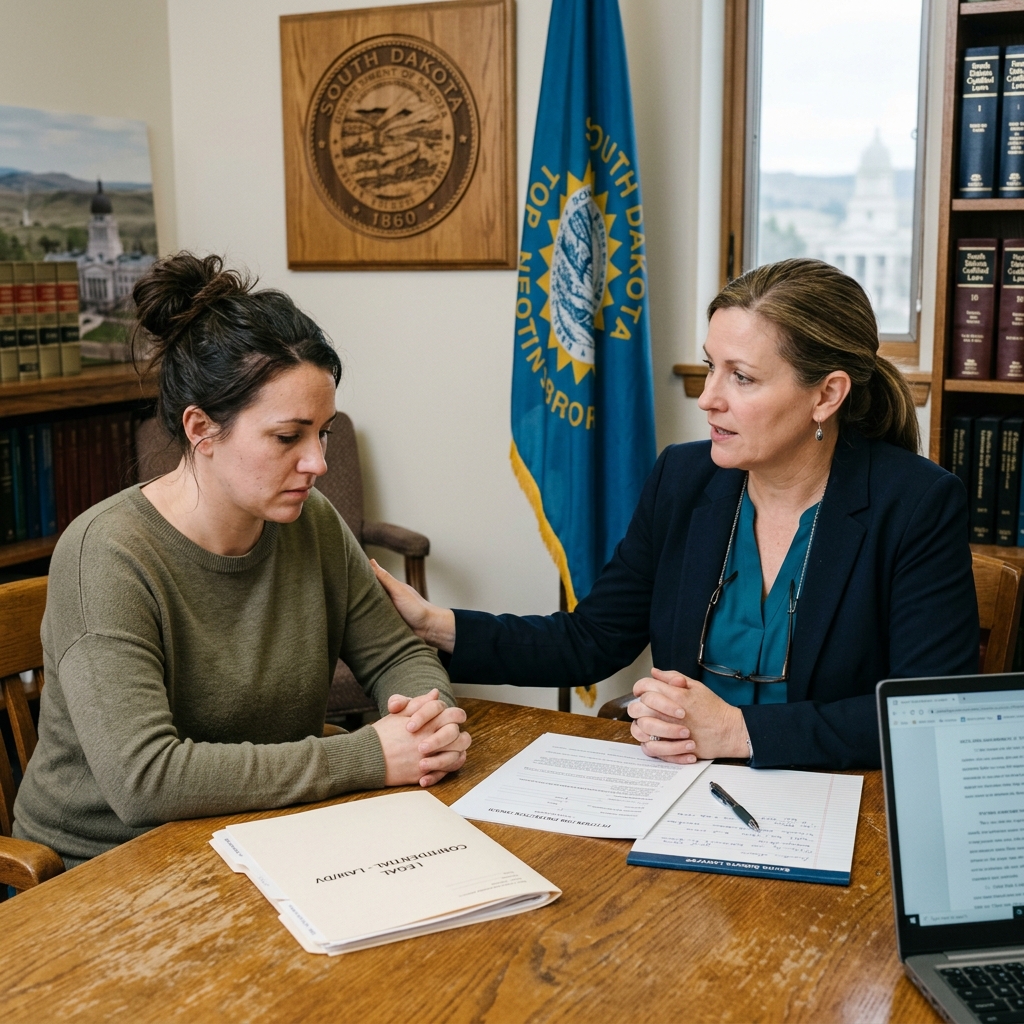
Domestic violence affects every part of family life, from personal safety to housing, parenting, and finances. In South Dakota, domestic abuse is addressed through a combination of family law, civil protection orders, and criminal enforcement, all aimed at preventing further harm and supporting survivors.
This article explains how domestic violence is legally defined in South Dakota, what legal protections are available, how these issues interact with family law matters such as custody and support, and what practical steps survivors and their allies can take.
Core Legal Definition of Domestic Abuse in South Dakota
Understanding whether a situation qualifies as domestic abuse is the starting point for accessing legal protections. South Dakota law uses specific language to define domestic abuse, primarily in its civil protection order statutes.
Conduct That Counts as Domestic Abuse
Under South Dakota law, “domestic abuse” includes several types of harmful conduct occurring within certain close relationships.
- Physical harm: causing bodily injury to another family or household member.
- Attempts to cause harm: trying to injure someone, even if the attempt does not result in actual injury.
- Fear of imminent harm: actions or threats that place a person in reasonable fear that physical injury is about to happen.
- Stalking or related violent crimes: certain crimes such as stalking, kidnapping, and other defined crimes of violence committed within qualifying relationships also constitute domestic abuse.
- Violations of protection orders: breaking the terms of a domestic violence protection order can itself be treated as domestic abuse.
The law does not require serious visible injuries; fear of imminent physical harm or attempts to cause injury may be enough to qualify for protection.
Who Is Considered a Family or Household Member?
Domestic abuse laws apply only when the people involved are in certain types of close relationships. South Dakota law provides a list of qualifying relationships, often referred to as family or household members.
- Current spouses and former spouses.
- People related by blood, adoption, or law.
- Individuals living in the same household now or who have previously lived together.
- Parents of the same child, regardless of marital status or living arrangements.
If the relationship does not fall within these categories, other legal remedies may still be available, but the specific domestic abuse protections described here may not apply.
Civil Protection Orders: Key Tool for Safety
Civil protection orders are one of the most important tools available under South Dakota family law for survivors seeking to stop ongoing abuse and prevent future incidents.
Types of Protection Orders
South Dakota law distinguishes between temporary protection orders and longer-term protection orders.
| Order Type | Purpose | Typical Duration |
|---|---|---|
| Temporary protection order | Provides immediate, short-term protection until a full hearing can be held. | Generally up to 30 days, with limited extensions as permitted by law. |
| Protection order | Offers longer-term protection after the court reviews evidence at a hearing. | Up to five years or less, depending on the judge’s decision. |
Possible Protections Included in an Order
Once the court finds by a preponderance of the evidence that domestic abuse occurred, it may include a range of provisions to protect the survivor.
- Prohibiting the abuser from committing further acts of domestic abuse.
- Ordering the abuser to stay away from the victim’s home, workplace, or school.
- Excluding the abuser from a shared residence, even if both names are on the lease or deed.
- Granting temporary custody of minor children and setting visitation rules.
- Ordering temporary financial support for children or a spouse.
- Directing the abuser to obtain counseling or other services.
Violating the terms of a protection order can lead to arrest and criminal charges, and each violation may be treated as a separate offense.
Criminal Enforcement and Mandatory Arrest
Domestic violence in South Dakota is also treated as a serious criminal matter. Although there is not one single crime labeled “domestic violence,” crimes committed within a domestic relationship often carry special consequences through a domestic abuse indicator added to the case file.
Mandatory Arrest Policies
When law enforcement officers respond to domestic abuse calls, South Dakota statutes and policies require specific actions designed to protect victims.
- Police must arrest a person suspected of committing domestic abuse when probable cause exists.
- Officers must record a domestic abuse indicator on arrest and fingerprint documents when the case involves domestic abuse.
- If both parties allege assault, the officer is instructed to identify and arrest the predominant aggressor by comparing injuries, threats, and the intent to protect victims.
Mandatory arrest and predominant aggressor analysis are intended to reduce dual arrests and increase victim safety, though they can be complex in practice.
Release Conditions and No-Contact Orders
Following a domestic abuse-related arrest, the accused person’s contact with the survivor is tightly controlled.
- A defendant arrested for domestic assault or violating a protection order generally cannot be released until appearing before a judge or magistrate.
- The judge sets bail and imposes conditions designed to protect the victim, which often include no-contact provisions.
- Contact with the victim, unless specifically allowed by the court, is prohibited and can result in additional criminal charges.
These rules help prevent intimidation, retaliation, or further abuse during the early stages of a criminal case.
Potential Criminal Penalties
Domestic abuse-related crimes in South Dakota can be charged as misdemeanors or felonies, depending on the severity of the underlying conduct and prior history.
- Class 1 misdemeanors: up to 1 year in jail and up to a $2,000 fine.
- Class 6 felonies: up to 2 years in prison and up to a $4,000 fine.
- Class 5 felonies: up to 5 years in prison and up to a $10,000 fine.
- Class 4 felonies: up to 10 years in prison and up to a $20,000 fine.
- Class 3 felonies: up to 15 years in prison and up to a $30,000 fine.
Alongside incarceration and fines, courts may impose probation terms, counseling requirements, and continued no-contact orders.
Firearm Restrictions Linked to Domestic Violence
South Dakota law, together with federal law, imposes firearm restrictions on certain individuals with domestic violence convictions.
State-Level Firearm Limitations
State law prohibits individuals convicted of specific domestic violence misdemeanors from possessing or controlling firearms for a limited time.
- Those convicted of a misdemeanor involving an act of domestic violence are barred from possessing firearms for one year after conviction.
- Individuals convicted of a felony crime of violence or misdemeanor domestic violence crimes lose firearm rights for longer periods, with some prohibitions lasting up to 15 years after completion of sentence.
- Violating these firearm prohibitions can lead to additional misdemeanor or felony charges.
Interaction with Federal Law
Separate federal law permanently prohibits many individuals convicted of qualifying domestic violence misdemeanors from possessing firearms, regardless of the time elapsed since conviction. This means that even if state-level restrictions expire, federal law may still prevent gun ownership or possession.
Impact on Family Law: Custody, Visitation, and Support
Domestic violence is highly relevant to family law decisions in South Dakota. While specific standards are laid out in multiple statutes, courts consistently treat safety and the best interests of children as central concerns.
Custody and Parenting Time
When domestic abuse occurs, judges may modify or establish custody and visitation arrangements to prioritize safety and stability for children and the non-abusive parent.
- Parenting time may be supervised or limited if unsupervised contact poses safety risks.
- Exchange locations can be adjusted to minimize contact between parents, such as using neutral sites.
- Courts may consider documented domestic abuse when assessing each parent’s ability to provide a safe, nurturing environment.
Protection orders can temporarily assign custody and set visitation conditions, and these temporary arrangements often influence subsequent family court decisions.
Financial Support and Housing Stability
Domestic violence frequently destabilizes finances and housing. South Dakota family law tools can help survivors maintain stability while they seek long-term solutions.
- Temporary child support: Courts may order the abusive parent to contribute financially to a child’s needs during the protection order period.
- Spousal support: In some cases, temporary support may be granted to help a survivor maintain housing and essential expenses.
- Exclusive use of residence: Protection orders may remove the abuser from the home, allowing the survivor and children to remain.
These measures are not a substitute for a full divorce or long-term custody order, but they can provide critical breathing room.
Victims’ Rights and Support Resources
South Dakota offers legal rights and practical support services specifically designed for victims of crime and domestic abuse.[10]
Constitutional and Statutory Victims’ Rights
The South Dakota Constitution and laws recognize certain rights for victims of crime, including many domestic violence survivors.[10]
- The right to be informed of key court proceedings and developments in the case.[10]
- The right to be present at public criminal hearings, subject to limited exceptions.[10]
- The right to be heard in certain proceedings, including sentencing and release decisions, often through victim impact statements.[10]
- Protection from harassment and abuse throughout the legal process.[10]
These rights are intended to ensure that survivors are not sidelined during criminal cases and have a meaningful voice in how those cases proceed.
Support Services and Self-Help Tools
Survivors are encouraged to use both legal and non-legal resources for safety and healing. The South Dakota Unified Judicial System and advocacy organizations provide a variety of tools.
- Protection order forms and guidance: Self-help resources explain how to apply for protection orders and what to expect in court.
- Domestic violence advocacy organizations: Groups such as statewide coalitions offer safety planning, shelter, counseling, and legal referrals.
- Law enforcement: In emergencies, survivors should call 911 to obtain immediate assistance.
Combining legal remedies with community-based support often produces the strongest outcomes for survivors and their families.
Practical Steps for Survivors Considering Legal Action
Deciding to involve the legal system can be difficult. The following practical considerations may help survivors prepare while focusing on safety.
- Document incidents: Keep records of abusive behavior, including dates, descriptions, photos of injuries or property damage, and any messages or threats.
- Identify qualifying relationships: Consider whether the relationship with the abuser falls within the definition of family or household members required for domestic abuse protections.
- Consider requesting a protection order: If immediate safety is at risk, seek advice on applying for a temporary protection order.
- Plan for children’s safety: Think through safe childcare arrangements, school notifications, and pickup plans if an abuser might appear unexpectedly.
- Seek legal advice: Consulting a lawyer familiar with South Dakota family law and domestic abuse can clarify options and risks.
Every situation is different, and not all survivors will choose the same path. However, knowing the available legal tools can empower informed decisions.
Frequently Asked Questions About Domestic Violence and Family Law in South Dakota
Is domestic violence a separate crime category in South Dakota?
South Dakota does not use a single, stand-alone crime labeled “domestic violence.” Instead, common crimes such as assault, stalking, or kidnapping may be charged, and when they involve domestic abuse, a domestic abuse indicator is added to the case. This indicator triggers specific procedures and consequences, including mandatory arrest and no-contact orders.
How long can a domestic violence protection order last?
A temporary protection order usually lasts up to 30 days, giving immediate short-term protection until a full hearing. After that hearing, the court may issue a longer protection order that can remain in effect for up to five years or a shorter period, depending on the judge’s assessment.
Do I need visible injuries to qualify for a protection order?
No. South Dakota’s definition of domestic abuse includes attempts to cause harm and conduct that creates fear of imminent harm, even if no physical injury occurs. Stalking and certain crimes of violence may also qualify when committed by a family or household member.
Can domestic violence affect child custody decisions?
Yes. Courts place significant weight on safety and the best interests of children. Evidence of domestic abuse can influence custody arrangements, parenting time, and conditions attached to visitation, such as supervision or restricted exchanges. Temporary custody can also be addressed through protection orders.
What happens to my firearm rights after a domestic violence conviction?
South Dakota law restricts firearm possession for certain individuals convicted of domestic violence-related misdemeanors or violent felonies, often for periods ranging from one year to 15 years. Federal law can impose additional, sometimes permanent, firearm bans for qualifying domestic violence convictions. Violating these restrictions can lead to separate criminal charges.
References
- Codified Law 25-10-1 — South Dakota Legislature. 2025-01-01. https://sdlegislature.gov/Statutes/25-10-1
- Definitions of Domestic Violence – South Dakota — Child Welfare Information Gateway. 2022-06-01. https://www.childwelfare.gov/resources/definitions-domestic-violence-south-dakota/
- South Dakota Domestic Violence Laws — CriminalDefenseLawyer.com / Nolo. 2023-01-15. https://www.criminaldefenselawyer.com/resources/criminal-defense/domestic-violence/south-dakota-domestic-violence-laws-charges-pe
- Domestic Violence Gun Laws in South Dakota — Giffords Law Center. 2023-05-10. https://giffords.org/lawcenter/state-laws/domestic-violence-and-firearms-in-south-dakota/
- Support for Domestic Violence Victims — South Dakota Unified Judicial System Self Help. 2022-09-01. https://ujs.sd.gov/self-help/civil-law-help/protection-orders/protection-orders-domestic-violence/domestic-violence/
- Victim’s Rights in South Dakota — The Network: South Dakota Network Against Family Violence and Sexual Assault. 2021-11-01. https://sdnafvsa.com/victims-rights-in-south-dakota/
- What Is the Legal Definition of Domestic Abuse in South Dakota? — WomensLaw.org. 2022-04-20. https://www.womenslaw.org/laws/sd/restraining-orders/protection-orders-due-domestic-violence/basic-information/what-legal
Similar Articles








Read full bio of Sneha Tete


