
South Dakota Divorce: Requirements and Process Guide
A practical, plain‑English overview of South Dakota divorce law, from basic requirements to court procedure and final orders.
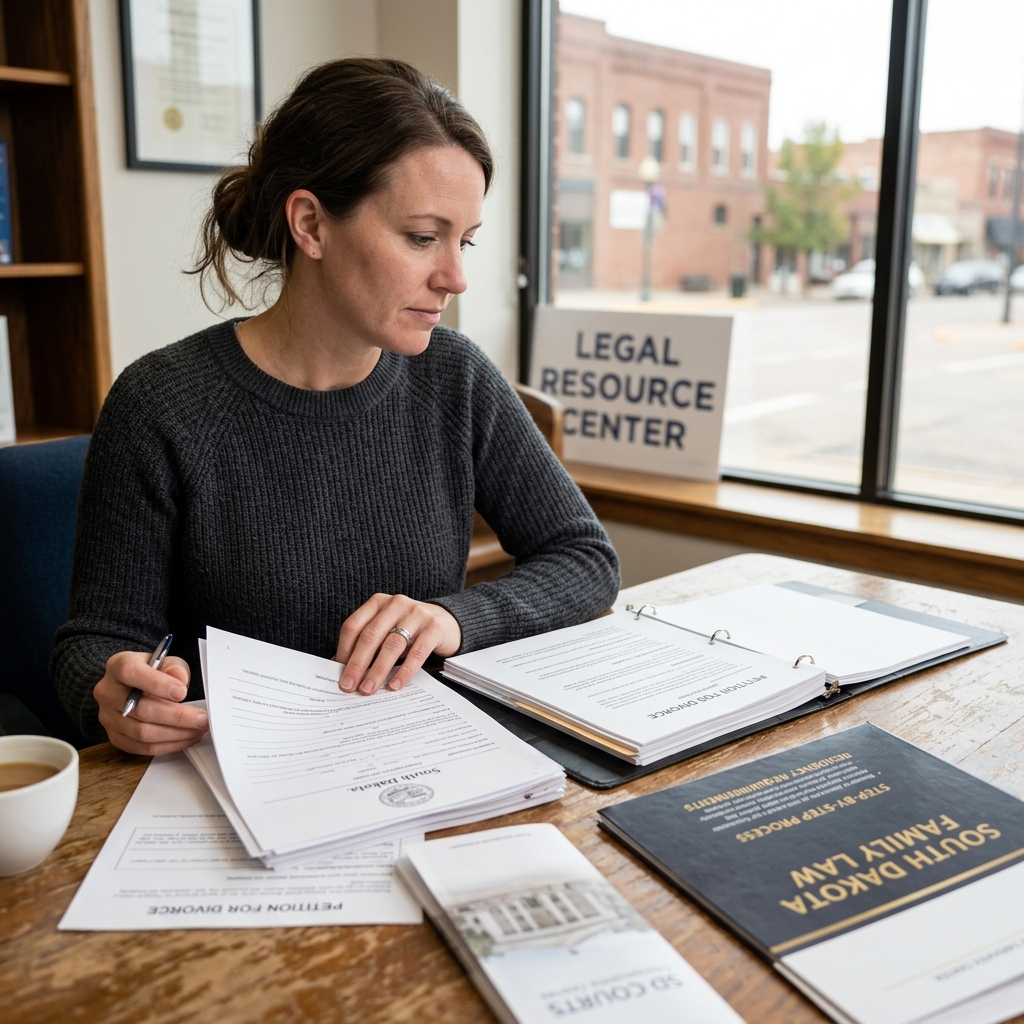
Ending a marriage is not only an emotional decision; it is also a legal process governed by South Dakota law. This guide explains the core rules and procedures that apply when you file for divorce in South Dakota, including residency, grounds, timelines, and the typical court steps.
Understanding How Divorce Works in South Dakota
South Dakota handles divorce in its state circuit courts under the family law statutes found in Chapter 25 of the South Dakota Codified Laws. The court’s job is not to decide whether you may separate, but to determine whether the legal standard for divorce is met and how to resolve related issues such as property division, child custody, and financial support.
In most cases, the process requires filing formal paperwork, officially notifying (serving) your spouse, observing a waiting period, and obtaining a final decree of divorce from a judge.
Residency and Military Service Requirements
Before a South Dakota court can grant a divorce, it must have authority (jurisdiction) over the case. One major part of jurisdiction is residency.
Who Counts as a Resident?
Under South Dakota law, you must be a resident of the state at the time you start your divorce case, or a member of the military stationed in South Dakota. Courts look at your actual presence in the state and your intent to remain, not just where your spouse lives.
- State resident: You live in South Dakota and intend to keep it as your home when you file for divorce.
- Military stationed in SD: You can file in South Dakota if you are assigned to a base or installation within the state, even if your official home of record is elsewhere.
Length of Residency and Waiting Period
Unlike many states, South Dakota does not require you to live in the state for months or years before filing. You must be a resident in good faith when you start the case and remain a resident until the divorce is final. However, there is a mandatory waiting period before the judge can grant the divorce.
| Requirement | Rule |
|---|---|
| Residency at filing | You must be a South Dakota resident or military stationed in SD when the case begins. |
| Residency duration | No fixed number of days before filing; you must maintain residency until the divorce is final. |
| Waiting period | The court cannot enter the final judgment until at least about 60 days after service of the summons and complaint. |
Grounds for Divorce: Fault and No‑Fault
To legally dissolve a marriage, you must state legally recognized reasons, known as grounds for divorce. South Dakota allows both fault-based and no‑fault grounds.
No‑Fault Divorce: Irreconcilable Differences
The most commonly used ground in South Dakota is irreconcilable differences, often called a no‑fault divorce ground. This means the marriage has broken down beyond repair, and there is no reasonable chance of reconciliation.
- You are not required to accuse your spouse of misconduct or prove specific bad behavior to the court.
- Irreconcilable differences is often used when both spouses want to avoid airing personal or sensitive details in public records.
- In practice, this ground may be available only when both parties agree to use it or the other spouse does not respond (defaults).
Fault‑Based Grounds
South Dakota law also recognizes several fault-based grounds, where one spouse claims the other caused the breakdown of the marriage through specific conduct.
- Adultery: Voluntary sexual intercourse with someone other than the spouse during the marriage.
- Extreme cruelty: Abuse or conduct causing severe bodily injury or significant mental suffering.
- Willful desertion: Leaving the marital home and refusing to return, without justification, for a legally sufficient period.
- Willful neglect: Failure to provide necessary support or care to the spouse in violation of marital obligations.
- Habitual intemperance: Regular abuse of alcohol or substances that interferes with normal functioning or causes serious emotional harm.
- Conviction of a felony or chronic mental illness: Certain serious criminal convictions or long‑term mental illness may also be grounds.
If you rely on fault grounds, you must present evidence to support your claims, such as witness testimony, documents, or other proof.
Contested vs. Uncontested Divorce
The complexity and length of your divorce will depend heavily on whether you and your spouse agree on the key issues.
Uncontested Divorce
An uncontested divorce occurs when both spouses agree on all major terms: how to divide property and debts, child custody and parenting time, child support, and whether spousal support (alimony) will be paid.
- Spouses often sign a written settlement agreement that sets out their decisions.
- The agreement is submitted to the court with the initial divorce papers or before the final hearing.
- Uncontested cases usually move faster and are less expensive because they require limited court involvement.
Contested Divorce
A contested divorce happens when spouses disagree on one or more issues. In this situation, the court may have to decide the disputed matters after hearings or trial.
- Each spouse can file documents explaining their position on custody, support, and property.
- The court may require financial disclosures and other evidence so the judge can make informed decisions.
- Contested cases tend to take longer, cost more, and involve more court appearances.
Overview of the South Dakota Divorce Process
Although each case is unique, many divorces in South Dakota follow a similar basic sequence, with specific forms and steps provided through the state’s Unified Judicial System.
Step 1: Preparing and Filing Initial Documents
The spouse who initiates the divorce (the plaintiff) files a Summons and Complaint for Divorce with the circuit court in the appropriate county.
- The complaint states the grounds for divorce and what you are asking the court to decide (custody, support, property division, etc.).
- The summons tells your spouse how long they have to respond and warns that a default judgment may be entered if they do not.
- Additional forms may be required, such as a case filing statement, financial affidavit, and parenting guidelines if children are involved.
Step 2: Service of Process
After filing, you must serve (formally deliver) the summons and complaint to your spouse according to the South Dakota Rules of Civil Procedure.
- Service is usually done by a sheriff, process server, or other authorized person rather than by you personally.
- Proper service is critical; the court generally cannot proceed until it is completed and documented.
Step 3: Waiting Period and Response Time
Once your spouse is served, two timelines begin:
- Response deadline: Your spouse typically has 30 days to file an answer or other responsive document if they wish to contest any part of the complaint.
- Mandatory waiting period: The court generally cannot finalize the divorce until at least about 60 days have passed after service. Some guidance from practitioners notes that completion cannot occur until around day 61.
If your spouse does not respond within the allowed time, you may be able to pursue a default divorce, but you will still need to complete certain forms and attend a hearing before the judge issues a final decree.
Step 4: Temporary Orders (If Needed)
While the case is pending, either spouse can ask the court for temporary orders to address urgent issues such as custody, parenting time, child support, use of the home, or payment of certain bills.
- Temporary orders remain in place until the judge issues new orders or enters a final decree.
- They can provide stability and clarity during the divorce process, particularly when children or substantial financial obligations are involved.
Step 5: Discovery and Negotiation
In contested cases, spouses may engage in discovery, a process for gathering information about each other’s finances, property, and other facts relevant to the divorce.
- Common discovery tools include financial affidavits, document requests, and written questions (interrogatories).
- Spouses may negotiate directly or through attorneys to reach a settlement on all outstanding issues.
Step 6: Final Hearing and Decree of Divorce
To complete the case, the court will hold a hearing. In an uncontested or default case, this may be relatively brief; in a contested case, the hearing may resemble a trial with witness testimony and evidence.
- The judge reviews the settlement agreement (if any) to ensure it is fair and consistent with South Dakota law and the best interests of any children.
- The judge issues a decree of divorce, which formally dissolves the marriage and sets out binding orders on custody, support, and property division.
Key Legal Issues Decided in a South Dakota Divorce
A divorce case may resolve several major topics beyond simply ending the marriage. Understanding these areas can help you prepare for negotiations or court hearings.
Property and Debt Division
South Dakota follows an equitable distribution approach. When a divorce is granted, the court can divide property belonging to either or both spouses in a manner it considers fair, even if title is in just one spouse’s name.
- “Equitable” does not always mean an exact 50/50 split; the judge may consider factors such as the length of the marriage, each spouse’s contributions, and economic circumstances.
- The court’s orders about who is responsible for certain debts do not change creditors’ rights; creditors can still collect from the person named on the account even after divorce, unless the debt is refinanced or otherwise legally changed.
Child Custody and Parenting Time
If the divorcing couple has minor children, the court must make decisions about legal and physical custody and parenting schedules. South Dakota law directs judges to focus on the best interests of the child.
- The court can approve agreed‑upon parenting plans or set its own orders after a contested hearing.
- Standard parenting guidelines or forms may be required, and parents must often complete child‑related paperwork as part of the divorce.
Child Support and Spousal Support
Financial support may be ordered to meet the needs of children and, in some cases, a spouse.
- Child support: Typically calculated using state guidelines that consider each parent’s income, the number of children, and custody arrangements.
- Spousal support (alimony): May be awarded based on factors like the length of the marriage, each spouse’s income and earning capacity, and contributions to the family.
Self‑Help Resources and Legal Assistance
Many people in South Dakota represent themselves during divorce, especially in uncontested cases. The Unified Judicial System offers self‑help forms and instructions for starting and finalizing a divorce action.
- Official forms and guidance are available from South Dakota’s court system for both parties in a divorce.
- Legal aid organizations and private attorneys can provide advice or representation, particularly for complex cases or those involving significant assets or disputed custody.
Common Questions About Divorce in South Dakota
FAQ 1: Do I have to live apart from my spouse before filing for divorce?
No. South Dakota law does not require spouses to live separately before filing for divorce. You may continue living together until the court issues the final decree.
FAQ 2: How long will my divorce take?
The minimum time is generally around 60 days after service of the summons and complaint, because the court cannot finalize the divorce before the waiting period expires. Contested cases often take longer due to discovery, negotiation, and hearings.
FAQ 3: Can I file for divorce if my spouse lives in another state?
Yes, as long as you meet South Dakota’s residency rules and properly serve your spouse with the paperwork wherever they live. The court’s power over property or custody may depend on additional jurisdiction rules.
FAQ 4: Will the court always divide everything 50/50?
Not necessarily. South Dakota uses equitable distribution, which focuses on what is fair rather than strictly equal. The judge may award different shares of property and debt based on factors such as financial needs, earning ability, and contributions to the marriage.
FAQ 5: Do I need a lawyer to get divorced in South Dakota?
It is possible to represent yourself, especially in an uncontested case, using forms and instructions provided by the state courts. However, legal advice is strongly recommended if your case involves children, significant assets, or disputes, because the decisions made in a divorce decree can have long‑term consequences.
References
- South Dakota Family Law: Divorce, Custody, and Domestic Relations — South Dakota Legal Services Authority. 2023-04-10. https://southdakotalegalservicesauthority.com/southdakota-family-law-overview
- Codified Law 25-4 — South Dakota Legislature. 2022-01-01. https://sdlegislature.gov/Statutes/25-4
- South Dakota Legal Requirements for Divorce — FindLaw. 2021-11-15. https://www.findlaw.com/state/south-dakota-law/south-dakota-legal-requirements-for-divorce.html
- Divorce – Legal Help & Info — State Bar of South Dakota. 2020-09-01. https://findalawyerinsd.com/pages/areas-divorce
- South Dakota Divorce — WomensLaw.org. 2022-06-20. https://www.womenslaw.org/laws/sd/divorce
- Frequently Asked Questions — Keller Law Office, Prof. LLC — Keller Law Office. 2023-02-01. https://www.thomaskellerlaw.com/faqs
- Divorce Information & Forms — South Dakota Unified Judicial System. 2022-05-01. https://ujs.sd.gov/self-help/family-law-help/divorce/
Similar Articles








Read full bio of Sneha Tete


