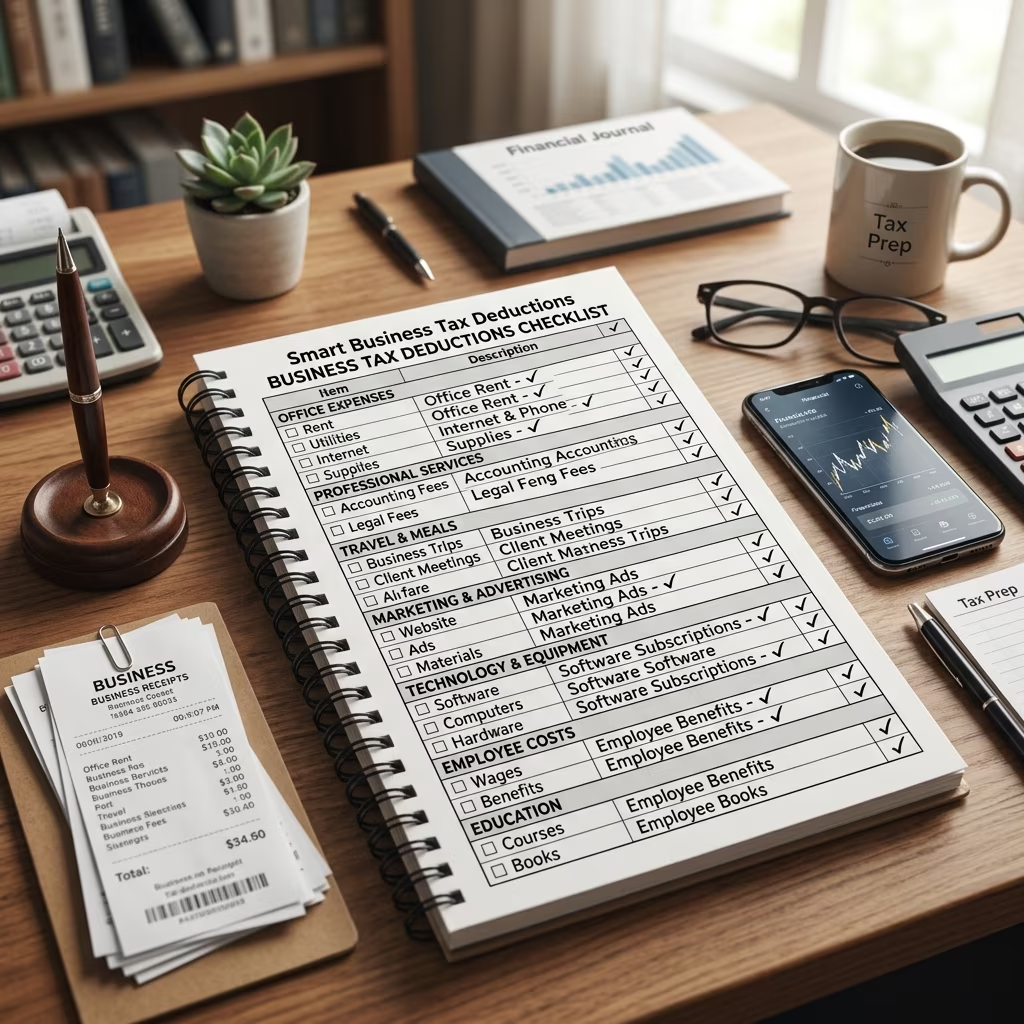
Business tax deductions can significantly reduce the amount of income you pay tax on, but only if you know what to look for and how to document it properly. This guide offers a structured checklist to help small business owners identify common deductible expenses, understand basic rules, and prepare for a smoother tax filing season.
While this article draws on general IRS guidance and best practices, it is intended for education only and is not individual tax advice. Complex situations, changing tax laws, and state‑specific rules mean it is wise to speak with a qualified tax professional for decisions that affect your business.
Core Principles of Business Tax Deductions
Most business tax deductions in the United States are built around two key concepts: whether an expense is ordinary and necessary, and whether it is clearly related to business rather than personal use.
- Ordinary expense: A cost that is common and accepted in your type of business. For example, software subscriptions are ordinary for a digital agency.
- Necessary expense: A cost that is helpful and appropriate for your business, even if it is not strictly indispensable.
- Business vs. personal: Only the business portion is deductible. Mixed‑use items (like a car or phone) require reasonable allocation and documentation.
Keeping accurate records throughout the year—receipts, invoices, mileage logs, and accounting reports—makes it far easier to support these deductions if questioned by the tax authorities.
Startup and Organizational Costs
New businesses often incur costs before they officially open their doors: forming a legal entity, researching markets, and hiring professional advisors. Many of these can be treated as startup deductions.
- Typical startup costs may include market research, initial advertising, consulting fees, and travel to meet potential suppliers or customers.
- Organizational costs relate to setting up the legal and structural framework of the business, such as legal fees to form a corporation or partnership.
U.S. rules generally allow a portion of qualified startup and organizational expenses to be deducted in the first active year of the business, with the remainder spread over future years. Because eligibility is technical, reviewing IRS guidance and speaking with a professional can help you categorize these costs correctly.
Startup Checklist
- Document the date your business began active operations.
- Maintain a separate folder for pre‑opening receipts and invoices.
- Label each expense as either “startup”, “organizational”, or “regular operating” cost.
- Ask your tax preparer how much can be deducted in the first year versus amortized.
Business Operations: Everyday Deductible Expenses
Once your business is up and running, many routine costs qualify as deductible operating expenses so long as they meet the ordinary and necessary standard.
Common Operating Expenses
- Office supplies and postage – pens, paper, stationery, printer ink, shipping costs, and similar everyday items.
- Software and subscriptions – accounting tools, customer relationship management platforms, design software, and productivity suites.
- Advertising and marketing – online ads, printed flyers, sponsored events, and marketing agency fees.
- Professional services – accounting, legal, and consulting fees tied directly to business operations.
- Bank and payment processing charges – transaction fees, merchant account costs, and business loan interest.
For most small businesses, these costs are fully deductible in the year they are incurred, and they form the backbone of the tax deductions checklist. Keeping them clearly separated from personal spending is essential for compliance.
Workspace Costs: Home Office and Rented Space
Whether you run your business from a spare room or a leased office, the cost of your workspace can usually be deducted, subject to specific rules.
Home Office Deduction Basics
Many small business owners qualify for a home office deduction if a portion of their home is used regularly and exclusively for business. The IRS offers a simplified method based on the square footage of the office and a standard rate per square foot, up to a capped amount per year.
- The space must be used solely for business—using the same room as a guest bedroom or playroom generally disqualifies it.
- It should be your principal place of business or a place where you meet clients or customers.
- Under the simplified option, a fixed rate per square foot is applied, with a maximum area allowed.
Rented Office or Commercial Space
Businesses that rent office or commercial property typically deduct rent payments, utilities, and routine maintenance as current expenses. Larger improvement projects may need to be treated as capital investments and depreciated rather than deducted all at once.
| Workspace Type | Key Requirements | Typical Deduction Method |
|---|---|---|
| Home office | Regular and exclusive use; principal place of business | Simplified per‑square‑foot method or actual cost allocation |
| Rented office | Lease agreement; business use of rented space | Rent and utilities usually deductible as operating expenses |
| Owned commercial building | Business use; proper records of improvements | Depreciation for building; current deduction for routine repairs |
Vehicles, Travel, and Meals
Many small businesses rely on cars, travel to conferences, and meals with clients. These can be deductible, but they are governed by detailed rules and partial limits.
Business Vehicle Use
If you use a vehicle for business, you can usually deduct either a standard mileage rate or actual costs such as gas, maintenance, insurance, and depreciation, based on the portion of business use.
- Maintain a mileage log noting date, destination, purpose, and distance traveled.
- Clearly separate commuting (for example, driving from home to your regular workplace), which is generally not deductible.
- Apply the chosen method consistently for the tax year unless rules allow a change.
Business Travel
Travel away from your tax home for business purposes—overnight stays for client meetings, conferences, or site visits—often qualifies for deductions.
- Deductible expenses can include airfare, lodging, taxis, and other transportation.
- Costs must be directly related to business activities; extending a trip for personal sightseeing can limit what is deductible.
- Good records of itineraries and receipts help demonstrate the business purpose.
Meals with a Business Purpose
Meals can be deductible when they have a clear business objective, such as meeting with a client or traveling for work. However, only a portion of meal costs is typically deductible, and lavish or purely entertainment‑oriented expenses may not qualify.
- Note who attended the meal and the business topic discussed.
- Separate meal costs from non‑deductible entertainment activities.
- Be prepared for special rules if you provide meals to employees as part of their work.
Employees, Contractors, and Benefits
Paying others to help run your business—through wages or contract payments—is generally deductible when tied to ordinary and necessary services.
Wages and Contractor Payments
- Employee wages – salaries, hourly pay, bonuses, and commissions are typically deductible if they are reasonable and for services actually provided.
- Independent contractors – fees paid to freelancers or consultants are usually deductible, provided the worker is correctly classified and reported.
- Payroll taxes – employer‑side social security, Medicare, and unemployment taxes are part of the cost of having employees.
Employee Benefits
Many forms of employee compensation beyond wages are also deductible business expenses.
- Health insurance premiums for employees.
- Retirement plan contributions made by the business.
- Education and training support, such as tuition reimbursement up to allowed limits.
- Paid leave and certain family or medical leave programs.
Clear documentation and plan documents are important to demonstrate that these benefits are organized as part of the business, not personal gifts.
Equipment, Depreciation, and Large Purchases
Not all business expenses are deducted in the year you pay for them. Some larger purchases—such as machinery, computers, and furniture—are treated as capital assets and recovered over time through depreciation.
What Typically Requires Depreciation
- Office furniture and fixtures.
- Computers and peripheral equipment.
- Manufacturing or specialized machinery.
- Certain building improvements.
Tax rules allow accelerated deductions or special provisions for qualifying property, including options that can effectively write off much of the cost in the first year. However, limits and phase‑outs apply, especially for larger businesses, so professional guidance is useful when dealing with high‑value purchases.
Telecom, Utilities, and Insurance
Modern businesses rely heavily on phones, internet access, electricity, and various forms of insurance coverage. These core operating costs can often be deducted in full or in proportion to business use.
Phone and Internet
The business portion of cellphone and internet bills may be deductible when such services are essential to daily operations.
- Separate business lines and accounts whenever practical.
- Track business use if services are shared with personal use, and apply a reasonable percentage.
- Include additional connectivity costs, such as Wi‑Fi purchased while traveling for business.
Utilities and Insurance
Utilities for business premises and necessary insurance policies generally qualify as business deductions.
- Electricity, water, and gas used in a dedicated office or commercial space.
- Business liability insurance and property insurance.
- Specialized insurance policies relevant to your industry.
Practical Documentation Tips
Identifying deductions is only half the job. The other half is making sure you can support each deduction with records.
- Use a business bank account and separate credit card to keep business transactions distinct from personal spending.
- Retain digital and paper receipts for at least the period recommended by your tax advisor and regulatory guidance.
- Maintain logs for mileage, home office square footage, and business travel.
- Review IRS publications each year for updated standard mileage rates and deduction rules.
FAQs: Small Business Tax Deductions
1. Do I need to make a profit to claim business deductions?
Not necessarily. Genuine businesses can report a loss, and legitimate business deductions may exceed income in some years. However, if an activity consistently generates losses and appears more like a hobby than a business, tax authorities may limit deductions. Reviewing IRS guidance on hobby loss rules can help clarify your situation.
2. Can I deduct clothing I wear for work?
Only certain types of clothing qualify, such as uniforms or protective gear that are not suitable for everyday wear. General professional attire like suits or dresses is usually considered personal and non‑deductible, even if you only wear it at work.
3. Are business gifts fully deductible?
Business gifts are subject to strict limits. In many cases, only a portion of the cost per recipient per year can be deducted, and detailed records of who received the gift and why are important. Because the rules can be technical, checking current IRS guidance or consulting a tax professional is recommended.
4. How do I know whether an expense is personal or business?
Ask whether the expense is directly connected to generating or supporting business income. If the answer is yes and the expense is ordinary and necessary for your type of business, it is often deductible. For mixed‑use items, you may need to allocate based on a reasonable percentage of business use and keep supporting documentation.
5. Should I handle my own business tax deductions or hire a professional?
Very small, straightforward businesses sometimes manage their own returns using tax software and IRS publications. As operations grow more complex—employees, multiple states, significant assets, or unusual transactions—working with a qualified tax professional can reduce risk and help you identify deductions you might otherwise miss.
References
- Credits and Deductions for Businesses — Internal Revenue Service. 2024-02-28. https://www.irs.gov/credits-deductions/businesses
- Small Business Tax Deductions You Should Know — U.S. Chamber of Commerce CO. 2023-10-12. https://www.uschamber.com/co/run/human-resources/small-business-tax-deductions
- 22 Small Business Tax Deductions for Your Return in 2026 — Insureon. 2026-03-05. https://www.insureon.com/blog/small-business-tax-deductions
- Top 20 Small Business Tax Deductions (2026 Guide) — Rippling. 2026-01-18. https://www.rippling.com/blog/small-business-tax-deductions
- Top 14 Small Business Tax Deductions You Shouldn’t Miss in 2026 — Pilot. 2026-02-10. https://pilot.com/blog/small-business-tax-deductions-guide
- The 2026 Big List of Tax Deductions for Small Businesses — Fraim CPA. 2026-03-22. https://fraimcpa.com/big-list-tax-deductions/
- Small Business Tax Deductions Cheat Sheet — Intuit QuickBooks (PDF). 2023-11-01. https://digitalasset.intuit.com/render/content/dam/intuit/sbseg/en_us/Blog/Downloadable-assset/Checklist/small-business-tax-deductions-checklist-us-en.pdf