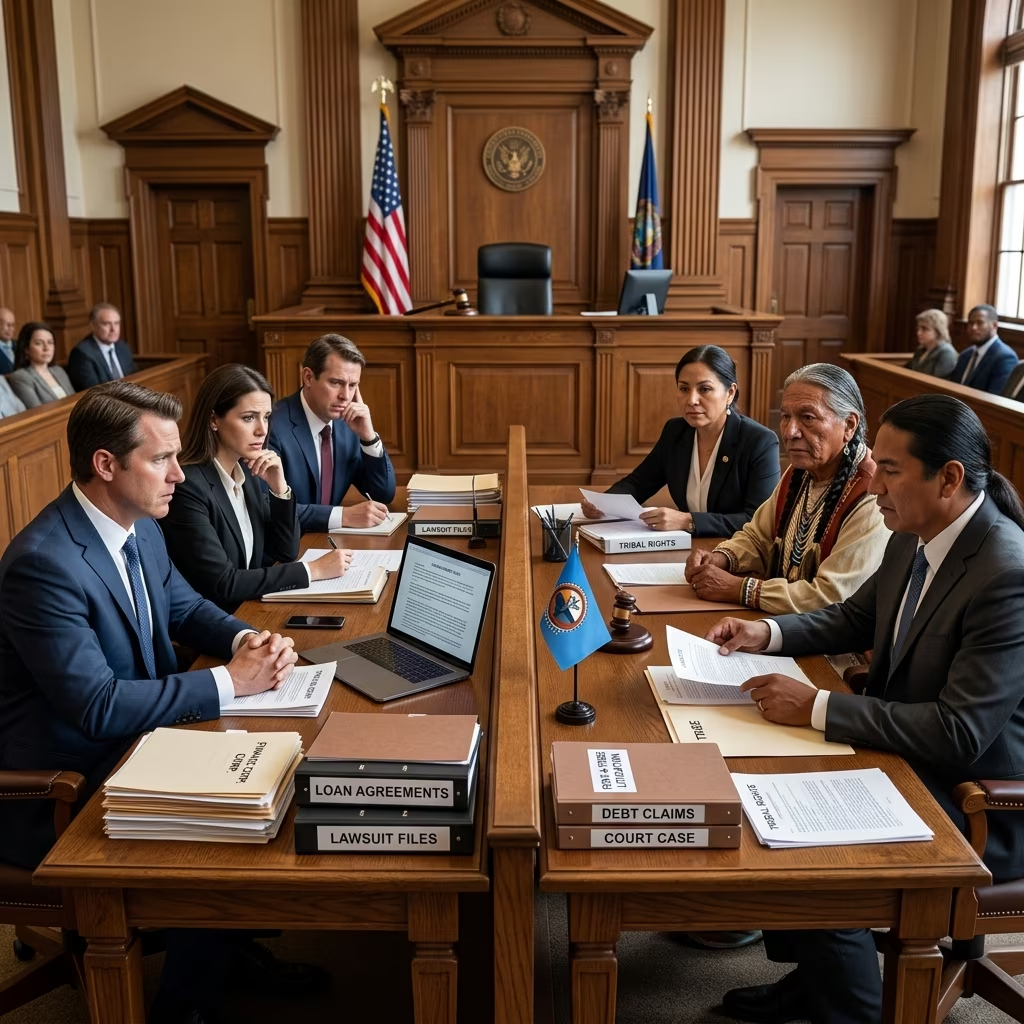
Rent-a-tribe lawsuits arise when lenders allegedly use a tribal affiliation to disguise an otherwise unlawful lending operation. These cases usually focus on very high-cost payday or installment loans, claims of tribal immunity, and whether the real business structure is designed to evade state consumer-protection laws.
For borrowers, the issue is not only the interest rate. Courts and regulators also look at who actually controls the loan program, where the money flows, whether the lender is licensed, and whether contract terms were used to limit the borrower’s rights. Federal appeals courts have allowed claims challenging such arrangements to go forward when the allegations suggest the tribe was used as a shield rather than as a genuine operating partner.
What a rent-a-tribe arrangement means
The phrase refers to a lending setup in which a non-tribal company allegedly partners with, leases, or otherwise uses a Native American tribe to claim immunity from state lending laws. In that structure, the lender may argue that tribal sovereign immunity blocks many consumer claims, even when the practical business decisions are made elsewhere.
These cases commonly involve payday loans or short-term cash advances that carry extremely high annual percentage rates and aggressive collection practices. Public reporting and consumer advocacy descriptions of these schemes repeatedly identify interest rates far beyond ordinary state limits, sometimes reaching several hundred percent.
Why these cases attract legal attention
State lending laws often cap interest rates or require lenders to hold a license. If a company is not licensed but still makes loans into a state, that can create exposure under usury laws, licensing statutes, and consumer-protection laws. When the business claims tribal immunity, the central legal question becomes whether the tribe truly operates and controls the lending business or whether its name is being used mainly to avoid regulation.
Courts have shown increasing willingness to examine the real economic relationship behind the paperwork. In one appellate decision, the court allowed a proposed consumer class action to continue against the orchestrator of a tribal payday-loan scheme, concluding that the complaint could proceed despite the immunity defense.
Common warning signs borrowers should watch for
Several features often appear in alleged rent-a-tribe lending schemes. None of these signs alone proves illegal conduct, but together they may indicate a problem.
- Unusually high interest rates that greatly exceed state limits or typical market rates.
- Limited lender information, such as vague company names, missing licensing details, or unclear business addresses.
- Arbitration clauses or similar contract terms that make it harder to sue or join a class action.
- Automatic rollovers or repeated refinancing that can trap borrowers in long-term debt cycles, a feature commonly associated with payday lending concerns.
- Collection activity by affiliated entities that appear separate on paper but function as part of the same lending network.
How courts analyze these disputes
Judges generally look beyond the label used in the contract and examine the substance of the arrangement. That analysis may include who markets the loans, who sets the rates, who receives profits, who services the accounts, and who controls disputes and collections.
If the non-tribal company is effectively running the program while the tribe receives only a small share of the revenue, a court may be more willing to treat the case as a challenge to an unlawful lending enterprise rather than as a protected tribal business. A law review article discussing both rent-a-bank and rent-a-tribe structures explains that the legal system has struggled with competing tests that can either expose or preserve these arrangements depending on how much emphasis is placed on form versus substance.
Possible claims in a lawsuit
Borrowers and state officials may bring several types of claims in these cases, depending on the facts and the jurisdiction. The exact causes of action vary, but the most common theories focus on illegal interest rates, unlicensed lending, unfair practices, and deceptive business conduct.
| Claim type | What it usually means |
|---|---|
| Usury | The lender charged interest above the legal maximum. |
| Unlicensed lending | The company made loans in a state without the required approval. |
| Deceptive practices | The lender misled borrowers about who controlled the loan or what laws applied. |
| Unfair collection | The lender or its affiliates used improper methods to collect payments. |
| Class action claims | Many borrowers seek relief together because the same lending terms affected large groups of people. |
What evidence can matter most
Successful cases often depend on records showing how the lending program actually worked. Useful evidence can include loan agreements, bank statements, payment histories, marketing materials, emails, servicing records, and documents showing the flow of revenue between the lender and the tribal entity.
Borrowers may also benefit from preserving screenshots of the lender’s website, copies of arbitration provisions, and any notices that identify the lender or its affiliates. That information can help a lawyer determine whether the operation was genuinely tribal or simply structured to appear that way.
What remedies borrowers may seek
When a borrower proves unlawful lending, courts may award remedies that undo the damage caused by excessive interest or improper collection. Depending on the governing law, a borrower may seek repayment of overcharged interest, damages, statutory penalties, attorney’s fees, or other relief authorized by the court.
Some cases may also lead to broader consequences for the lender, including injunctions, loss of business privileges, or enforcement actions by regulators. In especially serious matters, government investigators may pursue fraud, racketeering, or related charges if the facts support them.
How tribal sovereignty fits into the issue
Tribal sovereignty is a real and important legal doctrine. Native American tribes generally possess a measure of sovereign authority, and that can limit lawsuits against a tribe acting within its lawful sphere.
The dispute in rent-a-tribe cases is not whether tribal sovereignty exists, but whether the lending arrangement is truly tribal in nature. If the tribe is only nominally involved while outside financiers run the business, courts may decide that immunity does not bar consumer claims. That distinction is central to many modern cases.
What borrowers should do if they suspect a problem
A borrower who believes a loan may be part of a rent-a-tribe scheme should gather documents immediately and avoid destroying account records. It is also wise to stop making assumptions that the contract cannot be challenged simply because it mentions a tribe or includes arbitration language.
- Save every loan agreement, payment receipt, and collection notice.
- Write down the dates and amounts of all payments made.
- Check whether the lender was licensed in the borrower’s state.
- Review the stated interest rate and compare it with state law.
- Consult a consumer law attorney or the appropriate regulator as soon as possible.
Legal advice can be especially important because tribal immunity, arbitration clauses, and multi-state lending laws can make these disputes procedurally complex.
Frequently asked questions
Is every tribal lending business illegal?
No. Tribal ownership or involvement is not automatically unlawful. The problem arises when the structure is allegedly used to evade state lending laws or when the tribe is only a nominal participant.
Do borrowers always lose because of tribal immunity?
No. Courts may look past the label if the facts suggest a non-tribal company controlled the lending operation. In at least one appellate case, claims challenging a rent-a-tribe payday-loan scheme were allowed to continue.
Why are arbitration clauses important?
Arbitration clauses can limit where and how a borrower may bring a dispute. In these cases, they may also be used to delay class actions or force individual proceedings, which is why they receive close scrutiny.
Can a borrower get money back?
Yes, depending on the law and the facts. Potential recovery can include excess interest, damages, and other relief permitted under consumer protection statutes or common-law claims.
Should borrowers speak to a lawyer?
Yes. Because these cases often involve complex issues such as sovereignty, usury, licensing, and class-action procedure, a lawyer can help determine whether a claim is viable and what documents are needed.
References
- ‘Rent-a-Tribe’ Class Action Lawsuit Alleges Fineday Funds Issued Predatory Loans — ClassAction.org. 2024-02-08. https://www.classaction.org/news/rent-a-tribe-class-action-lawsuit-alleges-fineday-funds-issued-predatory-loans
- Suit Over ‘Rent-A-Tribe’ Payday Loan Scheme Survives on Appeal — Bloomberg Law. 2024-03-11. https://news.bloomberglaw.com/litigation/suit-over-rent-a-tribe-payday-loan-scheme-survives-on-appeal
- ‘Rent-a-Tribe’ Class Action Alleges American Web Loan, Five Others Made Millions Collecting Debt From Usurious Loans — ClassAction.org. 2024-02-16. https://www.classaction.org/news/rent-a-tribe-class-action-alleges-american-web-loan-five-others-made-millions-collecting-debt-from-usurious-loans-in-w.v
- The End for ‘Rent-A-Tribe’ Payday Lending Schemes? — Public Interest Research Group. 2019-11-14. https://pirg.org/edfund/articles/the-end-for-rent-a-tribe-payday-lending-schemes/
- Crossing State Lines: The Trojan Horse Invasion of Rent-a-Bank and Rent-a-Tribe Lending Schemes — The George Washington Law Review. 2019-04-01. https://www.gwlr.org/wp-content/uploads/2019/04/87-Geo.-Wash.-L.-Rev.-468.pdf
- Rent-a-Tribe or Sovereign Immunity: Fort Belknap Lawsuit Exposes Legal Gray Areas of Payday Lending — Daily Montanan. 2023-09-13. https://dailymontanan.com/2023/09/13/rent-a-tribe-or-sovereign-immunity-fort-belknap-lawsuit-exposes-legal-gray-areas-of-payday-lending/
- AG’s suit allowed in “Rent-a-Tribe” Payday Lending Scheme — FOX43. 2024-05-01. https://www.fox43.com/article/news/local/contests/ags-suit-allowed-in-rent-a-tribe-payday-lending-scheme/521-e87f92fd-92fb-493a-955e-788c09451e60