When police stop, question, search, or arrest someone, they cannot act on pure instinct or personal bias. United States law requires officers to meet specific proof standards before they interfere with a person’s liberty, property, or privacy. Two of the most important standards are reasonable suspicion and probable cause.
This guide explains what each term means, how they differ, and why understanding them is essential for anyone who wants to know their rights during a police encounter. The focus is on practical, real-world implications, not just abstract legal theory.
Why These Standards Matter Under the Fourth Amendment
The Fourth Amendment to the U.S. Constitution protects people against “unreasonable searches and seizures.” In plain terms, that means government agents, including police officers, must have a legitimate legal basis before they:
- Stop you on the street or pull your car over
- Detain you for questioning
- Search your body, clothing, vehicle, home, or digital devices
- Arrest you or seize your property
Courts use standards like reasonable suspicion and probable cause to decide whether a particular police action was constitutionally permissible. If officers fail to meet the correct standard, evidence they obtain can be excluded from court, and sometimes an entire case can be weakened or dismissed.
Core Definitions: Reasonable Suspicion and Probable Cause
Although both terms deal with an officer’s judgment about possible criminal activity, they describe different levels of certainty and allow different kinds of police actions.
What Is Reasonable Suspicion?
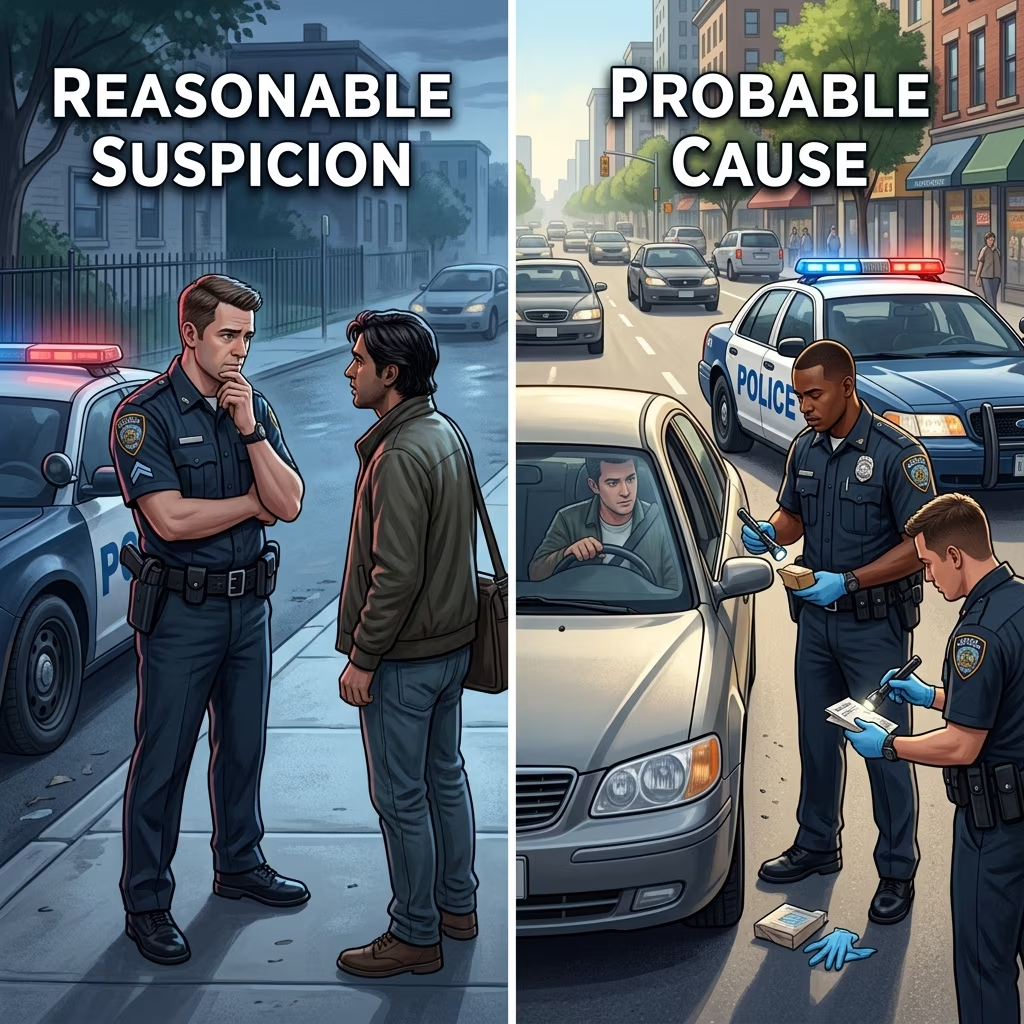
Reasonable suspicion is the lower of the two standards. It exists when an officer can point to specific, objective facts that, combined with their training and experience, suggest that a person may be involved in criminal activity.
- It must be more than a vague feeling or unarticulated hunch.
- It must be grounded in observable circumstances, such as behavior, location, time of day, or other concrete details.
- It does not require proof that a crime definitely happened, only that criminal activity is reasonably suspected.
The U.S. Supreme Court has described reasonable suspicion as a “common-sense” conclusion about human behavior, based on facts that would lead a practical person to suspect that a crime has been, is being, or is about to be committed.
With reasonable suspicion, officers can briefly stop and investigate, but they have limited authority to search or arrest.
What Is Probable Cause?
Probable cause is a higher standard of proof. It exists when the known facts and circumstances would lead a reasonable person to believe that a crime has likely been committed, is being committed, or will be committed, and that a specific person or place is connected to that crime.
- It requires more concrete, reliable information than reasonable suspicion.
- Court decisions often describe probable cause as meaning that it is more likely than not that a crime occurred—roughly a “greater than 50%” likelihood.
- It is the standard required for major actions like arrests, full searches, and warrants.
Under the Fourth Amendment, police generally must have probable cause before they conduct searches and make arrests, whether or not they have a warrant.
Side-by-Side Comparison
The table below summarizes key differences between reasonable suspicion and probable cause in everyday terms.
| Feature | Reasonable Suspicion | Probable Cause |
|---|---|---|
| Level of proof | Lower; specific facts suggesting possible crime | Higher; specific facts indicating a crime likely occurred |
| Typical officer belief | Person may be involved in criminal activity | Person probably committed a crime or crime evidence is present |
| Primary uses | Investigative stop, brief detention, limited frisk for weapons | Arrest, full search, warrants, seizure of property |
| Duration of encounter | Only long enough to confirm or dispel the suspicion | Custody can continue through booking and arraignment |
| Judicial involvement | Reviewed later if challenged in court | Often reviewed in advance when officers seek warrants |
What Police Can Do With Each Standard
The most important practical difference between reasonable suspicion and probable cause is what they allow officers to do. The standard must match the level of intrusion into a person’s rights.
Actions Permitted With Reasonable Suspicion
When officers have reasonable suspicion, they can conduct limited investigative actions aimed at clarifying whether a crime is actually occurring.
- Brief stop (Terry stop) – Officers may stop an individual or vehicle for a short time to ask questions and observe behavior.
- Temporary detention – Officers may keep a person for just long enough to investigate the suspicious circumstances.
- Protective frisk for weapons – If officers reasonably suspect someone is armed and dangerous, they may pat down outer clothing for weapons to ensure safety.
Reasonable suspicion does not normally justify a full search of a person’s pockets or bags, a detailed search of a vehicle, or an arrest. Those actions almost always require probable cause.
Actions Permitted With Probable Cause
Probable cause opens the door to more serious interventions by law enforcement. If officers can show probable cause, they may:
- Make an arrest – Detain a person and take them into custody based on facts indicating they likely committed a crime.
- Conduct a full search – Search a person’s body, clothing, and belongings incident to a lawful arrest, or search a vehicle or property where evidence is likely located.
- Seek a search warrant – Present evidence to a judge to obtain authorization to search a home, business, phone, or other private area.
- Seek an arrest warrant – Ask a judge to authorize an arrest when immediate, warrantless arrest is not appropriate.
- Seize property as evidence – Take items believed to be stolen or connected to a crime for use in a criminal case.
In short, probable cause is the gateway standard for most major enforcement actions under the Fourth Amendment.
How Courts Evaluate These Standards
Courts do not assess reasonable suspicion or probable cause in isolation; they consider the totality of the circumstances. This means judges look at all the facts together, rather than focusing on any single detail.
- Officers must be able to explain the facts they relied on and why those facts pointed to criminal activity.
- Factors like officer experience, known crime patterns, and context (time, place, behavior) affect whether suspicion or cause was reasonable.
- Different judges may weigh facts differently, but decisions must stay within constitutional limits set by Supreme Court precedent.
If a court later decides that an officer lacked reasonable suspicion or probable cause, any evidence obtained as a result may be suppressed, meaning it cannot be used against the defendant at trial.
Common Situations Where These Standards Apply
The difference between reasonable suspicion and probable cause comes up frequently in everyday situations. Here are some typical contexts.
Traffic Stops
- Reasonable suspicion is usually required for an officer to pull a vehicle over—such as seeing a traffic violation, unusual driving, or other facts suggesting illegal activity.
- Probable cause may arise if the officer then observes more concrete evidence, such as visible contraband, admissions, or the smell of illegal substances.
The initial stop must be justified by reasonable suspicion; a more intrusive search or arrest requires probable cause.
Street Encounters
- With reasonable suspicion, officers may briefly stop and question someone whose behavior or circumstances suggest criminal activity.
- If further investigation reveals stronger evidence—such as matching a suspect description, seeing illegal items, or hearing incriminating statements—probable cause may develop, supporting arrest or search.
Search Warrants
Judges review warrant applications to ensure that probable cause supports any requested search. The written affidavit must connect specific facts to the place to be searched and the items expected to be found.
- Reasonable suspicion alone is not enough for a search warrant.
- Officers must demonstrate a factual basis showing that evidence of a crime is likely present at the location.
What These Standards Mean for Your Rights
Understanding reasonable suspicion and probable cause helps you assess what police can legally demand from you during an encounter. While legal advice should always come from a qualified attorney, some general principles apply in many situations.
- Police stops are not automatic proof of guilt.
A brief stop may be based only on reasonable suspicion, which is a preliminary investigative step, not a conclusion that you committed a crime. - More intrusive actions require more proof.
Searches, arrests, and warrants almost always require probable cause. If officers lack that level of evidence, those actions may be challengeable later in court. - You generally retain the right to remain silent.
Even when an officer has reasonable suspicion or probable cause, you typically are not required to answer questions beyond limited identification requirements under state law. Legal advice should be sought for specifics in any given jurisdiction. - Improper police actions can affect the case.
If officers act without the appropriate legal standard, evidence may be suppressed, which can change the outcome of the prosecution.
FAQs About Reasonable Suspicion and Probable Cause
1. Is reasonable suspicion enough for an arrest?
No. Reasonable suspicion allows only brief investigative stops and limited protective frisks. An officer needs probable cause to arrest someone, meaning enough facts to reasonably believe a specific crime was committed and that the person arrested is responsible.
2. Can police search my car with only reasonable suspicion?
Typically, no. Reasonable suspicion justifies a stop and, in some cases, a limited frisk for weapons. A more intrusive search of a vehicle usually requires probable cause, such as seeing contraband or other clear evidence of a crime.
3. What happens if a court decides there was no probable cause?
If a judge finds that officers lacked probable cause for a search or arrest, evidence obtained as a result may be excluded under the exclusionary rule. This can significantly weaken the prosecution’s case and may lead to dismissal of charges in some circumstances.
4. Do officers have to explain their reasonable suspicion at the time of the stop?
Officers are not always required to give a detailed explanation during the encounter, but they must be able to articulate the specific facts supporting their suspicion later if the stop is challenged in court.
5. Are these standards the same in every state?
The basic concepts of reasonable suspicion and probable cause come from federal constitutional law and apply nationwide. However, individual states can provide additional protections or specific rules in their statutes and case law, as long as they do not reduce the minimum federal protections.
References
- Probable Cause Versus Reasonable Suspicion — Maricopa County Attorney’s Office. 2022-05-10. https://www.maricopa.gov/919/Probable-Cause-Versus-Reasonable-Suspici
- What Are “Reasonable” Suspicion & “Probable” Cause? — Law Offices of Randy Collins. 2023-03-14. https://www.occriminaldefenseattorney.com/blog/reasonable-suspicion-probable-cause/
- Reasonable Suspicion vs. Probable Cause: What’s the Difference? — Ike Law Firm. 2026-03-01. https://www.ike-law.com/blog/2026/march/reasonable-suspicion-vs-probable-cause-whats-the/
- What’s the Difference Between Reasonable Suspicion and Probable Cause? — FindLaw. 2024-08-15. https://www.findlaw.com/criminal/criminal-procedure/whats-the-difference-between-reasonable-suspicion-and-probable-cause.html
- Probable Cause v. Reasonable Suspicion — Lueck Law. 2023-11-02. https://www.luecklaw.com/probable-cause-v-reasonable-suspicion/