
Qualifying Relative Rules for Tax Dependents
Understand who can qualify as a tax dependent and how the IRS tests apply.
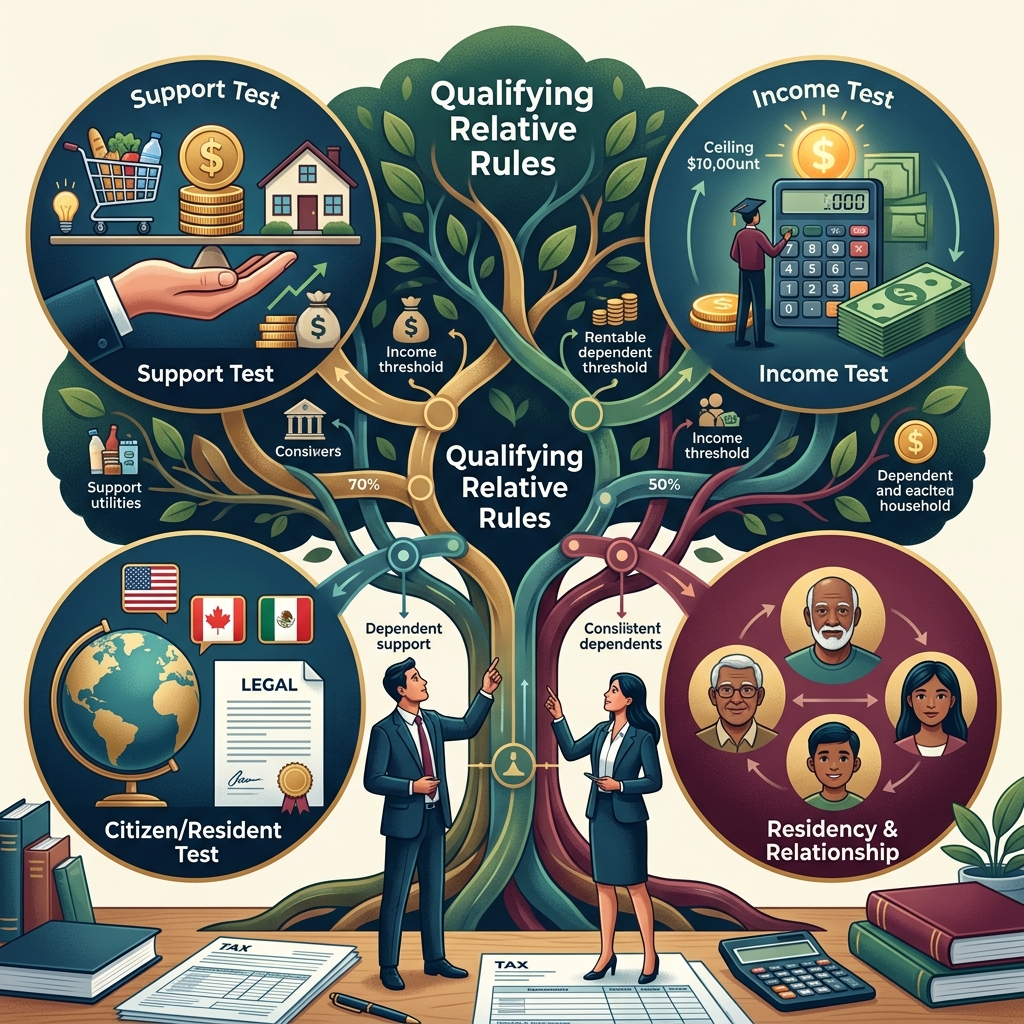
Claiming a qualifying relative as a tax dependent can lower your tax bill and open the door to important credits and filing benefits. The IRS does not use a single family-based rule to decide eligibility; instead, it applies several tests that focus on relationship, income, support, and whether the person can be claimed as someone else’s dependent.
Although the phrase qualifying relative sounds like it applies only to close family members, that is not always true. In some situations, a household member who is not related to you at all may still qualify, as long as the IRS conditions are met.
What the IRS Means by a Qualifying Relative
For tax purposes, a qualifying relative is a person who depends on you financially and meets the IRS dependency rules. The designation matters because it may help you claim tax benefits associated with dependents, including certain credits and household filing advantages.
The key point is that a qualifying relative is not defined only by family ties. The IRS cares about whether the person fits into one of the allowed categories and whether you provided more than half of the person’s support during the year.
The Main IRS Tests You Must Satisfy
To claim someone as a qualifying relative, you generally need to satisfy four core tests. These are the backbone of the IRS rule set and each one must be met.
- The person cannot be your qualifying child or the qualifying child of another taxpayer.
- The person must either live with you all year as a member of your household or be related to you in one of the IRS-recognized ways.
- The person’s gross income must fall below the IRS threshold for the year.
- You must provide more than half of the person’s total support for the year.
In addition, the general dependency rules also require that the dependent be a U.S. citizen, U.S. resident alien, U.S. national, or a resident of Canada or Mexico, subject to limited exceptions found in the tax rules.
How the Relationship Rule Works
The relationship requirement is broader than many taxpayers expect. Some relatives qualify even if they do not live with you, while other people may qualify only if they live in your household for the full year.
Relatives who may qualify without living with you include parents, grandparents, children, stepchildren, siblings, half-siblings, stepparents, and certain in-laws. The IRS also recognizes descendants of some of those relatives, such as grandchildren or nieces and nephews in certain family lines.
By contrast, if the person is not one of the listed relatives, then the individual generally must live with you for the entire year as a member of your household. Temporary absences usually do not break the residency requirement.
| Situation | Can it qualify? | Why it matters |
|---|---|---|
| Parent or grandparent living elsewhere | Yes | These relatives are in the IRS list and do not have to live with you. |
| Unrelated adult roommate | Possibly | May qualify if the person lived with you all year and the other tests are met. |
| Cousin | Usually no | Cousins are not generally included in the relationship list. |
| In-law relative | Yes, often | Some in-laws are specifically recognized by the IRS. |
Understanding the Household Test
If the person is not one of the IRS-listed relatives, the household test becomes especially important. The individual must live with you for the entire year as a member of your household, and the arrangement must not violate local law.
The IRS treats certain absences as temporary rather than permanent. That means someone may still be considered part of your household while away for school, vacation, medical treatment, military service, detention, or similar reasons.
This rule can also help in situations involving short-term or unavoidable separations. The question is not whether the person was physically present every day, but whether the absence was temporary and the home remained the person’s residence in a practical sense.
Why Gross Income Is a Separate Test
The gross income test prevents a taxpayer from claiming a dependent who earns too much on their own. The IRS sets an annual income ceiling, and the person’s gross income must stay below that amount for the year.
Different tax years may use different thresholds, so taxpayers should verify the correct amount for the year in question using official IRS guidance or current tax materials.
Gross income generally refers to income that is subject to tax before deductions. If the person has income that is received but not actually used for support, that distinction can matter when the support test is applied.
How the Support Test Is Applied
To meet the support test, you must provide more than half of the person’s total support for the year. Support can include housing, food, clothing, medical care, transportation, and similar expenses tied to the person’s maintenance.
This test often requires careful recordkeeping because support may come from more than one source. If the person contributes significant funds of their own, or if another relative helps cover costs, the taxpayer may not provide enough support to qualify.
Income that the individual receives but does not spend on support is treated differently from income actually used for living expenses. That distinction can affect the calculation of whether you supplied more than half of total support.
Who Cannot Be Claimed as a Qualifying Relative
Some people simply cannot be claimed as qualifying relatives even if a taxpayer helps pay for their care. Most notably, the person cannot already count as someone else’s qualifying child.
Other common disqualifiers include exceeding the income threshold, failing the support test, or not falling within the permitted relationship or household categories.
- A person who is another taxpayer’s qualifying child cannot also be claimed as a qualifying relative.
- A spouse generally is not claimed as a dependent when you file jointly.
- A person with gross income above the IRS limit generally fails the test.
- A person for whom you do not provide most of the support usually will not qualify.
Special Situations That Often Cause Confusion
Several common tax situations can create uncertainty. One example is a relative who is away from home for a long period but still counts as living with you because the absence is temporary.
Another frequent issue involves people who live in the same home but are not biologically related. The IRS allows a household-member route, so a nonrelative may qualify if the full-year residency and support rules are satisfied.
Taxpayers also sometimes assume that any dependent must be a child. That is not correct. The IRS divides dependents into two groups: qualifying children and qualifying relatives.
Why Claiming a Qualifying Relative Can Matter
When a person qualifies as your dependent, the result may affect more than just one line on a return. Dependency status can influence access to tax credits and filing advantages that depend on household composition and support relationships.
For some taxpayers, having a qualifying relative may also influence filing status considerations, especially where household support and family responsibilities are central to the return.
A Practical Way to Review Eligibility
Before claiming someone as a qualifying relative, it helps to work through the IRS tests in order. A simple checklist can reduce errors and make it easier to gather supporting records if the IRS later asks questions.
- Confirm the person is not someone else’s qualifying child.
- Check whether the relationship fits the IRS list or whether the person lived with you all year.
- Compare the person’s gross income with the annual IRS limit.
- Add up the support you provided and verify that it exceeds half of the total support for the year.
- Make sure the general dependency rules are also satisfied, including citizenship or residency requirements.
Records That Can Help Support the Claim
Taxpayers should keep records that show where the person lived, how support was paid, and what types of expenses were covered. Helpful documents may include lease records, utility bills, bank statements, receipts, medical bills, and proof of income.
Good documentation matters because dependency claims are often fact-specific. The more mixed the household finances are, the more important it becomes to show exactly how the support test was satisfied.
Frequently Asked Questions
Does a qualifying relative have to be related to me?
No. Some people may qualify as household members even if they are not related to you, as long as they live with you for the full year and meet the other IRS tests.
Can I claim a cousin as a qualifying relative?
Usually not. Cousins are not generally included in the IRS relationship list for qualifying relatives.
What if the person lived with me only part of the year?
That usually is not enough for the household-member route unless the absence was temporary, such as for school, medical care, or military service.
Can someone with income still qualify?
Yes, but only if the person’s gross income stays below the IRS annual limit and the support test is still satisfied.
Can more than one taxpayer claim the same person?
Generally no. A dependent cannot be claimed on more than one return except in limited situations under the tax rules.
Closing Thoughts for Taxpayers
The qualifying relative rules are designed to identify people who are genuinely dependent on the taxpayer for support. Because the IRS uses multiple tests, eligibility is rarely based on just one fact.
If you are unsure whether someone qualifies, the safest approach is to compare the person’s relationship, living arrangement, income, and support level against the current IRS rules before filing.
References
- Dependents — Internal Revenue Service. 2026-01-01. https://www.irs.gov/credits-deductions/individuals/dependents
- Member of Household Test – Understanding Taxes — Internal Revenue Service. 2026-01-01. https://apps.irs.gov/app/understandingTaxes/hows/tax_tutorials/mod04/tt_mod04_07.jsp
- Claiming dependents on taxes: IRS rules for a qualifying dependent — H&R Block. 2026-01-01. https://www.hrblock.com/tax-center/filing/dependents/irs-rules-to-claim-a-dependent/
- Qualifying Relative – Dependency Test — TaxAct. 2026-01-01. https://www.taxact.com/support/14153/qualifying-relative-dependency-test
- What is a Qualifying Relative? — TaxSlayer Support. 2026-01-01. https://support.taxslayer.com/hc/en-us/articles/360019037351-What-is-a-Qualifying-Relative
- Who counts as a dependent and qualifying relative in 2025 — NATP. 2025-01-01. https://www.natptax.com/news-insights/blog/who-counts-as-a-dependent-and-qualifying-relative-in-2025/
Similar Articles








Read full bio of medha deb




