
Marriage License: 7 Legal Issues And Actions To Protect Rights
Learn when a marriage license may be invalid, how that affects the marriage itself, and what legal steps you can take to protect your rights.
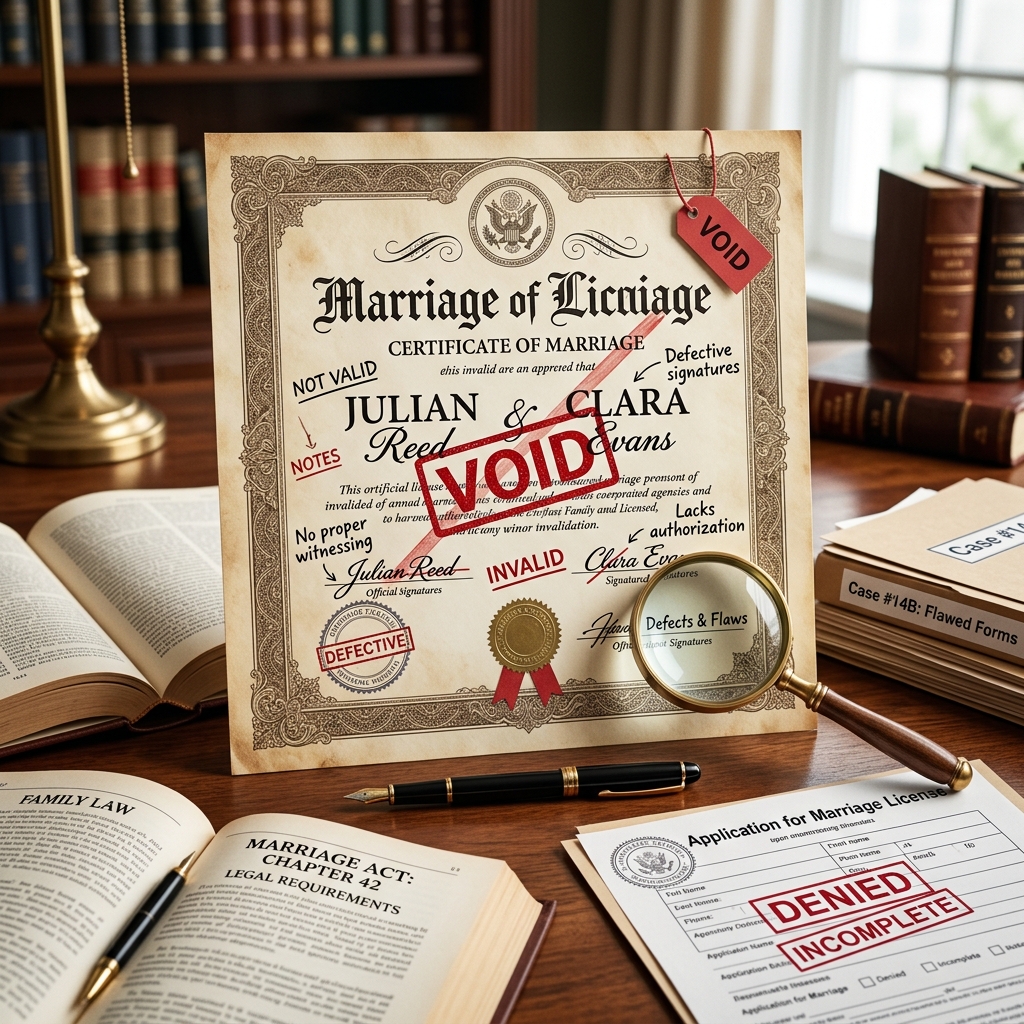
A marriage license is more than a ceremonial document; it is a legal authorization from the state that allows two people to enter into a recognized marriage. An error, omission, or act of deception during the licensing process can raise serious legal questions about whether the marriage is valid. This article explains when a marriage license may be considered invalid, how that interacts with concepts such as void and voidable marriages, and what steps you can take if you suspect a problem with your license or your marriage.
What Is a Marriage License and Why Does It Matter?
In every U.S. state, couples must obtain a marriage license before a lawful marriage ceremony can take place. The license functions as official permission from the government and typically includes both parties’ names, identifying information, and proof that they meet legal requirements such as age and marital status.
Although details vary by jurisdiction, most states share common principles:
- The license is issued by a government authority, often a county clerk or similar official.
- There may be a waiting period between issuance of the license and the date the ceremony is allowed.
- The marriage must be solemnized (the ceremony performed) within a fixed period, after which an unused license expires.
- The officiant usually has a duty to return the completed license to the issuing office to create a permanent record of the marriage.
Because the license is a gateway to legal recognition, defects in the license or the licensing process can have consequences for property rights, inheritance, benefits, and family relationships.
Invalid License vs. Invalid Marriage: Key Legal Distinctions
It is important to distinguish between an invalid license and an invalid marriage. These are related but not identical concepts, and states handle them differently.
| Concept | What It Means | Typical Consequence |
|---|---|---|
| Invalid license | The document authorizing the marriage is defective (procedural errors, missing information, or legal impediments). | May or may not affect the validity of the marriage, depending on state law and the nature of the defect. |
| Void marriage | A marriage that is considered legally nonexistent because it violates fundamental legal rules (e.g., incest, bigamy). | Treated as if it never occurred; usually no formal annulment is required, though a court order may still be sought for clarity. |
| Voidable marriage | A marriage that is valid unless and until a court declares it invalid due to specific defects (fraud, force, certain age or mental capacity issues). | Requires a legal action (often called annulment) by the affected party to dissolve the marriage. |
Some licensing problems are minor and do not undermine the marriage. For example, in some jurisdictions, if an officiant fails to return the license to the clerk, the officiant may be penalized, but the marriage itself can still be legally valid. In other situations, the defect goes to the heart of whether the couple had legal capacity to marry, and the marriage may be void or voidable.
Common Reasons a Marriage License May Be Invalid
States define their own rules for issuing licenses and recognizing marriages, but the following are widely recognized grounds that can lead to a license—and potentially the marriage—being questioned or declared invalid.
1. Fraud or Misrepresentation
Providing false information or concealing major facts on the license application is a frequent basis for disputing the validity of a marriage. Fraud may involve:
- Hiding an existing, undissolved marriage (undisclosed bigamy).
- Misrepresenting age or identity.
- Entering into the marriage primarily to obtain immigration status or other legal benefits.
Where fraud affects a party’s decision to marry, many states treat the resulting marriage as voidable. Under California law, for example, consent obtained by fraud can make a marriage voidable, allowing the injured spouse to seek an annulment. Similarly, legal advisers describe situations where undisclosed bigamy and false statements on a license may justify treating a marriage as void or voidable.
2. Coercion, Threats, or Force
Marriage must be based on voluntary consent. If one party is forced or threatened into signing a license or participating in the ceremony, the marriage can be challenged. Washington law provides that a marriage whose consent is obtained by force is voidable at the suit of the affected party. Many states impose similar rules, reflecting the principle that coerced relationships should not receive the protections of marriage.
3. Bigamy: Already Being Married to Someone Else
Bigamy—marrying a new partner while still legally married to another—is almost universally prohibited. A license issued in such circumstances may be subject to attack, and the resulting marriage is often classified as void from the outset.
Even when a state allows a narrow exception (for instance, when a spouse was absent and believed dead), statutes often specify conditions under which the marriage is voidable rather than automatically void. This can influence what type of legal proceeding is needed to unwind the relationship.
4. Prohibited Relationships (Incest)
Most states prohibit marriage between close relatives such as parent-child or siblings. If a couple fails to disclose a prohibited relationship when applying for a license, the license may be improperly issued, and the marriage is typically considered void.
Because these rules are grounded in public policy, courts ordinarily will not validate such marriages even if both parties knowingly consented.
5. Underage Marriage and Lack of Capacity
Marriage laws also set minimum age requirements and standards for mental capacity.
- In some states, a marriage entered into when either party is under the minimum age may be void or voidable depending on circumstances.
- Washington, for example, declares marriages where a person has not reached age 18 to be void.
- Marriages in which a party lacks sufficient understanding of the nature of marriage, or is of unsound mind, may be voidable at the request of that party.
Capacity questions can arise in cases of severe intellectual disability, mental illness, or when a party is under heavy influence of drugs or alcohol at the time of marriage. If the licensing authority was unaware of the incapacity, the license might be issued, but the marriage could still be later challenged.
6. Sham Marriages and Immigration Motives
Some couples enter into marriages solely to obtain immigration status, financial benefits, or other legal advantages. When the primary purpose of the marriage is not to form a genuine marital relationship, courts may treat the marriage as fraudulent. Legal commentary notes that marrying solely to obtain a green card is a classic example of fraud that can make a marriage voidable under California law.
Furthermore, federal immigration authorities may independently investigate such marriages, and findings of fraud can affect both marital status in state law and immigration consequences.
7. Procedural Errors and Missing Information
Licensing errors do not always lead to invalid marriages. Common procedural issues include:
- Application filed in the wrong county.
- Officiant performing a ceremony without a valid license or failing to file the license after the ceremony.
- Failure to comply with waiting periods or expiration dates for the license.
Maryland’s legal guidance, for instance, indicates that even if a ceremony occurs without a license, the marriage itself may still be considered valid, though the officiant may face a fine. Similarly, Michigan statutes require officiants to be authorized and to return the license, and impose criminal penalties for those who knowingly perform marriages with legal impediments. Yet a lost or unreturned license does not necessarily void a marriage, especially when the ceremony was properly conducted within the required time frame.
Void and Voidable Marriages: How They Relate to the License
Understanding whether a marriage is void or voidable helps determine what remedies are available when a license problem arises.
Void Marriages
Void marriages are treated as if they never legally existed. Typical examples include:
- Marriages involving close blood relatives prohibited by law.
- Marriages entered into while one party remains in a valid existing marriage.
- Certain underage marriages where statutes specify that the union is void.
Because void marriages conflict with fundamental legal rules, they are generally not validated by later consent or cohabitation. A court order may be sought to confirm the marriage’s nonexistence, but the order is usually declaratory rather than dissolving a legally recognized union.
Voidable Marriages
Voidable marriages are legally valid unless and until a court declares them invalid. State family codes often list conditions that make a marriage voidable, such as:
- Fraud affecting consent to marry.
- Force or duress.
- Unsound mind or lack of understanding at the time of marriage.
- Certain physical incapacities that prevent consummation.
California law, for example, identifies unsound mind, fraud, force, physical incapacity, and specific prior-marriage circumstances as bases for a voidable marriage. The affected spouse must bring a legal action—commonly referred to as an annulment—to have the marriage declared invalid.
Practical Consequences of an Invalid License or Marriage
Finding out that your marriage license may be defective, or that your marriage could be void or voidable, raises concerns beyond marital status alone. Consequences can include:
- Property and finances: Division of property, responsibility for debts, and eligibility for spousal support may depend on whether the marriage is recognized.
- Inheritance and benefits: Spousal rights in estates, pensions, health insurance, and Social Security typically presume a valid marriage.
- Children: Parental rights and child support obligations remain in place regardless of marital status, but custody and decision-making structures may differ.
- Immigration and citizenship: For marriages involving noncitizens, immigration authorities may revisit visa or residency status if the marriage is later deemed invalid.
Because these issues can span multiple areas of law, people facing potential invalidity often consult both family law and, when relevant, immigration or estate-planning attorneys.
Legal Remedies: Annulment, Divorce, and Correcting Records
If you suspect that your marriage license or marriage itself may be invalid, several legal paths might be available depending on state law and your circumstances.
Annulment for Voidable Marriages
Annulment is a court process that declares a marriage invalid as of its inception, rather than dissolving it like a divorce. In states such as Michigan and California, obtaining an annulment generally requires proof of grounds like fraud, force, underage status, or lack of mental capacity.
Legal practitioners emphasize that you must demonstrate that you would not have agreed to marry but for the misrepresentation or coercion. Evidence can include documents, testimony, and communications showing the nature of the fraud or force.
Divorce When the Marriage Is Valid but Broken
In many situations, the marriage and license are legally sound, even if serious relationship problems exist. When there are no recognized grounds for void or voidable status, the appropriate remedy is usually divorce rather than annulment. Divorce dissolves a valid marriage and addresses property division, support, and custody.
Seeking a Court Declaration on Void Marriages
Although void marriages are typically considered null from the start, parties often seek a formal court declaration for clarity. Such an order can remove doubt when dealing with third parties, such as employers, insurers, or government agencies.
Correcting Licensing and Marriage Records
Sometimes the problem lies not in the marriage itself but in the records. Courts and clerks may offer procedures to correct clerical errors on licenses or certificates. For example, Maryland courts allow petitions to correct marriage records, including licenses and applications, and the exact procedure depends on the court involved.
Correcting records can be crucial for proving marital status in future legal matters even when no questions exist about the marriage’s validity.
Preventing Problems: Steps Before and After You Marry
Couples can reduce the risk of encountering invalid-license or invalid-marriage issues by taking practical precautions.
Before Applying for a License
- Confirm you both meet age and capacity requirements in your state.
- Ensure all prior marriages are legally terminated, with documentation available.
- Gather accurate personal information, including birth dates, legal names, and addresses.
- Disclose any prior divorces or annulments when the application requires it.
- Read and follow county-specific rules about waiting periods and location requirements for the license.
During and After the Ceremony
- Use an officiant who is authorized under state law to solemnize marriages.
- Verify that the ceremony takes place within the time frame when the license is valid (e.g., within 60 days or other statutory limit).
- Confirm that the officiant completes and promptly returns the signed license to the issuing office.
- Obtain a certified copy of your marriage certificate after recording, so you have proof of the marriage for future needs.
Attention to these details may feel tedious, but they can prevent confusion years later when you need to prove marital status for legal or financial reasons.
Frequently Asked Questions (FAQs)
Does a missing or unreturned marriage license automatically invalidate my marriage?
Not necessarily. In some states, a marriage can still be considered valid even if the officiant fails to return the license, although the officiant may face penalties. However, rules vary by jurisdiction, so it is important to verify local law and, if needed, correct the record.
Can I get an annulment if my spouse lied on the marriage license application?
Possibly. Fraud that affects your decision to marry—such as hiding a prior marriage, misrepresenting intentions, or concealing significant facts—can be grounds for an annulment in many states. You typically must show that you would not have entered the marriage had you known the truth.
What happens if we married before reaching the legal age?
Consequences vary. In some jurisdictions, underage marriages are void, while in others they are voidable at the request of the underage spouse once they learn of their rights or reach adulthood. Consulting a family law attorney can clarify your options.
We discovered our officiant was not properly authorized. Is our marriage invalid?
Many states protect couples who marry in good faith before someone who appears to be authorized. For example, Washington law provides that a marriage solemnized by a person professing to be a religious official is not void if the couple believed they were lawfully joined. Local statutes will determine whether a defect in the officiant’s authority affects your marriage.
Who should I contact if I think my marriage license or marriage is invalid?
The first step is usually to speak with a family law attorney in your state, who can analyze whether your situation involves a void, voidable, or valid marriage and explain possible remedies such as annulment, divorce, or record correction. You may also need to contact the clerk’s office that issued the license to review their records and procedures.
References
- Chapter 26.04 RCW: Marriage — Washington State Legislature. 2023-01-01. https://apps.leg.wa.gov/Rcw/default.aspx?cite=26.04&full=true
- Marriage License and Ceremony — Maryland People’s Law Library. 2022-06-15. https://www.peoples-law.org/license-officiation
- Void and Voidable Marriages in California — McCunn Gordon & Jarvis. 2021-09-10. https://www.mcjglaw.com/blog/void-and-voidable-marriages-in-california/
- Chapter 551, Marriage — Michigan Legislature. 2018-01-01. https://www.legislature.mi.gov/documents/mcl/pdf/mcl-chap551.pdf
- Marriage License Question & Answer (Michigan) — Reddit Legal Advice (summarizing Michigan law). 2018-10-24. https://www.reddit.com/r/legaladvice/comments/9tetwd/mi_husband_and_i_no_longer_want_to_turn_in_signed/
- Can You Get an Annulment in Michigan? — BPC Attorneys. 2020-05-14. https://www.bpcattorneys.com/can-you-get-an-annulment-in-michigan
- Legal Options After Invalid Marriage: Expert Q&A Guide — JustAnswer Family Law. 2019-03-12. https://www.justanswer.com/family-law/tli72-undisclosed-bigamy-after-marriage-license.html
Similar Articles








Read full bio of Sneha Tete


