
Oklahoma Workers’ Compensation: A Practical Guide for Employees and Employers
Understand who is covered, how to file a claim, what benefits are available, and how disputes are resolved under Oklahoma workers’ compensation law.
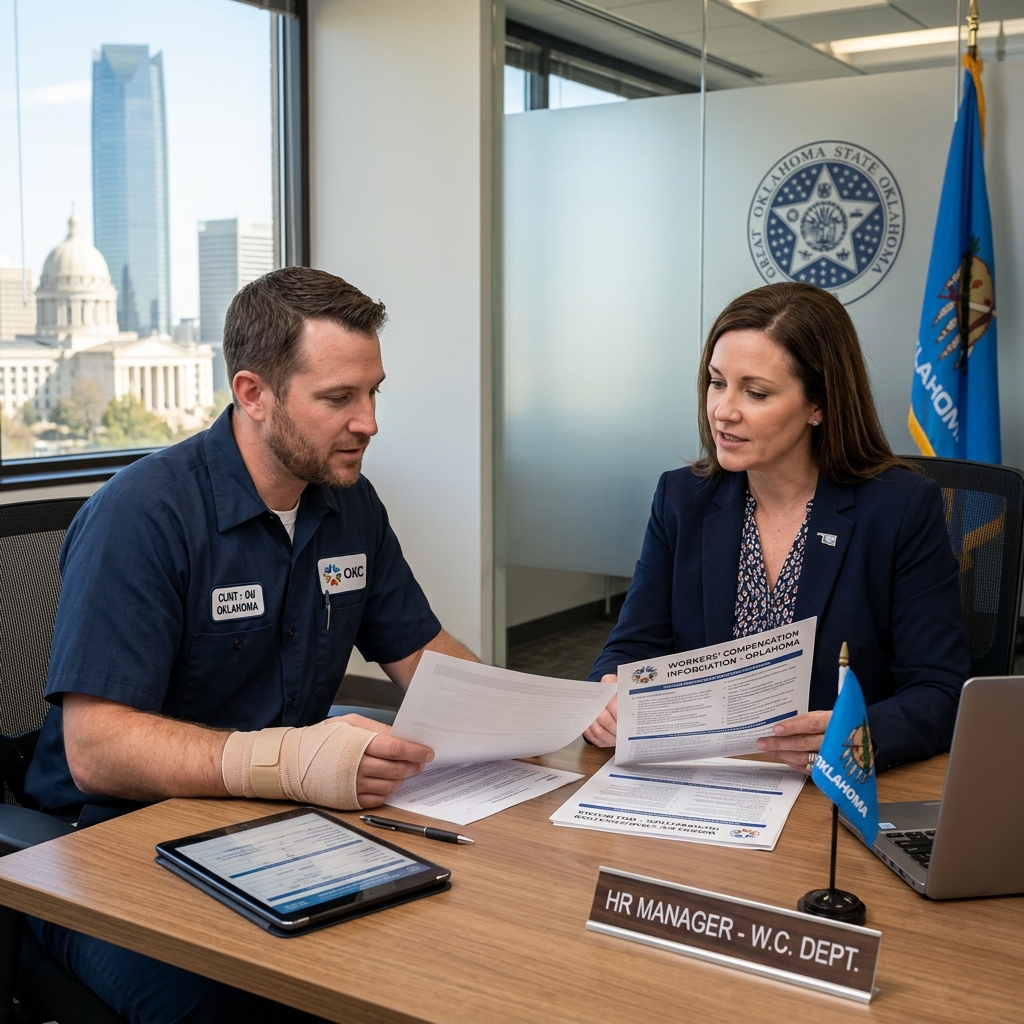
Oklahoma’s workers’ compensation system is designed to protect employees who suffer job-related injuries or illnesses and to give employers a clear process for handling those claims. It provides medical care, wage replacement, and disability benefits in exchange for limiting most lawsuits arising from workplace injuries. Understanding how coverage works, what benefits are available, and how to file or contest a claim can make a major difference in the outcome of a work injury case.
Overview of Oklahoma’s Workers’ Compensation System
Oklahoma law requires most employers to provide workers’ compensation coverage through insurance or self-insurance, ensuring that injured employees have access to defined benefits without needing to prove fault. The system is governed primarily by the Administrative Workers’ Compensation Act, codified in Title 85A of the Oklahoma Statutes.
The Oklahoma Workers’ Compensation Commission (OWCC) administers most new claims, while the Workers’ Compensation Court of Existing Claims handles older cases. The Commission also issues rules, forms, and fee schedules for health care reimbursements.
- No-fault system: Benefits are generally available even if the employer was not negligent, as long as the injury arises out of and in the course of employment.
- Exclusive remedy: Workers’ compensation benefits usually replace the right to sue the employer in civil court for workplace injuries, with limited exceptions.
- Administrative process: Claims are decided by administrative law judges at the Commission rather than by juries in civil court.
Who Must Have Workers’ Compensation Coverage?
In Oklahoma, workers’ compensation requirements center on the employer’s duty to secure coverage for most employees. Nearly every business employing workers in the state is required to carry workers’ compensation insurance or be approved as a self-insured employer.
Employers Typically Required to Carry Coverage
Under Oklahoma law, the obligation to provide workers’ compensation coverage applies to most employers engaged in business in the state. The law extends broadly, in contrast to earlier “hazardous occupation” statutes that covered only select industries.
- Corporations and larger businesses employing non-family staff
- Most private employers with non-exempt employees
- Certain public or governmental entities employing eligible workers
Employers can satisfy their obligation by purchasing private insurance, using state-funded competitive workers’ compensation coverage, or qualifying as self-insured under Commission rules.
Common Employer and Ownership Exemptions
Oklahoma law allows certain individuals and business structures to be exempt from mandatory coverage, although employers may voluntarily include them under a policy.
- Sole proprietors who operate their own business without covered employees
- LLC members owning at least a specified share of the company’s capital (commonly 10% or more)
- Partners in a partnership business structure
- Major stockholders holding a defined minimum percentage of corporate capital
- Some small family businesses with a limited number of related employees
In addition, Oklahoma historically excluded agricultural and domestic workers from many workers’ compensation provisions, although coverage details can change over time. Employers should review current statutes and Commission guidance when determining who must be covered.
Which Workers Are Covered?
Workers’ compensation protection is primarily tied to employee status. The Administrative Workers’ Compensation Act defines a range of terms, including who qualifies as an employee and how dependency and disability are determined.
Employees Generally Eligible for Benefits
Most individuals working for an employer that carries or is required to carry workers’ compensation coverage are eligible for benefits if they suffer a compensable work-related injury or occupational disease.
- Full-time employees
- Part-time employees
- Some temporary or seasonal workers, if they meet statutory criteria
- Minors employed lawfully by a covered employer
Eligibility requires that the injury arise out of and in the course of employment, meaning it must be directly connected to job duties or workplace conditions.
Workers Often Not Covered
Certain categories are normally excluded from workers’ compensation protection in Oklahoma unless specifically covered by policy language or statute.
- Independent contractors who control how their work is performed and are not economically dependent employees
- Owners or partners who have elected not to be covered
- Some agricultural or domestic workers under older statutory frameworks
- Individuals performing work that does not meet the statutory employment definitions
Misclassification can be a major issue. A worker labeled as an “independent contractor” may still be considered an employee for workers’ compensation purposes if the employer exercises significant control over the work. In disputes, the Commission evaluates factors such as supervision, equipment ownership, method of payment, and the nature of the work.
What Injuries and Illnesses Are Compensable?
To be covered, an injury or illness must meet statutory definitions and must be proven by a preponderance of the evidence with objective medical findings. Oklahoma recognizes a wide range of work-related harm.
Typical Compensable Conditions
- Acute physical injuries from specific incidents, such as falls, equipment accidents, or lifting injuries
- Repetitive trauma injuries like carpal tunnel syndrome or chronic back strain caused by repeated motions over time
- Occupational diseases arising from workplace exposure to chemicals, dust, noise, or other hazards
- Exacerbation of pre-existing conditions when work activity materially worsens a prior medical issue, subject to statutory rules
Situations That May Limit or Bar Benefits
Even if an injury occurs at work, certain circumstances can reduce or eliminate eligibility for workers’ compensation benefits.
- Injuries occurring while the worker is intoxicated or under the influence of illegal drugs, when that intoxication contributes to the accident
- Injuries resulting from intentional self-harm or criminal conduct
- Injuries happening while the worker is engaged in activity outside the scope of employment, such as personal errands unrelated to work
- Failure to comply with safety rules in ways that violate company policy, depending on the facts and statutory language
These limits are highly fact-specific. Medical documentation, witness statements, and employer policies often matter in determining whether the injury is compensable.
Core Benefits Available Under Oklahoma Law
Once a claim is accepted, Oklahoma workers’ compensation provides several categories of benefits, each governed by statutes and Commission rules.
Medical Care
Covered workers are entitled to reasonable and necessary medical treatment for their work-related injury or illness, subject to the Commission’s fee schedule.
- Emergency treatment and hospitalization
- Doctor visits and specialist care
- Diagnostic testing and imaging
- Physical therapy and rehabilitation services
- Prescribed medications and medical equipment
Employers or insurers typically have the right to direct medical care through authorized providers, though there are procedures for contesting or changing physicians.
Temporary Total Disability (TTD)
TTD benefits replace a portion of wages when an injured worker is completely unable to work for a temporary period.
- Paid at about 70% of the worker’s average weekly wage, capped at a percentage of the statewide average weekly wage
- Generally not payable for the first few days of disability unless the worker is off for an extended period
- Subject to maximum duration limits, commonly around 104 weeks, with potential extension in certain consequential injury cases
Permanent Disability Benefits
When a worker reaches maximum medical improvement but retains lasting impairment, permanent disability benefits may be available.
- Permanent partial disability (PPD): Compensation for specific loss of function or impairment rating, often based on medical evaluations and statutory schedules
- Permanent total disability (PTD): Benefits for workers who are unable to perform any gainful employment due to combined work injuries; paid over a defined period, such as up to 15 years or until Social Security retirement age, subject to statute
Death Benefits and Dependency
If a worker dies from a compensable injury or occupational disease, surviving dependents may receive death benefits.
- Weekly benefits based on a percentage of the worker’s wage
- Funeral expense allowances up to statutory limits
- Definitions of “actually dependent” include surviving spouses and certain children, as detailed in Title 85A
| Benefit Type | Purpose | Typical Trigger |
|---|---|---|
| Medical Care | Pay for treatment of work-related injury or illness | All accepted compensable injuries |
| Temporary Total Disability (TTD) | Replace wages during complete temporary inability to work | Worker off work and under medical restrictions |
| Permanent Partial Disability (PPD) | Compensate lasting partial impairment | Maximum medical improvement with residual limitations |
| Permanent Total Disability (PTD) | Provide long-term support for total work incapacity | Worker unable to perform any gainful employment |
| Death Benefits | Support dependents and cover final expenses | Work-related death of an employee |
How to Report a Workplace Injury
Early reporting and documentation are critical in Oklahoma workers’ compensation claims. Delays can complicate proof and may affect benefits.
Immediate Steps for Injured Workers
- Seek medical attention promptly for any significant injury or serious symptoms.
- Notify your employer as soon as possible, ideally in writing, with details of the injury, date, time, location, and witnesses.
- Record your symptoms, treatment received, and changes in your condition over time.
Employers generally have the initial responsibility to report the injury to their insurer and to facilitate medical care. However, if an employer fails to act, the worker can initiate a formal claim with the Commission.
Filing a Workers’ Compensation Claim in Oklahoma
Formal claims are filed with the Oklahoma Workers’ Compensation Commission using specific forms. These filings trigger adjudication if benefits are disputed.
Key Claim Forms
The Commission provides multiple claim forms for different situations, all available via its official website.
- CC-Form 3: Worker’s initial notice of accidental injury and claim for compensation
- CC-Form 3A/3B/3C: Specialized forms for occupational disease, cumulative trauma, or other particular claim types
- Other Commission forms: Used for medical disputes, settlement agreements, and procedural motions
Deadlines and Time Limits
Oklahoma workers’ compensation claims are subject to strict statutory deadlines. While exact time limits can vary, common rules include:
- General filing deadline: Often within two years of the date of injury or last payment of compensation, depending on the claim type and statute.
- Notice requirements: Employers should be notified promptly to avoid disputes about late reporting.
- Appeal and hearing deadlines: Specific time frames apply if the worker wants to contest a denial or adverse decision.
Missing a deadline can lead to dismissal of the claim. Workers are encouraged to review current statutory provisions and seek advice if they are unsure about timing.
Disputes, Hearings, and Appeals
Not all workers’ compensation claims proceed smoothly. Disputes can arise over compensability, medical treatment, degree of disability, or benefit amounts.
Dispute Resolution Through the Commission
When disagreement occurs, either party may request a hearing before an administrative law judge at the Commission.
- Workers typically file a hearing request form (such as a CC-Form 9 or similar) to bring the dispute before a judge.
- Evidence may include medical records, expert testimony, wage records, and witness statements.
- The judge issues a written decision that can grant, modify, or deny benefits.
Appeals of Commission Decisions
Parties dissatisfied with an administrative law judge’s ruling may appeal within defined time limits.
- Internal appeals to the full Commission or designated appellate panels, depending on current procedure
- Further judicial review by higher courts, such as the Oklahoma Supreme Court, for legal errors or constitutional issues
Appeals focus on whether the law was applied correctly and whether there is sufficient evidence to support the decision.
Special Considerations: Multiple Injuries and Prior Impairment
Workers who already have a physical impairment and then suffer a new compensable injury may face complex benefit calculations. Oklahoma law addresses these scenarios through defined standards for “physically impaired persons.”
- The worker must meet the statutory definition of a physically impaired person based on prior disability.
- The worker must suffer a subsequent compensable injury, with an award of permanent disability for that new injury.
- The combination of prior and new disabilities must result in permanent total disability as defined by law to qualify for particular benefits or additional fund payments.
Because these situations rely heavily on medical and legal analysis, many workers seek professional assistance when multiple injuries are involved.
Employer Responsibilities and Risk Management
Oklahoma employers have legal duties under workers’ compensation law and can also take proactive steps to manage risk.
Legal Duties of Employers
- Secure coverage: Obtain valid workers’ compensation insurance or self-insurance approval for all required employees.
- Post required notices: Provide workers with information about workers’ compensation rights and reporting procedures, as required by Commission rules.
- Report injuries: Timely report compensable injuries to the insurer and cooperate with the claims process.
- Comply with safety regulations: Implement workplace safety programs that meet state and federal standards to reduce injuries.
Best Practices for Employers
- Maintain clear written policies on injury reporting and workers’ compensation procedures.
- Train supervisors to respond promptly to injury reports and to document incidents thoroughly.
- Work closely with insurers and medical providers to facilitate appropriate care and return-to-work plans.
- Regularly review classifications of workers to avoid misclassifying employees as independent contractors.
Frequently Asked Questions (FAQs)
1. Do I have to prove my employer was at fault to receive workers’ compensation in Oklahoma?
No. Oklahoma uses a predominantly no-fault workers’ compensation system. You generally need only to show that the injury arose out of and in the course of employment, supported by objective medical evidence.
2. Can I choose my own doctor for a work injury?
Initially, employers or insurers usually have the right to direct medical care to approved providers under Commission rules and fee schedules. However, workers may request changes or challenge inadequate care through Commission procedures.
3. How much wage replacement will I receive while I am off work?
Temporary total disability benefits are commonly calculated at around 70% of your average weekly wage, subject to caps based on the statewide average weekly wage and specific statutory limits. Exact amounts depend on your date of injury and current statutory figures.
4. What happens if my workers’ compensation claim is denied?
You may file a request for hearing with the Oklahoma Workers’ Compensation Commission using the appropriate form, present evidence, and obtain a decision from an administrative law judge. If you disagree with the decision, you may have appeal rights.
5. Are all small family businesses exempt from workers’ compensation requirements?
No. While some closely held or family-run businesses may qualify for limited exemptions, many still must carry coverage for non-exempt employees. Each employer should review the applicable statutes and consult the Commission or legal counsel for current requirements.
References
- OKLAHOMA STATUTES TITLE 85A. Workers’ Compensation — Oklahoma Legislature. 2025-01-01. https://law.justia.com/codes/oklahoma/title-85a/
- OKLAHOMA STATUTES TITLE 85A. Administrative Workers’ Compensation Act (Definitions) — Oklahoma Legislature. 2019-12-01. https://oksenate.gov/sites/default/files/2019-12/os85A.pdf
- Administrative Rules of the Oklahoma Workers’ Compensation Commission — Oklahoma Workers’ Compensation Commission. 2017-09-12. https://oklahoma.gov/content/dam/ok/en/health/health2/documents/2017-perm-rules-eff-9-11-17-and-eme-rule-25-1-2-eff-9-12-17.pdf
- Guide for Injured Workers — OKLaw.org. 2017-01-01. https://oklaw.org/resource/guide-for-injured-workers/download/1D683F37-D3A1-2981-9184-7FE3597B8866
- Oklahoma Workers’ Compensation Insurance — The Hartford. 2024-01-01. https://www.thehartford.com/workers-compensation/oklahoma
- OK WCC | Home — Oklahoma Workers’ Compensation Commission. 2024-01-01. https://www.wcc.ok.gov/
- Forms – Oklahoma Workers’ Compensation Commission — Oklahoma Workers’ Compensation Commission. 2024-01-01. https://www.wcc.ok.gov/forms
Similar Articles








Read full bio of Sneha Tete




