
NYC Airbnb Fines, Appeals, and Tenant Rights
Understanding how New York City regulates short-term rentals, enforces fines, and what options tenants have when facing penalties.
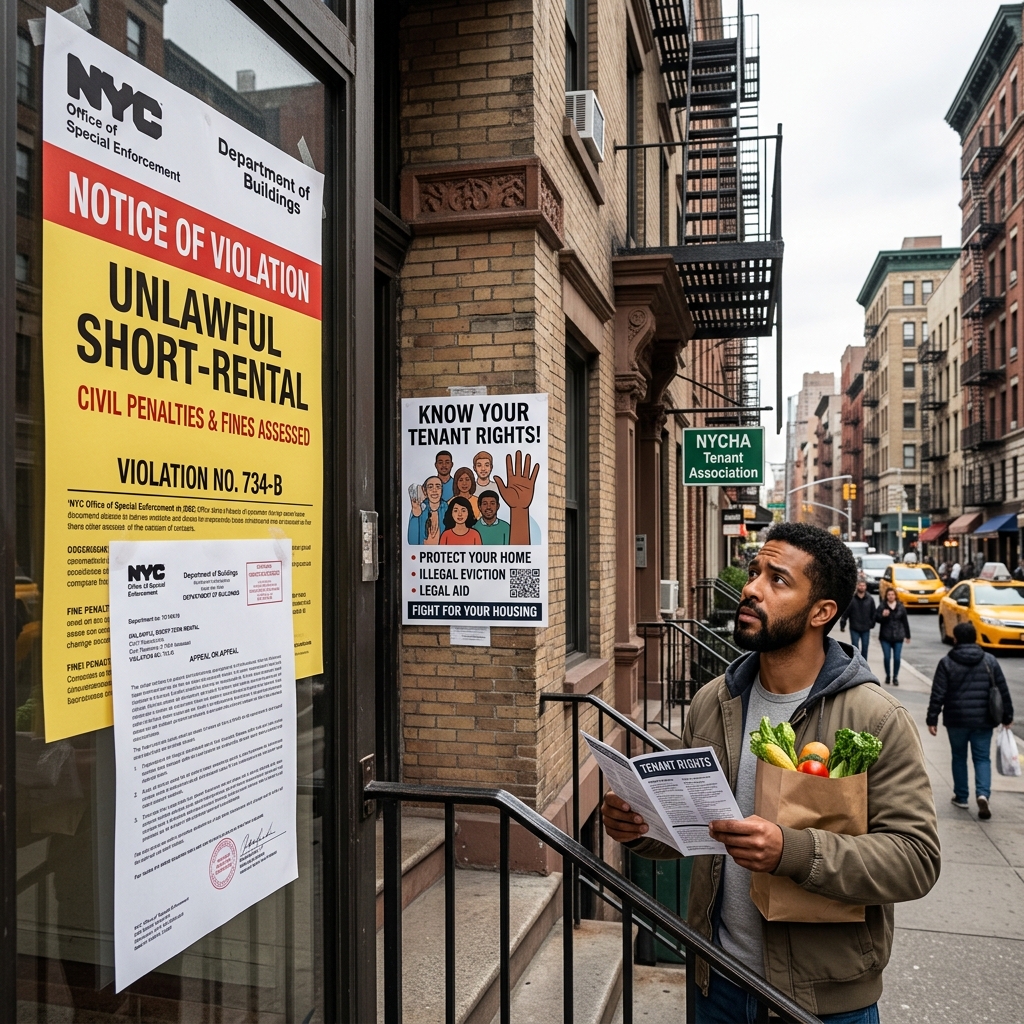
New York City has become a testing ground for how large global cities regulate short-term rentals such as Airbnb. While the city has long imposed strict rules on using residential apartments for transient stays, recent enforcement efforts and new registration requirements have made compliance more complex for both tenants and hosts. At the same time, administrative review boards and courts occasionally overturn fines, raising important questions about due process, evidence, and tenant protections.
This article explains the current regulatory framework for short-term rentals in NYC, when and why fines are issued, and how tenants may challenge penalties. It uses a specific enforcement dispute as inspiration, but the discussion here is general: it is designed as a practical legal-information guide for anyone considering hosting guests, subletting, or responding to a notice of violation.
The Legal Landscape of Short-Term Rentals in NYC
Short-term rental activity in New York City is shaped by several overlapping bodies of law and regulation, including state housing statutes, city zoning rules, building codes, and more recently, Local Law 18, the short-term rental registration law. Together, these rules create a framework in which most entire-apartment rentals for fewer than 30 days are unlawful in typical residential buildings.
Core Policy Goals
New York City’s approach to regulating Airbnb and similar platforms serves multiple policy objectives:
- Preserving permanent housing stock: Limiting transient use of apartments is meant to prevent residential units from being diverted into de facto hotel rooms.
- Protecting building safety: Short-term rentals often involve unfamiliar guests in buildings not designed or equipped as hotels, raising fire safety and egress concerns.
- Ensuring zoning compliance: Many residential zones prohibit commercial or transient lodging uses.
- Maintaining neighborhood stability: Frequent turnover of short-term guests can affect noise, security, and community cohesion.
Against this backdrop, NYC’s enforcement agencies have authority to inspect buildings, investigate complaints, and impose civil penalties on owners, tenants, and platforms that violate the rules.
Local Law 18: Registration and Platform Enforcement
In 2022, New York City adopted Local Law 18, sometimes colloquially referred to as the city’s “Airbnb law” or “short-term rental registration law.” The law took full effect in 2023 and dramatically changed how hosts and platforms must operate.
Key Requirements for Hosts
Under Local Law 18, hosts offering stays of fewer than 30 consecutive days must comply with all of the following conditions:
- Mandatory registration with the Mayor’s Office of Special Enforcement (OSE) before listing or renting a unit for short stays.
- Primary residence requirement, meaning the host typically must live in the unit for at least 183 days per year.
- Host presence during the stay for rentals under 30 days; the host must be physically present and share the dwelling with the guests.
- Guest limit of two paying guests at a time in most host-occupied units.
- Compliance with safety and building rules, including unobstructed exits, proper smoke and carbon monoxide detectors, and adherence to building codes.
Entire-apartment rentals for fewer than 30 days without the permanent resident present are broadly prohibited in most standard residential buildings, often classified as “Class A” multiple dwellings.
Responsibilities of Platforms
Local Law 18 also imposes obligations on booking platforms such as Airbnb, Vrbo, and similar services.
- Platforms must verify a host’s registration number with the city before processing reservations.
- They are prohibited from accepting payment for unregistered short-term rentals and must block or remove listings that OSE has denied or revoked.
- Failure to comply can lead to monetary penalties against the platform for each illegal transaction.
These rules have had a significant impact on the number of active short-term rental listings in NYC. Some analyses report reductions exceeding 90% in the availability of legal short-term rentals between the law’s implementation and early 2025, illustrating how aggressive enforcement reshaped the city’s market.
When Fines Are Issued: Common Violations
Tenants and owners may face fines when they engage in short-term rental activity that violates NYC law or when they facilitate such activity in their building. Civil penalties often arise from investigations by the Office of Special Enforcement, the Buildings Department, or the Fire Department, depending on the nature of the violation.
Typical Infractions
Common conduct that can trigger penalties includes:
- Offering an entire apartment for stays of fewer than 30 days while the permanent resident is absent.
- Operating a short-term rental without required registration under Local Law 18.
- Exceeding the two-guest limit in a host-occupied unit.
- Renting in a building listed as prohibited for short-term rentals by the city.
- Ignoring building codes or safety rules, such as blocked exits or inadequate alarms.
The fines themselves can be substantial. Hosts may face civil penalties ranging from approximately $1,000 to $5,000 per violation, or in some cases, three times the illegal revenue obtained, whichever is greater. Platforms may incur separate penalties per unlawful transaction.
Who Can Be Held Responsible?
Responsibility for violations can extend beyond the individual who posted a listing. Depending on the circumstances, enforcement agencies may seek to hold:
- Tenants who rent out their apartment contrary to the lease and local law.
- Owners or landlords who knowingly permit or ignore illegal transient occupancy in their building.
- Property managers who advertise or facilitate short-term stays.
- Platforms that process bookings without verifying registration.
This multi-party approach is intended to ensure that both the supply-side (hosts) and infrastructure (platforms and landlords) align with the city’s regulatory objectives.
Case-Based Lessons: Evidence, Due Process, and Overturned Fines
In some enforcement disputes, tenants have successfully challenged fines by arguing that the city’s evidence was insufficient or that they were improperly blamed for activity they did not control. In those cases, administrative boards or hearing officers may overturn penalties after reviewing the record. While each matter turns on its specific facts, a few general lessons emerge.
Importance of Accurate Identification
To impose fines on a particular tenant, enforcement authorities must show a sufficient connection between that person and the alleged short-term rental activity. Problems can arise when:
- A listing uses a nickname, partial name, or generic label that does not clearly match the tenant’s legal name.
- The unit number, building address, or photos are ambiguous or inconsistent.
- Multiple occupants or subtenants share control of a space, and responsibility is unclear.
When an enforcement action relies heavily on screenshots, web listings, or third-party information, tenants may argue that the evidence does not reliably link them to the alleged violations. In some disputes, boards have agreed, concluding that penalties cannot rest on uncertain identity or circumstantial proof.
Role of Administrative Review Boards
Administrative review boards—such as environmental control boards, building violation tribunals, or specialized housing panels—play a crucial role in evaluating fines imposed for regulatory violations. These bodies typically:
- Review the evidence presented by city inspectors and enforcement agencies.
- Consider the tenant or owner’s testimony, documents, and legal arguments.
- Apply relevant statutes, regulations, and prior decisions.
- Affirm, modify, or overturn penalties based on the record.
Cases in which short-term rental fines are reversed often involve close scrutiny of the city’s proof and a careful distinction between mere suspicion and documented violation. For tenants, these precedents underscore that they are not powerless when facing large fines; they can request hearings, present evidence, and seek relief on procedural or substantive grounds.
How Tenants Can Respond to Short-Term Rental Fines
If a tenant receives a notice of violation or fine related to alleged Airbnb or other short-term rental activity, several practical steps can help protect their rights. Although this article is not legal advice, it highlights common actions tenants take in enforcement disputes.
Immediate Steps
- Read the notice carefully to understand the specific alleged violation, dates, and property details included.
- Check for accuracy in your name, apartment number, and other identifying information.
- Preserve evidence such as lease documents, communications with the landlord, and any records showing you did not host unlawful short stays.
- Note deadlines for responding or requesting a hearing; missing these can limit appeal options.
Gathering Documentation
Tenants who challenge fines typically assemble a package of evidence that may include:
- Lease copies showing occupancy terms and permitted uses.
- Proof of primary residency, such as utility bills or tax documents, if relevant.
- Evidence that they were not present or did not control the unit at the time of the alleged rentals.
- Printed screenshots or records of relevant platform listings, especially if a listing misidentifies them or uses another person’s information.
Careful documentation can help demonstrate that a tenant either complied with law or should not be held responsible for the conduct alleged.
Seeking Legal Assistance
Because fines can be substantial and may affect a tenant’s housing stability, many individuals consult private attorneys, legal aid organizations, or tenant advocacy groups experienced in NYC housing law. These professionals can:
- Interpret complex regulations under Local Law 18 and other housing statutes.
- Identify procedural defenses, such as inadequate notice or improper service.
- Develop arguments based on insufficient evidence or misidentification.
- Represent tenants at hearings before administrative boards or in court.
Although some matters are resolved informally, appeals can proceed through multiple levels of review, making early and informed action important.
Landlord–Tenant Dynamics in the Era of Local Law 18
Short-term rental rules affect not only tenants and enforcement agencies, but also owners and property managers. Landlords in NYC must navigate both citywide regulations and the terms of individual leases when responding to suspected short-term rental activity.
Lease Provisions and Building Policies
Many residential leases explicitly prohibit subletting or short-term rentals without written landlord consent. Even when leases are silent, landlords may adopt building policies that bar transient use to avoid fines, protect insurance coverage, and maintain building security. In this environment:
- Tenants who host guests via Airbnb without landlord approval may face not only city penalties but also lease violations.
- Owners may cooperate with enforcement agencies, providing building information and access for inspections.
- Disputes over alleged short-term rentals can intersect with broader conflicts about lease renewal, rent increases, or eviction.
When fines are overturned, it can sometimes ease tensions, but underlying lease issues may remain. Tenants and landlords both benefit from clarity and proactive communication about what uses are permitted.
Table: Key Features of NYC Short-Term Rental Regulation
| Regulatory Feature | General Rule in NYC |
|---|---|
| Short stays under 30 days | Legal only if host is present and registered; entire-unit rentals generally prohibited in most residential buildings. |
| Host registration | Required with the Office of Special Enforcement for hosts offering rentals under 30 days. |
| Guest limit | Typically no more than two paying guests in a host-occupied unit. |
| Platform obligations | Platforms must verify registration numbers and cannot process bookings for unregistered listings. |
| Penalties | Civil fines can range from about $1,000 to $5,000 per violation, or three times illegal revenue; platforms may be fined per unlawful booking. |
Reform Debates and Policy Proposals
Since Local Law 18 took effect, debate has grown over whether the current regime strikes the right balance between protecting housing and enabling residents to earn supplemental income from hosting visitors. Some analyses from the platform industry argue that strict rules have not materially improved affordability and have instead harmed small hosts and limited options for travelers. On the other hand, housing advocates emphasize the importance of preserving long-term rental stock.
Proposals for reform have included modest adjustments such as raising guest limits in certain settings, allowing primary residents to share their homes while away under controlled conditions, and permitting more privacy features in shared units. Any future changes are likely to maintain basic registration and safety requirements, but might recalibrate details like occupancy limits and host presence rules.
Practical Compliance Tips for Tenants and Hosts
Given the complexity and evolving nature of NYC’s short-term rental laws, tenants and small-scale hosts can reduce risk by adopting cautious practices and seeking reliable information.
- Verify legality before listing: Confirm whether your building type allows short-term rentals, whether you meet primary residence and host presence requirements, and whether your lease permits such use.
- Complete registration: Use the city’s official portal to register with OSE before offering any stays under 30 days.
- Respect occupancy limits: Do not exceed the two-guest limit in host-occupied units unless future reforms clearly allow otherwise.
- Maintain safety: Ensure clear exits, functioning alarms, and compliance with building codes to protect guests and reduce liability.
- Keep records: Document stays, communications, and compliance steps so that you can respond effectively if enforcement questions arise.
Frequently Asked Questions (FAQs)
Is Airbnb completely banned in New York City?
No. Airbnb is not fully banned, but it operates under strict conditions. Short-term rentals under 30 days are generally only legal when the host is registered, lives in the unit as a primary residence, and is present during the guest’s stay.
Can I rent my entire apartment for a weekend if I’m not there?
In most standard residential buildings in NYC, renting out an entire apartment for fewer than 30 days while you are absent is prohibited. Local Law 18 and other housing rules aim to prevent such transient use of permanent dwellings.
What happens if I host guests without registration?
Hosting short-term stays without required registration can lead to civil penalties for both the host and possibly the platform that processed the booking. Fines may range from roughly $1,000 to $5,000 per violation, and listings can be removed.
Can a fine for alleged Airbnb activity be overturned?
Yes. If the evidence is weak, misidentifies the responsible party, or fails to show a clear violation, administrative boards or courts can reduce or overturn fines. Tenants often improve their chances by presenting documentation, testimony, and legal arguments at hearings.
Where can I find official information about NYC’s short-term rental rules?
The Mayor’s Office of Special Enforcement publishes official guidance on registration requirements and enforcement policies, and platforms like Airbnb provide help center pages summarizing local rules. Consulting these sources, along with legal counsel when necessary, is essential for accurate, up-to-date information.
References
- Registration Law (Local Law 18) — Mayor’s Office of Special Enforcement, City of New York. 2023-09-05. https://www.nyc.gov/site/specialenforcement/registration-law/registration.page
- New York Airbnb Laws & NYC Vacation Rental Regulations — Proper Insurance. 2024-03-01. https://www.proper.insure/regulations/new-york-airbnb-laws/
- Airbnb Rules in New York City (NYC): Complete Compliance Guide — Hostaway. 2024-02-15. https://www.hostaway.com/blog/complying-with-nyc-regulations-your-definitive-guide-to-hosting-on-airbnb-in/
- NYC Airbnb Rules: How the Recent Ban Affects STRs — Truvi. 2023-11-10. https://truvi.com/blog/new-york-airbnb-ban/
- The Impact of New York City’s Short-Term Rental Law: Two Years In — Goldberg, Deblanc & Goldstein, LLP. 2025-02-01. https://www.gdblaw.com/blog/impact-new-york-citys-short-term-rental-law-two-years
- New York, NY – Short-term rental regulations — Airbnb Help Center. 2023-09-01. https://www.airbnb.com/help/article/868
- Two years later, momentum grows to reform NYC’s short-term rental rules — Airbnb Public Policy. 2025-03-10. https://impact.airbnb.com/news/two-years-later-momentum-grows-to-reform-nycs-short-term-rental-rules/
Similar Articles








Read full bio of Sneha Tete


