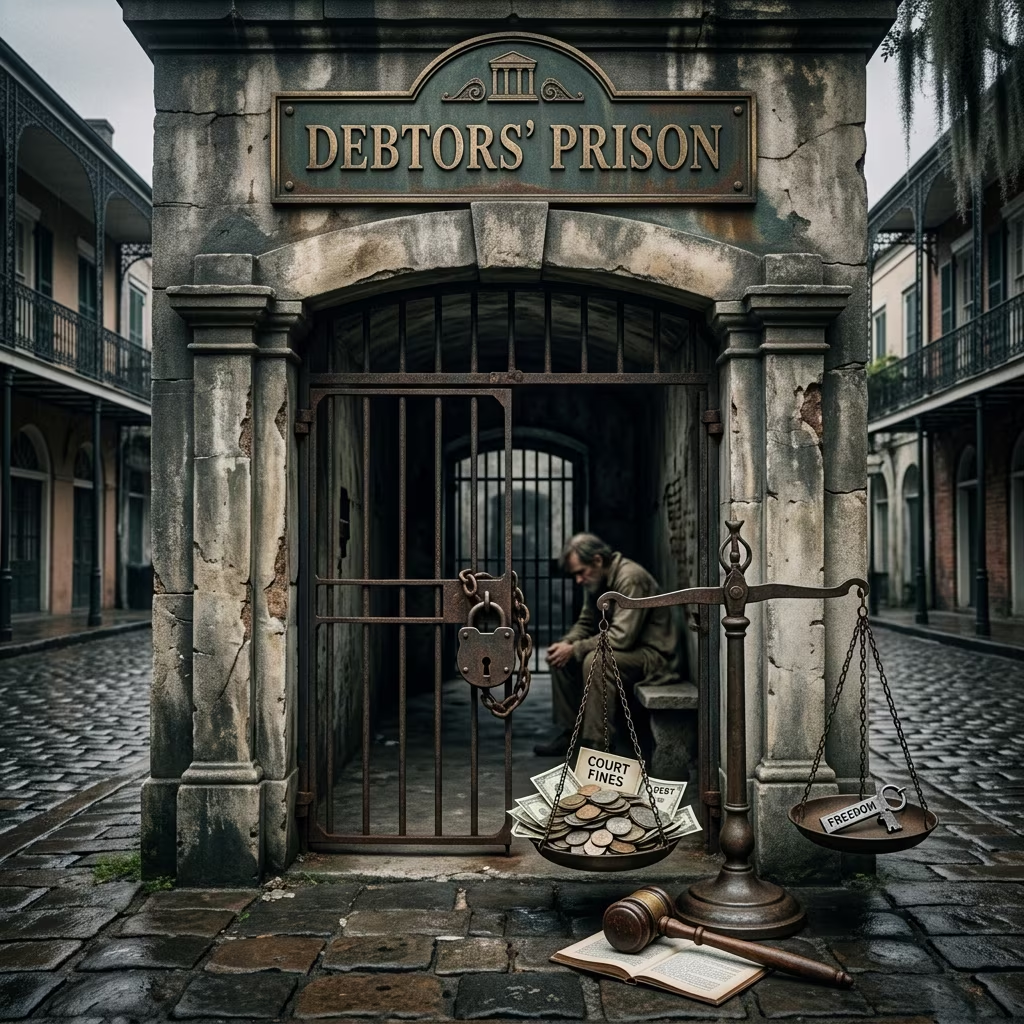
In 2019, the U.S. Court of Appeals for the Fifth Circuit issued a major decision striking down a debtors’ prison scheme in New Orleans, holding that the way local criminal courts funded themselves through fines, fees, and bond charges violated the Constitution’s requirement of a neutral tribunal. This ruling did more than address one city’s practices; it highlighted structural problems in how many courts across the country finance their operations on the backs of people who can least afford it.
This article explains what debtors’ prisons are, why the New Orleans system was found unconstitutional, how the decision fits into longstanding Supreme Court precedent, and what it means for the future of court funding and criminal justice reform.
Understanding Modern Debtors’ Prisons
Historically, a “debtors’ prison” referred to the practice of jailing people simply because they failed to pay private debts. That practice has been formally abolished in the United States for more than a century, and Congress and the Supreme Court have made clear that imprisonment for mere inability to pay is impermissible.
Yet advocates and scholars use the term modern debtors’ prisons to describe situations where people are incarcerated for court-imposed financial obligations they cannot realistically afford. These obligations can include:
- Criminal fines imposed as part of sentencing.
- Fees and surcharges used to help fund courts, jails, or other local agencies.
- Costs of supervision such as probation charges or monitoring fees.
- Bond fees or charges imposed when someone is released pretrial.
In many jurisdictions, failure to keep up with these payments can lead to arrest, jail time, or extended supervision, especially when judges are given broad discretion and few resources exist to distinguish between can’t pay and won’t pay.
How New Orleans’ Court Funding System Worked
The Fifth Circuit case focused on the Orleans Parish Criminal District Court (OPCDC), the criminal court for New Orleans. For years, OPCDC relied heavily on money collected from people moving through the criminal justice system to fund basic court operations.
Key features of the scheme included:
- Judges imposed fines, fees, and court costs on defendants and then controlled part of the resulting revenue.
- A dedicated account, often called a judicial expense fund, received a substantial share of these payments, which judges could use for staff salaries, equipment, and other court needs.
- In a related ruling, the court examined bond fees used to support pretrial services and found similar constitutional problems.
Because the court’s budget depended on how much money defendants paid in these cases, judges’ day-to-day decisions about fines, fees, and enforcement had direct financial consequences for the institution over which they presided.
Constitutional Conflict: Neutral Judge vs. Financial Interest
The Fifth Circuit held that this arrangement created an unconstitutional conflict of interest for the judges. The Constitution’s Due Process Clause requires that criminal cases be heard by a neutral decision-maker—someone who does not have a personal or institutional stake in the outcome.
In New Orleans, however, the judges’ court depended on the very revenue they generated when they imposed and enforced fines and fees. According to the court, this gave judges a powerful temptation to consider the court’s finances when deciding how much to charge and whether to jail defendants for nonpayment.
In practical terms, the court identified three interrelated problems:
- Institutional financial dependence: A “substantial portion” of the court’s budget came from fines and fees levied in criminal cases.
- Judicial control over funds: The same judges who imposed financial obligations controlled significant expenditures from the fund they replenished through those obligations.
- Lack of neutrality: This dual role made it impossible for OPCDC to operate as the neutral tribunal the Constitution demands.
Because of this, the Fifth Circuit affirmed district court rulings that New Orleans’ system violated the Due Process Clause of the Fourteenth Amendment.
Key Supreme Court Precedents on Imprisonment for Debt
The Fifth Circuit’s decision fits into a long line of Supreme Court cases limiting the use of incarceration to enforce financial obligations. These cases collectively stand for the principle that people cannot be jailed solely because they are too poor to pay criminal justice debt.
| Case | Year | Core Holding |
|---|---|---|
| Williams v. Illinois | 1970 | States cannot extend a maximum prison term just because a defendant cannot pay fines or court costs. |
| Tate v. Short | 1971 | Defendants may not be converted from fine-only punishment to imprisonment solely due to indigence. |
| Bearden v. Georgia | 1983 | Courts cannot revoke probation for nonpayment without first determining whether the failure to pay was willful and whether alternatives to imprisonment exist. |
These decisions emphasize that incarceration cannot be the default response when someone fails to pay criminal justice debt. Courts must consider a person’s ability to pay, look for reasonable alternatives, and avoid punishing poverty itself.
Some of the difficulty in implementing these principles arises because the Supreme Court did not fully define key concepts such as “indigence” and “willfulness.” That leaves significant discretion to local judges, which can lead to uneven protection and, in some communities, continuing reliance on jail to enforce payment obligations.
What Made the New Orleans Scheme Different
In many places, the constitutional problem with modern debtors’ prisons is that courts jail people without properly assessing their ability to pay or considering alternatives. New Orleans raised a different, additional issue: the structure of the court’s finances themselves.
The Fifth Circuit did not only say that judges must ask whether people are able to pay. It examined the court’s revenue model and concluded that when judges both:
- Generate revenue by imposing fines and fees, and
- Control how a significant portion of that revenue is spent,
they cannot be considered neutral actors. According to the ruling, this is incompatible with due process even if a judge’s personal salary isn’t directly tied to a specific defendant’s payments.
In a related decision addressing bond fees, the court similarly found that funding essential pretrial services through charges controlled by judges exceeded what due process permits.
Impact on New Orleans and the Fifth Circuit Region
The immediate impact of the decision was on the Orleans Parish Criminal District Court itself. The court could no longer maintain a funding structure that tied its operating budget so closely to fines, fees, and bond charges imposed on defendants.
Advocates emphasize several concrete consequences:
- Policy changes requiring the city and state to find more stable, non-conflicted sources of court funding.
- Heightened scrutiny of how judges use financial obligations and whether courts adequately consider defendants’ ability to pay.
- Ripple effects across other courts in the Fifth Circuit’s jurisdiction (Louisiana, Texas, and Mississippi), which must ensure their practices align with the decision’s due process principles.
Legal commentators have noted that the ruling serves as a warning to any court that relies on criminal justice debt as a major revenue stream: where funding and adjudication are too closely intertwined, constitutional problems are likely to arise.
Debtors’ Prisons in a National Context
Although the New Orleans case was specific to one city and one set of courts, it forms part of a broader national conversation about criminal justice debt and equality before the law. Research and advocacy groups have documented similar patterns in many states, where courts and local governments use fines and fees to make up budget shortfalls.
Common concerns include:
- Regressive impact: Court debt falls disproportionately on people with low incomes and communities of color, deepening existing inequalities.
- Perverse incentives: When agencies depend on fines and fees for revenue, they may be tempted to impose higher charges or more aggressive enforcement.
- Barrier to reentry: Outstanding court debt can hinder employment, housing, and credit, making it harder for people to rebuild their lives after involvement with the justice system.
Scholars have argued that state-level bans on debtors’ prisons and Supreme Court precedent together create a strong constitutional basis for challenging systems that rely heavily on criminal justice debt. The Fifth Circuit’s ruling adds to this body of law by focusing on the structural conflict that arises when judges are both adjudicators and fundraisers.
Reforming Court Fines, Fees, and Funding Models
In the wake of decisions like the New Orleans case, many jurisdictions are reconsidering how they finance courts and related criminal justice functions. Reform proposals often center on separating adjudication from revenue generation.
Key strategies include:
- General budget funding: Relying primarily on city or state general funds, rather than fines and fees, to support court operations.
- Ability-to-pay assessments: Requiring courts to conduct transparent, standardized evaluations of a person’s financial circumstances before imposing or enforcing monetary sanctions.
- Alternative sanctions: Using community service, treatment programs, or other non-monetary penalties when fines would cause undue hardship.
- Fee abolition or reduction: Eliminating certain fees (for example, costs of public defender services or probation supervision) that make access to justice contingent on ability to pay.
These reforms seek to ensure that punishment is based on the seriousness of the offense and public safety considerations, not on a person’s wealth or a court’s budgetary needs.
Frequently Asked Questions (FAQs)
1. Does the New Orleans ruling mean debtors’ prisons are now illegal everywhere?
The practice of jailing people solely because they cannot pay debt has long been unconstitutional under Supreme Court precedent. The New Orleans ruling did not create that rule; instead, it applied and extended due process principles to a specific court funding structure, emphasizing that judges cannot have a financial stake in the revenue they generate.
2. What exactly was unconstitutional about the New Orleans system?
The Fifth Circuit found that Orleans Parish Criminal District Court judges had an institutional financial interest in imposing and collecting fines, fees, and bond charges, because those payments directly supported a fund they controlled and used for court operations. This arrangement created an unconstitutional conflict of interest and violated the requirement of a neutral decision-maker under the Fourteenth Amendment’s Due Process Clause.
3. Can courts ever use fines and fees to fund their operations?
The ruling does not ban all fines and fees. Instead, it limits systems where judges both impose monetary obligations and directly benefit from the resulting revenue. Courts may still impose lawful fines as punishment, but funding structures must avoid placing the judge in the position of both adjudicator and financial beneficiary.
4. How does this affect low-income defendants in practice?
Decisions like the New Orleans case, along with Supreme Court precedent, strengthen the legal basis for challenging incarceration and harsh penalties imposed purely because someone cannot afford to pay. Over time, they can encourage courts to use more meaningful ability-to-pay assessments and to rely less on revenue-generating sanctions that disproportionately burden low-income people.
5. Is this only about New Orleans, or does it apply to other states?
The Fifth Circuit’s decisions are binding on federal courts in Louisiana, Texas, and Mississippi, and they carry persuasive weight elsewhere. Any court system that relies heavily on criminal justice debt and allows judges to control the resulting funds may need to reevaluate its practices to avoid similar constitutional problems.
References
- Federal Court Declares New Orleans Debtor’s Prison Unconstitutional — Forbes (Nick Sibilla). 2019-08-30. https://www.forbes.com/sites/nicksibilla/2019/08/30/federal-court-declares-new-orleans-debtors-prison-unconstitutional/
- Fifth Circuit Rules New Orleans Debtors’ Prison Scheme Violates Constitutional Rights of the City’s Poorest Citizens — Lawyers’ Committee for Civil Rights Under Law. 2019-08-27. https://www.lawyerscommittee.org/fifth-circuit-rules-new-orleans-debtors-prison-scheme-violates-constitutional-rights-of-the-citys-poorest-citizens/
- Orrick Pro Bono Effort Helps Secure Ruling Finding Louisiana Debtors’ Prison Unconstitutional — Orrick. 2019-08-23. https://www.orrick.com/en/News/2019/08/Orrick-Pro-Bono-Effort-Helps-Secure-Ruling-Finding-Louisiana-Debtors-Prison-Unconstitutional
- Debtors’ Prisons, Then and Now: FAQ — U.S. Department of Justice, U.S. Attorney’s Office (Southern District of Alabama). 2016-06-30. https://www.justice.gov/usao-sdal/page/file/918356/dl
- State Bans on Debtors’ Prisons and Criminal Justice Debt — Harvard Law Review (Vol. 129). 2015-01-01. https://harvardlawreview.org/print/vol-129/state-bans-on-debtors-prisons-and-criminal-justice-debt/