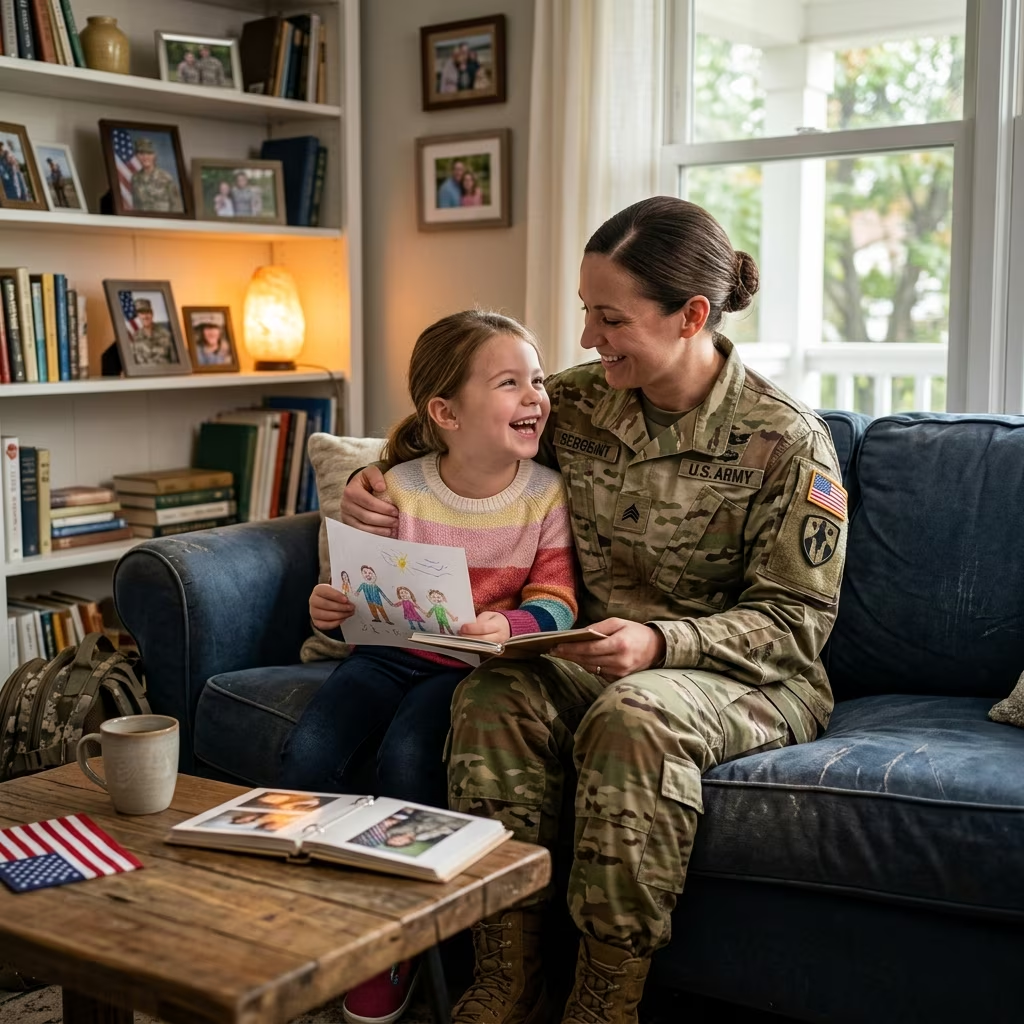
Military parents face unique challenges in maintaining regular contact with their children. Training cycles, temporary duty assignments, and overseas deployments can disrupt a carefully planned parenting schedule. At the same time, states and the federal government have developed safeguards to protect the parent–child relationship and to ensure that military service alone does not cost a parent custody or visitation.[10]
This guide explains how military duties interact with child visitation laws, what protections exist for service members and their children, and how both parents can create practical, child-centered plans before, during, and after deployment.
Core Principles: How Courts View Military Parents
Across the United States, most custody and visitation laws revolve around the best interests of the child. Military status is just one factor a judge may consider, and it cannot be the single reason to strip a parent of custody or meaningful parenting time.[10]
- Equal rights in principle: A military parent generally has the same fundamental custody and visitation rights as a civilian parent.
- Service is not a punishment: Laws in many states explicitly say that a parent’s military deployment, standing alone, cannot justify permanently changing custody or denying visitation.[10]
- Temporary vs. permanent changes: When deployment requires adjustments to a schedule, courts typically treat those changes as temporary, with a presumption that the original order will be restored when the service member returns, unless there is clear evidence that this would not be in the child’s best interests.
These principles are reflected in statutes and model laws such as the Uniform Deployed Parents Custody and Visitation Act (UDPCVA), which provides a standard framework for courts handling deployment-related custody and visitation issues.[10]
Deployment and Parenting Time: What Usually Happens
Deployment rarely occurs in a legal vacuum. In most families there is already a custody order or parenting plan in place before deployment. When orders arrive, parents and courts must decide how to adapt that plan while preserving the child’s stability and important relationships.[10]
Temporary Orders During Deployment
Many states allow courts to issue temporary orders that modify custody or visitation for the length of the deployment only.[10]
- The court can temporarily shift physical custody to the non-deploying parent if necessary for the child’s daily care.
- Visitation or contact between the child and the deploying parent is preserved through leave, electronic communication, and, in some cases, visitation delegated to relatives.
- Under the UDPCVA and state laws modeled on it, these temporary changes normally expire shortly after the service member returns, and the prior order resumes unless the court finds that reversion would harm the child.[10]
Courts increasingly expect parents to use technology (video calls, messaging, email) to maintain frequent and meaningful contact while a parent is away.
Post-Deployment: Returning to the Original Order
When deployment ends, the legal focus typically shifts back to restoring the pre-deployment parenting arrangement as quickly and safely as possible.
- Temporary orders linked to deployment usually contain a built-in expiration date, after which the prior order automatically resumes unless the court decides otherwise.
- Some states require courts to give the returning parent immediate, reasonable contact consistent with post-deployment leave and reintegration.
- In certain jurisdictions, noncustodial military parents may request “make-up visitation” to compensate for parenting time they missed solely because of deployment, if filed within a set timeframe.
The guiding question remains the same: does the proposed schedule support the child’s safety, emotional well-being, and ongoing relationship with both parents?
Legal Protections for Military Parents
Several layers of legal protection work together to support military families in custody and visitation matters.
The Servicemembers Civil Relief Act (SCRA)
The Servicemembers Civil Relief Act is a federal law that helps active duty service members handle civil legal matters, including custody disputes, without being unfairly disadvantaged by their duties.
- Civil courts must consider delaying proceedings if military service materially affects a parent’s ability to appear and defend a case.
- In many situations, judges can grant a stay (delay) of at least 90 days when a parent’s deployment or duties prevent participation.
- This protection gives the service member time to obtain legal counsel, gather evidence, and, where possible, appear in person or through secure remote means.
Uniform Deployed Parents Custody and Visitation Act (UDPCVA)
The UDPCVA is a model state law designed to create consistent rules for cases involving deployed parents. Many states have adopted some or all of its provisions.[10]
| UDPCVA Concept | Practical Effect on Military Child Visitation |
|---|---|
| Deployment cannot be the sole basis for a custody decision | Courts may consider the realities of deployment, but they cannot deny custody or visitation just because a parent is or may be deployed.[10] |
| Interim custodial responsibility | Parents and courts may create temporary parenting arrangements that last only during deployment and end shortly after return. |
| Delegation of visitation | A deployed parent can sometimes authorize a relative with a strong, existing bond (such as a grandparent or stepparent) to exercise some visitation in their absence. |
| Preservation of jurisdiction | Deployment does not change the child’s “home state” for jurisdictional purposes, helping prevent forum-shopping or conflicting orders.[10] |
State-Specific Military Parent Laws
Individual states supplement federal law and the UDPCVA with their own statutes. Although details vary, common features include:[10]
- Prohibiting permanent custody changes based solely on a parent’s military service, relocation, or inability to exercise visitation because of orders.
- Authorizing courts to grant visitation rights to a deploying parent’s family member when this benefits the child and reflects a preexisting relationship.
- Requiring the non-deploying parent to reasonably facilitate communication between the child and the deployed parent, including phone calls and video chats, when safe and appropriate.
Because of these differences, military families are strongly encouraged to seek legal advice in the state where the child lives and where the custody order was issued.[10]
Designing a Child-Centered Parenting Plan Around Military Service
Even with legal protections in place, a thoughtful parenting plan is essential. The more specific the plan is about what happens before, during, and after deployment, the less uncertainty and conflict the child will face.
Key Issues to Address in a Parenting Plan
- Primary residence during deployment: Where will the child live if the custodial or noncustodial parent is deployed for several months?
- Regular communication schedule: How often will the child talk to the deployed parent by video, phone, or messaging? Who will initiate and supervise these contacts?
- Leave and in-person visitation: How will visits be arranged when the service member comes home on leave? Who pays for travel and where will exchanges occur?
- Delegated visitation: Should a trusted grandparent, stepparent, or other relative have stand-in visitation rights while the parent is deployed, and under what limits?
- Information sharing: How will parents share school updates, medical information, and address or contact changes while one parent is away?
These provisions can be incorporated into formal court orders or written agreements approved by the court. Once in place, they give both parents a clear roadmap for handling future deployments or duty-related moves.
Using Technology to Maintain Connection
Modern communication tools allow a deployed parent to remain an active presence in a child’s life even when thousands of miles away.
- Video chats during regular weekly time blocks.
- Recorded videos or voice messages for the child to play at bedtime or before school.
- Shared digital photo albums or journals documenting daily life.
- Secure messaging apps for older children to contact the deployed parent directly when appropriate and safe.
In some jurisdictions, courts may specifically order “virtual visitation” as part of the parenting plan to ensure ongoing contact during deployment.
Relocation, PCS Moves, and Jurisdiction
Military service often involves relocations, whether permanent change of station (PCS) moves within the United States or overseas assignments. These moves raise complex questions about which state’s court has authority over custody and visitation.
Under the Uniform Child Custody Jurisdiction and Enforcement Act (UCCJEA), most states treat the child’s “home state” as the one where the child has lived with a parent for at least six consecutive months before the case is filed. The UDPCVA reinforces that deployment alone does not change this home-state status.[10]
- The child’s home state generally retains jurisdiction even when a parent deploys or moves for military reasons.[10]
- Temporary changes to the parenting schedule during deployment do not typically transfer long-term custody authority to another state.
- Parents should be cautious about filing new cases in a different state without legal advice, as competing orders can cause serious enforcement problems.
Service members who expect future relocations should discuss jurisdiction issues with a legal assistance attorney or civilian family law attorney early in the process.[10]
Protecting Children in High-Conflict or Unsafe Situations
Although laws aim to protect military parents’ rights, child safety remains the top priority. Where there is domestic violence, abuse, or serious neglect, courts may limit or supervise visitation regardless of a parent’s military status.
- If the deployed or non-deployed parent has a history of violence, courts may order supervised visits, restricted communication, or specific safeguards in the parenting plan.
- Some states allow address confidentiality for survivors of domestic violence so that a deployed parent can receive information about the child without knowing the exact location of the other parent.
- Installation family advocacy programs and legal assistance offices can help service members navigate overlapping military and civilian protective order systems.
In these scenarios, specialized legal and counseling support is essential for crafting safe visitation arrangements that still preserve healthy parent–child bonds where appropriate.
Practical Tips for Military Parents and Co‑Parents
Managing child visitation around unpredictable military schedules requires planning, flexibility, and good communication. The following practices can help:
- Plan early: As soon as you receive deployment or PCS orders, review your custody order and talk to the other parent about necessary adjustments.
- Use legal assistance resources: Each branch of the armed forces offers legal assistance offices that can help service members understand local laws and prepare documents related to custody and visitation.
- Document your efforts: Keep records of attempted calls, messages, and requests to see or speak with your child. Documentation can be important if future disputes arise.
- Be child-focused: When negotiating or asking the court for changes, explain how your proposal supports the child’s routine, education, relationships, and emotional needs rather than focusing solely on parental rights.
- Consider mediation: Many states encourage or require mediation in custody disputes. Mediation can produce practical, customized visitation solutions that a court might not otherwise order.
Frequently Asked Questions About Military Child Visitation
Can I lose custody or visitation just because I am deployed?
In most states, no. Laws influenced by the UDPCVA and related statutes prevent courts from using deployment alone as the reason to permanently modify custody or deny visitation. Judges must base decisions on the child’s best interests, considering all circumstances.[10]
What happens to my parenting time while I am deployed?
Courts can issue temporary orders that adjust physical custody and visitation during your deployment while preserving your underlying parental rights. These orders typically expire shortly after you return, and the original parenting plan resumes unless the court finds that would be harmful to the child.
Can my child spend my visitation time with a grandparent or stepparent when I am deployed?
In some states, yes. Laws modeled on the UDPCVA or similar statutes allow a deploying parent to request that a close family member with a substantial relationship to the child exercise some visitation on the parent’s behalf. The court must still find that this arrangement is in the child’s best interests.
Do I have a right to video calls with my child while away on duty?
Courts increasingly recognize the importance of virtual visitation. Many orders now require both parents to facilitate reasonable electronic communication between the child and the deployed parent, so long as it is safe and appropriate for the child. You may need to specifically request this in your court filings.
Which court handles custody if my child moves to another state while I am deployed?
Under the UCCJEA and related laws, the child’s original home state usually retains jurisdiction over custody cases, even if the child temporarily lives elsewhere due to deployment-related changes. The UDPCVA reinforces that deployment does not by itself change the home state.[10] However, jurisdiction questions can be complex, so legal advice is critical.
Where can I get help as a military parent dealing with custody and visitation?
Military parents can contact their installation’s legal assistance office or use official resources such as Military OneSource to locate family law help. These services can explain both military-specific protections and the civilian laws in your state.
References
- Military Parent Custody and Visitation — National Conference of State Legislatures. 2022-08-10. https://www.ncsl.org/military-and-veterans-affairs/military-parent-custody-and-visitation
- Child Custody Considerations for Military Families — Military OneSource (Department of Defense). 2023-03-15. https://www.militaryonesource.mil/relationships/separation-divorce/child-custody-considerations-for-military-families/
- Uniform Deployed Parents Custody and Visitation Act — Military Divorce Guide. 2020-05-01. https://www.military-divorce-guide.com/parenting/uniform-deployed-parents-custody-visitation-act
- Child Custody When One Parent is in the Military or Overseas — Minella Law Group. 2022-06-20. https://minellalawgroup.com/blog/child-custody-when-one-parent-is-in-the-military-or-overseas/
- How Does a Parent’s Military Deployment Affect Custody/Visitation? — WomensLaw.org (NNEDV). 2021-11-05. https://www.womenslaw.org/laws/ak/custody/military-deployment-and-custodyvisitation/how-does-parents-military-deployment
- Military Deployment and Child Custody — TexasLawHelp.org. 2023-01-30. https://texaslawhelp.org/article/military-deployment-and-child-custody
- Chapter 6.2. Virginia Military Parents Equal Protection Act — Code of Virginia (State of Virginia). 2023-07-01. https://law.lis.virginia.gov/vacodefull/title20/chapter6.2/