
Master Tenant and Subtenant Rights Explained
Understand how master tenants and subtenants share legal duties, rent risks, and eviction rules in modern rental arrangements.
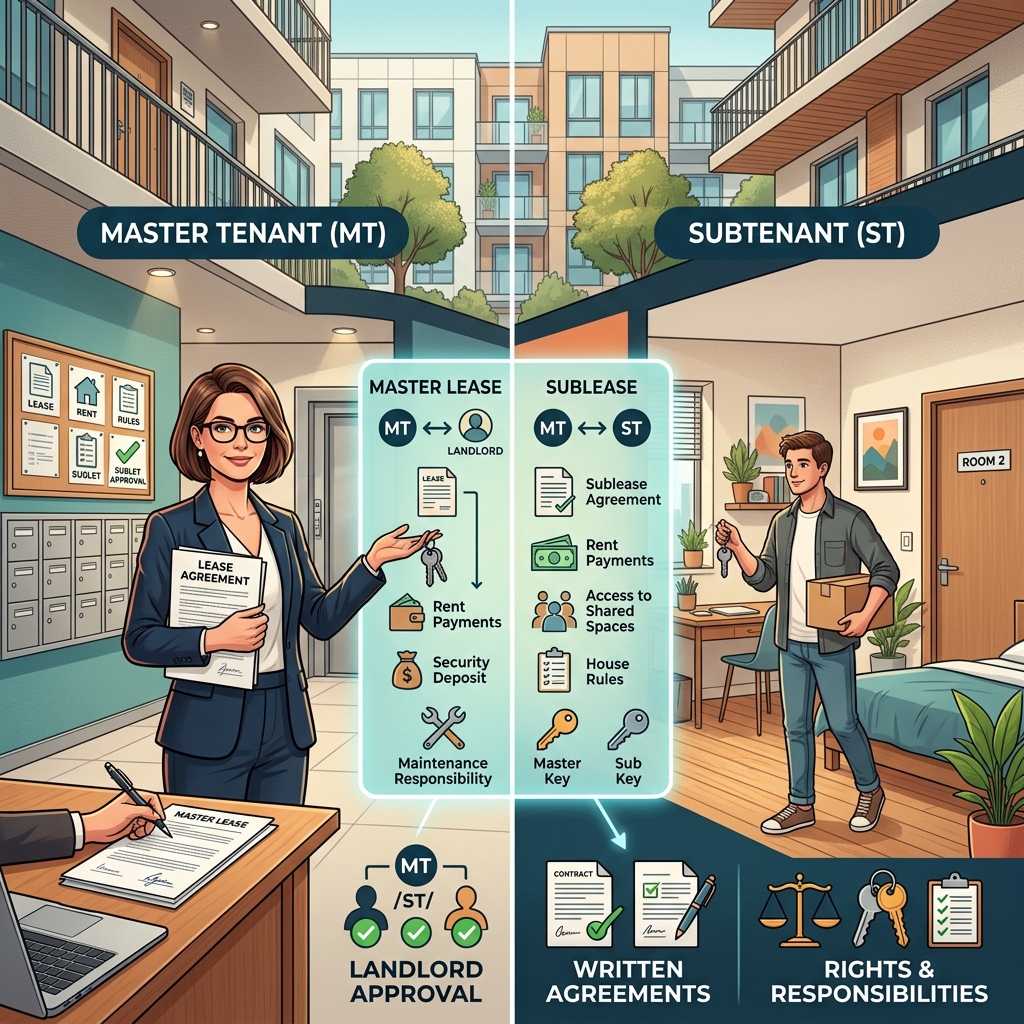
Renting with roommates or subletting your place can make housing more affordable, but it also creates a complex web of legal relationships. Understanding how a master tenant (also called primary tenant) and a subtenant relate to each other and to the landlord is essential for avoiding disputes, unexpected costs, and even eviction.
1. What Is a Master Tenant and What Is a Subtenant?
In most rental situations, the person whose name appears on the lease and who deals directly with the landlord is the master tenant. When that person rents part or all of the premises to someone else, that new occupant becomes a subtenant and the arrangement is usually documented in a sublease agreement.
| Role | Contract With Landlord? | Pays Rent To | Main Legal Status |
|---|---|---|---|
| Master tenant (primary tenant) | Yes, named on the main lease | Landlord directly | Full tenant with all rights and duties under the lease |
| Subtenant | No direct lease with landlord (usually) | Master tenant (unless landlord agrees otherwise) | Tenant of the master tenant under a sublease |
| Co-tenant | Yes, all roommates sign same lease | Landlord (each is liable for full rent) | Equal tenant; not a subtenant arrangement |
Key distinctions:
- Master tenants remain fully responsible for the lease, even if they move out and sublet the unit.
- Subtenants typically have no contract with the landlord; their rights come from the sublease and local landlord-tenant laws.
- Co-tenants share equal rights and obligations because they all sign the same lease with the landlord.
2. Legal Relationships: Who Owes What to Whom?
A sublease creates layered legal duties. The landlord, master tenant, and subtenant all have obligations, but not always directly to one another. In most cases, the master lease (between landlord and master tenant) controls what is allowed, and the sublease cannot give the subtenant more rights than the master tenant has.
2.1 Landlord and Master Tenant
The landlord’s contract is with the master tenant. Even if the master tenant finds subtenants, the landlord usually:
- Looks to the master tenant for full rent payment every month.
- Holds the master tenant responsible for damage or lease violations.
- Can choose whether or not to accept direct contact from subtenants (for repairs, notices, etc.).
2.2 Master Tenant and Subtenant
When a master tenant sublets, they essentially become a landlord to the subtenant. The sublease should clearly state:
- The exact rent amount and due date for the subtenant.
- Which utilities and services are included or separate.
- Rules for use of common areas, guests, noise, and cleanliness.
- How security deposits are handled and when they may be returned.
Because the master tenant cannot give what they do not have, a subtenant:
- Cannot gain more rights than the master tenant enjoys under the lease.
- Must follow the same basic property rules (for example, no pets if the main lease prohibits them).
2.3 Co-Tenants: A Different Structure
A co-tenant arrangement exists when all roommates sign the lease directly with the landlord. In that case:
- Each co-tenant has equal rights to occupy the unit.
- Each is usually jointly and severally liable, meaning the landlord can collect the full rent from any one of them.
- No roommate acts as a landlord to another; there is no master tenant.
3. Rent, Deposits, and Money Matters
Financial responsibility is often the biggest source of conflict in sublease situations. Official tenant guides emphasize that both tenants and subtenants must pay rent on time and may be liable for damage, but the master tenant remains the primary point of contact for the landlord.
3.1 How Rent Flows in a Sublease
In a typical sublease:
- The landlord charges total rent to the master tenant under the main lease.
- The master tenant collects the subtenant’s share according to the sublease.
- If the subtenant fails to pay, the master tenant is still obligated to pay the landlord in full.
Best practices for setting rent in a sublease include:
- Clearly defining whether the subtenant pays a fixed amount or a percentage of total rent.
- Ensuring the sublease does not contradict rent limits or controls found in the main lease or local law.
- Documenting any rent increases in writing, often via a rent increase notice or updated sublease.
3.2 Security Deposits and Damage
State-level tenant guides explain that whoever holds the security deposit has specific duties about how it is used and returned. In a sublease, there are usually two possible arrangements:
- The landlord holds a deposit from the master tenant only; the master tenant then collects a separate deposit from the subtenant.
- The landlord agrees to hold a deposit for the subtenant directly (less common without a formal consent).
Important points regarding deposits:
- Subtenants may be charged for damage they cause and may forfeit some or all of their deposit.
- Master tenants remain liable to the landlord for any damage, even if a subtenant caused it.
- The timeline and procedure for returning deposits are normally governed by state law (for example, written itemization and specific deadlines).
4. Rights and Responsibilities of the Master Tenant
Because the master tenant is the only tenant directly bound by the main lease, they carry significant legal and practical responsibilities.
4.1 Core Legal Obligations
- Pay full rent to the landlord even if subtenants do not pay their share.
- Maintain the unit in line with lease terms and housing codes (cleanliness, safety, and non-damage).
- Communicate with the landlord about major issues, such as serious repairs or legal notices.
- Respect occupancy limits and any lease restrictions on subletting or additional roommates.
4.2 Acting as Landlord to the Subtenant
Official tenant guidance notes that when a master tenant rents to a subtenant, they take on many duties similar to a landlord. This may include:
- Providing a copy of relevant lease rules so the subtenant understands what is allowed.
- Responding to reasonable requests for repairs in the subleased space.
- Respecting the subtenant’s privacy and following local rules about entry, notice, and inspections.
- Using proper legal procedures if they need to end the sublease or evict the subtenant.
4.3 Risk of Holdover and Illegal Subletting
If the master tenant sublets without required landlord consent or allows a subtenant to stay beyond the lease term, they may become a holdover tenant and be liable for rent and other damages.
- Check the main lease for any clause that prohibits or limits subletting.
- Seek written approval from the landlord before finalizing a sublease whenever required by the lease or local law.
- Ensure the subtenant moves out or signs a new agreement before the master lease expires.
5. Rights and Responsibilities of the Subtenant
Subtenants are tenants, but their primary relationship is with the master tenant rather than the landlord. Their rights stem from the sublease, local housing laws, and, indirectly, the master lease.
5.1 Basic Legal Rights
In many jurisdictions, subtenants have rights similar to other tenants, including:
- The right to a rental unit that meets basic health and safety codes.
- Protection against certain forms of unlawful discrimination under fair housing laws.
- Procedural rights if the master tenant seeks to evict them, such as notice and an opportunity to respond.
- Access to the premises and common areas as allowed under the sublease.
5.2 Financial and Behavioral Duties
Subtenants are generally expected to:
- Pay rent on time to the master tenant, as defined in the sublease.
- Follow all house rules and restrictions that arise from both the sublease and the main lease.
- Avoid causing damage or nuisance that could violate housing codes or lease provisions.
- Notify the master tenant promptly about serious maintenance or safety issues.
If a subtenant fails to pay rent or violates the sublease, the master tenant may pursue legal remedies, including eviction procedures consistent with local law.
6. Eviction and Ending the Arrangement
Eviction becomes more complicated in sublease scenarios because there may be two separate legal relationships: landlord vs. master tenant, and master tenant vs. subtenant.
6.1 Landlord Evicting Master Tenant (and Possibly Subtenant)
If the master tenant violates the lease or fails to pay rent, the landlord may start an eviction action against the master tenant. Because the master tenant’s rights control the subtenant’s occupancy, an eviction of the master tenant usually ends the subtenant’s right to stay as well.
- The landlord generally does not need to name the subtenant separately in the eviction to remove them, unless local law requires it.
- The subtenant’s rights in that situation are limited because their occupancy depends on the master tenant’s lease.
6.2 Master Tenant Evicting Subtenant
In rent-controlled or similar settings, official guidance often treats the master tenant as a landlord to the subtenant, meaning eviction requires just cause and following proper procedures.
Common lawful reasons may include:
- Non-payment of rent.
- Serious or repeated violation of important sublease terms.
- Creating a nuisance or significant disturbance for others.
Eviction procedures typically require:
- Formal written notice that clearly states the reason and any deadline to cure the problem.
- Filing in court if the subtenant does not leave voluntarily, following local landlord-tenant rules.
- Never using “self-help” tactics such as changing locks or removing belongings without a court order.
7. Practical Tips for Avoiding Conflict
Legal rights are only part of the picture. Communication and careful planning are crucial to making master tenant–subtenant arrangements work smoothly.
7.1 Before You Sublet
- Review the main lease for any subletting restrictions or occupancy limits.
- Obtain written consent from the landlord if required.
- Screen potential subtenants carefully to assess reliability and compatibility.
- Use a written sublease that covers rent, deposits, duration, house rules, and exit procedures.
7.2 While Living Together
- Hold periodic check-ins to discuss shared expenses, cleaning, and any concerns.
- Keep written records of rent payments, repair requests, and important communications.
- Respect each other’s privacy and quiet hours to avoid disputes.
7.3 When Someone Wants to Move Out
- Consult the sublease and main lease to see what notice is required.
- Agree in writing on final payment, cleaning responsibilities, and deposit reconciliation.
- Coordinate timing so that the master tenant is not exposed to unpaid rent or unauthorized occupancy.
8. Frequently Asked Questions (FAQs)
FAQ 1: Can a subtenant pay rent directly to the landlord?
Sometimes. Unless the landlord expressly agrees, the master tenant is the only person obligated to pay rent to the landlord. In some cases, the landlord consents to a sublease and allows the subtenant to pay rent directly, but that should be clearly documented to avoid confusion.
FAQ 2: Is a subtenant protected if the master tenant is evicted?
Usually not. Because the subtenant’s rights depend on the master tenant’s lease, eviction of the master tenant typically ends the subtenant’s right to occupy the property. Local law may offer limited protections, but a subtenant often must move once the master tenant’s lease is terminated.
FAQ 3: Can a roommate evict another roommate?
Only in specific situations. If everyone is a co-tenant on the same lease, one roommate generally cannot evict another; only the landlord can start eviction. However, if one roommate is the master tenant and the other is a subtenant, the master tenant may evict the subtenant using lawful just-cause and proper procedures.
FAQ 4: Does a subtenant have the same rights as a tenant?
Subtenants have many of the same basic housing rights, such as to a safe and habitable unit, but they cannot have more rights than the master tenant has under the lease. Their specific rights and remedies depend on the sublease terms and local landlord-tenant law.
FAQ 5: What should be in a sublease agreement?
A well-drafted sublease should cover rent and utilities, deposits, duration, house rules, maintenance responsibilities, and how the agreement can be ended or renewed. It should also reference key terms of the main lease so the subtenant knows what broader rules apply.
References
- Primary Tenant & Subtenant Rights & Responsibilities — Rocket Lawyer. 2023-05-10. https://www.rocketlawyer.com/real-estate/tenants/move-or-find-roommates/legal-guide/master-tenant-and-subtenant-rights-and-responsibilities
- Co-Tenants’ Legal Rights & Obligations on a Lease — Justia. 2021-09-01. https://www.justia.com/real-estate/landlord-tenant/information-for-tenants/roommates-and-guests/
- Subleasing — Otsego County, Michigan. 2020-01-15. https://www.otsegocountymi.gov/328/Subleasing
- A Practical Guide for Tenants and Landlords — Michigan Legislature. 2019-06-01. https://www.legislature.mi.gov/publications/tenantlandlord.pdf
- Subletting Laws and Regulations in Michigan — Steadily. 2026-02-10. https://www.steadily.com/blog/subleasing-laws-regulations-michigan
- Roommates 101 — Bornstein Law. 2022-03-20. https://bornstein.law/roommates-101/
- Tenant vs. Subtenant: Legal Differences — Nolo. 2020-08-12. https://www.nolo.com/landlord-tenant/difference-between-tenant-and-subtenant.html
Similar Articles








Read full bio of Sneha Tete


