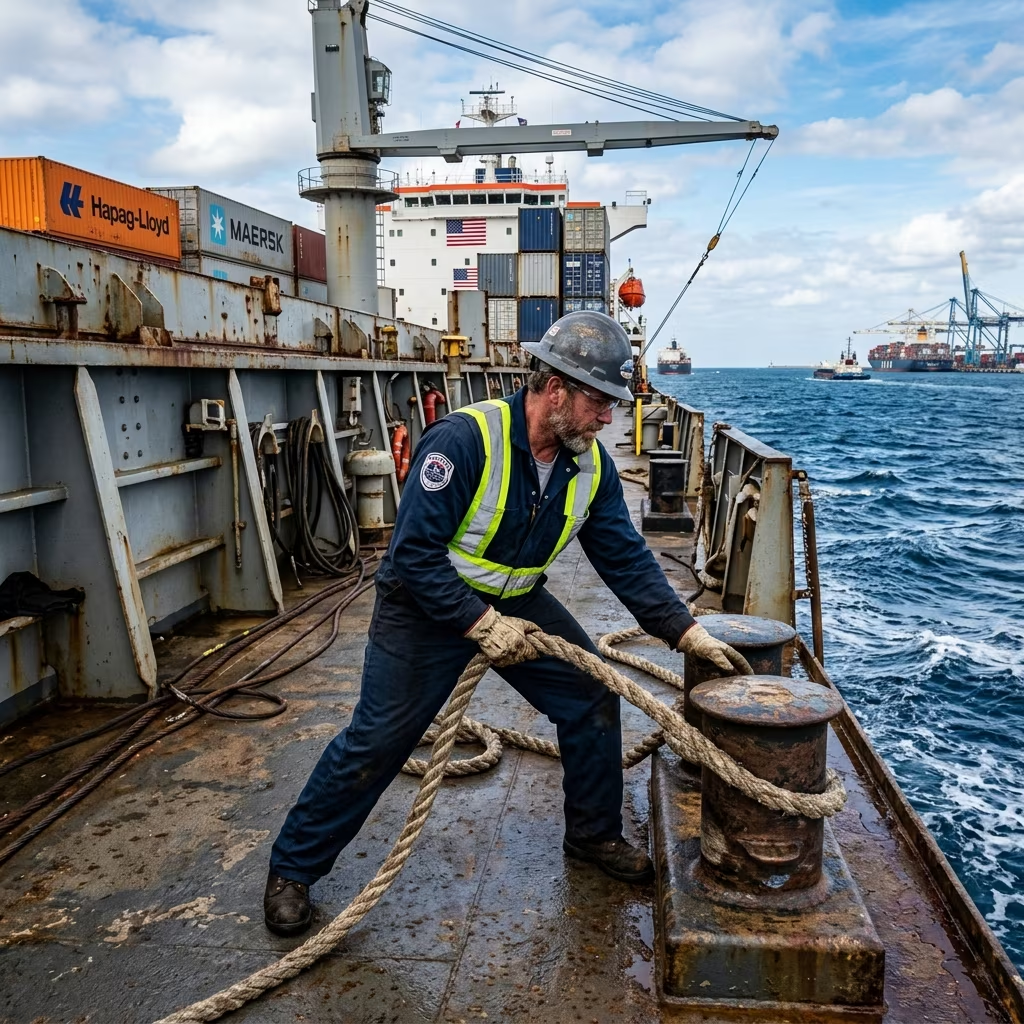
The Jones Act, formally part of the Merchant Marine Act of 1920, is a cornerstone of United States maritime law that gives injured seamen powerful rights to seek compensation when their employer’s negligence contributes to an on-the-job injury. Unlike typical land-based workers’ compensation systems, it allows maritime workers to file a lawsuit directly against their employer and pursue full damages for their losses.
1. What the Jones Act Is and Why It Matters
The Jones Act serves two broad purposes:
- Regulates U.S. maritime commerce and cabotage (trade between U.S. ports).
- Protects seamen injured in the course of employment by extending to them rights similar to those granted to railroad workers under the Federal Employers’ Liability Act (FELA).
For injured maritime workers, the critical part of the Jones Act is its worker protection function rather than its shipping and trade rules. It creates a legal pathway for seamen to recover damages if their employer’s negligence played any role in causing an injury, even a very small one.
Key Features at a Glance
- Applies to “seamen” employed on a vessel in navigation on navigable waters.
- Requires proof of negligence by the employer, co-worker, or agent, but the burden is lighter than in many other negligence claims.
- Permits recovery of a wide range of damages, including lost wages, medical costs, pain and suffering, and more.
- Works alongside other maritime doctrines, such as maintenance and cure and unseaworthiness claims.
2. Who Qualifies as a “Seaman” Under the Jones Act?
The Jones Act does not protect all maritime or port workers. It is limited to individuals who qualify as seamen under federal law. Courts have developed tests to determine who falls into this category.
Core Eligibility Requirements
While each case is fact-specific, an injured worker generally must meet three main criteria:
- Maritime employment: The worker performs duties related to the operation or mission of a vessel or fleet.
- Connection to a vessel in navigation: There must be an employment-related relationship with a vessel that is afloat, operational, and on navigable waters, or with a fleet under common ownership or control.
- Substantial time on the vessel: As a widely accepted guideline, the worker spends at least 30% or more of their working time in service of the vessel or fleet.
Examples of Workers Often Covered
Individuals who may qualify as seamen if they meet the time and connection tests include:
- Deckhands, engineers, and captains
- Offshore platform workers serving on movable drilling rigs or support vessels
- Crew members on barges, tugboats, ferries, and cargo ships
- Some fishing crew and offshore construction personnel
Workers Typically Not Covered
The following workers often do not qualify as Jones Act seamen and may fall under other laws such as the Longshore and Harbor Workers’ Compensation Act (LHWCA):
- Longshore workers and harbor workers loading or unloading vessels from the dock
- Shipyard and vessel construction workers
- Port terminal employees who rarely go to sea
- Office staff and purely land-based support personnel
| Category | Likely Jones Act Seaman? | Key Consideration |
|---|---|---|
| Crew member who spends 70% of time offshore on a tug | Yes, usually | Substantial time and duties tied to vessel’s mission |
| Harbor crane operator on shore | No, usually | Land-based; not assigned to vessel in navigation |
| Shipyard welder building new ships | No | Vessels under construction are not “in navigation” |
| Offshore worker splitting time between platform and supply vessel | Maybe | Must assess total time and connection to vessel(s) |
3. What Counts as a “Vessel in Navigation”?
To claim protection under the Jones Act, your injury must be tied to a vessel in navigation. This concept is broader than just moving ships at sea.
General Characteristics
- The structure is afloat and capable of moving on water.
- It is operational or ready for its mission, not out of service or undergoing major reconstruction.
- It is located on navigable waters, such as oceans, rivers, or other waterways used for interstate or foreign commerce.
A vessel can sometimes be considered “in navigation” even when temporarily tied to a dock, as long as it remains capable of maritime transport and work. By contrast, a ship under construction or permanently moored as a stationary facility may not qualify.
4. Negligence and Fault Under the Jones Act
Unlike no-fault workers’ compensation systems, the Jones Act requires an injured seaman to show that negligence by the employer, a co-worker, or an agent contributed to the injury.
What Is Employer Negligence?
Negligence generally means a failure to use reasonable care under the circumstances. In the maritime context, examples can include:
- Failing to provide safe, non-skid walking surfaces
- Ignoring known hazards such as defective equipment or unguarded machinery
- Understaffing or inadequate supervision of dangerous tasks
- Not giving proper safety training or enforcing safety rules
- Requiring crew to work excessive hours leading to fatigue-related accidents
A key advantage for seamen is that the causation standard is relatively lenient. Courts have held that the worker may succeed if the employer’s negligence played even a small part in producing the injury, sometimes described as “featherweight” causation.
Role of Comparative Fault
If the injured seaman was also careless, their own negligence does not bar recovery, but it can reduce the damages proportionally. This is similar to comparative negligence principles used in other personal injury cases.
5. Maintenance and Cure: No-Fault Medical and Living Support
Separate from negligence-based damages, maritime law provides seamen with traditional rights to maintenance and cure when they are injured or become ill in the service of a vessel.
Maintenance
Maintenance refers to a daily allowance to cover basic living expenses while the seaman is unable to work and not receiving lodging and food from the vessel. It typically covers costs such as:
- Reasonable rent or housing
- Basic utilities
- Groceries and essential household needs
Cure
Cure is the obligation to pay for all reasonable and necessary medical treatment related to the injury or illness until the seaman reaches maximum medical improvement — the point where no further significant recovery is expected.
Key Characteristics of Maintenance and Cure
- Available regardless of fault — no need to prove negligence.
- Covers medical care and basic living expenses until maximum medical improvement.
- Failure of an employer to pay may expose the company to additional damages, including potentially punitive damages in serious cases, depending on the facts.
6. Types of Compensation in a Jones Act Lawsuit
In addition to maintenance and cure, a successful Jones Act negligence claim allows an injured seaman to seek broader categories of damages than are typical in workers’ compensation systems.
Common Damage Categories
- Medical expenses: Past and future treatment, surgery, rehabilitation, prescriptions, and related costs.
- Lost wages: Income lost during recovery and, where applicable, overtime and benefits.
- Loss of future earning capacity: Reduced ability to work or earn at the same level due to long-term impairments.
- Pain and suffering: Physical pain, discomfort, and loss of enjoyment of life.
- Emotional and psychological harm: Anxiety, depression, trauma, or other mental health impacts.
- Disfigurement or disability: Compensation for permanent scarring, amputation, or functional losses.
In some cases, courts may also consider punitive damages, particularly when an employer willfully withholds maintenance and cure or acts with reckless disregard for a seaman’s rights.
7. Time Limits: How Long Do You Have to File?
The Jones Act has a specific time window, called a statute of limitations, within which an injured seaman must file a lawsuit.
- In most cases, the limitations period is three years from the date of the injury.
- Certain claims, particularly those involving foreign cruise lines or contracts with shorter time limits, may have reduced deadlines, sometimes as short as one year.
Because maritime employment often involves complex work arrangements and international components, waiting too long can jeopardize a claim. Consulting a qualified maritime attorney promptly after an injury is often critical to preserve evidence and meet filing deadlines.
8. Practical Steps After a Maritime Injury
Actions taken immediately after a vessel or offshore injury can significantly affect a future Jones Act claim. The following steps reflect common best practices identified by maritime injury practitioners and legal guidance.
Immediate Safety and Medical Care
- Report the injury to your supervisor or officer on duty as soon as it is safe to do so.
- Request medical evaluation on board and, when necessary, evacuation to shore-based facilities.
- Follow treatment instructions and keep copies of all medical records, prescriptions, and bills.
Documentation and Evidence
- Prepare a written incident report that accurately describes what happened, without speculating or accepting blame.
- Collect names and contact information for any witnesses.
- Where possible, take photographs or videos of the accident scene, defective equipment, or hazardous conditions.
- Retain pay stubs, duty logs, and employment contracts that show your role and time at sea.
Protecting Your Legal Rights
- Be cautious about signing documents you do not fully understand, especially releases or waivers.
- Recognize that company representatives and insurers may not share your interests in maximizing your recovery.
- Consider consulting an experienced maritime or Jones Act attorney early to evaluate your status as a seaman, potential negligence, and available forms of compensation.
9. How the Jones Act Differs from Land-Based Workers’ Compensation
Maritime workers often assume that their rights are the same as those of land-based employees, but the Jones Act creates a distinct system.
| Feature | Jones Act (Seamen) | Typical Workers’ Compensation |
|---|---|---|
| Fault Requirement | Must prove employer or co-worker negligence | No-fault; benefits usually available regardless of negligence |
| Type of Claim | Civil lawsuit against employer in court | Administrative claim through an agency or insurer |
| Available Damages | Medical costs, full lost wages, future earnings, pain and suffering, etc. | Restricted benefits; generally no pain and suffering |
| Maintenance and Cure | Separate no-fault right to maintenance and cure for seamen | Not applicable |
These differences make it especially important for maritime workers to understand whether they qualify as seamen, because their remedies and strategy may be very different from those of shore-based colleagues performing similar tasks.
10. Frequently Asked Questions About the Jones Act
Do I qualify for Jones Act protection if I work partly on land and partly at sea?
Possibly. Courts often apply a guideline that you must spend at least 30% of your work time in the service of a vessel or fleet in navigation to qualify as a seaman. If your time is split, you would need to evaluate how many hours you actually spend aboard and how closely your duties are tied to the vessel’s mission.
Can I still recover if I was partly at fault for my own injury?
Yes. Under the Jones Act, comparative fault rules usually apply. Your damages may be reduced based on your share of responsibility, but you are not automatically barred from recovery if you were also careless.
What if no one was negligent — can I still bring a Jones Act claim?
The negligence-based portion of a Jones Act claim requires proof of fault, so a pure accident with no negligence may not support a negligence lawsuit. However, you may still have rights to maintenance and cure if the injury or illness occurred while you were serving the vessel, regardless of fault.
Does the Jones Act apply to foreign-flag vessels?
The Jones Act’s worker-protection provisions can sometimes apply to U.S. seamen working on certain foreign-flag vessels, depending on the circumstances, employment contract, and connection to U.S. commerce. The trade restrictions of the Act primarily apply to coastwise traffic between U.S. ports for U.S.-flagged vessels. Because international issues are complex, individual legal advice is important in these cases.
How long do I have to start a Jones Act case?
Most injured seamen have three years from the date of their injury to file a Jones Act lawsuit. However, contractual provisions or special statutes may shorten this period, particularly in cruise and passenger contexts, so injured workers should not wait to seek legal guidance.
Can my employer fire me for filing a Jones Act claim?
Maritime and employment laws generally prohibit employers from retaliating against workers for asserting legal rights or reporting safety concerns, but retaliation claims involve complex factual and legal questions. Document any adverse actions and seek legal advice if you believe you are being punished for pursuing your Jones Act or maintenance and cure rights.
11. Key Takeaways for Maritime Workers
For anyone who spends significant time working at sea, understanding the Jones Act is essential. If you meet the definition of a seaman and are injured while serving a vessel in navigation, you may have:
- A right to maintenance and cure regardless of fault.
- The ability to sue your employer under the Jones Act for negligence-based damages.
- Access to broader compensation than is typically available in land-based workers’ compensation systems.
- Strict time limits within which to file your claim.
Because maritime law is highly specialized and fact-intensive, injured workers are often best served by carefully documenting their accident and promptly consulting a qualified maritime lawyer to evaluate all potential sources of recovery, including Jones Act negligence, unseaworthiness, and maintenance and cure.
References
- Jones Act | Wex — Legal Information Institute, Cornell Law School. 2023-01-01. https://www.law.cornell.edu/wex/jones_act
- Jones Act — Maritime Injury Guide. 2023-06-01. https://www.maritimeinjuryguide.org/jones-act/
- What Is the Jones Act and Who Does It Protect? — Oberheiden P.C. (Federal-Lawyer.com). 2025-07-01. https://federal-lawyer.com/injury-lawsuit/jones-act/
- Compensation for Injuries to Seamen Through the Jones Act — Gilman & Bedigian. 2024-05-01. https://www.gilmanbedigian.com/jones-act/
- Maritime Injuries in New York | The Jones Act — Norinsberg Law. 2024-03-01. https://norinsberglaw.com/maritime-injuries/
- The Jones Act — Broussard, David & Moroux. 2023-09-01. https://bdm.law/the-jones-act/
- What Is the Jones Act? — W3 Marine Insurance. 2025-04-10. https://marineins.com/blog/2025/04/what-is-the-jones-act/