
Los Angeles Divorce Basics: A Practical Guide
Understand how divorce works in Los Angeles, from residency rules to paperwork, timelines, custody, support, and court options.
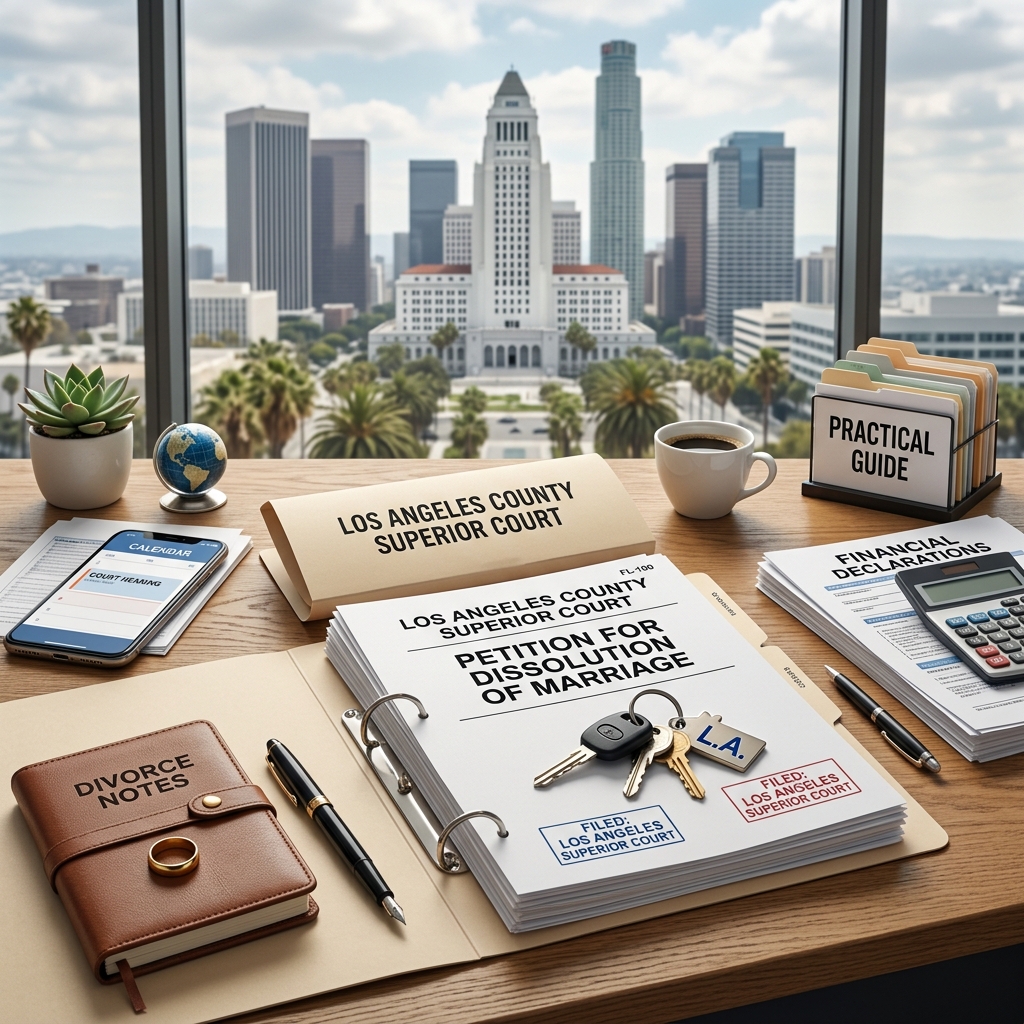
Ending a marriage in Los Angeles is more than an emotional decision; it is a structured legal process under California law. In California, divorce is formally called dissolution of marriage, and it follows statewide rules with some local procedures unique to Los Angeles County. This guide walks you through the essential steps, requirements, and practical choices so you can approach a Los Angeles divorce with realistic expectations and better preparation.
Understanding Divorce in California and Los Angeles
California uses the term dissolution for the legal process that ends a marriage or domestic partnership. Once the court issues a final judgment of dissolution, the parties are no longer legally married and can remarry if they choose. The same overall rules apply across the state, but you file and manage your case through the local Superior Court in the county where you live, such as the Superior Court of California, County of Los Angeles.
Although every case is different, most Los Angeles divorces must address four broad areas:
- Whether the court has authority to hear your case (residency and proper filing location)
- How the marriage ends legally (grounds for divorce and basic forms)
- Family-related issues such as child custody, parenting time, and child support
- Financial issues including division of property and debts and possible spousal support
Residency Requirements for a Los Angeles Divorce
You cannot file for a standard California divorce in any county you choose; you must meet specific residency rules. According to California court guidance, to start a divorce case in California, one spouse must have lived in the state for at least six months and in the current county for at least three months. WomensLaw, a legal information resource, confirms the same statewide residency requirements.
| Requirement | Minimum Time | Applies To |
|---|---|---|
| California residency | 6 months | Either spouse |
| County residency (e.g., Los Angeles County) | 3 months | Same spouse meeting state requirement |
If you have not yet reached these residency time periods, you typically must wait to file a standard divorce in Los Angeles County. However, some people explore legal separation while they build residency; legal separation has different jurisdiction requirements and can later be converted to divorce.
Legal Grounds for Divorce in California
California is a no-fault divorce state. You do not need to prove wrongdoing such as adultery or cruelty to obtain a divorce. WomensLaw explains that California allows divorce on two primary grounds:
- Irreconcilable differences that have caused the permanent breakdown of the marriage
- Permanent legal incapacity to make decisions (a narrow, medically-related ground)
For almost all Los Angeles divorces, the parties rely on irreconcilable differences. The court does not investigate who is “at fault”; instead, it focuses on procedural requirements and how to resolve financial and parenting issues.
Overview of the California Divorce Process
The California court system describes divorce as a four-part process applicable statewide, including Los Angeles:
- Start the case by filing and serving the initial papers
- Share financial information through mandatory disclosures
- Make decisions about property, debts, children, and support (by agreement or with court help)
- Finalize the divorce by submitting the judgment paperwork
These parts are the same whether your relationship is a marriage or a domestic partnership. Within Los Angeles County, you handle these steps through the local Superior Court, which offers resources to help you file at home or in person, depending on your comfort level and access to technology.
Minimum Time to Finalize a Divorce
Even if both spouses agree on every issue immediately, a California divorce cannot be finished overnight. The California Courts Self-Help Guide explains that divorce in California takes at least six months to complete. This waiting period is tied to the date the respondent is formally served with the summons and petition or appears in the case, and it applies to Los Angeles divorces as well.
Key timing points:
- The six-month waiting period begins after proper service or appearance.
- Your case can take longer if you have complex property, contested custody, or unresolved support disputes.
- Some steps, like exchanging financial information, must be completed even in simple cases.
Starting a Divorce Case in Los Angeles
To legally start a divorce in Los Angeles, one spouse (called the petitioner) files specified forms with the Los Angeles County Superior Court. The other spouse is the respondent. While the precise form numbers come from statewide rules and are described in detail on official court sites and legal guides, the basic actions are the same in every county:
- Prepare the initial divorce documents, often including a petition and a summons.
- File the forms with the correct Los Angeles Superior Court location and pay the filing fee.
- Arrange for legally valid service of the papers on the other spouse.
The Los Angeles Superior Court offers an online “File at Home” resource so parties can complete and submit many family law forms electronically, including documents to start or respond to a divorce. Court clerks generally cannot provide legal advice but can explain filing procedures, hours, and basic form requirements.
Service and the Respondent’s Role
Once the petitioner files the initial forms, the next legal step is service of process. This means the respondent must be officially given copies of the filed papers using approved methods (for example, personal service by someone over 18 who is not a party).
After service, the respondent has a set time to react:
- If the respondent files a response, the case continues with both sides participating.
- If the respondent does not respond by the deadline, the petitioner may move forward with a default divorce, following specific procedures.
Responding is important for spouses who want a say in how property is divided, how support is set, and what parenting plan is adopted.
Sharing Financial Information and Property Division
California law requires each spouse to fully disclose their finances during divorce. The Self-Help Guide stresses that the spouse who first filed must share financial information, and the other spouse must also disclose their finances if they participate in the case. This step is mandatory in Los Angeles divorces; it is not optional even if the parties agree on everything.
Financial disclosure typically covers:
- Income from employment and other sources
- Real estate, savings, retirement accounts, and other assets
- Credit card balances, loans, and other debts
- Monthly living expenses and budgets
The information is used to help determine how to divide property and debts and, when appropriate, how to set child and spousal support. California generally treats most property and debt acquired during marriage as community property, meaning it is shared and may be divided between the spouses at divorce. While this guide does not provide individualized legal advice, understanding that the court expects an accurate picture of your finances is crucial.
Custody, Parenting Time, and Child Support
When spouses in Los Angeles have minor children, the divorce must also address custody and support. The California Courts explain that decisions about children—such as who they live with, how time is shared, and how decisions are made—are part of the divorce case.
Key child-related topics include:
- Legal custody: who makes major decisions about education, health care, and welfare
- Physical custody: where the child lives most of the time
- Parenting time (visitation): the detailed schedule for each parent’s time
- Child support: ongoing financial support for the child, calculated under statewide guidelines
Parents can develop their own parenting plan through negotiation or mediation. If they cannot agree, the court can order child custody mediation and ultimately make decisions after reviewing evidence and the children’s best interests. Child support is typically based on state-wide formula guidelines that consider factors such as each parent’s income and the time the child spends with each parent.
Spousal Support (Alimony) Considerations
In some Los Angeles divorces, one spouse requests spousal support, sometimes called alimony. This financial support is distinct from child support. Courts look at factors such as income, earning capacity, length of the marriage, and each spouse’s needs and resources when deciding whether support is appropriate and, if so, in what amount and for how long.
Spousal support can be temporary (while the case is pending) or long-term (ordered in the final judgment). The court may encourage or require the supported spouse to make reasonable efforts toward self-support over time, depending on the circumstances.
Options for Resolving Your Los Angeles Divorce
How you resolve the issues in your divorce can significantly affect the time, cost, and stress involved. The California Courts Self-Help Guide outlines several options for working things out or asking the court to decide if you cannot agree.
- Agreement between spouses: Spouses reach a full written agreement on property, support, and custody, which the court can approve.
- Mediation: A neutral mediator helps the parties discuss disagreements and try to reach mutually acceptable solutions.
- Court hearings and trial: If agreement is not possible, one or more court hearings, and potentially a trial, will be needed so a judge can decide unresolved issues.
For many families, using resources such as mediation or cooperative negotiation reduces conflict and helps preserve working relationships, especially when parenting together after divorce. The Los Angeles Superior Court and community agencies provide access to family law facilitators and mediators, though their roles and availability can vary.
Finalizing the Divorce Judgment
Once all major issues have been resolved—either through agreement or court orders—you must still take formal steps to finish the case. The California Self-Help Guide explains that you finalize a divorce by submitting the necessary judgment paperwork to the court.
Finalization generally involves:
- Ensuring all required forms are completed accurately
- Attaching any written agreements or court orders that describe property division, custody, and support
- Submitting the packet to the Los Angeles Superior Court for review and signature by a judge
When the judge signs and the clerk processes the judgment, your divorce becomes legally final as of the effective date on the order. Only then are you free to remarry or enter a new domestic partnership.
Accessing Local Los Angeles Divorce Information
Because divorce is handled at the county level, it is important to know how to access local information for Los Angeles. The Los Angeles Superior Court provides online tools to help you start or respond to a divorce, and the County Clerk can provide information about divorce records and where a particular case was filed.
Helpful local resources include:
- Superior Court of California, County of Los Angeles family law pages: forms, instructions, and “File at Home” options for divorce cases.
- Los Angeles County Clerk and court records services: information on where records are stored and how to locate them.
- California Courts Self-Help Guide: statewide instructions that apply to Los Angeles divorces.
While these resources provide procedural guidance, they do not replace individualized legal advice. Complex cases involving high-value assets, business interests, or contested custody may benefit from consulting an experienced family law attorney.
Frequently Asked Questions About Los Angeles Divorce
How long does a divorce take in Los Angeles?
Under California law, a divorce takes at least six months from the date the respondent is properly served or appears in the case. The process can take longer if there are contested issues, complicated finances, or delays in providing required information or preparing final paperwork.
Do I have to prove fault to get divorced?
No. California is a no-fault state. You usually only need to claim irreconcilable differences, meaning the marriage has broken down permanently. The court does not require you to prove misconduct such as infidelity.
Can I file for divorce in Los Angeles if I just moved here?
Not immediately, in most cases. To file a standard divorce in Los Angeles County, either spouse must have lived in California for at least six months and in Los Angeles County for at least three months before filing. If you do not meet those requirements, talk to a legal professional about temporary options such as legal separation.
What if my spouse does not respond to the divorce papers?
If your spouse is properly served and does not file a response within the deadline, you may be able to proceed with a default divorce, following specific rules and additional paperwork. The court will still review your proposed orders and may require financial disclosures and, in cases involving children, information about custody and support.
Do we have to go to court if we agree on everything?
Not necessarily for a contested hearing, but your case still goes through the court system. If you reach a full agreement on property, debts, custody, and support, you can often submit a written agreement and judgment forms to the court for approval without a trial. A judge must still sign the final order.
Where can I get official divorce forms for Los Angeles?
You can obtain statewide California divorce forms through the California Courts and access county-specific instructions and filing options through the Los Angeles Superior Court’s family law and “File at Home” pages. Many people use these official resources to start or respond to a case without an attorney, though legal advice may be helpful in complex situations.
References
- Divorce in California — California Courts, Self-Help Guide. 2024-03-01. https://selfhelp.courts.ca.gov/divorce-california
- The divorce process — California Courts, Self-Help Guide. 2024-03-01. https://selfhelp.courts.ca.gov/divorce
- California Divorce — WomensLaw.org. 2023-06-15. https://www.womenslaw.org/laws/ca/divorce
- File At Home — Superior Court of California, County of Los Angeles. 2026-01-10. https://www.lacourt.ca.gov/pages/lp/file-at-home
- Divorce Record Information — Los Angeles County Registrar-Recorder/County Clerk. 2025-08-20. https://www.lavote.gov/home/county-clerk/marriage-licenses-ceremonies/divorce-record-information/divorce-record-information_
Similar Articles








Read full bio of Sneha Tete


