Understanding Hybrid Business Structures for Social Enterprises
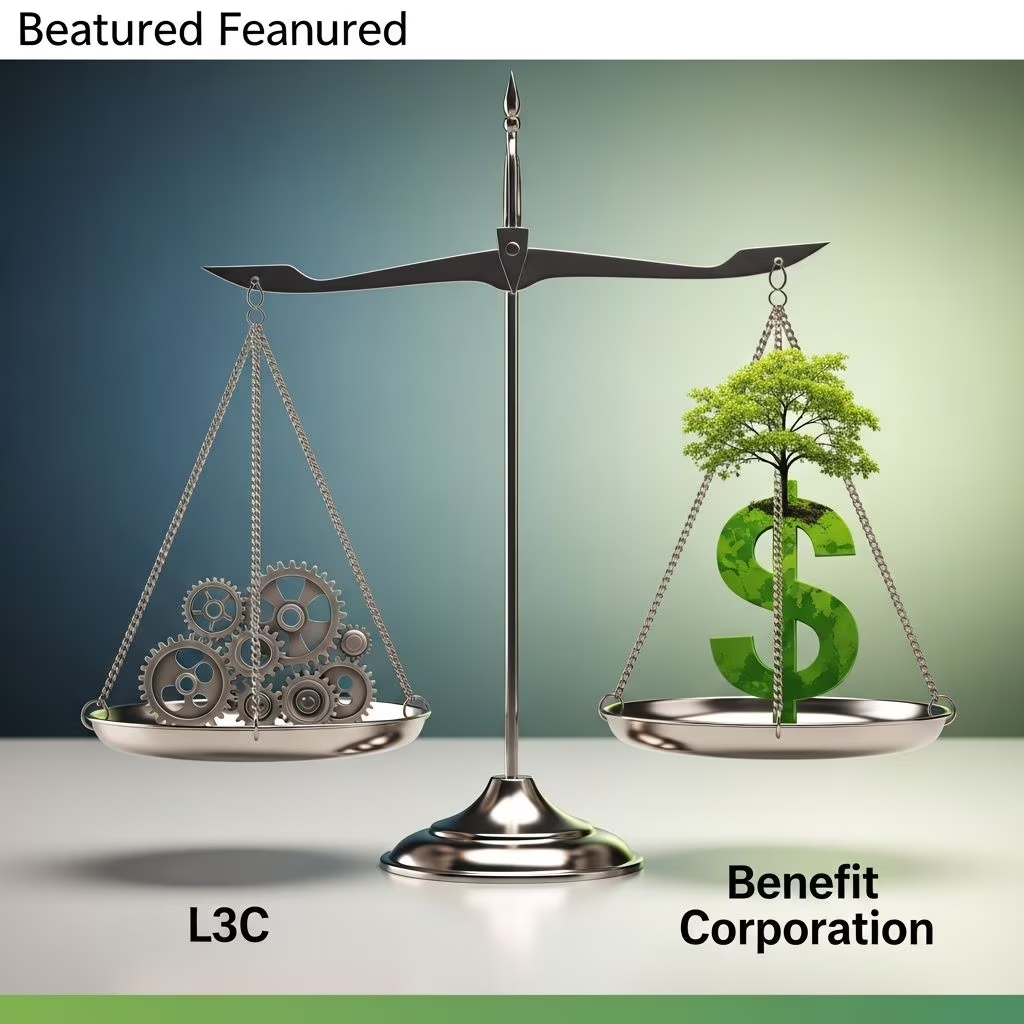
Entrepreneurs with missions to create positive social or environmental impact while maintaining profitable operations have increasingly turned to alternative business structures. Among the most prominent options are L3Cs (Low-Profit Limited Liability Companies) and benefit corporations. Both represent hybrid business models that allow founders to prioritize social good alongside financial returns, yet they operate quite differently in practice. Understanding the distinctions between these two structures is essential for entrepreneurs deciding which legal framework best aligns with their organizational vision and operational needs.
Defining L3Cs: The Mission-Driven LLC
An L3C represents a specialized form of limited liability company designed specifically for ventures that emphasize social mission as their primary objective while maintaining profitability as a secondary consideration. The structure emerged relatively recently in the business landscape, first appearing in 2008, making it one of the newer organizational frameworks available to entrepreneurs. From a fundamental standpoint, an L3C maintains the same tax treatment and operational characteristics as a standard LLC, with the critical distinction being its ability to access certain funding mechanisms unavailable to traditional LLCs.
The most significant advantage of an L3C structure lies in its eligibility to receive Program-Related Investments (PRIs) from private foundations. Foundations are legally required to distribute at least 5% of their assets annually to maintain their tax-exempt status. PRIs represent one vehicle through which foundations can fulfill this requirement while simultaneously supporting mission-aligned ventures. This funding pathway can provide substantial capital for social enterprises that might otherwise struggle to attract conventional venture capital or traditional financing.
Operationally, L3Cs function almost identically to conventional LLCs. They maintain the same tax classification, cannot accept tax-deductible donations like nonprofits, and distribute profits to owners in the same manner as traditional LLCs. The operational simplicity of L3Cs compared to benefit corporations represents one of their principal advantages, as they require less formal management structures and record-keeping procedures than their corporate counterparts.
Benefit Corporations: Corporate Structures with Purpose
Benefit corporations (also referred to as B Corps) represent a fundamentally different approach to hybrid business organization. Rather than being built upon the LLC framework, benefit corporations are constructed as specialized corporations that operate under different state statutes and regulatory requirements. First introduced in Maryland in 2010, benefit corporations have experienced more rapid legislative adoption across the United States, now available in more than 20 states including California and Delaware.
A benefit corporation functions as a traditional for-profit corporation that explicitly permits owners to establish social or environmental purposes alongside wealth creation. Unlike nonprofit organizations, benefit corporations can generate substantial profits and distribute earnings to shareholders. However, unlike standard corporations, they must demonstrate measurable progress toward their stated public benefit objectives. This dual mandate distinguishes them from purely profit-maximizing enterprises while preserving the flexibility and capital-raising advantages of the corporate structure.
One defining characteristic of benefit corporations involves their certification requirements. Many benefit corporations pursue third-party certification through B Lab, a nonprofit organization that administers rigorous impact assessment protocols. Achieving B Lab certification requires earning at least 80 points on a comprehensive evaluation and maintaining ongoing compliance with B Lab’s accountability provisions. This certification provides external validation of a company’s social or environmental impact claims, offering consumers and investors confidence in the organization’s authentic commitment to its stated mission.
Structural and Legal Framework Distinctions
The foundational difference between L3Cs and benefit corporations stems from their underlying legal frameworks. L3Cs are specialized versions of limited liability companies, inheriting the organizational structure and management approach characteristic of LLCs. Benefit corporations, conversely, operate as specialized corporations with more formal governance requirements and corporate decision-making procedures. This distinction has profound implications for how these organizations operate on a day-to-day basis.
State availability represents another critical structural difference. L3Cs currently exist in only nine states: Maine, Vermont, Rhode Island, Michigan, Illinois, Kansas, Louisiana, Utah, and Wyoming. Entrepreneurs seeking to establish an L3C in other states face the cumbersome option of forming their entity in a state permitting L3Cs, then registering as a foreign entity in their home state, creating additional compliance obligations. Benefit corporations, by contrast, have achieved much broader geographic availability, existing in more than 20 states. This wider availability makes benefit corporations a more accessible option for most entrepreneurs regardless of their location.
| Aspect | L3C | Benefit Corporation |
|---|---|---|
| Base Structure | Limited Liability Company | Corporation |
| Tax Treatment | LLC taxation (pass-through) | Corporate taxation (unless S-Corp election) |
| State Availability | 9 states | 20+ states |
| Primary Funding Mechanism | Program-Related Investments (PRIs) | Conventional investment + B Lab certification |
| Management Formality | Less formal | More formal |
| Third-Party Certification | Optional | Often pursued (B Lab) |
Tax Implications and Financial Considerations
The tax treatment of L3Cs and benefit corporations differs significantly in ways that affect overall operational costs and financial planning. L3Cs maintain standard LLC taxation, which means the entity itself pays no federal income tax; instead, profits pass through to owners who report income on their personal tax returns. This pass-through taxation structure is generally simpler and often more favorable for small to medium-sized enterprises with modest profit distributions.
Benefit corporations, unless they elect S-Corporation tax status, are taxed as traditional corporations. This means the corporation pays corporate income taxes on profits, and shareholders face additional taxation on dividends, creating the classic “double taxation” scenario familiar to standard C-corporations. However, benefit corporations may have access to certain tax incentives or credits in some states that recognize their social impact objectives. Neither structure qualifies for the federal 501(c)(3) nonprofit exemption, meaning both L3Cs and benefit corporations must pay standard corporate or pass-through income taxes.
The funding landscape differs markedly between these structures. L3Cs were specifically designed to access PRIs from private foundations, potentially providing favorable financing terms from institutional sources committed to social impact. However, the IRS has not provided definitive guidance on PRIs for L3Cs, causing some foundations to hesitate in committing capital to these structures. Benefit corporations typically access funding through conventional investment channels, potentially supplemented by impact investors who value their certified social benefits. Benefit corporations with B Lab certification often enjoy greater credibility among impact investors compared to L3Cs, which face more skepticism regarding their long-term viability and regulatory clarity.
Operational Requirements and Record-Keeping
Management structure and administrative burdens represent practical considerations that significantly affect day-to-day operations. L3Cs, as LLC variants, generally require less formal management protocols and record-keeping procedures than benefit corporations. An L3C can operate with flexible management structures defined in an operating agreement, and administrative requirements remain relatively minimal, similar to traditional LLCs.
Benefit corporations impose more extensive governance requirements and record-keeping obligations typical of corporate structures. Boards of directors must formally document their consideration of social and environmental objectives alongside profit maximization. This more formal approach ensures greater accountability but demands additional administrative effort and documentation. For benefit corporations pursuing B Lab certification, third-party auditing creates additional reporting requirements to demonstrate measurable progress toward stated social or environmental goals.
Both structures, however, require enhanced record-keeping compared to standard LLCs or corporations to substantiate their achievement of public benefit objectives. This documentation proves essential for maintaining the legal protections and operational flexibility these hybrid structures provide. Entrepreneurs should anticipate these administrative requirements when selecting between these two frameworks.
Accountability and Mission Alignment
A fundamental distinction between L3Cs and benefit corporations involves how they approach accountability for social mission achievement. Benefit corporations have emerged as the more widely favored structure for demonstrating authentic commitment to social benefit. They require deliberate board decisions to balance social objectives with financial returns, ensuring mission considerations receive formal organizational attention. Many benefit corporations pursue B Lab certification specifically to signal to stakeholders that their social impact claims have undergone independent verification.
L3Cs approach mission alignment differently, focusing on their designation as “low-profit” entities that prioritize social benefit while accepting modest profit returns. However, the legal mechanisms ensuring L3Cs maintain their mission focus remain less developed than those governing benefit corporations. Some legal scholars have questioned whether L3Cs provide meaningful advantages over standard LLCs with carefully crafted operating agreements designed to prioritize social mission.
Critical Advantages and Disadvantages
L3C Advantages:
- Simpler operational and management requirements compared to corporate structures
- Access to Program-Related Investments from private foundations
- Pass-through taxation avoiding corporate double taxation
- Flexibility in defining social mission through operating agreements
L3C Disadvantages:
- Limited availability in only nine states, creating formation complications for entrepreneurs elsewhere
- Lack of definitive IRS guidance on PRIs, creating uncertainty for foundations and entrepreneurs
- Relatively new structure with evolving legal precedents and regulatory treatment
- Less recognition among impact investors compared to benefit corporations
Benefit Corporation Advantages:
- Available in 20+ states, offering greater geographic flexibility
- B Lab certification provides third-party credibility and market recognition
- More established legal framework with precedents and regulatory clarity
- Greater appeal to impact investors seeking certified social enterprises
- Formal governance structures ensure sustained mission focus
Benefit Corporation Disadvantages:
- More complex management and record-keeping requirements than L3Cs
- Potential for double taxation if organized as C-Corporation
- Third-party certification (B Lab) involves costs and ongoing compliance obligations
- No unique tax benefits compared to traditional corporations
Selecting the Right Structure for Your Mission
Choosing between an L3C and benefit corporation requires evaluating multiple organizational factors. Consider your geographic location first: if you operate outside the nine L3C-permitted states, benefit corporation formation becomes substantially simpler. Evaluate your funding strategy next; if accessing PRI capital from foundations represents a core financing pillar, L3C structure may be appropriate despite regulatory uncertainty. Assess your stakeholder base and market positioning; if B Lab certification and impact investor credibility matter significantly, benefit corporation status aligns better with those objectives.
Consider your operational preferences and administrative capacity. Organizations comfortable with formal corporate governance structures and additional reporting requirements may find benefit corporations less burdensome than anticipated. Conversely, entrepreneurs prioritizing operational simplicity and flexibility should evaluate whether L3C advantages justify formation complications in non-permitting states.
Common Questions About L3Cs and Benefit Corporations
Q: Can an L3C become a benefit corporation or vice versa?
A: Yes, though the process requires restructuring your legal entity. You would need to formally convert or dissolve the existing entity and establish the new structure, involving legal and administrative steps that should be guided by qualified business attorneys.
Q: Do L3Cs and benefit corporations need business licenses and permits like regular companies?
A: Yes, both structures require standard business licensing and permits applicable to your industry and location, just like conventional businesses. The hybrid status affects only tax treatment and governance structure, not licensing requirements.
Q: Can investors make a profit from L3Cs and benefit corporations?
A: Yes, both structures permit profit distributions to owners and investors. The distinction is that these entities must also pursue measurable social or environmental objectives alongside profit generation.
Q: Is B Lab certification required for benefit corporations?
A: No, B Lab certification is optional for benefit corporations. However, many benefit corporations pursue certification to signal authentic commitment to impact objectives and attract impact-focused investors.
Q: Which structure is better for attracting venture capital?
A: Benefit corporations generally attract more venture capital and impact investment due to greater market recognition and regulatory clarity. However, both structures can potentially raise capital depending on investor interest in your mission and business model.
References
- Benefit Corporation vs. L3C – ZenBusiness — ZenBusiness. 2026. https://www.zenbusiness.com/benefit-corporation-vs-l3c/
- The Difference Between B-Corp, Benefit Corp, L3C, And PBC — EthixMerch. 2026. https://ethixmerch.com/blog/b-corp-benefit-corp/
- L3C vs LLC: Key Differences, Benefits, and Legal Considerations — UpCounsel. 2026. https://www.upcounsel.com/l3c
- LLC, S Corporation, L3C, Benefit Corporation? — Impact Foundation. 2026. https://www.impactfoundation.org/blog/llc-or-benefit-corporation
- Benefit Corporation and L3C Adoption: A Survey — Stanford Social Innovation Review. 2026. https://ssir.org/articles/entry/benefit_corporation_and_l3c_adoption_a_survey
- Exploring Social Purpose Business Structures — Farm Commons. 2026. https://farmcommons.org/resources/articles/exploring-social-purpose-business-structures/