
IRS Whistleblower Rewards and Tax Fraud Risk
How IRS whistleblower rewards work, who can report, and why tax compliance matters more than ever.
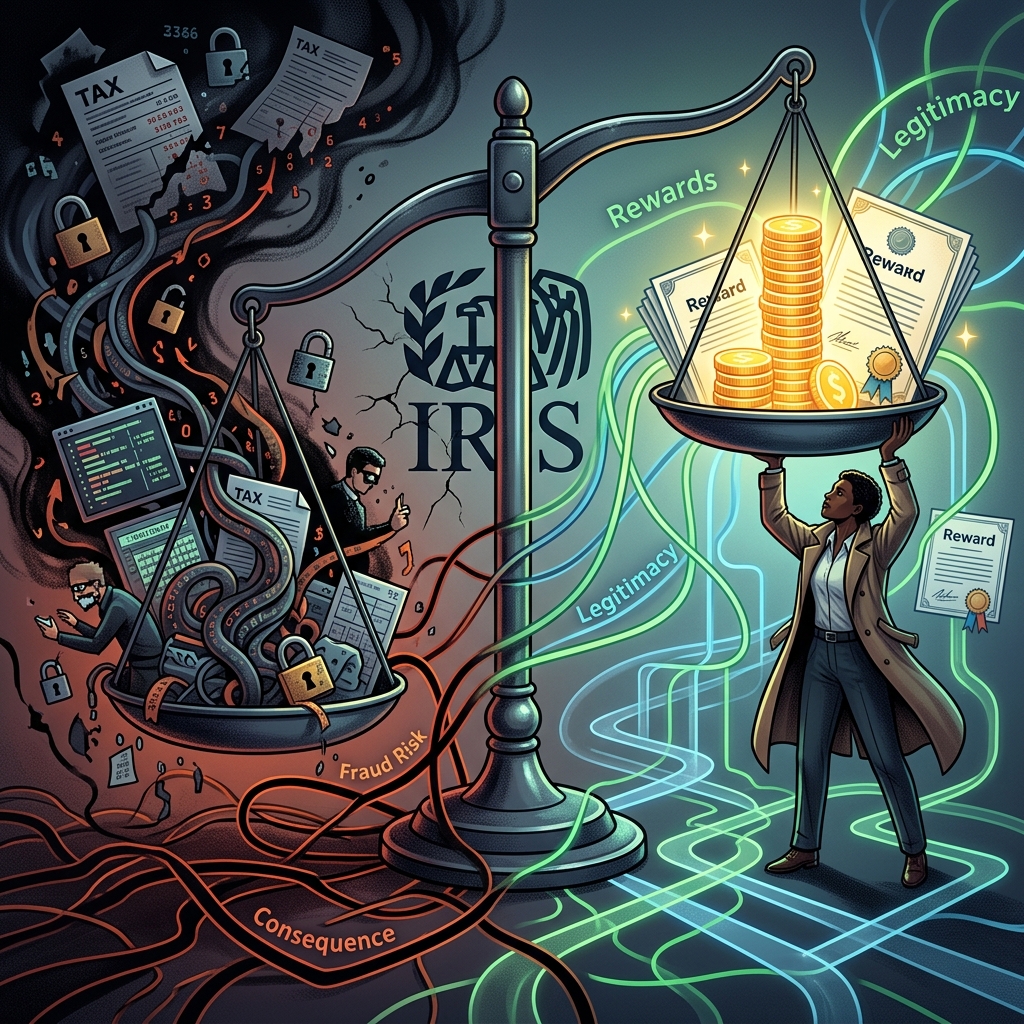
The IRS can pay significant rewards to people who provide original information about serious tax underpayment or fraud, and that reality has made whistleblowing a real compliance concern for businesses and individuals alike. For small companies, the lesson is straightforward: weak bookkeeping, aggressive deductions, and informal cash practices can create exposure not only to audits, but also to insider reports.
Why tax whistleblowing matters
Tax whistleblowing is not a side issue or a theoretical enforcement tool. It is a formal part of the federal tax system that can convert an insider’s knowledge into an investigation, and potentially into a payout if the information leads to collected revenue. The point of the program is to encourage people with first-hand knowledge to come forward when tax cheating would otherwise remain hidden.
That incentive changes behavior inside businesses. Employees, former employees, accountants, contractors, and business partners may all have access to records that reveal underreported income, improper deductions, hidden assets, payroll manipulation, or other forms of noncompliance. Once a person believes the government may pay for useful information, the chance that internal problems stay private drops sharply.
How the reward system generally works
The IRS whistleblower program can provide a reward of between 15% and 30% of the money actually collected when the information leads to recovery in a qualifying case. In the materials provided, the higher-end awards are associated with larger cases, including matters involving at least $2 million in taxes, penalties, and interest. Smaller recoveries may still produce a payment, but the program is designed to motivate reporting in serious cases rather than minor disputes.
In practice, the award does not arrive simply because someone files a complaint. The government must use the information, pursue the matter, and collect money. That means the quality of the tip matters: the best claims tend to include specific facts, documents, and a clear explanation of how the misconduct works.
What kinds of conduct are most likely to attract attention
Not every tax error will interest a whistleblower or the IRS. The cases most likely to trigger serious scrutiny are those involving substantial unpaid tax, repeated concealment, or a pattern of deception. Large-dollar matters are especially attractive because the reward formula is tied to money actually collected, and because the government prioritizes claims where the stakes justify an investigation.
Examples of risky conduct often include the following:
- unreported cash receipts or off-the-books sales
- fictitious expenses or inflated deductions
- misclassified workers or payroll manipulation
- hidden offshore or domestic accounts
- improper use of business funds for personal expenses
- records that do not match actual operations
These categories matter because they can be explained, documented, and traced. The more a business relies on informal processes, the easier it is for someone with access to records to reconstruct the story for investigators.
Who can report, and why insiders are especially important
The strongest whistleblower claims usually come from people who saw the conduct from the inside. A former employee, bookkeeper, CPA, controller, sales manager, or business associate may know where the records are kept and how the numbers were altered. That insider perspective is valuable because it can connect financial statements, bank records, invoices, emails, and tax filings into a single picture.
Outside observers can also report suspected violations, but they may have less detail. The reward system favors information that is original and useful, not rumor or speculation. In other words, a vague complaint that a business “seems shady” is far less powerful than a document-based explanation showing where income was omitted or expenses were fabricated.
How the reporting process is usually started
According to the sources provided, the IRS whistleblower process commonly begins with the submission of Form 211, the application for an award for original information. The form is typically supported by a narrative explaining the alleged misconduct and, where available, copies of relevant documents. In many cases, a claimant works with counsel to organize the facts and present them in a way that is usable to investigators.
This is not a fast, informal tip line. The process is built around documentation, review, and enforcement follow-up. That structure helps the IRS separate serious allegations from weak or repetitive claims, though it also means the path from report to payment can be long.
Why the program can be hard to use
Although the reward structure can be generous, the program is not simple. The information must be specific enough to help the IRS identify a real tax problem, and the government must actually recover money before any award is paid. Sources also indicate that many claims do not produce a payout, which is not surprising given the need for strong evidence, jurisdictional fit, and successful collection.
There are also practical barriers. A person may know something useful but lack records. Another person may have records but not know how to explain them. Timing matters too: if the case is too old, too small, or too speculative, it may not move forward. That is why the program tends to work best when a claimant can provide facts, dates, entities, and documents that point directly to a tax issue.
What businesses should do to reduce whistleblower risk
Businesses cannot stop employees from reporting lawful concerns, and they should not try to. The better strategy is to reduce the chance that there is anything worth reporting. Strong internal controls are the first line of defense. Clear policies, timely reconciliations, and consistent recordkeeping make it much harder for inaccurate practices to develop unnoticed.
Key preventive steps include:
- separating bookkeeping, payment approval, and reconciliation duties
- reviewing cash handling and deposit procedures regularly
- keeping business and personal spending separate
- documenting contractor and payroll classifications carefully
- retaining source records for deductions and credits
- performing internal audits before filing returns
These measures are not just about avoiding penalties. They also reduce the likelihood that an employee or vendor will notice a pattern and decide to document it for the IRS.
What to do if a reporting issue has already surfaced
If a business learns that someone may have contacted the IRS, the first step is to preserve records and avoid destroying documents. Deleting files or backdating records can create a far more serious problem than the underlying tax issue. The next step is usually to review the facts with tax counsel and determine whether there are filing corrections, disclosure options, or procedural responses that make sense.
It is also important to separate the tax issue from the personnel issue. If an employee appears to be the source of the report, retaliation can create additional legal exposure. A measured response should focus on compliance, document preservation, and accurate legal advice rather than suspicion-driven reaction.
Comparing weak and strong whistleblower claims
| Factor | Weak claim | Strong claim |
|---|---|---|
| Information quality | Vague suspicion or rumor | Specific facts tied to records and dates |
| Documentation | Little or no supporting proof | Invoices, emails, ledgers, or filings |
| Tax impact | Small or uncertain loss | Large underpayment or repeated concealment |
| Outcome potential | Unlikely to lead to collection | More likely to trigger review and recovery |
Why the IRS reward structure changes business behavior
The existence of a paid informant program changes the calculus for anyone who sees noncompliance from the inside. A former worker who might once have walked away quietly may now have a financial incentive to gather records and file a claim. That does not mean every disgruntled employee becomes a whistleblower, but it does mean hidden misconduct is less likely to remain hidden for long.
For compliant businesses, this is not a threat but a reminder. Transparent accounting, clean payroll practices, and careful tax reporting lower the odds of a dispute and make the business more defensible if questions arise. For businesses operating on the edge, the risk is that an insider may eventually have both the knowledge and the motivation to speak up.
Frequently asked questions
Can the IRS really pay someone for tax information?
Yes. The sources provided explain that the IRS pays whistleblowers when their information leads to collected taxes, penalties, and interest in qualifying cases.
How much can a whistleblower receive?
The reported range is generally 15% to 30% of the amount collected, with the higher range tied to larger cases involving at least $2 million.
Does every report lead to a reward?
No. The IRS must use the information and collect money before an award is possible, and many claims do not result in payment.
What is the usual first step in submitting a claim?
The reporting process commonly begins with Form 211, supported by a written explanation and documents that show the alleged tax problem.
What is the best way for a business to avoid whistleblower problems?
Consistent compliance, accurate books, documented deductions, and strong internal controls are the most effective ways to reduce risk.
References
- Beware the IRS Rat: Tax Cheats and Paid Informants — FindLaw. 2009-12-14. https://www.findlaw.com/legalblogs/small-business/beware-the-irs-rat-tax-cheats-and-paid-informants/
- How the IRS reward informant leads concerning tax crimes — Klasing & Associates. n.d. https://klasing-associates.com/question/criminal-tax-representation-faq/irs-reward-informant-leads-concerning-suspected-tax-crimes/
- Tax Informants Are On The Loose — Lynam Knott. 2009-12-14. https://www.tax-whistleblower.com/news_lynam/tax-informants-are-on-the-loose/
- Becoming an IRS Informant Can Make You Money — YouTube. n.d. https://www.youtube.com/watch?v=mfEL3LienPQ
- After Budget Cuts, the IRS’ Work Against Tax Cheats Is Facing Collapse — ProPublica. n.d. https://www.propublica.org/article/after-budget-cuts-the-irs-work-against-tax-cheats-is-facing-collapse
- IRS adds Palantir tech to find tax cheats — Charlotte Observer Facebook post. n.d. https://www.facebook.com/thecharlotteobserver/posts/irs-adds-palantir-tech-to-find-tax-cheats/1394392329393399/
- Red tape, old guard slow whistleblowing on corporate tax cheats — Tucson Sentinel. 2011-06-22. https://www.tucsonsentinel.com/nationworld/report/062211_irs_whistleblowers/
Similar Articles








Read full bio of Sneha Tete




