
Holiday Decorations, HOAs, and Your Legal Rights
How far can your homeowners association go in regulating Christmas and other holiday displays, and when do those rules cross legal lines?
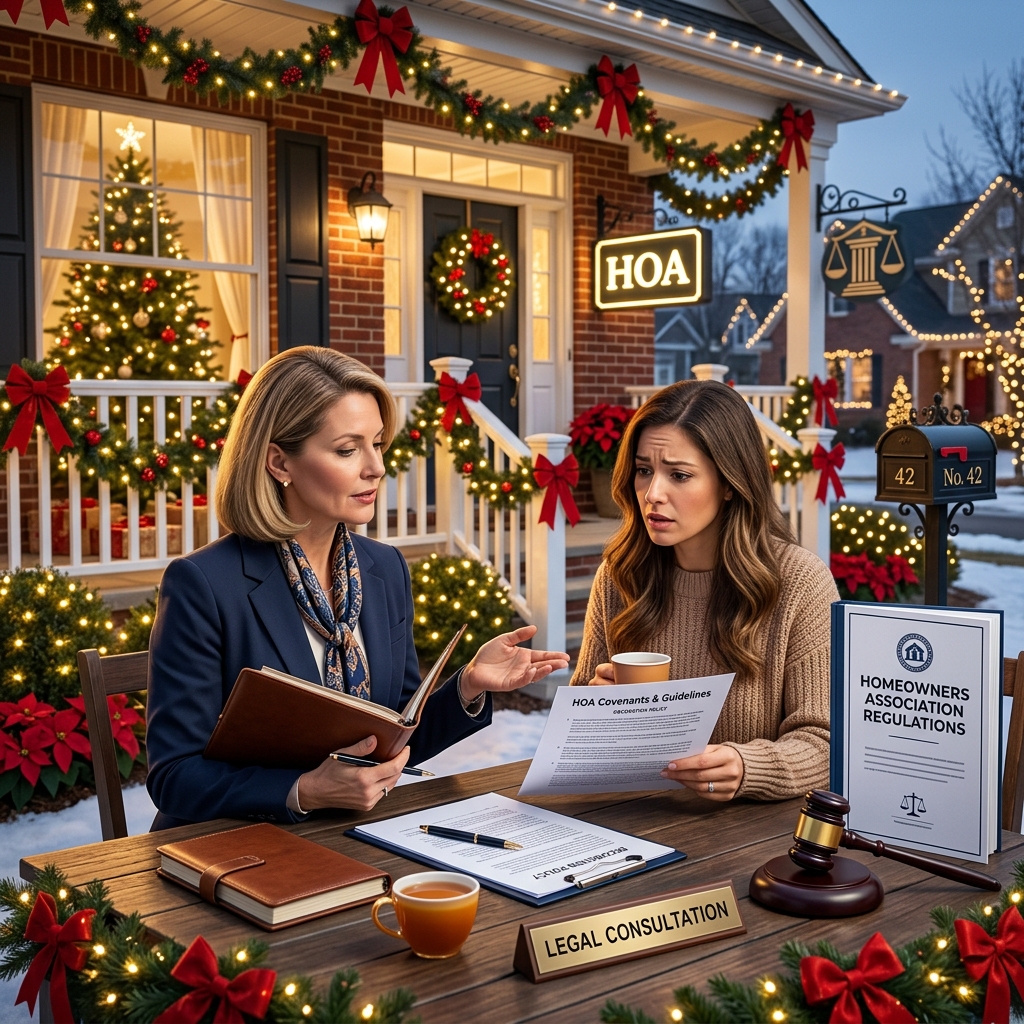
Every December, homeowners associations (HOAs) across the country clash with residents over Christmas lights, nativity scenes, inflatable snowmen, and other holiday displays. Some communities embrace enthusiastic decorating, while others strictly limit what can go on balconies, lawns, or front doors. These conflicts raise an important question: how far can an HOA go in regulating holiday decorations, and when might those rules be legally problematic?
This article explains how HOA authority works, what kinds of holiday rules are typically allowed, and when restrictions on Christmas or other religious displays may intersect with fair housing laws or constitutional protections. It also offers practical strategies for homeowners who want to challenge or change HOA policies without immediately resorting to litigation.
Understanding HOA Power: What Gives Associations Their Authority?
Homeowners associations are private governing bodies created by real estate developers and then managed by elected boards of directors. Their authority does not come from the government but from contracts, usually a set of documents such as:
- Declaration of Covenants, Conditions, and Restrictions (CC&Rs) – the master document that establishes the community and sets out use restrictions.
- Bylaws – rules for how the association is managed, including elections and board meetings.
- Rules and regulations or guidelines – more detailed standards for day-to-day matters such as landscaping, parking, and decorations.
When you purchase property in an HOA community, you agree to follow these covenants and rules as a condition of ownership. State law typically supports this framework; for example, many states have HOA or condominium acts that define the association’s powers and procedures.
In practice, this means HOAs generally can regulate holiday decorations, as long as their rules are:
- Authorized by the governing documents.
- Consistent with applicable state and federal law.
- Adopted and enforced in a reasonable, non-discriminatory manner.
Common HOA Rules About Holiday Decorations
Associations often adopt holiday-specific policies to balance community aesthetics, safety, and neighbor relations. These policies usually regulate how long decorations may be displayed, how big they can be, and where they may be placed rather than banning holidays outright.
Typical Time Limits
Many communities set clear timelines for when residents can install and remove holiday decorations, especially Christmas lights:
- Decorations allowed to go up 30 days before the holiday.
- Decorations required to be removed within two weeks after the holiday or by the second week of the new year for Christmas.
These rules aim to prevent year-round displays and maintain a consistent appearance in the community. They generally apply equally to all holidays.
Limits on Size, Brightness, and Noise
HOAs often focus on the impact of displays on neighbors and safety. Common restrictions include:
- Maximum total length of lights (for example, 100–200 feet) to avoid excessive displays.
- Restrictions on very large inflatables that could obstruct views or blow into streets, causing hazards.
- Curfews for illuminated or musical decorations, such as lights and sound being allowed only between 9 a.m. and 9 p.m., or requiring holiday lights to be turned off between 11 p.m. and 6 a.m.
These rules are usually framed in neutral terms: they apply regardless of whether a display is religious or secular.
Placement and Safety Restrictions
Associations also regulate where decorations can go, focusing on structural integrity and safety:
- Permitted areas might include roof lines, front doors, front windows, and front yards.
- Certain placements, like roof-anchored inflatables or attachments to shared structures (lampposts, gates, pool houses), may be prohibited.
These rules help avoid damage to common property and reduce the risk of injuries or property loss.
Application and Approval Processes
Some HOAs require residents to submit applications for more elaborate or non-standard decorations:
- Architectural review committees may review proposals to ensure they comply with aesthetic standards and safety guidelines.
- Residents may need approval for large displays, heavy electrical use, or unusual placements.
While administrative, these processes are intended to make enforcement consistent rather than arbitrary.
Can an HOA Ban Christmas or Religious Decorations?
The central concern for many homeowners is whether an HOA can target Christmas or other religious holidays specifically. The legal analysis turns on two key points:
- Whether the HOA is a private association or a state actor.
- Whether its rules are neutral or discriminatory toward certain religions or protected classes.
Constitutional Protections and Private HOAs
The First Amendment protects religious exercise and prohibits governmental establishment of religion. However, those constitutional limits apply primarily to government entities, not private organizations. Because HOAs are generally private corporations or non-profit entities, they are not typically treated as state actors. As a result, HOAs do not directly violate the First Amendment simply by restricting decorations, even when those decorations are religious in nature.
In rare situations where an HOA’s actions are heavily intertwined with local government functions, constitutional claims might be explored, but those cases are unusual and highly fact-specific.
Fair Housing Laws and Religious Discrimination
Even though HOAs are private, they are subject to federal and state fair housing laws. The U.S. Fair Housing Act prohibits discrimination in housing-related services based on religion, race, national origin, sex, disability, familial status, and other protected characteristics.
In the holiday context, problematic HOA conduct might include:
- Explicitly banning only religious displays (for example, nativity scenes or menorahs), while permitting secular decorations.
- Allowing Christmas decorations but forbidding displays associated with other faiths.
- Selective enforcement—issuing violation notices to residents of one religion while ignoring comparable displays by others.
These patterns could be evidence that the HOA is providing unequal terms or conditions in housing based on religion, potentially violating fair housing protections. Homeowners may have grounds to file administrative complaints with fair housing agencies or pursue legal remedies.
Neutral Rules Versus Targeted Bans
| Type of HOA Rule | Example | Legal Risk Level |
|---|---|---|
| Neutral time, place, manner | “Decorations may be displayed up to 30 days before a holiday and must be removed within 14 days after.” | Generally low, if applied consistently. |
| Content-based, religiously neutral | “No flashing lights above a set brightness level; no amplified music outdoors after 9 p.m.” | Usually acceptable; focused on impact rather than message. |
| Religion-specific ban | “No religious symbols or nativity scenes allowed on front lawns.” | Higher risk; may raise fair housing concerns if enforced against particular faiths. |
| Selective enforcement | Strict enforcement against one religious group, lax enforcement for others. | High risk; inconsistent enforcement can suggest discriminatory intent. |
When Could You Sue an HOA Over Holiday Rules?
Not every frustrating HOA decision justifies a lawsuit. Courts usually expect homeowners to exhaust internal procedures first and reserve litigation for clearer legal violations. Nevertheless, homeowners may consider legal action when:
- The association violates its own covenants or fails to follow required procedures.
- Holiday rules are applied in an arbitrary or discriminatory way.
- The HOA’s conduct potentially violates fair housing laws or state statutes.
Contract and Statutory Claims
Because HOA rules arise from contractual covenants, many disputes are framed as breach of contract or violation of applicable HOA statutes. Potential claims might include:
- The board adopted holiday restrictions without the member vote required by the CC&Rs.
- The association imposed fines without proper notice or hearing, contrary to state HOA law.
- Holiday rules far exceed the authority granted in the governing documents.
In these cases, owners seek court orders to invalidate improper rules, stop enforcement, or recover improperly charged fines.
Discrimination and Fair Housing Claims
If an HOA appears to be targeting religious displays or treating certain groups differently, homeowners may explore fair housing complaints. Evidence could include:
- Written rules that single out religious symbols for prohibition.
- Statements by board members suggesting hostility toward particular faiths.
- Patterns of enforcement showing certain groups receive more warnings or fines for comparable holiday displays.
Residents can file complaints with local or federal fair housing agencies, which may investigate and, where appropriate, bring enforcement actions.
Practical Steps Before You Consider Suing
Legal action is costly and time-consuming. Most disagreements over Christmas lights or holiday decor can be resolved more effectively through communication and community processes. Consider taking these steps before involving lawyers:
1. Review the Governing Documents
- Read the CC&Rs, bylaws, and any published rules or guidelines about decorations.
- Check whether recent holiday rules were adopted by the board or by community vote and whether those procedures were followed.
This can clarify whether the HOA is acting within its authority.
2. Talk to the Board or Management Company
- Request a meeting or submit a written inquiry asking for the rationale behind the rule.
- Ask whether exceptions or accommodations are possible, particularly for sincerely held religious practices.
Many boards are open to feedback and may adjust policies if residents raise reasonable concerns.
3. Use Internal Appeal or Hearing Procedures
Most state HOA laws and many governing documents provide mechanisms for owners to challenge violations:
- Owners can request a hearing before the board to contest violation notices or fines.
- Residents may present evidence, including photos, documentation, or comparative examples showing inconsistent enforcement.
Presenting your case clearly at this stage can avoid escalation and create a record if further action is needed.
4. Build Community Support
- Talk with neighbors to see if others are affected by the same rules.
- Consider organizing a petition or proposing revised holiday guidelines that balance aesthetics, safety, and tradition.
If many residents support a change, boards are more likely to adopt compromises such as standardized time frames or community-themed decorations.
Best Practices for HOAs: Avoiding a “War on Christmas”
From the association’s perspective, clear, fair, and neutral rules can reduce conflict and potential legal exposure. Boards can adopt best practices to manage holiday decor while respecting diverse beliefs.
Focus on Objective Impacts, Not Messages
- Regulate size, brightness, noise, and safety rather than the religious or cultural content of displays.
- Apply the same time frames and standards to all holidays, avoiding any suggestion that the HOA prefers one tradition over another.
Engage the Community in Rulemaking
- Seek input from residents when drafting or revising holiday policies.
- Explain the reasons for rules—such as energy use, safety, or insurance concerns—to improve compliance.
Transparent processes help residents see rules as legitimate rather than arbitrary.
Communicate Early and Often
- Send reminders of holiday guidelines well before the season via email, newsletters, and notices.
- Include a simple FAQ addressing common questions about timing, size limits, and acceptable types of decor.
Enforce Rules Consistently
- Schedule inspections or walkthroughs and apply standards evenly across the community.
- Avoid favoritism or selective enforcement that could appear discriminatory.
Promote Inclusive, Shared Decorations
- Use association funds to decorate common areas with neutral or multi-faith themes fostered through community input.
- Consider organizing decorating contests or events that welcome diverse traditions.
Frequently Asked Questions
Can my HOA completely ban outdoor Christmas decorations?
Many HOAs are legally permitted to restrict or even ban outdoor decorations if their governing documents allow it and the rule is applied in a neutral, non-discriminatory manner. However, a total ban that targets only Christmas or only religious symbols may raise fair housing concerns if it effectively singles out particular religious groups.
Does the First Amendment protect my religious display from HOA rules?
In most cases, no. The First Amendment restricts government entities, not private HOAs. Because associations are typically private corporations, their content-neutral restrictions on decorations do not directly violate the Constitution. Fair housing and contract law, rather than constitutional law, are usually the primary sources of rights in HOA disputes.
What should I do if I receive a violation notice about holiday lights?
First, review the cited rule and confirm whether your display clearly violates it. If you believe enforcement is unfair or discriminatory, request a hearing or follow the association’s appeal procedure. Present your case calmly, with photos or documentation, and consider seeking legal advice if you suspect a fair housing issue.
Can an HOA treat religious and secular decorations differently?
HOAs can adopt content-neutral rules that affect both secular and religious displays equally—for example, curfews for lights or bans on excessively large inflatables. Differentiating solely based on religious content, especially in a way that disfavors specific faiths, increases legal risk and may be challenged under fair housing laws.
How can homeowners influence HOA holiday policies?
Homeowners can attend meetings, vote for board candidates, serve on committees, and propose changes to rules. Coordinated feedback—such as petitions or community forums—often leads boards to reconsider strict policies and adopt more balanced guidelines that respect both aesthetics and individual traditions.
References
- Holiday Lighting Rules In Your HOA: What’s Fair? — Clark Simson Miller. 2020-11-10. https://clarksimsonmiller.com/holiday-lighting-rules/
- HOA Holiday Decorations: What Rules To Enforce? — Cedar Management Group. 2021-11-15. https://www.cedarmanagementgroup.com/hoa-holiday-decorations-rules/
- Seasonal Holiday Lighting & Decorations and Your HOA — Aperion Management Group. 2019-10-01. https://www.aperionmgmt.com/homeowner-learning-hub/seasonal-holiday-lighting-amp-decorations-and-your-hoa
- Holiday lights & HOAs: Where the rules cross the line — WUSA9 (YouTube transcript). 2017-12-15. https://www.youtube.com/watch?v=rRq6FRA0Pvc
- Keeping the Peace When it Comes to Holiday Decor in Your Community — CAMS Community Association Management. 2020-11-20. https://www.camsmgt.com/cams-blog/keeping-the-peace-when-it-comes-to-holiday-decor-in-your-community
- Holiday Decorations, HOAs, and Happy Homeowners — Keystone Pacific Property Management. 2018-11-30. https://www.kppm.com/holiday-decorations-hoas-and-happy-homeowners/
Similar Articles








Read full bio of Sneha Tete


