
Hawaii Overtime Law: What Workers, Employers Must Know In 2025
Learn how Hawaii overtime rules work, who qualifies, and when special pay rules apply.
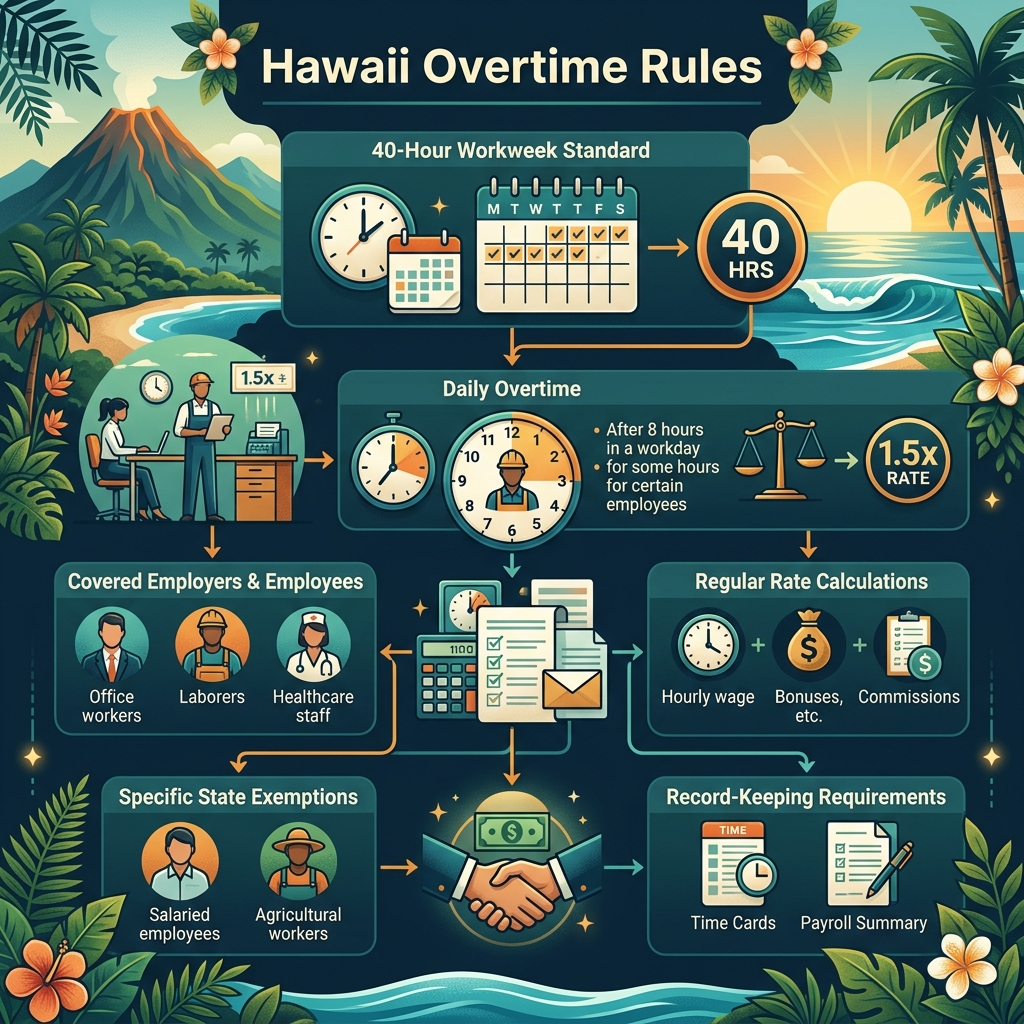
Hawaii overtime law is built around a simple rule: most employees earn extra pay when they work more than 40 hours in a workweek. In some jobs, especially certain public works construction roles, overtime can begin after eight hours in a day and also apply on weekends and state holidays. The details matter because exemptions, job duties, and the type of project can all affect whether overtime is owed.
This article breaks down the main overtime rules in plain language. It explains who is covered, which workers may be exempt, how overtime is calculated, and what to do if overtime pay is missing. The goal is to give workers and employers a clear, practical overview of the law without legal jargon.
How Overtime Usually Works in Hawaii
For most workers, Hawaii follows the familiar federal-style weekly overtime rule. If a nonexempt employee works more than 40 hours in a workweek, the employer must pay at least 1.5 times the employee’s regular rate for the extra hours. That is commonly called time and a half.
The key point is that Hawaii’s general overtime rule is based on the workweek, not the day. A person can work a long shift, even more than eight hours, and still not earn overtime if the total for the week stays at 40 hours or less. That is different from states that use daily overtime rules for all workers.
- Overtime threshold: More than 40 hours in a workweek
- Overtime rate: 1.5 times the regular rate of pay
- General rule: Daily overtime does not apply to most jobs
When Daily Overtime Can Apply
Hawaii does recognize a special overtime rule for some public works construction projects. On qualifying state or county public construction jobs, overtime may be owed after eight hours in a single day. Those employees may also be entitled to overtime for work performed on Saturdays, Sundays, and state holidays.
This special rule does not apply to every construction job. It is tied to public works projects governed by state law, so the type of project and the funding source are important. A worker on a private construction site may be subject only to the standard 40-hour weekly rule, while a worker on a covered public project may receive overtime under the more generous daily standard.
| Work situation | Overtime trigger | Overtime rate |
|---|---|---|
| Most nonexempt jobs | More than 40 hours in a workweek | 1.5 times regular rate |
| State or county public works construction | More than 8 hours in a day, plus Saturdays, Sundays, and state holidays | 1.5 times regular rate |
Who Is Covered by Hawaii Overtime Laws
Hawaii overtime protections generally apply to nonexempt employees. These are workers who do not fall into one of the law’s exemption categories. Whether someone is exempt depends on the facts of the job, not just the employee’s title or pay method.
Being paid a salary does not automatically remove overtime rights. Likewise, simply calling someone a manager does not necessarily make that person exempt. The legal test usually looks at the real nature of the duties, the level of discretion or supervision involved, and the worker’s pay structure.
In practical terms, many hourly workers are covered, while some white-collar, highly paid, or specialized employees may not be. Employers should not assume an exemption applies without checking the job duties and the applicable wage rules.
Common Exemptions Under Hawaii Law
Hawaii recognizes several overtime exemptions. Some of these overlap with federal exemptions, while others are specific to state law. Exemptions can be technical, so a worker’s industry, job duties, and compensation terms all matter.
- Certain agricultural employees
- Specified domestic service employees
- Workers employed by family members
- Certain employees involved in aquatic farming or related activities
- Seamen
- Some drivers of passenger vehicles
- Golf caddies
- Certain workers in dairy, sugar cane, livestock, poultry, agricultural, or horticultural processing
Some employees may also be exempt under broader executive, administrative, professional, supervisory, outside sales, or collection-related categories. These exemptions are not automatic. The employer generally must show that the employee actually fits the legal definition of the exemption.
Pay Level and Exempt Status
Wage level can also play a role in overtime eligibility. In some situations, federal and state rules exempt workers who receive a guaranteed monthly income above a certain amount. That means pay structure can matter just as much as job duties.
However, high pay alone does not always settle the question. A worker may earn a salary above a threshold and still be nonexempt if the job does not meet the duties test. The safest approach is to examine both the compensation arrangement and the employee’s actual responsibilities.
Employers who classify workers as exempt should be prepared to explain why the exemption applies. Workers who believe they have been misclassified should look closely at what they do each day, not just what their job description says.
How Regular Rate and Overtime Pay Are Calculated
Overtime is paid at 1.5 times the regular rate of pay. The regular rate is more than just the hourly wage if the worker also receives certain types of additional compensation. In many cases, the regular rate includes commissions, nondiscretionary bonuses, and other pay tied to work performed.
To calculate overtime, the employer generally determines the employee’s regular rate for the week and then multiplies that amount by 1.5 for each overtime hour. If an employee has fluctuating compensation, the calculation can become more complex, especially if bonuses or other earnings must be included.
For example, if a worker’s regular rate is $20 per hour, overtime should be paid at $30 per hour. If the worker earns a bonus that must be counted in the weekly total, the regular rate may be higher than the base hourly wage, which can increase the overtime amount owed.
- Regular rate includes more than hourly wages in many cases
- Overtime premium is generally 50% above the regular rate
- Accurate weekly payroll records are important for the calculation
Do Breaks, Holidays, and Comp Time Change Overtime?
Hawaii law does not generally require extra pay just because work is performed on a holiday. If a worker is scheduled on a holiday, overtime is not automatically owed unless the hours also trigger a legal overtime rule. Some employers may choose to offer holiday premium pay, but that is usually a policy choice rather than a legal requirement.
Likewise, there is no broad rule requiring paid breaks for adult workers under Hawaii overtime law. The state’s child labor rules do require certain rest or meal periods for younger minors, but those protections are separate from the overtime statute.
Comp time, or compensatory time off instead of overtime pay, is not generally a substitute for overtime wages in the private sector. Workers who are entitled to overtime typically must be paid in money, not merely given time off later, unless a lawful exception applies.
Employer Recordkeeping and Payment Timing
Employers must keep accurate records of hours worked. That includes start and end times, break periods when relevant, and any off-the-clock concerns. Good records help prove whether overtime was earned and whether it was paid correctly.
Overtime should also be paid on time, according to the employer’s regular payroll schedule. If wages are delayed, miscalculated, or left out of a paycheck, the worker may have a wage claim. Missing overtime can create problems quickly because the underpayment may repeat every pay period.
Employees should review pay stubs carefully and compare them with their own records. If hours worked do not match what appears on the paycheck, that is often the first sign of an overtime issue.
What to Do If Overtime Is Missing
If an employee believes overtime was not paid, the first step is usually to gather records. Useful documents include timesheets, schedules, pay stubs, texts from a supervisor, and any personal log of hours worked. Even informal records can help establish the pattern of unpaid time.
The worker may then raise the issue with payroll, human resources, or a supervisor. In some cases, a simple correction fixes the problem. If the employer refuses to pay, the employee may be able to file a wage complaint with the appropriate state agency or seek legal advice about recovery of unpaid wages.
Because overtime claims often depend on exact hours and classification rules, workers should not wait too long to act. Back wages can be limited by time deadlines, so delaying can reduce the amount that can be recovered.
Common Questions About Hawaii Overtime
Does working more than eight hours in one day always mean overtime?
No. For most jobs in Hawaii, overtime starts after 40 hours in a workweek, not after eight hours in a day. Daily overtime usually applies only in special public works construction situations.
Can my employer call me salaried to avoid overtime?
No. Salary by itself does not erase overtime rights. The employee must also fit a legal exemption based on job duties and other requirements.
Are holidays paid at a higher rate in Hawaii?
Not automatically. Holiday premium pay is generally a matter of employer policy unless a specific law, contract, or project rule requires it.
Can I agree to waive overtime?
In general, no. Overtime rights are protected by wage law, and private agreements usually cannot eliminate a worker’s legal entitlement to overtime pay.
Do bonuses affect overtime pay?
Sometimes. Nondiscretionary bonuses and similar compensation may need to be included when calculating the regular rate used for overtime.
Practical Tips for Workers and Employers
Workers should keep independent records of hours, especially if schedules change or breaks are not consistently recorded. Employers should train supervisors carefully so they do not permit off-the-clock work or inconsistent timekeeping.
Clear policies help reduce disputes. A good payroll system should distinguish exempt from nonexempt employees, flag overtime automatically, and document any special project rules that may trigger daily overtime. On public construction projects, contract administrators and payroll staff should confirm whether the project falls under the special state or county rule.
- Track actual hours worked every week
- Review whether a job classification is truly exempt
- Apply the correct rate when bonuses or commissions affect pay
- Check public works rules before assuming weekly-only overtime applies
Hawaii overtime law is not complicated in its main rule, but the exceptions can be important. Workers who know the difference between ordinary weekly overtime and special project-based daily overtime are better prepared to spot payroll mistakes. Employers who classify employees correctly and pay overtime on time can avoid costly disputes and back-pay claims.
References
- Minimum Wage and Overtime – Wage Standards Division — Hawaii Department of Labor and Industrial Relations. n.d. https://labor.hawaii.gov/wsd/minimum-wage/
- Wage and Hour FAQs — Hawaii Department of Labor and Industrial Relations. n.d. https://labor.hawaii.gov/wsd/wage-and-hour-faqs/
- Hawaii Overtime Laws — FindLaw. n.d. https://www.findlaw.com/state/hawaii-law/hawaii-overtime-laws.html
- Hawaii Wage Laws — LawInfo. n.d. https://www.lawinfo.com/resources/wages/hawaii/
- Hawaii Overtime Laws | 2026 — Jibble. 2026. https://www.jibble.io/labor-laws/us-state-labor-laws/hawaii/overtime-laws
Similar Articles








Read full bio of medha deb




