
Vermont Employment Law: 2025 Practical Employer Compliance Guide
A practical, plain‑language overview of key Vermont employment rules on wages, leave, discrimination, hiring transparency and worker protections.
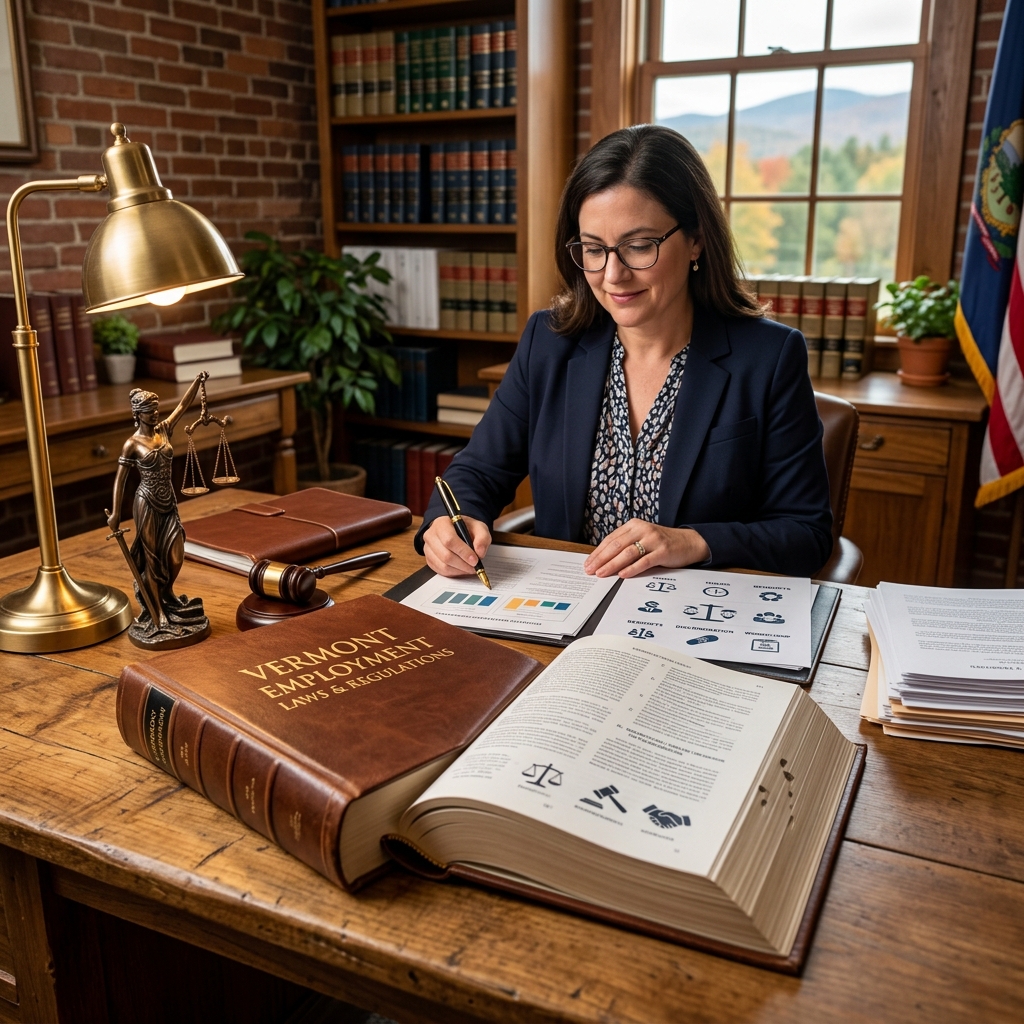
Vermont employment law combines federal requirements with state-specific protections that often go beyond the national baseline. Employers operating in Vermont and workers who live or work in the state should understand how rules on wages, hours, leave, discrimination, and hiring transparency interact with each other. This guide explains the major features of Vermont employment law in clear terms, focusing on practical implications for everyday workplace decisions.
At-Will Employment and Exceptions in Vermont
Like most U.S. states, Vermont follows the at-will employment doctrine. In an at-will relationship, either the employer or employee may end employment at any time, for almost any reason, or for no stated reason at all.
However, Vermont law places important limits on at-will termination:
- Employers may not terminate workers for unlawful discriminatory reasons, such as race or sex.
- Termination cannot be in retaliation for exercising protected rights (for example, requesting leave or reporting harassment).
- Written policies, handbooks, or contracts may modify at-will status if they promise specific job security or termination procedures.
- Public policy constraints apply; firing an employee for reasons that clearly violate public policy (such as refusing to engage in illegal conduct) may be unlawful.
Employers should review offer letters, handbooks, and disciplinary procedures to ensure they do not unintentionally create contractual obligations that limit at-will status.
Minimum Wage, Tipped Wages, and Overtime Rules
Vermont’s wage and hour rules are a key area where state law offers protections beyond federal requirements.
Minimum Wage and Tip Credits
Vermont sets a statewide minimum wage that is higher than the federal minimum. The exact rate is periodically adjusted and employers must monitor annual updates.
For tipped employees, such as servers and bartenders, state law permits a tip credit: employers may pay a lower cash wage so long as tips bring the employee’s total hourly earnings at least up to the state minimum wage.
- The state limits the maximum tip credit per hour, which caps how much of the employee’s income can be satisfied through tips.
- If an employee’s tips plus base wage do not reach the minimum wage in any workweek, the employer must make up the difference.
- Employers must keep accurate records of hours and tipped earnings to demonstrate compliance.
Overtime Requirements
Under federal law and Vermont’s corresponding rules, non-exempt employees are generally entitled to overtime pay at 1.5 times their regular hourly rate for all hours worked over 40 in a single workweek.
Key points for Vermont employers:
- Overtime is based on hours worked, not hours paid. Paid time off does not count toward the 40-hour threshold.
- Some employers, such as certain hospitals and nursing homes, may use a special “Eight and 80” system that averages hours over a two-week period, subject to federal and state rules.
- The salary threshold for exempt status aligns with federal law. Employees paid below that threshold are usually entitled to overtime regardless of job title.
| Topic | General Rule |
|---|---|
| Minimum wage | Higher than federal rate; adjusted periodically, applies to most private-sector employees. |
| Tipped employees | Lower cash wage allowed with tip credit, but total pay must reach state minimum wage. |
| Overtime | 1.5× regular rate for hours over 40 per week for non-exempt workers. |
| Recordkeeping | Employers must keep accurate records of hours worked and wages paid. |
Working Time, Breaks, and Meal Periods
Vermont does not have detailed prescriptive rules on rest periods, but it does require employers to provide reasonable opportunities during work to eat and to use toilet facilities.
In practice, employers should understand how federal law treats breaks and meal periods:
- Short breaks of about 5–20 minutes are generally counted as hours worked and must be paid.
- Meal periods of 30 minutes or more can be unpaid if the employee is fully relieved of all work duties during the break.
- Policies should be clearly communicated so employees know whether breaks are paid or unpaid and what is expected of them.
Even without rigid state rules, failing to provide reasonable time to eat and use restroom facilities may expose employers to claims under health, safety, or wage and hour laws.
Anti-Discrimination Protections and Equal Pay
The Vermont Fair Employment Practices Act (VFEPA) is the foundation of the state’s workplace discrimination laws. It applies broadly to employers and protects workers from discrimination in hiring, firing, compensation, and other terms and conditions of employment.
Protected Characteristics
Vermont law covers all federally protected classes and adds additional categories. Employers may not discriminate based on factors such as:
- Race, color, national origin, ancestry
- Sex, pregnancy, gender identity, sexual orientation
- Religion
- Age (subject to statutory thresholds)
- Physical or mental condition or disability
- Other characteristics specified under state law and regulations
Discrimination includes not only overt adverse actions such as termination or demotion, but also more subtle practices like unequal pay, biased job assignment, or hostile work environment harassment.
Equal Pay and Wage Transparency
Vermont also regulates pay practices to reduce inequities:
- Employers may not pay employees of one sex less than employees of another sex for equal work requiring equal skill, effort, and responsibility under similar conditions, unless the difference is based on nondiscriminatory factors such as seniority or merit.
- Employers may not prevent employees from discussing their own wages or the wages of coworkers. Policies that forbid wage discussion are unlawful.
- Employers are restricted in how they can inquire about an applicant’s current or past compensation. They may not require that past pay meet minimum or maximum criteria as a condition of hiring.
These rules support pay transparency and aim to reduce wage gaps and hidden inequities in compensation practices.
Job Posting and Pay Transparency Requirements
Vermont has adopted explicit requirements promoting transparency in job advertisements. New laws require covered employers to disclose compensation information in most written job postings.
Which Employers and Postings Are Covered?
In general, the pay transparency rules apply to employers who have at least a small threshold number of employees (for example, five or more), including remote workers, when at least one employee works in Vermont.
Covered job postings typically include:
- Written advertisements for specific open positions, whether internal or external.
- Postings for jobs primarily performed at a Vermont location or a Vermont-based office, even if the worker resides elsewhere.
Postings for work performed entirely outside Vermont may be excluded from these requirements.
Required Pay Disclosures
For most covered positions, employers must include either:
- The expected compensation for the position, or
- A range of compensation showing the minimum and maximum salary or hourly wage the employer, acting in good faith, expects to pay at the time the advertisement is created.
Additional rules apply to jobs paid primarily through tips or commissions:
- For tipped positions, the advertisement must disclose that the job is tipped and must state the anticipated range of non-tip base wages.
- For commission-based roles, the posting must indicate that compensation is based partly or entirely on commission; however, the law may not require a specific range to be listed.
Noncompliance may be treated as an unfair employment practice, and enforcement actions may be brought by state authorities such as the Vermont Attorney General’s Office.
Leave Laws: Parental, Family, Sick, and Other Time Off
Vermont’s leave laws are more generous than federal requirements in several areas, especially for smaller employers and short-term health needs.
Parental and Family Leave
Under Vermont’s Parental and Family Leave Act (PFLA), eligible employees may receive up to 12 weeks of unpaid, job-protected leave in a 12-month period for certain qualifying reasons.
- Parental leave may be used for the birth or adoption of a child, allowing time for bonding and care.
- Family leave may be available to care for a seriously ill family member or for the employee’s own serious health condition.
- Coverage thresholds under PFLA may differ from federal Family and Medical Leave Act (FMLA) rules, extending protections to employees of smaller employers.
Earned Sick Time
Vermont’s Earned Sick Time Law (VESTL) requires employers doing business in the state to provide paid sick leave to eligible employees.
Core features include:
- Employees typically earn at least one hour of sick time for every 52 hours worked.
- Sick time can be used for the employee’s own illness or injury, for a family member’s health needs, and for diagnostic, preventive, routine, or therapeutic care.
- Employers may adopt reasonable notice and documentation policies as long as they do not undermine employees’ ability to use their accrued time.
Other Leave Protections
Vermont law and federal statutes provide additional leave rights:
- Members of the U.S. armed forces reserves may take unpaid time off for training, drills, encampments, and certain periods of active service.
- Some employees may have access to short periods of unpaid leave for civic duties or other reasons defined in state law or employer policy.
- Vacation time is generally governed by employer policy; Vermont does not mandate vacation but may require payout of accrued vacation if a contract or policy promises it.
Flexible Working Arrangements and Scheduling Requests
Vermont promotes dialogue about flexible work by requiring employers to consider employee requests for alternative schedules.
Under state law, employers must, at least two times per year, consider any request for a flexible working arrangement, which may include:
- Changes in the number of hours or days worked
- Adjustments to arrival and departure times
- Working from home or telecommuting
- Job sharing or similar arrangements
Employers are not required to grant every request, but they must consider them in good faith and should document discussions and reasons for decisions.
Final Wages, Vacation Pay, and Separation
Vermont law sets timelines and conditions for paying employees when employment ends.
- When an employee is fired or laid off, the employer must pay final wages within 72 hours of termination.
- If an employee voluntarily resigns, final wages must be paid by the next regular payday, or the following Friday if no regular payday exists.
- Accrued vacation must be paid at separation if the employer’s policy or contract provides for such payment.
Clear written policies about vacation accrual and payout are essential to avoid disputes when employees leave.
Special Rules for Young Workers and Workplace Safety
Vermont follows federal child labor standards and adds restrictions on hazardous work and excessive hours for minors.
For workers aged 16–18, certain dangerous occupations are prohibited, and limits apply to work hours in manufacturing or mechanical establishments.
More broadly, employers must maintain a safe workplace, comply with federal Occupational Safety and Health Administration (OSHA) standards, and follow state-specific health and safety rules applicable to their industry.
Sexual Harassment and Workplace Conduct
Vermont law provides all employees the right to a workplace free from sexual harassment and other forms of unlawful harassment.
Employers should:
- Adopt clear anti-harassment policies and complaint procedures.
- Train supervisors and managers to recognize and address harassment promptly.
- Investigate complaints in a timely, impartial manner and take appropriate remedial action when necessary.
- Ensure that employees who report harassment or participate in investigations are protected from retaliation.
Practical Compliance Tips for Vermont Employers
Given the breadth of Vermont employment law, employers should adopt proactive compliance strategies. Consider the following steps:
- Audit pay practices regularly to verify compliance with minimum wage, tip credit limits, overtime rules, and equal pay requirements.
- Review job postings to ensure compensation ranges or pay disclosures are included as required.
- Update handbooks to reflect earned sick time, parental and family leave, anti-discrimination protections, and wage transparency rights.
- Train managers on responding to flexible scheduling requests, handling leave requests, and preventing discrimination and harassment.
- Document decisions related to hiring, promotion, discipline, and termination to show legitimate, non-discriminatory reasons.
Frequently Asked Questions About Vermont Employment Laws
1. Does Vermont require employers to provide paid vacation?
No. Vermont does not mandate paid vacation. Whether employees receive vacation time depends on the employer’s policy or contract. However, if a policy or agreement promises payment of accrued vacation at separation, the employer must honor that promise.
2. Are all Vermont employees entitled to paid sick leave?
Most employees working for employers doing business in Vermont are covered by the earned sick time law and accrue paid sick leave based on hours worked, subject to certain eligibility rules and limited exceptions.
3. Can my employer stop me from talking about my wages?
Under Vermont law, employers may not prohibit employees from discussing their own pay or the pay of coworkers. Policies that forbid wage discussions are unlawful and may be treated as unfair employment practices.
4. Do small employers in Vermont have to provide parental or family leave?
Vermont’s Parental and Family Leave Act reaches some employers that are too small to be covered by federal FMLA, so employees of smaller Vermont employers may still have unpaid, job-protected leave rights under state law.
5. Are employers required to post pay ranges for all job openings?
Covered Vermont employers must generally include expected compensation or a range of compensation in written job postings for positions performed in Vermont or primarily based in a Vermont office, with specific rules for tipped and commission jobs.
References
- State Law Changes for Vermont Employers: Act 155 Pay Transparency — Sheehey Furlong & Behm. 2024-09-03. https://sheeheyvt.com/state-law-changes-for-vermont-employers/
- Vermont Employment and Labor Laws — Paylocity. 2024-01-15. https://www.paylocity.com/resources/tax-compliance/state-laws/vermont/
- Quick and Easy Guide to Labor & Employment Law: Vermont — Baker Donelson. 2023-11-10. https://www.bakerdonelson.com/easy-guide-vermont
- Employment and Labor Laws in Vermont Guide — Multiplier. 2024-06-01. https://www.usemultiplier.com/us-state-guides/vermont
- Vermont Employment Law Overview — Brightmine (formerly LexisNexis). 2023-08-22. https://www.brightmine.com/us/resources/hr-compliance/vermont-employment-law/
- Vermont Employment & Labor Law Overview — Deputy. 2025-02-10. https://www.deputy.com/compliance-hub/states/vermont
- Worker Rights in Vermont — Vermont Legal Aid / VT Law Help. 2023-05-17. https://www.vtlawhelp.org/worker-rights
Similar Articles








Read full bio of Sneha Tete




