
Graffiti, Art, and the Law: When Does Paint Become a Crime?
Explore how consent, property rights, and local laws decide whether graffiti is celebrated as street art or punished as vandalism.
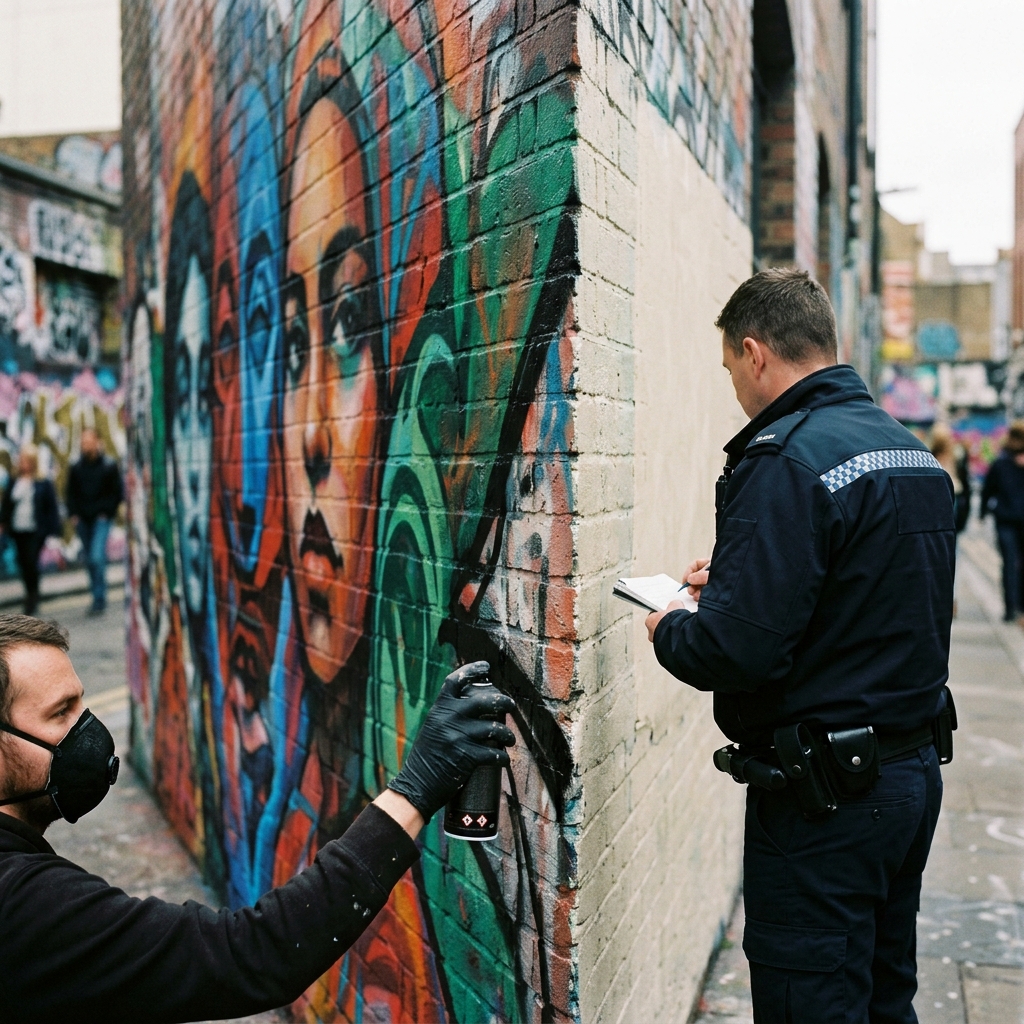
Graffiti sits at a unique crossroads between creative expression and
Graffiti as Expression: Why the Debate Exists
Modern graffiti covers a wide spectrum, from quick tags and slogans to intricate murals that can rival gallery art. Universities and criminology scholars point out that some forms of graffiti are now recognized as street art and can have social, political, or cultural value. At the same time, many residents and city officials view large amounts of unauthorized graffiti as a sign of disorder, contributing to perceptions of crime, neglect, or lower property values.
This tension creates an ongoing debate:
- Art perspective: Graffiti can be a form of protest, identity, or cultural storytelling, giving voice to people who lack access to traditional art spaces.
- Legal perspective: Unapproved markings on buildings, vehicles, monuments, or natural features are generally treated as criminal damage to property, regardless of artistic merit.
- Community perspective: Some neighborhoods embrace curated street art while strongly opposing random, unauthorized tags and markings.
How Criminal Law Defines Graffiti and Vandalism
Although definitions vary by jurisdiction, many legal codes treat graffiti as a specific form of vandalism or criminal mischief. The common thread is that the law focuses on damage to property without consent, not on whether the markings are aesthetically pleasing.
Key Legal Elements Found in Many Statutes
Across different states and cities, graffiti-related offenses often include similar elements:
- Marking property: The person paints, sprays, scratches, etches, or otherwise marks a tangible surface such as a building, fence, vehicle, monument, tree, or rock.
- Belonging to another: The surface is public or private property that the person does not own and has no right to alter.
- Without consent: No express or effective permission has been granted by the owner or authorized agent to place the design or writing there.
- Intent or knowledge: The person acts intentionally or knowingly, aware that they are marking the property and that they lack permission.
In some locations, it is even a crime to possess certain items—such as spray paint, etching tools, or large markers—with the intent to make graffiti, particularly in specified zones or situations. This reflects a policy choice to intervene early and deter defacement before it happens.
Examples from Different Jurisdictions
| Jurisdiction | How Graffiti Is Defined | Key Legal Features |
|---|---|---|
| New York (USA) | “Making graffiti” is a form of criminal mischief involving marking property without permission. | Requires proof of marking property, intent to damage, and lack of express permission; possession of graffiti instruments can also be an offense. |
| Texas (USA) | Graffiti is knowingly making markings on someone else’s property without effective consent using paint, markers, or etching tools. | Penalties scale with the amount of financial loss, ranging from misdemeanors to first-degree felonies. |
| District of Columbia (USA) | Graffiti includes inscriptions, drawings, or designs on structures, vehicles, or natural features visible from public ways, placed without consent. | Penalties include fines, up to 180 days in jail, and restitution; possession of graffiti materials can also be penalized. |
The Central Legal Divider: Consent and Property Rights
Across criminal statutes, one factor consistently determines whether graffiti is treated as art or as a crime: consent of the property owner. Property law gives owners the right to control what appears on their land, buildings, and other assets, and courts generally enforce that control even when artistic value is high.
Why Property Rights Matter More Than Artistic Quality
- Owner’s control: Property owners have a legally protected interest in deciding how their property looks and is used.
- Damage and cost: Removing unwanted paint or etching can be expensive, and the law often requires offenders to reimburse cleanup costs.
- Neutral view of art: Judges and prosecutors usually do not evaluate whether graffiti is “good” art. They focus instead on whether it was placed lawfully.
As a result, an elaborate mural created at night on a private warehouse wall without permission will almost always be treated legally as vandalism, even if art critics praise it. By contrast, a simple tag painted with full permission from the building owner would not meet the definition of a crime because the core element—lack of consent—is missing.
Consent in Practice: From Murals to Community Projects
Many cities now support legal street art through mural programs and designated spaces. In these projects, artists obtain approvals from building owners and often from city departments before painting.
- Walls are formally offered for artistic use.
- Conditions are set on size, themes, or safety protocols.
- Finished works are promoted as part of local culture and tourism.
Once permission is granted, the same artistic act that would otherwise be vandalism becomes lawful creative expression. This demonstrates how legal status depends not on the medium (spray paint versus oil paint) but on whether the artist has a legitimate right to alter that surface.
Types of Graffiti and How Law Sees Them
From a cultural standpoint, graffiti can take many forms:
- Tags: Stylized signatures used to mark presence or territory.
- Throw-ups: Larger bubble-letter designs, often quick and repetitive.
- Pieces and murals: Complex, colorful works that may take hours or days to complete.
- Stencil art: Designs created using cut-out templates and spray paint.
- Political graffiti: Slogans or images conveying social critique or protest.
Law, however, typically does not distinguish between these types when determining criminality. If a mark is placed without consent, it is generally treated as defacement, regardless of whether it is a simple tag or a detailed mural. The main legal distinctions instead relate to:
- Extent of damage or cost of removal.
- Location and type of property: public transit systems, monuments, schools, or historic buildings may receive special protection.
- Prior history: repeat offenders can face more severe penalties.
Penalties: When Graffiti Becomes a Serious Crime
Graffiti offenses are often categorized based on the value of damage and the type of property affected. Legal consequences can range from minor fines to felony convictions with substantial prison time.
Common Consequences for Illegal Graffiti
- Fines: Courts may impose monetary penalties that increase as the estimated cost of damage or cleanup rises.
- Community service: Offenders may be required to remove graffiti or participate in neighborhood clean-up programs.
- Restitution: Artists can be ordered to reimburse property owners for repainting, repairs, or professional cleaning.
- Criminal records: Convictions can appear on background checks, affecting employment, education, and housing opportunities.
- Imprisonment: In more serious cases, particularly where damage is extensive or repeated, jail or prison sentences are possible.
In places like Texas, penalties are explicitly tied to the pecuniary loss—the financial value of the damage—ranging from misdemeanors for minor damage to first-degree felonies when losses exceed certain thresholds. Other jurisdictions use similar graduated scales to reflect the seriousness of the offense.
Balancing Public Art and Legal Boundaries
City governments and communities increasingly recognize that street art can enrich public spaces when managed responsibly. Educational initiatives and official programs aim to distinguish between invited art and damaging graffiti while respecting free expression.
Approaches Cities Use to Manage Graffiti
- Designated legal walls: Specific areas are set aside where artists can paint freely with prior authorization.
- Curated mural programs: Local organizations commission artists to create themed murals, often in partnership with businesses and property owners.
- Rapid removal policies: Governments may invest in quick cleanup services to deter repeat tagging in sensitive areas.
- Youth outreach: Workshops and mentorship programs channel graffiti skills into legal art and design careers.
- Clear legal communication: Public information campaigns explain where art is welcome and where markings will lead to charges.
These strategies attempt to preserve the positive aspects of graffiti as a vibrant art form while reinforcing the principle that property cannot be altered without consent. They also acknowledge that complete elimination of graffiti is unlikely and that constructive engagement may reduce harmful forms more effectively than punishment alone.
Frequently Asked Questions About Graffiti, Art, and Crime
Is graffiti always a crime?
No. Graffiti is generally a crime only when it is placed on property without permission from the owner or authorized agent. When artists secure consent—such as in approved mural projects or legal walls—the same activity becomes lawful street art.
Does it matter if the graffiti has political or social meaning?
From a legal standpoint, content rarely changes the analysis. Even politically charged or socially important messages can be treated as criminal damage if they are placed without consent on someone else’s property. Other laws, such as those protecting freedom of expression, do not usually allow people to bypass property rules.
Can I be charged just for carrying spray paint or markers?
In some jurisdictions, yes. Laws may prohibit possession of tools commonly used for graffiti, such as spray paint or etching devices, when there is evidence of intent to use them to damage property or when carried in restricted settings. Legal outcomes depend on local statutes and the circumstances.
What should property owners do if their building is tagged?
Owners generally have the option to report the incident to law enforcement, document the damage, and pursue cleanup or restitution if an offender is identified. Many cities also provide guidance or services to help remove graffiti quickly, which can discourage further tagging.
How can artists work legally with graffiti styles?
Artists can seek permission from property owners, participate in official mural programs, or use canvases and portable surfaces that they own or can lawfully display. Understanding local laws and building relationships with community partners helps ensure their work is recognized as art instead of vandalism.
Practical Takeaways for Artists and Communities
For anyone interested in graffiti and street art, a few principles help navigate the boundary between creativity and criminal liability:
- Always obtain clear, preferably written, permission before painting or marking someone else’s property.
- Learn how local laws define graffiti, criminal mischief, and vandalism, including any rules about possession of tools.
- Explore legal venues for street art, such as community mural projects, commissioned work, or designated walls.
- Consider the impact of your work on residents, businesses, and public spaces, not just its artistic value.
- For communities, balance enforcement with opportunities for lawful expression to reduce harmful graffiti and support positive art.
Ultimately, the law draws a clear line: consent and property rights
References
- Legal vs illegal contexts of graffiti creation — Graffitifun Europe. 2023-05-10. https://graffitifun.com/legal-vs-illegal-contexts-of-graffiti-creation/
- New York Graffiti and Tagging Frequently Asked Questions — Stephen Bilkis & Associates. 2022-08-01. https://criminaldefense.1800nynylaw.com/faqs/new-york-graffiti-and-tagging-frequently-asked-questions/
- Is Mural Art Moral Graffiti?: Determining the Standards of Criminality for Street Artists — George Washington University Law School. 2020-02-10. https://studentbriefs.law.gwu.edu/clb/2020/02/10/is-mural-art-moral-graffiti-determining-the-standards-of-criminality-for-street-artists/
- Graffiti: Texas Penal Code §28.08 — Saputo Law Firm. 2023-04-15. https://saputo.law/criminal-law/texas/graffiti/
- Graffiti: crime or free expression? — OpenLearn, Open University. 2018-06-20. https://www.open.edu/openlearn/society-politics-law/an-introduction-crime-and-criminology/content-section-2.1
Similar Articles








Read full bio of Sneha Tete




