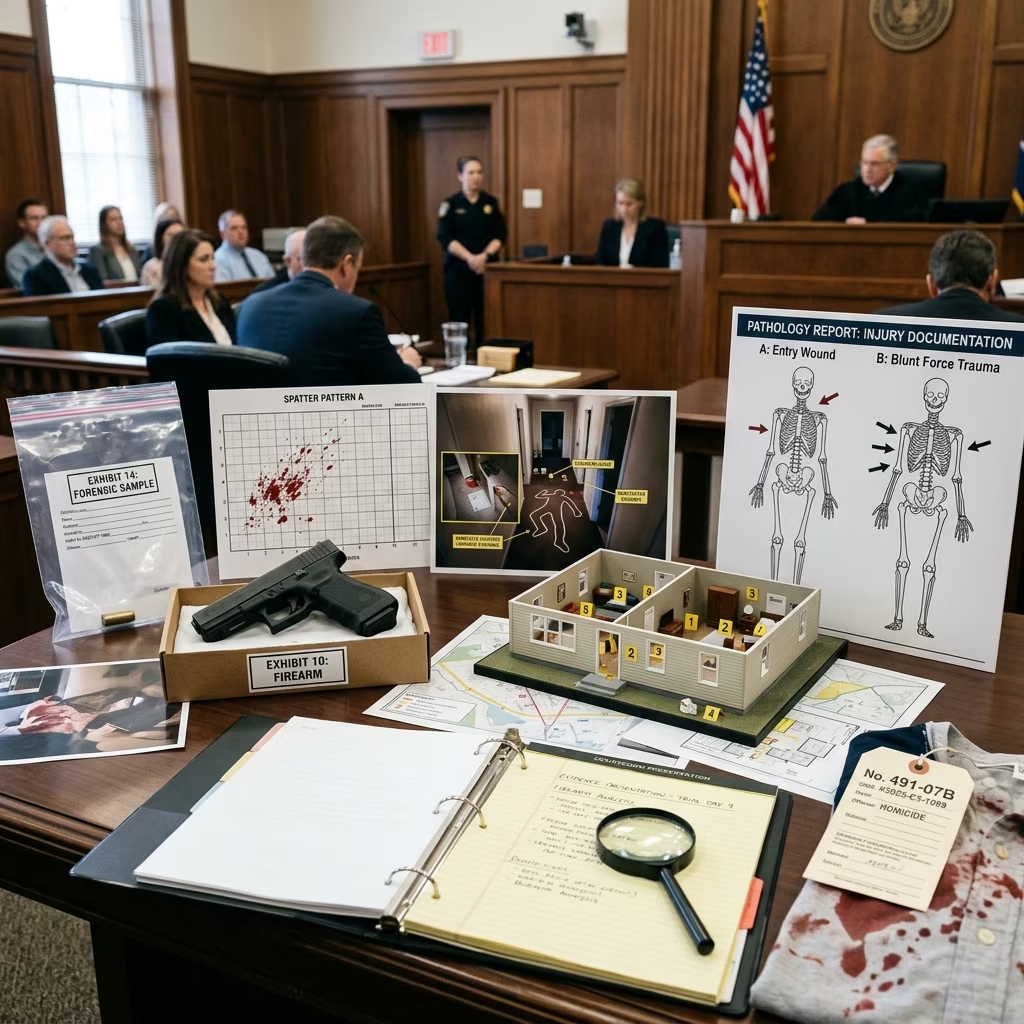
Demonstrative evidence has become a core feature of modern criminal trials. When used properly, visual and illustrative materials can transform dense testimony into clear, memorable stories for judges and juries. This guide explains what demonstrative evidence is, how it differs from other forms of proof, the rules that govern its use, and practical strategies for deploying it effectively in criminal cases.
Understanding Demonstrative Evidence
In criminal litigation, demonstrative evidence refers to visual, graphic, or auditory aids used to explain or illustrate testimony or other evidence, rather than to serve as independent proof of a fact. Courts treat these materials as tools that help the fact-finder understand the case rather than as traditional, standalone evidence items.
Core Definition and Purpose
According to guidance used in various court systems, demonstrative evidence includes any visual or sound aid that clarifies a witness’s testimony or a party’s presentation of its case. It is typically:
- A visual or auditory aid (such as a diagram, map, video clip, or audio recording) designed to make complex facts more accessible.
- Based on other evidence or testimony rather than being created as an independent factual record.
- Used to explain or illustrate what a witness is saying, particularly when concepts are technical, spatial, or chronological.
Legal sources emphasize that demonstrative aids are usually not admitted as substantive evidence and often do not accompany the jury into deliberations; instead, they are used in the courtroom to support understanding of admissible proof.
Distinguishing Demonstrative from Real Evidence
Courts regularly distinguish real evidence (physical evidence such as weapons, clothing, or seized narcotics) from demonstrative evidence like charts, models, or diagrams. Real evidence is received for the truth of what it represents—such as the actual knife used in an assault—while demonstrative evidence is admitted, if at all, as an explanatory aid. Although both can be persuasive, they play different roles in the evidentiary framework.
Common Forms of Demonstrative Evidence in Criminal Trials
Demonstrative exhibits take many forms, ranging from simple hand-drawn sketches to advanced digital simulations. Legal and expert practice materials list a variety of visual aids commonly used to help juries grasp complex testimony and evidence.
Traditional Visual Exhibits
- Photographs and Videos – Still images and recordings of crime scenes, injuries, property damage, or surveillance footage can help jurors visualize key locations and events.
- Diagrams and Illustrations – Scene layouts, body diagrams, and process sketches are frequently used to explain spatial relationships or technical details, such as bullet trajectories or movement patterns.
- Maps and Floor Plans – Geographic and architectural representations can show where events occurred, where witnesses stood, and how individuals moved within a space.
- Charts and Graphs – Data-heavy cases, such as financial crimes, may rely on charts to summarize call records, bank transactions, or timelines of actions.
Modern Digital and Interactive Demonstratives
- Computer-Generated Animations – Digital recreations can depict events such as vehicle collisions, gunshots, or movements through a building, giving jurors a dynamic view of the evidence.
- Simulations and Models – 3D models and simulations may demonstrate mechanical failures, ballistics scenarios, or forensic processes.
- Medical Imaging – X-rays, CT scans, and MRIs are often used to illustrate injuries, internal damage, or disease processes that relate to criminal liability or sentencing.
- Virtual Reality Environments – In rare, advanced cases, virtual reality can immerse jurors or experts in a representation of a scene or process to better understand spatial and temporal aspects.
Each type of exhibit may raise unique admissibility and fairness concerns, but all revolve around the same central function: helping the fact-finder understand the case.
Legal Standards Governing Demonstrative Evidence
Demonstrative evidence must comply with general rules of evidence and specific judicial standards for fairness and accuracy. Courts emphasize relevance, authentication, accuracy, and helpfulness to the jury or judge.
Relevance and Probative Value
Under frameworks like the Federal Rules of Evidence, all exhibits—including demonstratives—must be relevant, meaning they have any tendency to make a fact of consequence more or less probable. Courts may apply provisions on relevance and the management of evidence presentation (such as FRE 401, 402, and 611) to decide whether demonstrative materials are appropriate.
Even when relevant, a court can exclude demonstrative evidence if its probative value is substantially outweighed by risks such as unfair prejudice, confusion, or waste of time, consistent with rules like FRE 403.
Authentication and Accuracy
Judicial guidance emphasizes that demonstrative evidence must fairly and accurately depict what it claims to represent. Typical foundation requirements include:
- Testimony from a witness familiar with the scene, object, or data that the exhibit portrays.
- Confirmation that a photograph or video is an accurate representation of the scene at the relevant time.
- Verification that maps and models are drawn to scale when scale is important.
- Assurances that drawings and diagrams are reasonably accurate and not misleading.
Some jurisdictions articulate these requirements explicitly: an exhibit must be a fair and accurate representation and must help the fact-finder better understand the testimony or case presentation.
Helpful to the Trier of Fact
Courts generally have broad discretion to decide whether demonstrative aids will assist the jury or judge. Rules and case law often require that these exhibits genuinely help the fact-finder understand the evidence, rather than merely adding drama or repetition. The sponsoring witness typically explains why a given chart, model, or animation will make their testimony clearer.
Hearsay and Substantive Use Issues
Because demonstrative evidence is often based on underlying data or statements, it must avoid conflicts with hearsay rules. Commentary on trial demonstratives notes that such exhibits must comply with hearsay exceptions and not introduce new out-of-court statements that lack foundation. When a demonstrative summarizes voluminous records, counsel may rely on rules like FRE 1006, which permit the use of summaries, provided the underlying materials are available for inspection.
Strategic Use of Demonstrative Evidence in Criminal Trials
Beyond meeting evidentiary rules, demonstrative evidence is a tool of advocacy. When thoughtfully designed and timed, it can significantly enhance comprehension and retention of key points.
Where Demonstrative Evidence Appears in Trial
Practice materials highlight that courts may allow demonstrative exhibits at multiple stages of a criminal trial, subject to admissibility and fairness considerations.
- Opening Statements – Some courts permit demonstratives in opening if the exhibits are expected to be admitted and have been disclosed to opposing counsel. These visuals can frame the jury’s understanding of the case from the outset.
- Witness Examination – During direct or cross-examination, sponsoring witnesses often use diagrams, timelines, and photos to explain complex testimony, particularly in forensic and technical areas.
- Closing Arguments – Attorneys may reuse admitted demonstratives or permitted aids to structure their narrative and remind jurors of critical facts and logical connections.
Design Principles for Effective Demonstrative Exhibits
Guidance from practitioners underscores that demonstrative aids should be accurate, simple, and strategically presented. Useful design principles include:
- Base visuals on evidence – Ensure each chart, diagram, or animation reflects admitted or admissible evidence, rather than speculation.
- Keep exhibits clear and uncluttered – Overly detailed visuals can confuse rather than clarify. Multiple simple charts are often more effective than one complex display.
- Use incremental builds – Adding layers or steps to a visual can help jurors follow the logic of the presentation, especially in timeline or data-heavy exhibits.
- Encourage movement and interaction – When appropriate, witnesses can stand, point, or annotate in front of the jury to make the explanation more engaging.
- Maximize visibility – Keeping demonstratives in view long enough helps reinforce jurors’ memory and understanding.
Demonstrative Aids in Expert Testimony
Expert witnesses frequently rely on demonstrative evidence to communicate specialized knowledge to lay jurors. Expert-focused commentary notes that visual aids can enhance expert testimony in ways that spoken words alone cannot, particularly for complex subjects like medicine, engineering, or data analysis. When experts use diagrams, medical images, or simulations, they typically explain how the exhibit illustrates underlying evidence or scientific principles, reinforcing both comprehension and credibility.
Admissibility Foundations: A Practical Checklist
Before preparing demonstrative evidence, counsel should consider whether the court and fact-finder will be receptive and ensure that foundational requirements can be met. The following table summarizes key admissibility factors.
| Requirement | Practical Questions for Counsel |
|---|---|
| Relevance | Does the exhibit make a material fact more or less probable in a meaningful way? |
| Authentication | Is there a witness with personal knowledge who can confirm the exhibit accurately represents what it depicts? |
| Accuracy and Fairness | Is the exhibit a fair, non-misleading portrayal, and is it based on the underlying evidence rather than speculation? |
| Helpful to the Fact-Finder | Will the exhibit genuinely assist the jury or judge in understanding testimony or evidence, rather than merely dramatizing it? |
| Compliance with Other Rules | Does the exhibit avoid introducing hearsay, comply with summary rules, and survive a FRE 403 balancing analysis? |
Risks and Pitfalls When Using Demonstrative Evidence
Although demonstrative exhibits can be powerful, they carry risks. Courts and opposing counsel may challenge visuals that overreach, mislead, or unfairly prejudice jurors.
Potential Grounds for Exclusion
- Misleading or Inaccurate Representations – Exhibits that exaggerate distances, simplify timelines incorrectly, or misstate data can be excluded or limited.
- Undue Prejudice – Graphic images or emotionally charged animations may be excluded when their emotional impact outweighs their probative value under rules like FRE 403.
- Unreliable Digital Simulations – Computer animations based on assumptions rather than admissible evidence can be attacked for lacking sufficient foundation.
- Late Disclosure – Failure to share demonstrative exhibits with opposing counsel in time for review and possible motion practice can prompt judicial skepticism or sanctions.
Practical Steps to Avoid Problems
- Disclose demonstratives to opposing counsel early and be prepared for objections and motion practice.
- Work closely with witnesses, especially experts, to ensure exhibits accurately reflect their testimony and the case record.
- Test the exhibits in mock presentations to identify confusing or potentially prejudicial elements.
- Prepare alternative versions (e.g., less graphic images) in case the court limits certain content.
FAQs: Demonstrative Evidence in Criminal Trials
Is demonstrative evidence always admitted into evidence?
No. In many cases, demonstrative aids are used to help explain testimony but are not formally admitted as substantive exhibits. Legal commentary notes that such aids are often created after the fact and are not treated as evidence that goes back with the jury.
Who must sponsor a demonstrative exhibit?
A witness with sufficient personal knowledge—often an eyewitness, investigator, or expert—must usually sponsor the exhibit. That witness explains how the demonstrative helps convey their testimony and confirms that it is a fair and accurate representation of what it portrays.
Can demonstrative evidence be used during opening statements?
Courts have discretion. Some allow demonstrative exhibits during opening statements if the materials are likely to be admitted and have been disclosed in advance, while others are more cautious. Practice guidance recommends using only exhibits that will be admitted or have already survived motions in limine.
Are computer animations treated differently from photographs?
Computer animations can be more controversial because they often rely on assumptions and complex data. Courts may scrutinize their foundation more carefully, requiring detailed explanations of the underlying evidence and methodology. Photographs and videos, by contrast, are often authenticated by a witness familiar with the scene who verifies that they accurately depict the relevant time and place.
What role do rules like FRE 403 play in demonstrative evidence?
Rules such as Federal Rule of Evidence 403 allow courts to exclude demonstrative exhibits whose probative value is substantially outweighed by risks like unfair prejudice or confusion. This provision is often central to disputes over graphic images, emotionally charged visuals, and dramatic animations.
References
- 11.03 Demonstrative Evidence — New York Unified Court System, Guide to New York Evidence. 2023-01-01. https://www.nycourts.gov/judges/evidence/11-REAL-DEMONSTRATIVE/11.03_DEMONSTRATIVE_EVIDENCE.pdf
- Demonstrative Evidence — State Bar of Michigan, Michigan Bar Journal. 2010-03-01. https://www.michbar.org/file/barjournal/article/documents/pdf4article2724.pdf
- Demonstrative Evidence: Benefits & Admissibility in Expert Testimony — Expert Institute. 2022-05-10. https://www.expertinstitute.com/resources/insights/demonstrative-evidence-expert-testimony/
- Using Trial Demonstratives for Litigation — U.S. Legal Support. 2023-06-15. https://www.uslegalsupport.com/blog/trial-demonstratives/
- Demonstrative Aids: Use Them! — Holland & Knight LLP. 2014-01-01. https://www.hklaw.com/files/Uploads/Documents/Articles/DanSmall/demonstrative-aids-use.pdf
- demonstrative evidence (Wex) — Legal Information Institute, Cornell Law School. 2020-09-01. https://www.law.cornell.edu/wex/demonstrative_evidence