
When Helping Becomes a Crime: Florida’s Battle Over Feeding the Homeless
How permit rules, public parks, and local ordinances turned sharing food with homeless residents into an arrestable offense in Florida.
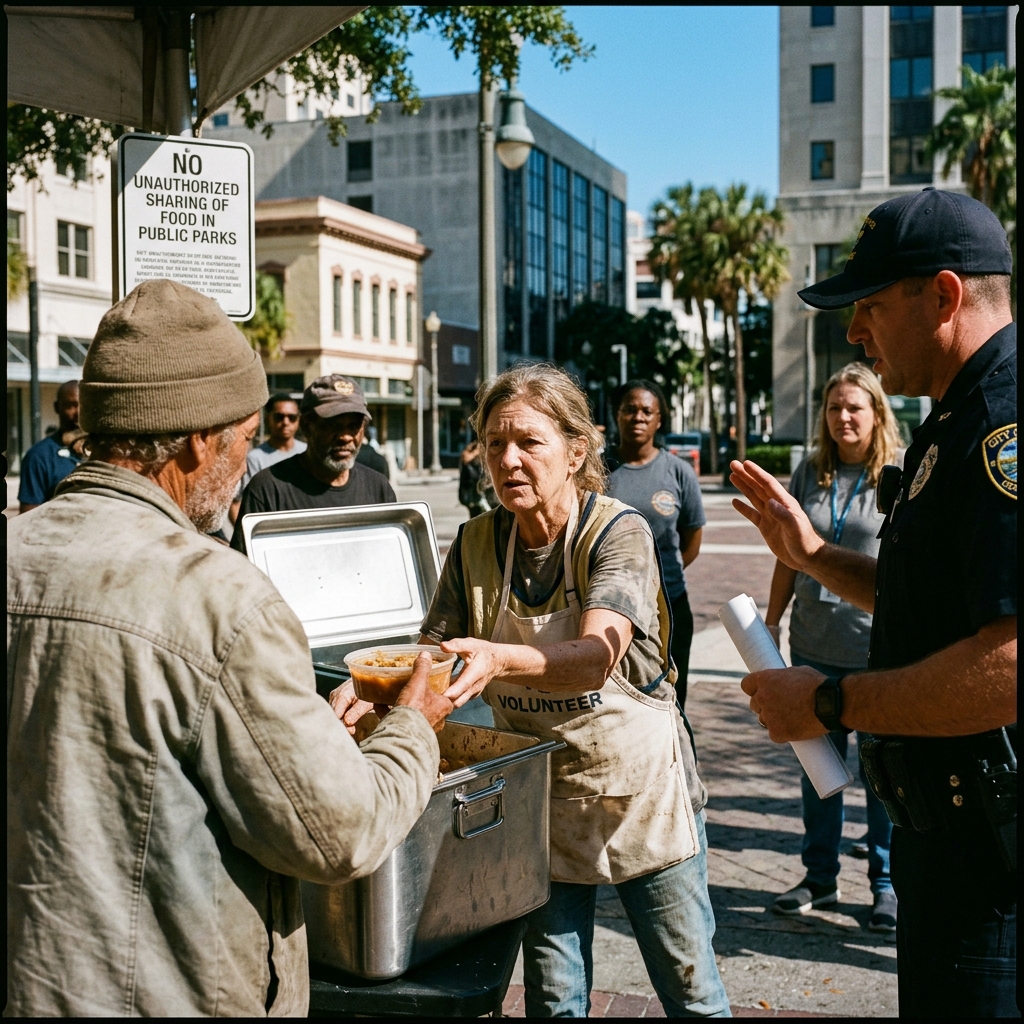
Across Florida, community volunteers have discovered that sharing food with homeless residents in public spaces can lead to arrest when they do not comply with local permit and zoning rules. At the center of the controversy are ordinances that treat outdoor food distribution as a regulated event, rather than a charitable act, raising complex questions about criminal law, public health, and constitutional rights.
From Charity to Criminal Charge: The Florida Context
The inspiration for this discussion comes from repeated incidents in Florida where activists were arrested for feeding homeless individuals in public parks without the required municipal permits. In Tampa, for example, members of the organization Food Not Bombs have been cited and arrested multiple times after serving meals in a downtown park, despite their long-standing mission to provide food to people experiencing homelessness.
While each city uses slightly different language, the pattern is similar:
- Outdoor food sharing is classified as an activity that requires a permit or approval.
- Violating these rules can result in citations, fines, or criminal misdemeanor charges.
- Police are tasked with enforcing ordinances that are framed as public health or public order measures.
These local rules exist against a broader backdrop of homelessness in the United States. The U.S. Department of Housing and Urban Development’s most recent point-in-time count reports hundreds of thousands of people experiencing homelessness nationwide on any given night, with Florida among the higher-burden states.[HUD 2024]
How Local Ordinances Regulate Feeding the Homeless
Generally speaking, Florida state law does not make it inherently illegal to feed homeless people; rather, the restrictions arise from city-level ordinances governing land use, public parks, and food distribution. These ordinances typically do not mention homeless individuals specifically, but they have a disproportionate impact on activities aimed at serving them.
Typical Requirements Found in City Rules
Local measures often include provisions such as:
- Permit requirements for any group serving food in a park or on city property.
- Distance rules that mandate a minimum space between feeding sites and residences or other feeding operations.
- Limitations on frequency, such as caps on how many times per week food can be served in a particular public location.
- Sanitation and equipment rules, requiring access to restrooms, hand-washing facilities, or specific food handling practices.
Violating these rules can lead to civil penalties and, in some jurisdictions, criminal charges. For example, failure to comply with Fort Lauderdale’s food-sharing ordinance has been associated with potential fines and up to 60 days in jail for repeat violations.
Why Cities Say These Rules Exist
City officials and supporters of these ordinances usually cite three main rationales:
- Public health: Ensuring that food distribution follows safety standards, including temperature control, sanitation, and oversight similar to licensed food service operations.[FDA 2023]
- Public order and park management: Managing crowds, preventing congestion, and balancing competing uses of parks and downtown spaces.
- Urban planning and homelessness strategy: Some policymakers argue that unsupervised food sharing may conflict with efforts to move homeless individuals into shelters or services rather than remaining in outdoor encampments.[HUD 2024]
Critics counter that these justifications often mask discomfort with visible poverty and result in criminalizing acts of basic compassion.
Case Study: Tampa and Food Not Bombs
In Tampa, seven volunteers associated with Food Not Bombs have been arrested for sharing food with homeless residents in a downtown park without securing the required permit. The organization, part of a broader international network, focuses on providing vegetarian meals to people in need while protesting war and economic inequality.
Key elements of the Tampa situation, as described in legal reporting, include:
- The city requires a special permit to serve food in public parks.
- Food Not Bombs argues that the permit process is overly burdensome and restricts their ability to consistently feed people who rely on their support.
- Police have repeatedly enforced the ordinance, leading to arrests and ongoing tension between activists and city officials.
| Aspect | Description |
|---|---|
| Location | Downtown Tampa public park as central feeding site. |
| Permit Rule | Groups must obtain a city permit to serve or share food on park property. |
| Primary Charge | Violation of park permit ordinance rather than direct ban on feeding the homeless. |
| Impact on Volunteers | Repeated arrests and citations for activists who continue food sharing in defiance of ordinance. |
These enforcement actions illustrate how administrative rules — often designed with general park management in mind — can effectively criminalize routine charitable outreach when they are applied strictly.
Legal Questions Raised by Food-Sharing Arrests
The arrests of activists feeding homeless people bring multiple areas of law into play, including criminal law, constitutional protections, and municipal governance. Although each city’s ordinances are different, the underlying questions tend to be similar.
Is Feeding the Homeless Ever “Illegal” by Itself?
Under ordinary circumstances, providing food to another person is not a crime. As legal commentators point out, if feeding homeless individuals were inherently illegal, every soup kitchen and homeless shelter would face serious legal obstacles. Instead, the criminal or civil liability usually arises from:
- Violating permit rules or park regulations.
- Ignoring zoning restrictions or distance requirements.
- Failing to comply with food safety or health codes.[FDA 2023]
From a legal perspective, cities frame these as neutral regulations on where and how food may be distributed, not bans on helping homeless people specifically.
First Amendment and Expressive Conduct
Some activist groups argue that their food-sharing efforts are not only charitable but also expressive conduct protected by the First Amendment, because they intend to convey a political message about poverty, war, or social priorities. When food distribution is part of a protest or political campaign, restrictions can raise free speech concerns.
Courts reviewing similar regulations consider whether:
- The ordinance is content-neutral and focused on time, place, and manner, rather than the message being conveyed.
- The government has a substantial interest, such as public health or safety.
- The rule leaves open adequate alternative channels for communication and charitable work.
These are fact-intensive questions, and outcomes can vary across jurisdictions.
Due Process and Vagueness
Another concern is whether ordinances are clear enough that ordinary people can understand what is forbidden. If rules about distances, permits, or gatherings are drafted vaguely, they may invite arbitrary enforcement or discourage lawful charitable activity. Advocates sometimes argue that inconsistent enforcement — citing some groups but not others — raises due process issues.
Policy Debates: Compassion, Control, and Consequences
Beyond the strict legal analysis, food-sharing arrests spark broader debate over how communities should respond to homelessness and public poverty.
Arguments Criticizing Criminalization
Opponents of restrictive ordinances often make several points:
- Morality and human dignity: Arresting people for sharing food with hungry neighbors is seen as fundamentally at odds with basic ethical commitments.
- Immediate needs vs. long-term plans: Even if cities offer long-term strategies for housing, people still need access to food right now.
- Chilling effect on volunteers: The risk of fines or jail discourages individuals and small groups from organizing grassroots assistance.
- Visibility and political pressure: Restricting outdoor food distributions may reduce visible signs of poverty, but it does not solve underlying economic and housing problems.
Arguments Defending Regulation
Supporters of permit requirements emphasize different concerns:
- Health safeguards: Large-scale food distribution in parks without oversight may pose risks if basic food safety practices are not followed, especially for vulnerable populations.[FDA 2023]
- Coordination with services: Cities may want people experiencing homelessness to connect with shelters, outreach teams, and case managers rather than relying solely on informal street-based support.[HUD 2024]
- Impact on neighborhoods: Residents and businesses sometimes complain about crowding, litter, or disorder around informal feeding sites, leading to pressure for regulation.
These competing views can make policy reform challenging, especially when public opinion is deeply divided.
Practical Implications for Volunteers and Organizations
Individuals and groups who want to help homeless residents by sharing food in Florida or other states need to navigate this complex landscape carefully. While legal specifics vary by city, several practical steps can reduce the risk of enforcement actions.
Steps to Minimize Legal Risk
- Review local ordinances: Check municipal codes for rules on park use, special events, and food distribution. City or county websites often publish these regulations.
- Apply for permits where required: Even if activists disagree with the policy, obtaining a permit can reduce the chance of citations or arrests while advocacy continues.
- Partner with established organizations: Collaborating with licensed shelters, churches, or nonprofits may provide access to indoor locations and existing compliance structures.[HUD 2024]
- Document sanitary practices: Demonstrating that food is prepared and served safely, consistent with basic public health guidelines, can strengthen arguments against stricter controls.[FDA 2023]
- Seek legal advice: Civil rights organizations and legal aid groups sometimes assist activists who believe their constitutional or statutory rights are being infringed.
Alternative Ways to Support Homeless Residents
Where outdoor food sharing faces constraints, volunteers may consider complementary approaches:
- Supporting local shelters with food, funds, or clothing.
- Helping with transportation to appointments or services.
- Assisting people with accessing identification documents and benefits programs.
- Advocating for inclusive, evidence-based homelessness policies at city council meetings.
Frequently Asked Questions (FAQs)
Is it always illegal to feed homeless people in Florida?
No. There is no statewide ban on feeding homeless people. Restrictions arise from city ordinances that regulate activities in parks or public spaces, often requiring permits or compliance with specific conditions. Many soup kitchens, shelters, and faith-based charities lawfully provide meals every day.
Why are activists sometimes arrested rather than just warned?
Police enforce municipal ordinances using the tools available to them. In some cases, repeated violations or highly publicized acts of defiance lead to citations and arrests, especially when activists state that they intend to continue without permits or compliance.
Do these ordinances target homeless people directly?
Most ordinances are written in general terms about food distribution, park use, or public events rather than naming homeless individuals. However, they tend to be enforced most often against activities aimed at serving homeless populations, which is why critics describe them as effectively criminalizing assistance to homeless people.
Can activists challenge these rules in court?
Yes. Some groups have challenged food-sharing restrictions on constitutional grounds, including free speech, freedom of association, or religious exercise. Outcomes depend on specific facts and legal arguments, and courts weigh city interests in health and order against claimed rights.
What role does public health law play in these regulations?
Public health frameworks influence how cities design food distribution rules, especially regarding sanitation, temperature control, and safety for vulnerable populations.[FDA 2023] These considerations are often central to local justifications for permits and restrictions, even when activists believe the requirements go beyond what is necessary.
References
- Florida Activists Arrested Again for Feeding the Homeless — FindLaw Legal Blogs. 2017-01-04. https://www.findlaw.com/legalblogs/criminal-defense/florida-activists-arrested-again-for-feeding-the-homeless/
- Florida Activists Arrested For Serving Food To Homeless — NPR. 2014-11-06. https://www.npr.org/sections/thesalt/2014/11/06/362019133/florida-activists-arrested-for-serving-food-to-homeless
- Florida Activists Continue to Feed Homeless, Despite Arrests by Police — CBC Radio, As It Happens. 2016-12-20. https://www.cbc.ca/radio/asithappens/as-it-happens-tuesday-edition-1.3929117/florida-activists-continue-to-feed-homeless-despite-arrests-by-police-1.3929126
- Point-in-Time Count and Housing Inventory Count — U.S. Department of Housing and Urban Development (HUD). 2024-01-08. https://www.hud.gov/program_offices/comm_planning/homeless
- Food Code 2022 — U.S. Food and Drug Administration (FDA). 2023-01-10. https://www.fda.gov/food/fda-food-code
Similar Articles








Read full bio of medha deb


