
Flag Protocols: Who Controls Half-Staff Orders
Understanding the legal authority behind half-staff flag proclamations and ceremonial protocols.
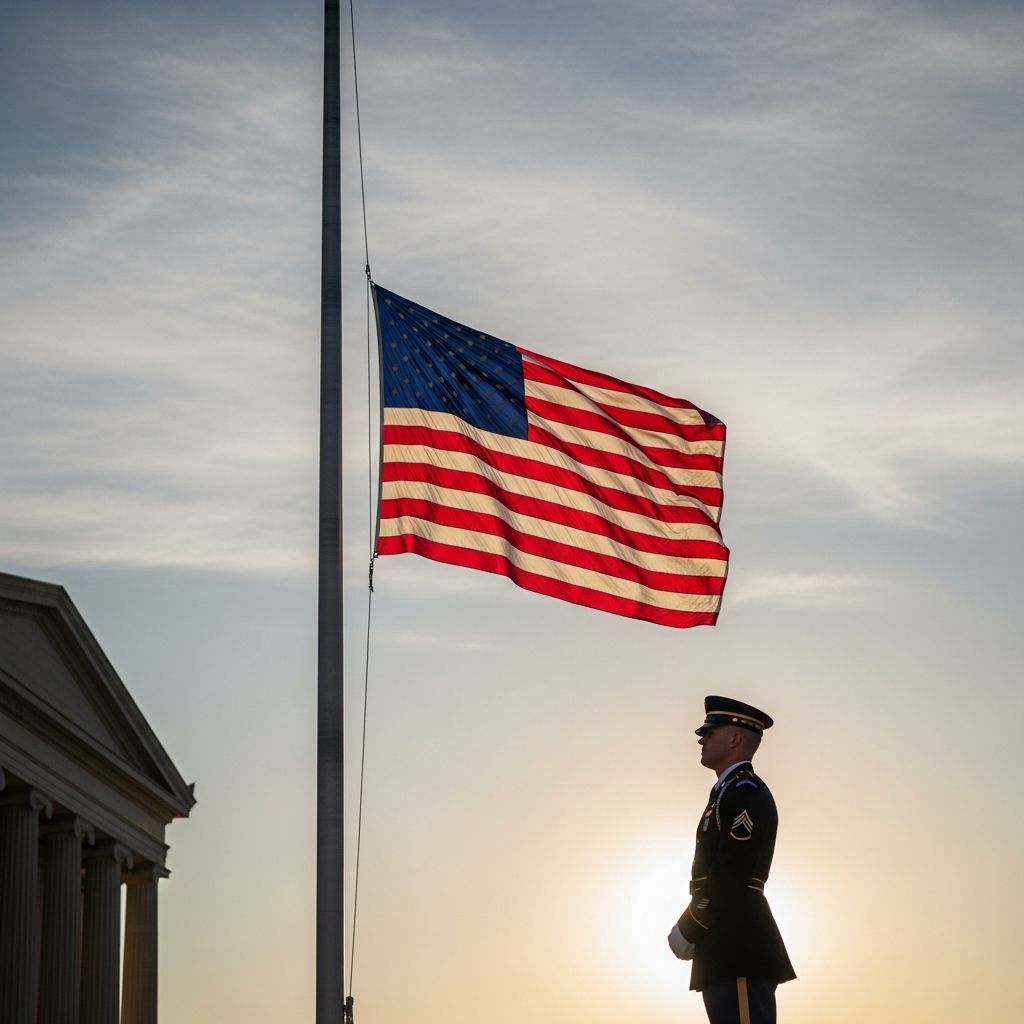
Understanding the Authority Behind Half-Staff Flag Declarations
The display of the American flag at half-staff represents a solemn gesture of national mourning and respect. However, not everyone possesses the authority to make this decision. The power to order flags lowered to half-staff is carefully restricted by federal law and concentrated in the hands of specific government officials. Understanding who holds this power and under what circumstances it may be exercised provides insight into how the nation honors its fallen and marks moments of collective grief.
The Legal Framework Governing Half-Staff Orders
The authority to order half-staff displays derives primarily from the United States Flag Code, a body of federal law that establishes guidelines for proper flag treatment and display protocols. This code was formally established through Presidential Proclamation 3044, issued by President Dwight D. Eisenhower on March 1, 1954, following years of inconsistent practices across the nation. Before this proclamation, different government agencies and officials applied varying standards, creating confusion about when and how flags should be lowered. Eisenhower’s proclamation standardized these practices, establishing clear protocols that remain in effect today.
The Flag Code specifies that only two categories of officials possess blanket authority to issue half-staff orders: the President of the United States and state governors. Additionally, the Mayor of the District of Columbia holds similar authority within Washington, D.C.’s jurisdiction. This concentrated authority ensures that half-staff displays maintain their significance as reserved gestures of national or state mourning rather than becoming commonplace responses to every tragic event.
Presidential Authority and National Proclamations
The President of the United States holds the broadest authority regarding half-staff flag orders, with the power extending across all federal facilities nationwide. Presidential authority encompasses multiple scenarios and categories of individuals whose deaths warrant flag displays at half-staff. The President’s power is not limited to specific circumstances but can be exercised through executive proclamation at the President’s discretion.
According to the Flag Code, the President may order flags to half-staff upon the death of principal figures of the United States government, including cabinet members, justices of the Supreme Court, and members of Congress. The President also possesses authority to order flags lowered upon the death of foreign dignitaries and other officials deemed significant by the sitting President. Furthermore, the President may extend this honor to commemorate national tragedies, including terrorist attacks, mass casualty events, or other catastrophic occurrences that profoundly affect the nation.
Duration of Presidential Half-Staff Orders
The Flag Code establishes specific timeframes for how long flags remain at half-staff following various deaths:
- 30 days following the death of a sitting or former President
- 10 days following the death of the Vice President, Chief Justice or retired Chief Justice, or Speaker of the House of Representatives
- From day of death until interment for an Associate Justice of the Supreme Court, cabinet member, former Vice President, or state governor
- Day of death and the following day for members of Congress
These varying durations reflect the hierarchical importance assigned to different government positions within the national structure. The longest periods honor the nation’s chief executive, while shorter periods mark the passing of other significant officials.
Gubernatorial Authority and State-Level Powers
State governors possess authority to order half-staff displays, though their power is more limited in scope than the President’s authority. Governors may order flags lowered within their states’ jurisdiction, but only under specific circumstances defined by law. Unlike the President’s broader discretionary power, governors operate under more constrained parameters regarding whom they can honor with half-staff displays.
Governors retain authority to lower flags upon the death of current or former state government officials, including other governors, state legislators, and state-level administrators. Additionally, governors possess special authority regarding members of the armed forces from their states. Following the passage of Public Law 110-41, governors gained the power to order flags at half-staff to honor fallen military service members who were residents of their states and died while serving on active duty. This expansion of gubernatorial authority reflected the nation’s desire to properly honor fallen soldiers.
Additional Gubernatorial Responsibilities
Governors also hold authority regarding first responders and law enforcement officers within their jurisdictions in some states. The scope of this authority may vary by state statute, with some states granting governors explicit power to honor fallen firefighters, police officers, and other emergency personnel. This reflects the increasing recognition of the sacrifices made by first responders in service to their communities.
Distinguishing Between Presidential and Gubernatorial Authority
| Authority Type | Scope | Applicable Occasions | Geographic Reach |
|---|---|---|---|
| Presidential | Broadest authority | Principal U.S. government officials, governors, foreign dignitaries, national tragedies | All federal facilities nationwide |
| Gubernatorial | Limited to state | State officials, fallen military from that state, sometimes first responders | State and federal facilities within the state |
| District Mayor | Washington, D.C. only | D.C. officials, D.C. armed forces members, D.C. first responders | Facilities within the District |
Who Must Follow Half-Staff Orders
Half-staff orders issued by the President or a governor apply to different categories of entities depending on the authority issuing the order. Presidential orders binding all federal buildings, grounds, and naval vessels throughout the United States and its territories and possessions. This includes post offices, courthouses, federal office buildings, national parks, and military installations.
State-level orders issued by governors typically apply to all state government buildings, federal facilities located within the state, and often public schools within the state. The specific requirements may vary by state, as governors operate within their delegated authority. Some states have enacted statutes that extend gubernatorial half-staff orders to include public schools and other state-controlled entities.
Private Entities and Voluntary Compliance
Private businesses, private schools, and other non-governmental organizations are not legally required to lower their flags in response to half-staff orders. However, many private entities choose to participate voluntarily, particularly when national tragedies occur or when the deceased held special significance to their community. This voluntary participation reflects the symbolic and cultural importance of the flag display.
Private organizations may lower their flags for reasons beyond those specified in the Flag Code. Companies sometimes lower flags to honor deceased employees, schools may lower them following community tragedies, and civic organizations may do so to mark significant local events. While not mandated by law, these voluntary displays demonstrate respect and solidarity during moments of grief.
The Mechanics of Raising and Lowering Flags at Half-Staff
Proper protocol dictates that flags should not be raised directly to the half-staff position. Instead, the flag must first be rapidly raised to the top of the staff, then slowly and deliberately lowered to the half-staff position, which is approximately one-third of the distance from the bottom of the staff. This protocol ensures that the gesture carries its full ceremonial weight and demonstrates proper respect for the flag itself.
When raising the flag at the conclusion of a half-staff period, the reverse process applies. The flag is first raised briskly to the top of the staff before being carefully secured. This proper handling reflects the deep symbolic significance attributed to the American flag within American culture and governance.
Special Circumstances and Exceptional Occasions
Beyond the standard circumstances outlined in the Flag Code, the President possesses the authority to declare half-staff periods following other tragic events. This discretionary power allows the President to respond to unprecedented circumstances or national catastrophes not specifically enumerated in the code. Historical examples include half-staff declarations following terrorist attacks, major natural disasters, and other events deemed to warrant national mourning.
The President may also direct relevant federal agencies to follow half-staff protocols. Proclamation 3044, Section 5 explicitly authorizes heads of federal departments and agencies to direct half-staff displays on their respective facilities for occasions beyond those specified in the basic code, provided such occasions are deemed appropriate. This provision allows for flexibility while maintaining the ceremonial significance of the gesture.
Finding Current Half-Staff Information
Citizens and organizations seeking to determine whether a half-staff order is currently in effect can consult several resources. The White House website regularly publishes presidential proclamations, and state government websites provide information about gubernatorial orders. Additionally, specialized websites and notification services track federal and state half-staff orders, providing real-time alerts to those who wish to remain informed.
Public schools, government agencies, and other organizations can access official proclamations to determine their obligations. This accessibility ensures that the public and relevant entities remain informed about current half-staff requirements and the occasions they commemorate.
Frequently Asked Questions
Q: Can a city mayor order flags to half-staff?
A: In most jurisdictions, only the state governor or President can order flags to half-staff at government facilities. The Mayor of Washington, D.C. holds this authority within the District, but mayors in other cities generally do not possess this power.
Q: Are private businesses required to lower their flags?
A: No. The Flag Code applies only to government facilities. Private businesses may choose to lower their flags voluntarily as a gesture of respect, but they are not legally required to do so.
Q: How long does a typical half-staff order last?
A: Duration depends on the occasion and the authority issuing the order. Presidential half-staff orders for presidents last 30 days, while orders for other officials vary from one day to the period until interment.
Q: Can governors lower flags for private citizens?
A: No. Governors can only order half-staff displays for government officials, military members from their state, and sometimes first responders, depending on state law.
Q: What is the proper way to lower a flag to half-staff?
A: The flag should be raised briskly to the top of the staff first, then slowly lowered to the half-staff position approximately one-third from the bottom. This protocol must be followed when both raising and lowering the flag.
Q: Are half-staff orders mandatory for all government buildings?
A: Presidential half-staff orders apply to all federal facilities nationwide. State governor orders apply to state facilities and federal facilities within their state. Local government buildings follow gubernatorial orders for their state.
References
- Flag Code FAQ: Half staff; half mast — USHistory.org. Accessed April 2026. https://www.ushistory.org/betsy/faq3.htm
- Flying the American Flag at Half Staff — U.S. Department of Veterans Affairs. Document. https://www.va.gov/opa/publications/celebrate/halfstaff.pdf
- Flying the US Flag at Half-Staff and Half-Mast — Flags Express. Accessed April 2026. https://flagsexpress.com/flying-the-us-flag-at-half-staff-and-half-mast/
- Which organizations have to follow half-staff flag orders — University of Georgia Politics. Video. Accessed April 2026. https://www.youtube.com/watch?v=Sr9SWJirER8
Similar Articles








Read full bio of medha deb




