
How to Record a Real Estate Deed in Maryland
A practical step-by-step guide to preparing, taxing, and recording real estate deeds in Maryland, from draft to land records.
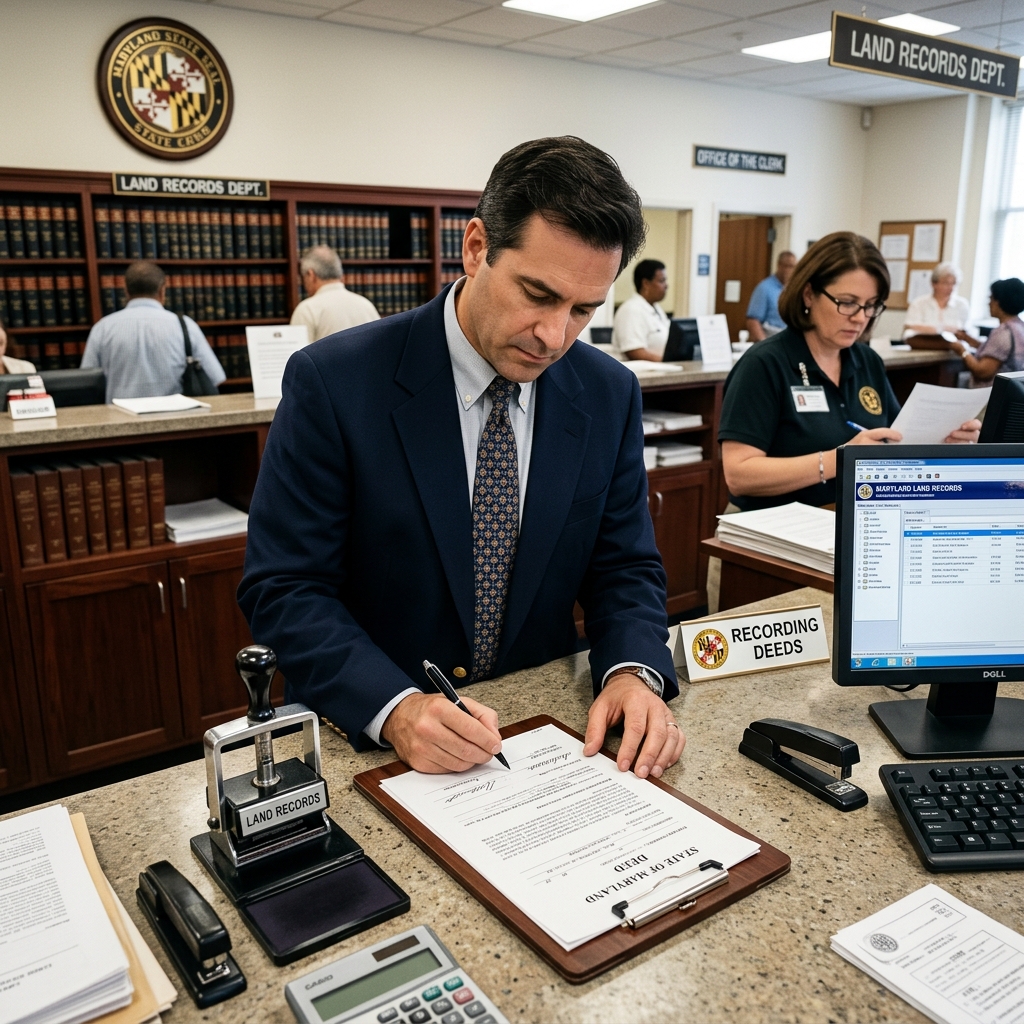
Recording a real estate deed in Maryland is a formal legal process that ensures a change in property ownership is recognized by the state and local government. Proper recording protects buyers and sellers, establishes public notice of ownership, and is required for most transfers to be enforceable against third parties.
This guide explains, in practical detail, how to prepare, tax, and record a deed for real property located in Maryland. It is designed for owners, buyers, and non-lawyers who want a clear roadmap, but it is also useful for professionals who need a concise overview of the state’s requirements.
Overview: Why Deed Recording Matters in Maryland
In Maryland, every deed must be recorded in the land records of the county (or Baltimore City) where the property is located. Recording:
- Provides public notice of who owns the property.
- Establishes priority against other claims, such as later liens or conflicting transfers.
- Triggers updating of tax and assessment records by local authorities.
- Is required before many government agencies will recognize the new owner.
Maryland statutes establish prerequisites that must be satisfied before a deed can be accepted for recording, including signatures, notarization, and payment of required taxes and fees.
Key Parties and Terms Involved in a Deed
Understanding basic deed terminology helps you navigate the recording process:
- Grantor – The current owner transferring all or part of their interest in the property.
- Grantee – The person or entity receiving ownership.
- Consideration – The value given in exchange for the transfer, often the purchase price. Maryland generally requires the deed to state the actual consideration if there is one.
- Legal description – The formal description of the property (lot, block, subdivision, or metes and bounds) that precisely identifies the land being conveyed.
- Land records – The official county records where deeds and mortgages are stored and indexed.[10]
Step 1: Decide on the New Ownership and Deed Type
The first step is to determine exactly how ownership will be held after the transfer. Common situations include:
- Transferring full ownership to a buyer after a sale.
- Adding a spouse or family member to the title.
- Removing an owner after divorce, buyout, or death.
- Transferring property into or out of a trust.
In Maryland, any change to who holds title generally requires a new deed transferring the property from the current owners to the desired new owner or owners. You cannot simply “edit” an existing deed; you must create and record a new instrument.
Step 2: Drafting the Deed Document
Maryland law requires deeds to include specific information to be valid and recordable. At a minimum, a properly drafted deed usually includes:
- Names and addresses of the grantor(s) and grantee(s).
- A clear statement of the interest being transferred (for example, fee simple ownership).
- A complete legal description of the property that matches prior deeds and assessment records.
- The amount of consideration or a clear statement that there is no consideration, if applicable.
- Any reference to prior recorded deeds by book and page numbers, if helpful for clarity.
Many deeds are prepared by attorneys or title companies, but Maryland does not require that a lawyer draft every deed. However, incorrect drafting can lead to rejection at recording or legal disputes later, so careful attention to detail is essential.
Certificate of Preparation
Maryland commonly requires a statement indicating who prepared the deed (for example, attorney or party), often referred to as a Certificate of Preparation. This helps the land records office and courts identify the responsible drafter if issues arise.
Step 3: Notarization and Required Affidavits
Before a deed can be recorded, it must be properly executed:
- The grantor signs the deed in ink.
- The signature is acknowledged before a notary public or other authorized official.
- The notary completes the acknowledgment, including date, jurisdiction, and seal.
In addition to notarization, some transactions require affidavits or certifications. Examples include:
- Owner-occupancy affidavits, especially for principal residences, which can affect tax treatment.
- Non-resident withholding forms if the seller is not a Maryland resident and subject to state income tax withholding on the sale.
- Tax exemption references when claiming relief from transfer or recordation taxes for specific types of transfers, such as certain family transfers or refinances.
These documents must be correctly completed and attached to the deed package; missing or altered forms can cause rejection.
Step 4: Lien Certificate and Local Charges
Many Maryland counties require a lien certificate or tax certificate before a deed can be recorded. This document states whether any unpaid taxes, water and sewer charges, or other obligations are outstanding on the property. Key points:
- You generally request the lien certificate from the county finance or taxpayer services office.
- An application form and fee are usually required, and processing can take several days or weeks.
- The certificate lists amounts that must be paid before the property can be transferred free of those local obligations.
Once the certificate is issued, most counties require all listed amounts to be paid at or before recording. The finance office typically stamps or signs the deed package or intake sheet to confirm that obligations have been satisfied.
Step 5: Completing the Maryland Land Instrument Intake Sheet
Maryland uses a standardized Land Instrument Intake Sheet for deeds and other land instruments. This form is crucial because it:
- Provides basic information about the parties and property.
- Helps the clerk calculate state and local transfer taxes and recordation taxes.
- Indicates any claimed exemptions and cites the applicable Maryland code sections.
The intake sheet generally accompanies the original deed and any required copies when you visit the land records division. In some counties, the finance office will sign or stamp the intake sheet after verifying tax payments and lien certificate obligations.
Step 6: Calculating and Paying Transfer and Recordation Taxes
Maryland imposes several taxes and fees when property is transferred and recorded:
- State transfer tax – A tax on the transfer of real property, often calculated as a percentage of consideration.
- County transfer tax – Additional local tax imposed by many counties.
- Recordation tax – A tax on recording instruments affecting property, including deeds and mortgages.
- Recording fee – A fee payable to the clerk of the circuit court for indexing and storing the deed in land records.
Tax amounts depend on the county, on the consideration stated in the deed, and on whether any exemptions apply. For example, Baltimore County directs parties to contact the Land Records Office for current state transfer tax and recording fees. Low-income or certain owner-occupied transfers may qualify for reduced or exempt taxes, but documentation and statutory references must be precise.
| Type of Payment | Payer | Purpose |
|---|---|---|
| State Transfer Tax | Usually buyer (grantee) | Tax on transferring real property in Maryland |
| County Transfer Tax | Buyer, seller, or shared by contract | Local tax imposed by many counties |
| Recordation Tax | Varies by agreement | Tax on recording instruments affecting land |
| Recording Fee | Person presenting deed | Clerk’s fee for indexing and preserving the deed |
Step 7: Presenting the Deed Package for Recording
Once the deed, intake sheet, lien certificate (if required), affidavits, and payment checks are assembled, you must deliver them for recording.
Typical steps include:
- Bring the original deed and at least one full copy.
- Include the completed Land Instrument Intake Sheet.
- Provide checks or other accepted forms of payment for taxes and fees, often payable to the Clerk of the Circuit Court and, where required, the county treasurer.
- Visit the Office of Finance (or similar agency) first in counties that require approval and stamping before the deed goes to land records.
- Submit the package to the Land Records Division of the circuit court for final recording.
County procedures vary. For example, Prince George’s County uses a two-step process: the deed and intake sheet are taken first to the Office of Finance for tax review and payment, then forwarded to or delivered to the Land Records Division for recording.
Step 8: What Happens After the Deed is Recorded
After the land records clerk accepts the deed package and confirms that all prerequisites have been met, the deed is assigned a book and page number or similar index reference and officially recorded.[10] Generally:
- The original deed is returned by mail to the party designated on the document, often within a few weeks.
- The county or state assessment office updates its records to reflect the new owner and may revise tax bills accordingly.
- The recorded deed can be viewed online through Maryland’s land records system (MdLandRec.net) after creating an account.
Once recorded, the deed becomes part of the public record. Anyone can look up the transaction and confirm ownership. Recorded deeds are also used in future transfers, refinances, or legal actions involving the property.
Common Reasons Deeds Are Rejected
Maryland recording offices frequently reject deeds for avoidable errors. Some of the most common issues include:
- Missing or incomplete notary acknowledgment.
- Legal description that does not match prior deeds or assessment records.
- Failure to state the correct consideration or purchase price.
- Omission of required affidavits or tax forms, especially for non-resident sellers or exempt transactions.
- Failure to include a completed intake sheet.
- Unpaid local taxes or charges listed on the lien certificate.
- Incorrect checks or payment amounts for transfer and recordation taxes.
Careful review of the deed and supporting documents before submission greatly reduces the risk of rejection and delays.
Practical Tips for a Smooth Recording Process
- Verify property information against prior deeds and online assessment records before drafting the deed.
- Consult county instructions for lien certificate requirements, intake sheet details, and current fee amounts.
- Prepare separate checks for each tax or fee if the county requires them to be paid to different offices.
- Do not alter official forms or affidavits; fill them out completely and accurately.
- Keep copies of all documents and receipts associated with recording for your records.
- Consider legal advice if you are changing ownership structure (such as adding or removing owners, dealing with estates, or transferring to a trust).
Frequently Asked Questions (FAQs)
Do I always need to record a deed in Maryland?
Yes. Maryland law requires deeds to be recorded in the land records of the county where the property is located to give public notice and to ensure the transfer is effective against third parties.
Can I change the names on a deed without creating a new deed?
No. To add or remove someone from title in Maryland, you must prepare and record a new deed transferring the property from the existing owners to the new ownership arrangement.
How do I find the current deed for my property?
You can look up deeds online through Maryland’s land records system (MdLandRec.net). You will need to create an account and search by county and property information. Assessment records from the Maryland Department of Assessments and Taxation can also help you identify book and page references.
What if the prior owner died and the deed does not match the will?
Generally, the deed controls how property is titled. Only property that is solely in the decedent’s name is governed by the will, and probate or other legal proceedings may be required to transfer title. When owners die without a will, Maryland’s intestacy laws determine who rightfully owns the property and who should receive a new deed.
How long does it take to get the original deed back after recording?
Most Maryland clerks mail the original deed back within a few weeks after recording, depending on local processing times and mail service.
Can I record a deed without paying outstanding taxes or charges?
Counties that require lien certificates generally insist that all listed obligations be paid before recording. If taxes or charges remain unpaid, the finance office may refuse to sign off on the intake sheet, and the land records office can reject the deed.
References
- Steps for Recording a Maryland Real Estate Deed — Maryland People’s Law Library. 2024-02-01. https://www.peoples-law.org/steps-recording-maryland-real-estate-deed
- Deed Transfer and Recordation — Baltimore County Government. 2023-09-15. https://www.baltimorecountymd.gov/departments/budfin/taxpayer-services/deed-transfer-recordation
- Deed Recording for Low-Income Clients — Maryland Volunteer Lawyers Service. 2024-09-01. https://mvlslaw.org/wp-content/uploads/2024/09/Recording-a-Deed-in-Maryland.pdf
- Avoiding Common Recording Issues in Maryland Real Estate Transactions — Eagle Title. 2023-05-10. https://eagletitle.com/how-to-record-your-deed-and-avoid-rejections-in-maryland/
- Land Records – Recording Process for Deeds — Maryland Courts, Washington County Clerk. 2022-06-01. http://www.courts.state.md.us/clerks/washington/recordingfees
- Land Records — Maryland Courts. 2023-11-20. http://www.mdcourts.gov/legalhelp/landrecords
- Frequently Asked Questions – Deeds — Maryland People’s Law Library. 2023-03-10. https://www.peoples-law.org/frequently-asked-questions-deeds
Similar Articles








Read full bio of Sneha Tete


