
Divorce, Separation, and U.S. Immigration: What Happens to Your Status?
Understand how divorce or separation may affect marriage‑based visas, green cards, and citizenship, and what options you may still have.
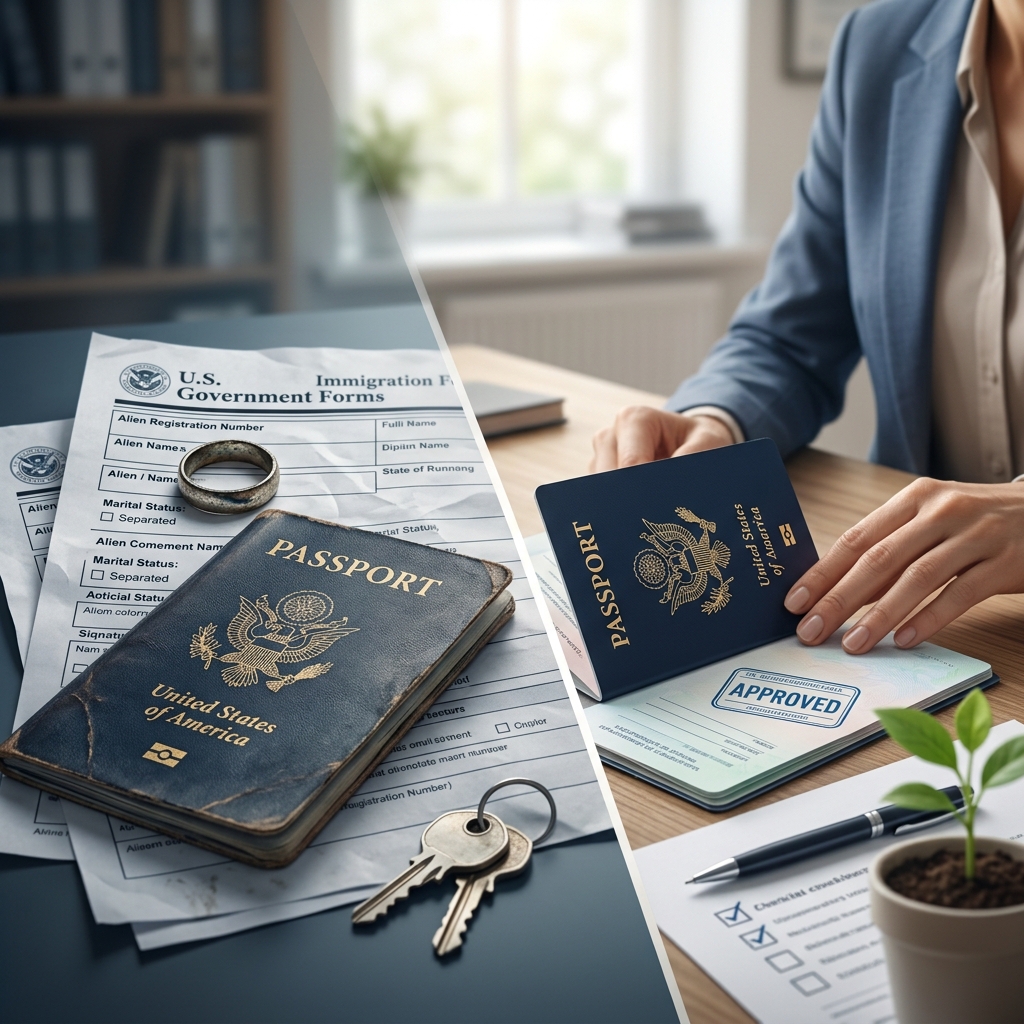
Ending a marriage is difficult on its own. When that relationship is also the basis for your U.S. immigration status, the stress can feel overwhelming. This guide explains in clear terms how divorce or legal separation can affect your visa, green card, and path to citizenship, and what options may still be available to you.
Why Divorce Can Affect Immigration Status
Many people obtain immigration benefits through a spouse who is a U.S. citizen or lawful permanent resident. When that marriage ends, the immigration benefit tied to the relationship may be at risk because the law assumes the marriage is the foundation of the benefit.
However, the impact of divorce is not the same for everyone. It depends on factors such as:
- Whether your case is still pending or already approved
- Whether you hold a dependent visa or your own independent status
- Whether you have a conditional or permanent green card
- Whether the marriage was good faith (real) versus fraudulent
- Whether domestic violence or abuse is involved, which may open special protections
Key Immigration Categories Affected by Divorce
To understand your situation, it helps to identify the immigration category you fall into. Divorce affects each category differently.
1. Marriage-Based Green Card Applicants (Case Still Pending)
If you are in the middle of the process and do not yet have permanent resident status, divorce can stop the case.
- The petition is based on a valid, ongoing marriage.
- Once the marriage ends, that basis usually disappears.
In many marriage-based cases:
- A divorce before approval often leads to denial of the pending application.
- You may need to find another legal basis to remain in the U.S., such as employment-based sponsorship, another qualifying family member, asylum, or relief connected to abuse.
2. Conditional Residents (Two-Year Green Cards)
People married for less than two years at the time their green card is approved receive a two-year conditional card instead of a ten-year card.
To keep status, conditional residents must file a petition to remove conditions (commonly known as Form I‑751) near the end of the two-year period. Normally, this petition is filed jointly with the U.S. citizen or permanent resident spouse.
Divorce during this conditional period can create significant risks:
- Without removing conditions, status expires and you can become deportable.
- A divorce can trigger closer scrutiny of whether the marriage was entered in good faith.
3. Permanent Residents (Ten-Year Green Cards)
Once you have a ten-year green card, your status is normally independent of your spouse.
In most situations:
- Divorce does not automatically revoke permanent resident status.
- Only the government (not your spouse) can attempt to revoke status, and usually only for reasons like fraud or serious criminal activity.
However, divorce may affect:
- The amount of time you must wait before applying for U.S. citizenship
- How closely your case is reviewed when you later apply for naturalization
4. Dependent Visa Holders
Some people are in the U.S. on a dependent visa tied to their spouse’s work or status, such as certain categories related to employment-based visas.
With many dependent visas:
- Your right to stay is directly linked to being that person’s spouse.
- When the divorce becomes final, you can lose this dependent status.
In these situations, you generally must seek a new form of status—such as switching to your own work visa, a student visa, or other options—if you plan to remain in the U.S. after divorce.
Divorce vs. Legal Separation: Different Legal Consequences
It is important to distinguish between divorce and legal separation. A legal separation allows couples to live apart and resolve some issues, but they remain legally married.
This difference matters because many immigration rules focus on whether the marriage is legally ended:
- A legal separation usually does not terminate the marriage under state law.
- A divorce judgment formally ends the marriage.
As a result:
- A separated spouse may still qualify for certain marriage-based immigration benefits because the marriage continues to exist legally.
- A divorce can cut off eligibility for some benefits or start deadlines for filing waivers and other applications.
Good Faith Marriage and Fraud Concerns
U.S. immigration law requires marriage-based cases to be based on a good faith marriage—one entered for genuine personal reasons, not just to obtain immigration status.
When a couple divorces, immigration authorities may look more closely at whether the marriage was real, especially when:
- The marriage was brief and ended soon after the immigrant obtained status
- There is limited documentation of shared life (e.g., joint accounts, shared housing)
- There are allegations of fraud, bigamy, or marriage only for immigration purposes
Evidence commonly used to show good faith marriage can include:
- Joint leases or home ownership documents
- Shared bank or credit accounts
- Birth certificates of children from the relationship
- Photos, correspondence, and statements from friends or family
Impact on Path to U.S. Citizenship
Divorce can also influence when you become eligible to apply for U.S. citizenship (naturalization), especially if your green card was based on marriage to a U.S. citizen.
| Situation | Typical Naturalization Waiting Period | Effect of Divorce |
|---|---|---|
| Married to U.S. citizen, living together, based on a good faith marriage | Can often apply after 3 years as a permanent resident | 3-year rule applies only while still married and living together |
| Permanent resident not relying on marriage-based 3-year rule | Standard 5-year waiting period | Divorce usually means you must follow the 5-year rule instead of the 3-year rule |
Even where divorce affects timing, it does not usually erase permanent resident status on its own.
Special Protections in Cases of Abuse
If your spouse is abusive, divorce or separation can interact with special provisions in U.S. immigration law that are designed to protect victims. These include laws often referred to as the Violence Against Women Act (VAWA)
These protections may allow an abused spouse or certain children to:
- Self-petition for immigration benefits without relying on the abusive spouse’s cooperation
- Seek to maintain or obtain status even after divorce or separation, when the abuse is documented
- Preserve confidentiality and avoid the abuser learning details of the immigration case
Because timelines and evidence rules can be complex in these cases, it is especially important for survivors to seek legal advice from someone familiar with both family and immigration law.
Practical Steps If You Are Divorcing With Immigration Issues
If divorce or separation is on the horizon and your immigration status is connected to the marriage, early planning is critical.
1. Identify Your Current Immigration Status
- Confirm whether you hold a dependent visa, a conditional green card, a permanent green card, or are still in a pending application stage.
- Check expiration dates and upcoming filing deadlines, especially if you have a two-year card requiring conditions to be removed.
2. Gather Evidence of Your Marriage
- Collect documents showing shared residence, finances, and family life.
- Keep copies of important records, especially if access may become difficult during a contentious divorce.
- Document any history of abuse or coercion if relevant, including police reports, medical records, or statements from counselors.
3. Seek Legal Advice
- Consult an immigration professional to understand how state family law procedures may affect federal immigration rules.
- In complex cases, it may be helpful to have both a family law attorney and an immigration attorney coordinate strategies.
4. Consider Alternative Immigration Options
- If a marriage-based application may be denied due to divorce, explore another basis for remaining in the U.S., such as employment-based status, humanitarian relief, or other family-based categories.
- Ask about self-petition options and waivers where abuse or other special circumstances are present.
Frequently Asked Questions
Will I automatically lose my green card if I get divorced?
No. Most people with a ten-year permanent resident card do not automatically lose status solely because they divorce. Status can be questioned if there are signs of fraud or other serious problems, but simply filing for divorce is not in itself a ground for automatic loss of lawful permanent residence.
What if my marriage-based green card case is still pending when we divorce?
When the marriage ends before approval, the petition tied to that marriage often cannot move forward, and the application may be denied. In that situation, you must usually find another legal path to remain in or return to the United States.
Can I remove conditions on my two-year green card after divorce?
Yes, in many cases. A divorced conditional resident may request a waiver of the usual joint filing requirement, but must provide strong proof that the marriage was entered in good faith. If you fail to remove conditions, your conditional status can expire, leaving you without lawful status.
Does legal separation affect my immigration status differently from divorce?
Yes. Legal separation typically does not end the marriage under state law, so some marriage-based benefits may continue while you are still legally married. By contrast, a finalized divorce can cut off certain marriage-based benefits and may start deadlines for filing waivers or other applications.
Can my U.S. citizen spouse revoke my green card during divorce?
No. A private individual, including a U.S. citizen spouse, does not have the authority to revoke lawful permanent resident status. Only government agencies can attempt to change or terminate status, and they must follow legal procedures and show valid grounds such as fraud or serious crimes.
What if my spouse was abusive?
Where there is abuse, special protections may allow you to pursue immigration options without relying on the abusive spouse. These protections can apply even if you are separated or divorced, and specific rules govern timing and confidentiality. Because these cases are sensitive and complex, speaking with a knowledgeable professional is strongly recommended.
References
- Divorce and Immigration Status Bench Card — National Immigrant Women’s Advocacy Project (NIWAP). 2019-04-01. https://niwaplibrary.wcl.american.edu/wp-content/uploads/Divorce-Bench-Card-4.1.2019-1.pdf
- Divorce & Legal Status — Immigrants and New York State Courts, Fund for Modern Courts. 2022-06-01 (approx.). https://immigrants.moderncourts.org/module/matrimonial-integrated-domestic-violence/divorce/
- Divorce and Your Green Card: Risks, Waivers, and Citizenship — Dixler & Associates. 2023-07-01 (approx.). https://dixler.com/what-are-the-consequences-of-divorce-on-a-marriage-based-green-card/
- Divorce & Green Card: Immigration Impact — PCB Law Firm. 2023-02-01 (approx.). https://www.pcblawfirm.com/divorce-immigration-green-card-status/
- Immigration and Divorce: Will I Lose My Green Card? — Dworken & Bernstein Co., L.P.A. 2022-10-01 (approx.). https://dworkenlaw.com/immigration-and-divorce-will-i-lose-my-green-card/
- How Divorce Can Affect the Immigration Process — JAD Law PLLC. 2022-05-01 (approx.). https://jadlawpllc.com/how-divorce-can-affect-the-immigration-process/
Similar Articles








Read full bio of Sneha Tete


