
Felony Convictions and Their Impact on U.S. Immigration Status
Understand how felony and related criminal convictions can affect visas, green cards, deportation risk, and future immigration options.
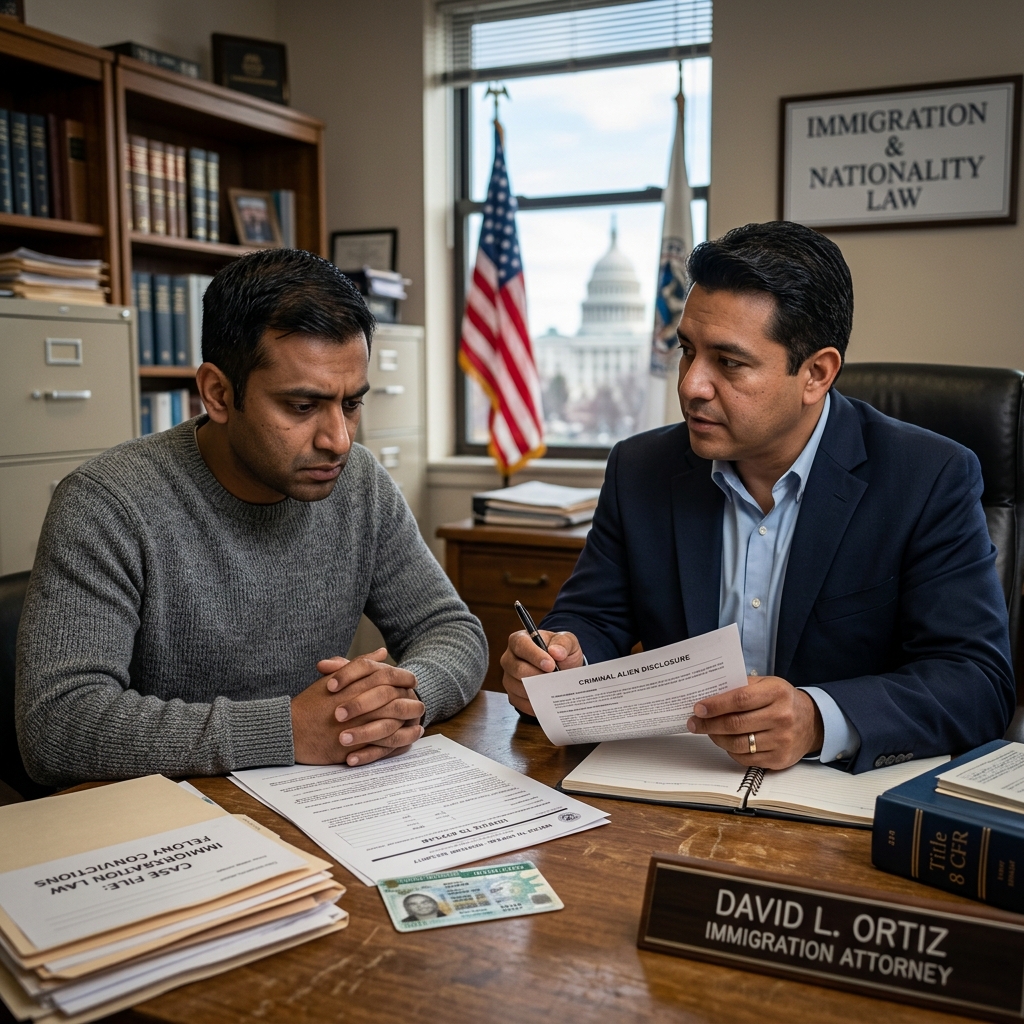
Criminal law and immigration law intersect in complex and often unforgiving ways. For noncitizens living in or seeking to enter the United States, a felony conviction or other serious criminal record can trigger detention, deportation, long-term bars to immigration benefits, and the loss of future opportunities such as citizenship.
This article explains how different types of convictions are treated under U.S. immigration law, what consequences they may have for people with visas, green cards, or no lawful status, and why speaking with both a criminal defense attorney and an immigration lawyer is critical before accepting any plea or going to trial.
Criminal Categories That Matter in Immigration Law
Immigration law does not simply copy state criminal codes. Instead, it uses its own classifications to decide who can be admitted, who can stay, and who must be removed from the country. Two categories are particularly important: aggravated felonies and crimes involving moral turpitude (CIMTs).
Aggravated Felonies
Despite the name, “aggravated felony” is a term of art in federal immigration law, not a label from state criminal statutes. Some offenses are treated as aggravated felonies even if a state calls them misdemeanors, and not all serious state felonies qualify. The federal definition appears largely in the Immigration and Nationality Act (INA) and is elaborated in agency guidance and case law.
Common examples of aggravated felonies include:
- Certain drug trafficking offenses
- Crimes of violence with a specified minimum sentence
- Theft or burglary with a sentence of at least one year
- Money laundering and fraud offenses above a monetary threshold
- Some firearms trafficking and alien smuggling offenses
A single aggravated felony conviction usually makes a noncitizen deportable and also cuts off access to most forms of immigration relief that might otherwise prevent removal.
Crimes Involving Moral Turpitude (CIMTs)
Crimes involving moral turpitude are offenses that involve inherently dishonest, base, or seriously harmful conduct. There is no single statutory definition, and courts have developed the concept over time. CIMTs often include:
- Fraud and embezzlement offenses
- Theft and larceny crimes with intent to permanently deprive
- Certain violent crimes showing extreme disregard for safety
- Serious offenses involving deception or abuse of trust
One CIMT can make a person inadmissible or deportable depending on timing, sentence, and prior history, while multiple CIMTs often create a stronger basis for removal or denial of future immigration benefits.
Felony Convictions and Deportation Risk
For noncitizens, the consequences of a felony conviction reach far beyond fines or jail. Immigration authorities may initiate removal proceedings and, in some situations, detain a person without the possibility of release on bond while the case is pending.
Who Can Be Placed in Removal Proceedings?
U.S. immigration law draws a distinction between deportable and inadmissible persons:
| Status | Where the Person Is | Typical Trigger | Example Impact |
|---|---|---|---|
| Deportable | Inside the United States after lawful admission | Conviction for certain deportable crimes, including many aggravated felonies | Placed in removal proceedings and may lose permanent residence |
| Inadmissible | Seeking entry or a new immigration benefit | Convictions or conduct that block admission under INA grounds | Denied visas, entry at the border, or adjustment to permanent residence |
Both categories can arise from felony convictions or certain misdemeanors, depending on the specific offense and sentence.
Consequences of an Aggravated Felony Conviction
Under the INA, an aggravated felony has some of the harshest immigration consequences available:
- Automatic deportability: Noncitizens with an aggravated felony conviction are generally removable from the United States.
- Loss of most relief: Many forms of discretionary relief, such as cancellation of removal for permanent residents, are barred to those convicted of aggravated felonies.
- Harsher penalties for unlawful reentry: A person who has been removed after an aggravated felony and then reenters without permission faces a significantly enhanced federal prison sentence.
Even where some limited forms of protection remain—such as withholding of removal or protection under the Convention Against Torture—the standards are high, and eligibility is narrow.
Immigration Consequences by Type of Status
The same felony conviction can affect people differently depending on whether they have a temporary visa, a green card, or no status at all.
Lawful Permanent Residents (Green Card Holders)
Permanent residents sometimes assume that a green card guarantees safety against deportation. In reality, certain convictions can lead to removal proceedings and loss of permanent residence.
Key risks for green card holders include:
- Aggravated felony at any time: A conviction for an offense classified as an aggravated felony under immigration law generally makes a permanent resident deportable.
- CIMT within five years of admission: A single crime involving moral turpitude committed within five years of entering the country, if it is punishable by a sentence of one year or more, can create deportability.
- Multiple CIMTs: Two or more CIMT convictions at any time after admission, when they stem from different incidents, may support removal.
In addition, certain controlled substance offenses, firearms crimes, and domestic violence-related offenses can also lead to deportation, even if they are not classified as aggravated felonies.
Nonimmigrant Visa Holders
People in the U.S. on temporary visas—such as students, workers, or visitors—face both deportability inside the country and inadmissibility if they travel and return. A serious conviction can cause:
- Revocation of the underlying visa
- Arrest and placement into removal proceedings
- Denial of future visa applications
Because many nonimmigrant categories require the absence of certain criminal records, even a single felony can effectively end an individual’s ability to maintain their current status or change to another category.
Undocumented Immigrants
Noncitizens without lawful status already face the risk of removal based on presence alone. A felony conviction intensifies that risk and can limit any future possibility of obtaining lawful status.
For example:
- Certain convictions can make a person permanently inadmissible without a waiver.
- Felony records may bar eligibility for humanitarian or family-based relief that could otherwise lead to status.
- Criminal history can increase the likelihood and severity of prosecution for unlawful reentry or related federal offenses.
Illegal Entry, Illegal Reentry, and Criminal Immigration Offenses
Some crimes are directly tied to immigration itself. Two key federal criminal statutes are unlawful entry and unlawful reentry.
Improper Entry (Illegal Entry)
Improper or illegal entry is governed by 8 U.S.C. § 1325. It generally involves entering or attempting to enter the United States without inspection, evading examination, or making false statements when seeking admission. A first offense is usually a misdemeanor with potential penalties of a fine, up to six months in prison, or both.
Illegal Reentry After Removal
Illegal reentry is addressed in 8 U.S.C. § 1326. It makes it a felony to return to or be found in the United States after having been deported, removed, or denied admission without proper consent from immigration authorities.
Consequences include:
- Felony-level punishment, commonly up to two years in prison for a basic violation
- Substantially higher maximum sentences when the prior removal followed certain criminal convictions, such as aggravated felonies
These immigration-related crimes can compound the civil consequences of removal and create long-term barriers to lawful return in the future.
Naturalization and Good Moral Character
A felony conviction does not only affect the right to stay; it also impacts the ability to become a U.S. citizen. Applicants for naturalization must show that they have good moral character during the statutory period, and certain offenses result in permanent bars to that finding.
Permanent Bars to Good Moral Character
According to U.S. Citizenship and Immigration Services (USCIS), anyone convicted of an aggravated felony on or after November 29, 1990, is permanently barred from establishing good moral character for naturalization.
Other permanent bars include convictions or participation in:
- Murder
- Genocide or particularly severe violations of religious freedom
- Torture or extrajudicial killings
- Certain forms of persecution linked to historical regimes
These bars apply regardless of the length of time that has passed since the offense and prevent a person from ever qualifying for citizenship through naturalization.
What Counts as a Conviction for Immigration Purposes?
Immigration law has its own rules for determining whether a person has been “convicted” of a crime. USCIS policy explains that a conviction generally exists when there has been a formal judgment of guilt by a court, or when a finding of guilt and some form of punishment, penalty, or restraint has been imposed, even if adjudication is later deferred.
Important features of this definition include:
- Convictions in foreign courts may count if the offense is considered criminal under U.S. standards.
- Convictions can still be treated as valid for immigration purposes even if records are expunged for rehabilitation.
- Certain sentencing modifications in state court may not erase the conviction unless they address fundamental defects in the underlying criminal proceeding.
These rules mean that efforts to “clean up” a record at the state level do not always translate into relief in the immigration context.
Limited Relief and Waivers After Serious Convictions
Although aggravated felonies and other serious crimes severely restrict options, some forms of protection may still be available in narrowly defined circumstances.
Humanitarian Protection
A person barred from many forms of discretionary relief may still seek:
- Withholding of removal: This protection may be available if the individual can show a likelihood of persecution on account of a protected ground if returned to their home country.
- Protection under the Convention Against Torture (CAT): CAT relief may be granted when a person can demonstrate that they are more likely than not to face torture by or with the consent of public officials upon return.
These forms of relief are mandatory if eligibility is proven but do not provide the same benefits as asylum; for example, they may not lead to permanent residence.
Waivers and Family-Based Options
In some immigration categories, waivers can soften the impact of certain convictions. For instance, there are circumstances where a noncitizen convicted of a crime that would normally bar admission might still be able to adjust status through a qualifying U.S. citizen or permanent resident family member, if a statutory waiver applies.
However, aggravated felonies, serious violent crimes, and controlled substance offenses often severely limit or completely eliminate waiver availability.
Practical Tips for Noncitizens Facing Criminal Charges
Because the stakes are so high, any noncitizen who is arrested or charged with an offense should immediately consider the immigration consequences of their case. Some practical steps include:
- Consult both criminal and immigration counsel: Defense strategies and plea proposals should be evaluated with input from a lawyer familiar with immigration law.
- Avoid quick pleas without analysis: Pleading guilty to seemingly minor charges can produce unexpected deportation or inadmissibility consequences.
- Document rehabilitation: While it may not remove statutory bars, demonstrating rehabilitation can matter in discretionary decisions where relief is still available.
- Understand travel risks: Leaving the country with a criminal record may lead to denial of reentry based on inadmissibility grounds.
Frequently Asked Questions
Does every felony lead to deportation?
No. Not every felony results in deportation, but many serious offenses can. Immigration courts focus on whether a conviction fits a deportability or inadmissibility ground, such as aggravated felonies, CIMTs, controlled substance offenses, or certain firearms and domestic violence crimes.
Can a permanent resident lose their green card over one conviction?
Yes. A single conviction that qualifies as an aggravated felony, or a qualifying CIMT committed within the statutory timeframe, can make a permanent resident deportable and lead to loss of the green card in removal proceedings.
If my conviction was expunged, is it still a problem for immigration?
Often, yes. USCIS guidance states that expunged convictions still count for immigration purposes in many contexts, including certain controlled substance offenses and CIMTs, particularly where expungement is based on rehabilitation rather than a finding of legal error.
Are foreign convictions treated differently?
Foreign convictions can be treated as valid if the underlying conduct would be criminal under U.S. standards and if sentencing meets federal criteria for determining whether an offense is a felony or misdemeanor. Immigration authorities evaluate foreign records under U.S. law, not the labeling used abroad.
Can someone with an aggravated felony ever become a U.S. citizen?
Generally no, if the aggravated felony conviction occurred on or after November 29, 1990. Such a conviction permanently bars the person from establishing the good moral character required for naturalization, even if they remain in some form of lawful status.
References
- How Does a Felony Affect Immigration Status? — FindLaw. 2023-05-15. https://www.findlaw.com/immigration/deportation-removal/felony-convictions-and-immigration-status.html
- § N.6 Aggravated Felonies — Immigrant Legal Resource Center. 2017-01-01. https://www.ilrc.org/sites/default/files/resources/n.6-aggravated_felonies_0.pdf
- Prosecuting People for Coming to the United States — American Immigration Council. 2020-07-01. https://www.americanimmigrationcouncil.org/fact-sheet/immigration-prosecutions
- Chapter 4 – Permanent Bars to Good Moral Character — U.S. Citizenship and Immigration Services (USCIS). 2022-03-18. https://www.uscis.gov/policy-manual/volume-12-part-f-chapter-4
- Chapter 2 – Adjudicative Factors — U.S. Citizenship and Immigration Services (USCIS). 2022-03-18. https://www.uscis.gov/policy-manual/volume-12-part-f-chapter-2
- Criminal Immigration — State Bar of Michigan, Michigan Bar Journal. 2010-05-01. https://www.michbar.org/file/barjournal/article/documents/pdf4article544.pdf
- Immigration Consequences of Crimes Summary Checklist — Immigrant Defense Project. 2017-01-01. https://www.immigrantdefenseproject.org/wp-content/uploads/Imm-Consq-checklist-2017-v3.pdf
Similar Articles








Read full bio of medha deb




