
Citizenship Rules for Military Children Born Abroad
Understand how U.S. citizenship works for children born overseas to military parents, and the steps needed to document and protect their status.
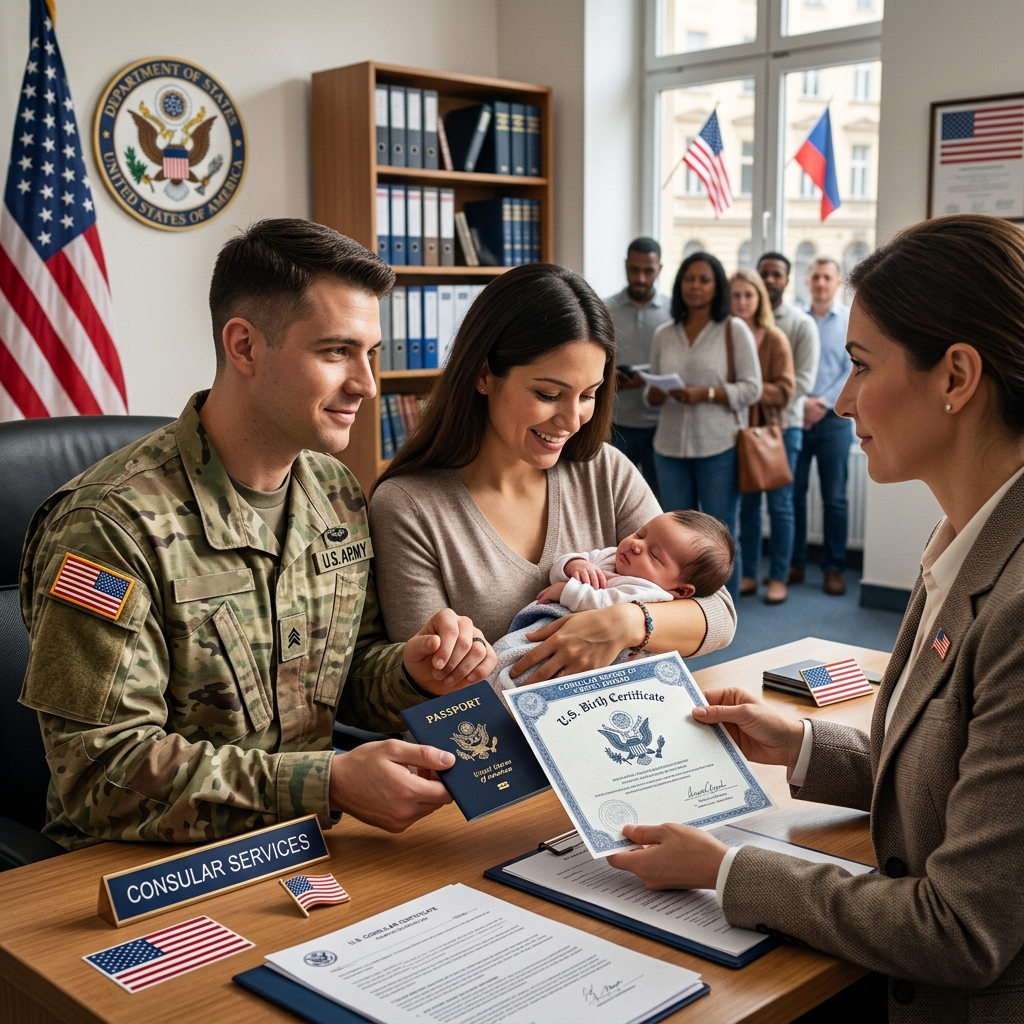
When a U.S. servicemember has a child while stationed in another country, questions about the child’s citizenship and immigration status arise immediately. Parents often assume that being on a U.S. base or serving in uniform guarantees automatic U.S. citizenship for their child, but the law is more complex and depends on several specific conditions.
This guide explains how citizenship works for children born overseas to U.S. military members, how to document that citizenship, and what to do if a child did not become a citizen at birth. It is designed to help military families understand their options and recognize when legal advice may be necessary.
Key Principles: Military Children Born Abroad
Whether a child born abroad to a servicemember is a U.S. citizen usually turns on three core questions:
- Where the child was born (inside or outside the United States and its territories)
- Citizenship status of the parents at the time of birth
- Physical presence or residence history of any U.S. citizen parent in the United States before the child’s birth
Understanding these basic ideas helps make sense of the more detailed rules that apply to military families.
Birth Abroad on a Military Base: What It Does and Does Not Mean
A common misconception is that a U.S. military base overseas counts as U.S. soil for birthright citizenship purposes. That is not correct.
- Being born on a U.S. base or in a U.S. military hospital abroad does not itself confer U.S. citizenship.
- For citizenship at birth, the United States follows either territorial rules (born in the U.S. or certain territories) or descent rules (citizenship transmitted through parents).
For most military children born abroad, eligibility for U.S. citizenship at birth depends on at least one parent being a U.S. citizen who has met statutory residence or physical presence requirements before the birth.
How Children Acquire U.S. Citizenship at Birth Through Parents
U.S. law provides several ways a child can acquire citizenship at birth when born outside the United States to U.S. citizen parents. The rules vary depending on the time period in which the child is born and whether one or both parents are U.S. citizens.
General Requirements for Acquisition of Citizenship
For many children born abroad to at least one U.S. citizen parent, citizenship at birth is available if the parent can show:
- They were a U.S. citizen when the child was born, and
- They were physically present in the United States (or its territories) for a minimum period before the child’s birth.
Physical presence usually means actual time spent inside the United States or a U.S. territory. U.S. government guidance clarifies that time served abroad in U.S. armed forces assignments may count for some physical presence calculations, but parents need to check the specific law that applies to their situation.
Standard Physical Presence Rules
Current State Department guidance provides that a child born abroad on or after November 14, 1986, to one U.S. citizen parent and one noncitizen parent obtains citizenship if the U.S. citizen parent:
- Was physically present in the United States or its territories for at least five years before the child’s birth
- And at least two of those years were after the parent turned 14.
Children born in earlier periods are subject to different, usually more stringent, time requirements.
Special Rules for U.S. Citizen Mothers
Historically, the law treated children born abroad to U.S. citizen mothers somewhat differently than those with U.S. citizen fathers. That framework has been significantly revised, but some transitional rules remain. For example, the State Department notes different physical presence requirements for U.S. citizen mothers depending on whether the child was born before or after June 12, 2017.
Because these maternal rules are technical and date-specific, military parents should verify the standard that applied at the time of their child’s birth by consulting official government guidance or legal counsel.
Documenting Citizenship: CRBA, Passport, and Certificates
Even when a child is a U.S. citizen at birth under the law, the family still must obtain documentation to prove that status. For military families living overseas, this usually involves the local U.S. embassy or consulate.
Consular Report of Birth Abroad (CRBA)
The primary document for children born overseas to U.S. citizens is the Consular Report of Birth Abroad (often called a CRBA). The U.S. Department of State uses this document to certify that a child acquired U.S. citizenship at birth.
Military parents typically should:
- Contact the nearest U.S. embassy or consulate as soon as possible after birth
- Provide evidence of the parents’ citizenship and physical presence (such as passports, school records, or tax returns)
- Show proof of the child’s birth (local birth certificate or hospital record)
- Confirm the parent–child relationship, including documentation for adopted children if applicable
Once issued, a CRBA serves as evidence of U.S. citizenship similar to a birth certificate issued in a U.S. state.
U.S. Passport for a Child Born Abroad
In addition to the CRBA, a U.S. passport is a practical and widely accepted proof of U.S. citizenship. For military children born abroad:
- Parents can apply for a U.S. passport for the child at the same embassy or consulate that processes the CRBA
- Both documents together create strong evidence of citizenship for future use in school enrollment, employment, and travel
Certificates of Citizenship: Forms N-600 and N-600K
Some military children do not obtain a CRBA or may not qualify as citizens at birth but become eligible later through a different process. U.S. Citizenship and Immigration Services (USCIS) administers these pathways.
Two common forms are:
- Form N-600 – Application for Certificate of Citizenship, often filed by individuals who already acquired citizenship automatically under the law (for example, after being admitted as lawful permanent residents and then automatically deriving citizenship from a parent) and now want formal documentation.
- Form N-600K – Application for Citizenship and Issuance of Certificate Under Section 322 of the Immigration and Nationality Act (INA). This can be used for certain children living outside the United States with a U.S. citizen parent, including children of U.S. armed forces members, when they did not acquire citizenship at birth but qualify for citizenship through a streamlined naturalization process.
Under USCIS policy, a child obtaining citizenship through the N-600K route must generally come to the United States, complete the process, and take the Oath of Allegiance before turning 18.
Special Provisions for Military Families
Because military families frequently live outside the United States under official orders, U.S. law and policy include specific rules to avoid penalizing them for this service-related residence abroad.
Children of U.S. Citizen Servicemembers Residing Abroad
USCIS has issued guidance specifically addressing children of U.S. citizen members of the armed forces who are stationed and residing outside the United States.
In many cases, a child who did not acquire citizenship at birth may still be able to:
- Naturalize under INA section 322 using Form N-600K
- Rely on the physical presence in the United States of a U.S. citizen parent or even a U.S. citizen grandparent to satisfy statutory requirements
- Complete the naturalization process in the United States while still under the age of 18
Legislative Efforts to Protect Military Children
In response to concerns about how certain policy changes affected children of servicemembers and federal employees abroad, Congress passed the Citizenship for Children of Military Members & Civil Servants Act. This legislation was designed to ensure that children living with their U.S. citizen service-member or federal-employee parents stationed overseas would continue to have access to automatic or streamlined citizenship pathways.
The Act applies to a variety of children, including some adopted and stepchildren, and seeks to remedy technical gaps that could otherwise leave military children without clear citizenship status.
Comparing Common Scenarios for Military Children Born Overseas
The table below illustrates how the rules might apply in typical military-family situations. It is a simplified overview and does not replace personalized legal advice.
| Scenario | Likely Citizenship Outcome | Typical Next Step |
|---|---|---|
| Both parents are U.S. citizens, stationed abroad; child born on foreign base | Child usually acquires U.S. citizenship at birth if at least one parent previously lived in the United States | Apply for CRBA and U.S. passport at U.S. embassy or consulate |
| One U.S. citizen parent, one noncitizen parent; U.S. citizen parent meets five-year physical presence rule | Child generally eligible for citizenship at birth | Obtain CRBA and passport; keep records of parent’s U.S. presence |
| U.S. citizen parent does not meet physical presence requirements | Child may not be a citizen at birth | Explore eligibility for naturalization under INA 322 via Form N-600K or other routes |
| Both parents are noncitizens (for example, lawful permanent residents serving in the military) | No citizenship at birth through parents; base location does not change result | Consider future naturalization options once a parent becomes a citizen or the child resides in the U.S. |
Host-Country Immigration Issues for Military Children
Citizenship in the United States is only part of the picture. Military children born overseas also have a legal relationship to the country where they are born.
Key considerations include:
- Whether the foreign country grants citizenship based on birth within its territory (jus soli) or descent (jus sanguinis)
- Whether the child will need a visa or residence permit to stay lawfully in that country after the family’s posting ends
- Whether dual citizenship is allowed or restricted by either the United States or the host nation
Families should consult the host country’s immigration authorities or qualified local counsel, particularly if the child will remain in the country after the military assignment ends or if the family plans to separate or divorce while overseas.
Risks of Missing Documentation or Delayed Action
Many problems involving military children arise years after birth, when the child applies for a driver’s license, enlists in the military, seeks federal student aid, or faces an immigration review. If the family never obtained a CRBA or other proof of citizenship, the child may struggle to demonstrate status.
Potential consequences include:
- Difficulty getting or renewing a U.S. passport
- Challenges in proving eligibility for certain federal benefits reserved for U.S. citizens
- In serious cases, exposure to immigration enforcement actions if the child was never lawfully documented as a citizen or permanent resident
If a now-adult child was born abroad to a U.S. citizen parent, they may still be able to confirm citizenship through older documents such as:
- An original CRBA
- A U.S. passport issued during childhood
- Naturalization or citizenship certificates
Where those records do not exist, it may be necessary to gather evidence of the parent’s citizenship and physical presence and apply for a Certificate of Citizenship through USCIS.
Practical Tips for Military Parents Expecting a Child Overseas
To minimize later complications, military families can take a series of proactive steps before and after birth:
- Confirm your own status: Ensure any U.S. citizen parent has documentation of citizenship and records of physical presence in the United States (school transcripts, W-2 forms, tax filings, and prior passports).
- Review official guidance: Check current rules from the U.S. Department of State and USCIS concerning acquisition and documentation of citizenship for children born abroad to U.S. citizens and military members.
- Contact the U.S. embassy or consulate early: Ask about required documents and how to schedule an appointment shortly after the child’s birth.
- Apply promptly for a CRBA and passport: Do this as soon as the child’s birth is registered locally and hospital records are available.
- Keep multiple certified copies: Store copies of the CRBA, local birth certificate, and U.S. passport in secure but accessible locations in case of loss.
- Monitor policy changes: Laws and policies affecting military children can change; organizations such as the American Immigration Council regularly explain significant legislative updates.
When Legal Advice Is Especially Important
While many straightforward cases can be handled by parents working with the embassy and USCIS, some situations call for consultation with an immigration or military-law attorney, such as:
- When the U.S. citizen parent is uncertain about meeting physical presence requirements
- When the child was adopted, or the parents used assisted reproductive technologies, raising questions about the legal parent–child relationship
- When the child is approaching age 18 and may lose eligibility for certain streamlined citizenship processes if action is not taken quickly
- When the family has received conflicting information from different agencies about the child’s status
Frequently Asked Questions (FAQ)
Does being born on a U.S. military base overseas automatically make a child a U.S. citizen?
No. U.S. military installations overseas are not treated as U.S. soil for birthright citizenship. A child’s citizenship depends on whether at least one parent is a U.S. citizen and whether that parent meets the relevant residence or physical presence requirements in U.S. law.
What is the difference between a CRBA and a Certificate of Citizenship?
A Consular Report of Birth Abroad (CRBA) is issued by a U.S. embassy or consulate to confirm a child acquired citizenship at birth outside the United States. A Certificate of Citizenship is issued by USCIS to someone who either acquired or derived citizenship under U.S. law (not necessarily at birth) and needs formal proof, often obtained using Form N-600 or N-600K.
If my child qualifies for citizenship at birth, can I wait to document it until they are older?
Delaying documentation is legally possible but strongly discouraged. Without a CRBA, passport, or certificate, your child may have trouble proving citizenship later, which can affect education, employment, travel, or even immigration status. Applying soon after birth reduces the risk of missing records or policy changes.
What if I am a lawful permanent resident serving in the U.S. military and my child is born abroad?
If neither parent is a U.S. citizen at the time of birth, the child generally does not acquire U.S. citizenship at birth through the parents, even if one parent is serving in the U.S. military abroad. However, once you naturalize as a U.S. citizen and your child is living in the United States as a permanent resident, they may be able to derive citizenship automatically under certain conditions, or you may be able to seek naturalization for them.
Can time spent stationed abroad count toward the physical presence requirement?
For some purposes, U.S. law allows certain time serving abroad in the U.S. armed forces to count toward physical presence requirements, especially when evaluating eligibility for naturalization routes like those under INA 322. The exact treatment can be complex, so parents with borderline physical presence histories should consult official guidance or legal counsel.
References
- Obtaining U.S. Citizenship for a Child Born Abroad — U.S. Department of State, Bureau of Consular Affairs. 2022-03-01. https://travel.state.gov/content/travel/en/legal/travel-legal-considerations/us-citizenship/Acquisition-US-Citizenship-Child-Born-Abroad.html
- U.S. Citizenship for Children of U.S. Citizen Members of the U.S. Armed Forces Residing Outside the United States (Fact Sheet) — U.S. Citizenship and Immigration Services (USCIS). 2020-03-26. https://www.uscis.gov/sites/default/files/document/fact-sheets/US_Citizenship_for_Children_of_US_Citizen_Members_of_US_Armed_Forces_Residing_Outside_the_United_States.pdf
- Congress Passes Bill Ensuring U.S. Citizenship for Children of Military Members and Civil Servants Living Abroad — American Immigration Council. 2019-03-09. https://www.americanimmigrationcouncil.org/blog/citizenship-military-children
- Citizenship for Military Children Born Outside of the U.S. — Veteran.com. 2021-08-30. https://veteran.com/citizenship-military-children/
- Overseas Birth Certificate for Military Dependents — U.S. Department of the Army (military public portal). 2021-01-15. https://www.war.gov/Contact/Help-Center/Article/article/2742724/overseas-birth-certificate-for-military-dependents/
Similar Articles








Read full bio of medha deb


