
California Wage and Hour Rules Explained
A practical guide to how federal wage rules interact with California’s stronger worker protections.
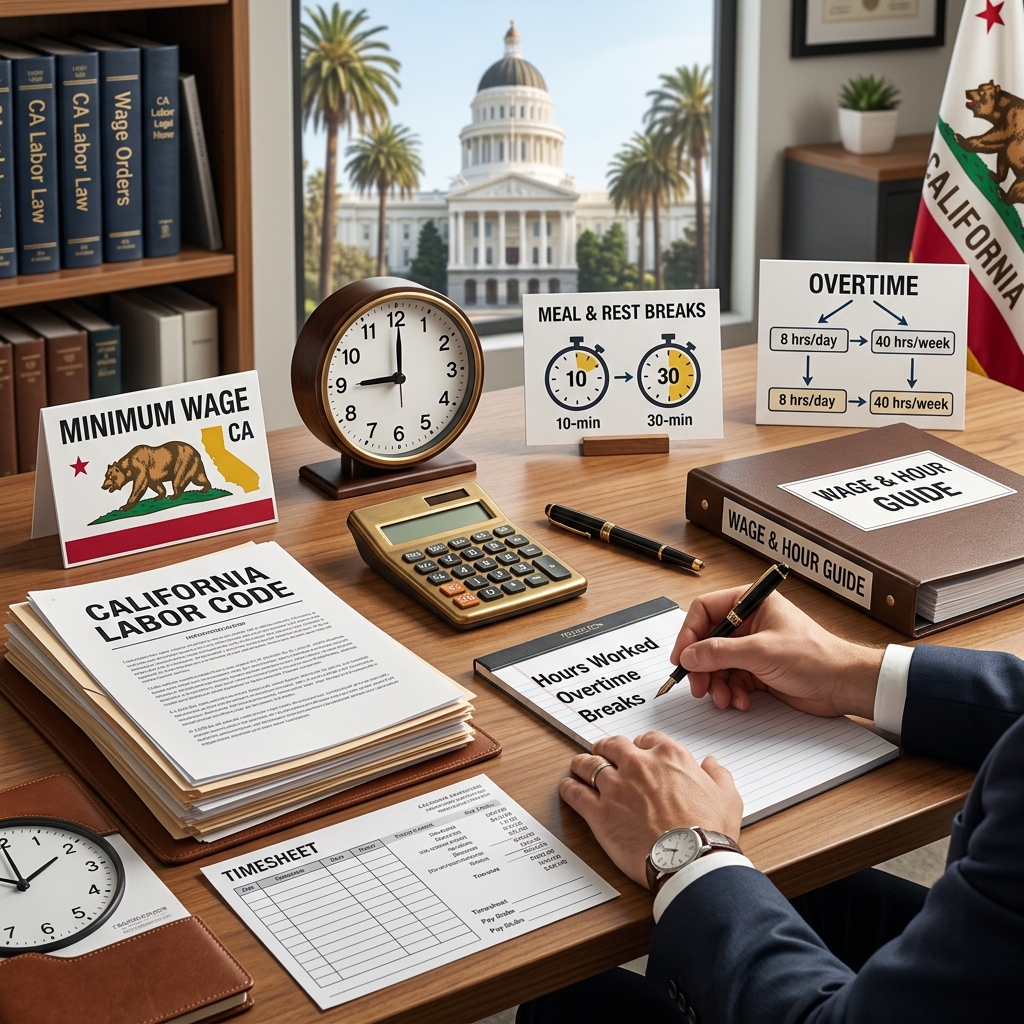
California employers must follow both federal wage rules and state law, but when the two differ, workers usually receive the stronger protection. That means the federal Fair Labor Standards Act sets a baseline, while California law often adds higher wages, stricter overtime rules, and broader employee rights.
This article explains the main wage-and-hour rules that matter most in California workplaces, including minimum wage, overtime, recordkeeping, exemptions, and common compliance issues.
Why federal and state wage laws both matter
The Fair Labor Standards Act is the federal law that covers minimum wage, overtime pay, recordkeeping, and youth employment standards for many workers in the private sector and in government jobs. The U.S. Department of Labor explains that covered nonexempt employees are entitled to at least the federal minimum wage and overtime pay after 40 hours in a workweek.
California law often goes further than the federal baseline. For example, California generally requires overtime after eight hours in a day, not just after 40 hours in a week, and it also provides double-time pay in some situations. When state and federal rules conflict, employers must apply the rule that gives the employee the greater protection.
Minimum wage: the starting point for pay
The federal minimum wage under the FLSA is $7.25 per hour. California’s minimum wage is higher, so most California workers who are covered by state law must be paid at least the California rate rather than the federal rate.
That difference matters because minimum wage is not just a number on paper. It affects regular hourly pay, overtime calculations, and the way employers classify workers. Employers who operate in California need to review both state and local rules, since some cities and counties also set their own wage floors.
| Rule | Federal baseline | California approach |
|---|---|---|
| Minimum wage | $7.25 per hour | Usually higher than federal law |
| Overtime trigger | After 40 hours in a workweek | After 8 hours in a day, 40 in a week, and in some seventh-day situations |
| Recordkeeping | Required for covered employers | Also required under state law and enforcement rules |
How overtime works in California
Federal law requires overtime pay at one and one-half times the regular rate for hours worked over 40 in a workweek. California adds a second overtime trigger: nonexempt employees must usually receive time-and-a-half for hours worked over eight in a day, as well as for hours over 40 in a week.
California also requires double-time pay in specific cases. According to wage-and-hour guidance summarizing California rules, employees may be entitled to twice their regular rate for hours worked over 12 in a day and for certain hours worked on the seventh consecutive day of work in a workweek. These rules make California overtime more protective than the federal standard.
- Time-and-a-half often applies after 8 hours in a day.
- Time-and-a-half also applies after 40 hours in a week.
- Double-time may apply after 12 hours in a day.
- Seventh-day work can trigger enhanced overtime rates.
For employees, the practical effect is that a long shift can create overtime even when the total weekly hours are not especially high. For employers, payroll systems must account for both daily and weekly calculations.
Who is covered and who is exempt
The FLSA does not cover every worker in exactly the same way. Many employees are “nonexempt,” which means they are entitled to minimum wage and overtime protections. Some workers are exempt, often because of their job duties, salary basis, or another specific legal exception.
Common exemptions can apply to certain executive, administrative, professional, outside sales, and some computer-related employees under federal rules. But an exemption is not automatic just because an employee has a title such as manager or supervisor. The actual job duties and pay structure matter.
California often uses its own exemption standards as well, and those standards can be narrower or different from federal law. Because the exemption question can change whether overtime is owed, employers should evaluate each position carefully rather than relying on job labels alone.
Recordkeeping obligations are not optional
Federal law requires covered employers to keep accurate records relating to hours worked, wages paid, and other employment details. The Department of Labor’s guidance identifies recordkeeping as one of the core parts of the FLSA.
Accurate records matter because wage claims often turn on exact schedules, clock-in data, and pay history. If an employer cannot prove the hours an employee worked, disputes may be harder to defend. Good records also help workers verify that overtime was paid correctly.
- Daily hours worked
- Regular hourly rate
- Overtime earnings
- Pay dates and pay periods
- Employee identifying information
Child labor rules and younger workers
The FLSA includes child labor protections designed to prevent work that could harm a minor’s health or interfere with education. The law sets age-related rules for certain jobs and limits hazardous work for younger employees.
These protections do not replace state law. California may impose additional restrictions on work hours, school-night scheduling, and job duties for minors. Employers who hire teenagers should check both federal and state requirements before assigning shifts.
Common payroll mistakes in California workplaces
Many wage disputes arise not from intentional wrongdoing, but from payroll systems that fail to reflect California’s rules. A business that follows only the federal overtime formula may underpay employees who work long daily shifts. Another common problem is misclassifying a nonexempt employee as exempt and then failing to pay overtime.
Other mistakes include calculating overtime from the wrong base rate, ignoring meal and rest-period related premium pay where applicable, or failing to track all hours worked. California employment rules are detailed, and small errors can become expensive when repeated across many pay periods.
| Frequent error | Why it creates risk |
|---|---|
| Using only the federal overtime rule | Can miss daily overtime under California law |
| Misclassifying employees as exempt | Can eliminate overtime and minimum wage protections improperly |
| Poor timekeeping | Makes it difficult to prove hours worked |
| Incorrect regular-rate calculations | Can underpay overtime even when hours are recorded correctly |
Employee rights when wages are missing
When an employer fails to pay required wages, workers may be able to recover unpaid overtime, unpaid minimum wages, and related damages depending on the facts and the legal claim. The FLSA provides a federal enforcement pathway, while California law also offers state remedies through labor agencies and civil claims.
The right next step often depends on the size of the wage issue, whether the employee is still working for the employer, and whether the problem affects one person or a larger group. In many cases, workers begin by collecting pay stubs, schedules, time records, and messages that show the hours they actually worked.
- Save pay stubs and wage statements.
- Keep your own record of hours worked.
- Preserve texts, emails, and schedule changes.
- Note any off-the-clock work or missed breaks.
How employers can reduce wage-and-hour risk
Compliance starts with correct classification. Employers should confirm whether each worker is exempt or nonexempt under both federal and California rules. They should also make sure managers understand that asking employees to work off the clock, skip meal periods without legal justification, or continue working after a shift can create wage liability.
Training supervisors, auditing payroll, and reviewing timekeeping records regularly can prevent costly mistakes. Employers with remote or hybrid teams should pay special attention to travel time, after-hours communications, and the time employees spend responding to messages outside normal schedules.
- Review employee classifications regularly.
- Use reliable timekeeping systems.
- Train supervisors on overtime rules.
- Audit payroll for daily and weekly overtime.
- Respond quickly to pay complaints.
Frequently asked questions
Is the federal minimum wage enough in California?
No. Federal law sets a baseline, but California generally requires a higher minimum wage, so California workers are usually entitled to the stronger state rate.
Do I get overtime only after 40 hours in a week?
Not in California. Federal law uses the 40-hour rule, but California also requires overtime after eight hours in a day in many situations.
Can a salaried worker still get overtime?
Yes. Salary alone does not automatically make an employee exempt. The employee’s duties, pay method, and legal classification all matter.
What if my employer does not keep accurate records?
That can create serious problems for the employer, because wage disputes often depend on proof of hours worked. Workers should keep their own notes and copies of schedules whenever possible.
Are all California workers protected by the same rules?
No. Some workers fall into exemptions or special categories, and some cities or industries may have additional rules. The exact legal standard depends on the job and the employer’s location.
When legal help becomes useful
Wage-and-hour disputes often involve detailed facts, such as job duties, shift patterns, travel time, meal breaks, and payroll calculations. If the amount of unpaid wages is significant or the employer disputes the claim, legal guidance can help determine whether state law, federal law, or both provide a remedy.
An employment lawyer can also help review whether a worker was misclassified, whether overtime was calculated correctly, and whether the employer’s records support the employee’s account. For employers, legal review can identify compliance gaps before they turn into claims.
References
- Wages and the Fair Labor Standards Act — U.S. Department of Labor. 2024-01-01. https://www.dol.gov/agencies/whd/flsa
- Handy Reference Guide to the Fair Labor Standards Act — U.S. Department of Labor. 2024-01-01. https://www.dol.gov/agencies/whd/compliance-assistance/handy-reference-guide-flsa
- California Overtime Laws Versus the Fair Labor Standards Act (FLSA) — UnpaidWages.com. 2024-01-01. https://www.unpaidwages.com/california-overtime-laws-versus-the-fair-labor-standards-act-flsa
- California Wage and Hour Law — HRCalifornia / CalChamber. 2024-01-01. https://hrcalifornia.calchamber.com/hr-library/pay-scheduling/california-wage-and-hour-laws
- Division of Labor Standards Enforcement — California Department of Industrial Relations. 2024-01-01. https://www.dir.ca.gov/dlse/
Similar Articles








Read full bio of Sneha Tete




