
Bankruptcy Chapters 7, 11, And 13: 3 Options To Consider Today
A clear guide to how the main bankruptcy chapters differ and when each may fit.
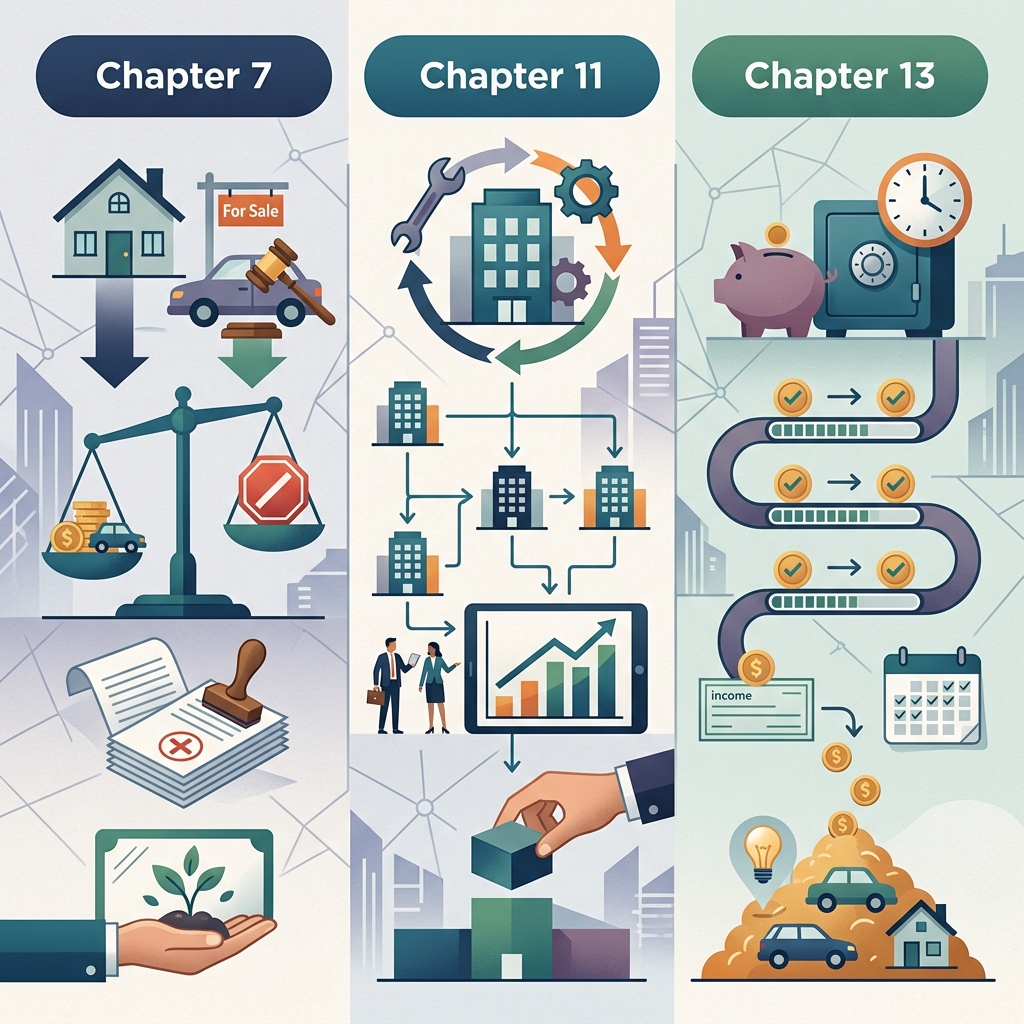
Bankruptcy is a federal legal process that helps people and businesses address debt they can no longer manage. The most widely discussed options are Chapter 7, Chapter 11, and Chapter 13, and each one works differently depending on income, assets, and the type of financial problem involved.
Some cases focus on wiping out qualifying debt quickly, while others are built around repayment over time. The right chapter depends less on a single “best” option and more on whether the filer needs liquidation, reorganization, or a structured payment plan.
How the three chapters differ at a glance
Although they all fall under the bankruptcy code, these chapters serve different purposes. Chapter 7 is usually the fastest path and is often associated with liquidation. Chapter 13 is centered on a court-approved repayment plan for individuals with regular income. Chapter 11 is broader and is often used by businesses, though some individuals use it when their finances are too complex or their debt is too large for Chapter 13.
| Chapter | Typical purpose | Common filer | Main feature |
|---|---|---|---|
| Chapter 7 | Liquidation and discharge of qualifying debt | Individuals with limited disposable income | Nonexempt assets may be sold to pay creditors |
| Chapter 11 | Reorganization | Businesses and some individuals | Debtor proposes a plan to restructure debt |
| Chapter 13 | Repayment plan | Individuals with regular income | Debts are repaid over a set period under court supervision |
Chapter 7: A liquidation-based fresh start
Chapter 7 is often described as the simplest form of bankruptcy for individuals. It is designed for people who do not have enough income to support a meaningful repayment plan. In a Chapter 7 case, a trustee may sell nonexempt property and use the proceeds to pay creditors according to bankruptcy rules.
For many filers, the main attraction is that unsecured debts such as credit card balances, medical bills, and personal loans may be discharged after the case is completed. Once a discharge is entered, creditors can no longer try to collect those wiped-out debts.
- Best suited for: People with limited income and relatively few nonexempt assets.
- Main goal: Eliminate qualifying unsecured debt as quickly as possible.
- Possible downside: Some property may be sold if it is not protected by exemptions.
Chapter 7 is not a universal solution. Secured debts, such as mortgages and car loans, are handled differently because they are tied to property. A filer may keep certain assets only if exemptions protect them and the person remains current on any obligations tied to those assets.
When Chapter 7 may make the most sense
Chapter 7 often works best when debt is overwhelming but future income is limited. If a person’s monthly budget cannot realistically support payments to creditors, a liquidation case may provide the cleanest route to a reset. It can also be attractive when the filer does not own much property beyond what the law protects.
That said, the chapter is not designed for people who mainly need time to catch up on overdue mortgage payments or preserve property that would otherwise be at risk. In those situations, a repayment chapter may offer more control.
Chapter 13: A structured repayment plan for individuals
Chapter 13 is often called a wage earner’s bankruptcy because it is built for individuals with steady income. Instead of liquidating property, the filer proposes a repayment plan that lasts several years and is overseen by the court. The person makes monthly payments to a trustee, who distributes money to creditors under the plan.
This chapter can be especially useful for someone who needs time to catch up on missed payments for a home or vehicle. It may also help protect property that could be harder to shield in Chapter 7. At the end of a successful plan, some remaining unsecured debt may be discharged.
- Best suited for: Individuals with regular income who need time to repay debt.
- Main goal: Keep property while repaying at least part of what is owed.
- Possible downside: The filer must stay on a multi-year payment schedule.
Chapter 13 is usually more demanding than Chapter 7 because it requires long-term discipline. But for someone trying to avoid foreclosure, stop repossession, or manage secured debts behind on payments, it can be a practical tool.
Chapter 11: Reorganization for complex financial situations
Chapter 11 is the best-known reorganization chapter. It is most often associated with businesses that want to keep operating while they restructure debt, but it can also be used by individuals in certain circumstances. Instead of focusing on immediate liquidation, the filer presents a plan for reorganizing obligations and moving forward under court supervision.
Compared with Chapter 13, Chapter 11 is generally more flexible and can handle larger or more complex debts. That flexibility can also mean greater cost, more paperwork, and more time. For that reason, it is usually not the first choice for a typical consumer bankruptcy case unless the debt load or financial structure makes Chapter 13 unavailable or impractical.
- Best suited for: Businesses and some high-debt individuals.
- Main goal: Reorganize debt while continuing operations or preserving value.
- Possible downside: More complicated and often more expensive than consumer chapters.
Which debts are usually handled differently?
Bankruptcy does not treat every debt the same way. Unsecured debts are often the most likely to be discharged or reduced, while secured debts are tied to a specific asset. Priority obligations and certain legal debts may also receive special treatment.
Common unsecured debts include credit cards, medical bills, and some personal loans. Secured debts include mortgages and auto loans. If the filer wants to keep the property tied to the loan, the bankruptcy plan or case structure usually has to account for those payments in some way.
| Debt type | General treatment | Typical example |
|---|---|---|
| Unsecured debt | May be discharged or repaid partly through a plan | Credit cards, medical bills |
| Secured debt | Usually tied to property and treated separately | Mortgage, car loan |
| Priority debt | Often receives special treatment under bankruptcy rules | Some taxes, domestic support obligations |
What role do income and assets play?
Income and assets are two of the biggest factors in deciding which chapter may fit. Chapter 7 is usually aimed at people who cannot afford a repayment plan. Chapter 13 is for individuals with regular income who can commit to monthly payments. Chapter 11 can accommodate more complicated financial structures, including larger debts and business operations that need to continue during the case.
Assets matter because they can determine whether liquidation is risky or whether exemptions can protect enough property to make Chapter 7 feasible. If keeping certain assets is a priority, a repayment chapter may be more appealing even if it takes longer.
Pros and tradeoffs to weigh before filing
Each chapter offers real benefits, but each also comes with a cost. A useful way to think about bankruptcy is not as a single solution, but as a set of tools with different levels of speed, control, and financial pressure.
- Chapter 7 benefit: Faster relief and potential discharge of many unsecured debts.
- Chapter 7 tradeoff: Nonexempt assets may be at risk.
- Chapter 13 benefit: Ability to catch up on missed payments while keeping property.
- Chapter 13 tradeoff: Long repayment commitment.
- Chapter 11 benefit: Flexible restructuring for complex situations.
- Chapter 11 tradeoff: Higher complexity and potentially greater cost.
How to think about the right chapter for your situation
The right choice often comes down to a few practical questions. Do you need a quick discharge, or do you need more time to repay? Do you have income that can support a plan? Do you own property you want to keep? Is your debt situation simple enough for a consumer chapter, or is it so large or complex that reorganization makes more sense?
People often begin by comparing the least disruptive option with the one that offers the strongest protection for important assets. A person with limited income and few assets may lean toward Chapter 7. Someone with a regular paycheck and overdue secured debts may prefer Chapter 13. A business or a person with unusually complex finances may need Chapter 11.
Frequently asked questions
Is Chapter 7 always the fastest option?
Chapter 7 is generally the quickest of the main consumer bankruptcy options, but timing can still vary based on the court, paperwork, and case details. The speed advantage is one reason it is often chosen by people who need immediate relief.
Can a person file Chapter 11 instead of Chapter 13?
In some cases, yes. Chapter 11 is available to individuals, but it is usually reserved for situations where Chapter 13 is not practical or available. Because it is more complex, it is not the common first choice for ordinary consumer debt problems.
Does bankruptcy erase every debt?
No. Bankruptcy can discharge many unsecured debts, but some obligations receive special treatment or may survive the case. The outcome depends on the type of debt, the chapter filed, and the facts of the case.
Can someone keep a house or car in bankruptcy?
Sometimes. The answer depends on the chapter, the value of the property, whether the debtor is current on payments, and whether exemptions or a repayment plan can protect the asset.
Why would a business choose Chapter 11?
Chapter 11 can allow a business to keep operating while it restructures debts. That makes it useful when the goal is preservation of enterprise value rather than shutting everything down and selling assets immediately.
Final considerations before choosing a chapter
Bankruptcy is a major legal step, and the practical differences between chapters matter more than the labels themselves. The choice should reflect the filer’s income, property, type of debt, and long-term ability to stay current after the case is filed. A fast discharge, a repayment plan, and a reorganization plan each solve different kinds of problems.
Before filing, it is important to understand which debts may be discharged, which assets may be exposed, and how long the process is likely to last. That comparison is often what separates the best chapter from the merely available one.
References
- Types of Bankruptcies Explained: Chapter 7, 11 and 13 — Debt.org. 2025. https://www.debt.org/bankruptcy/types/
- What is the difference between bankruptcy cases filed under Chapters 7, 11, 12 and 13? — U.S. Bankruptcy Court, Central District of California. 2024. https://www.canb.uscourts.gov/faq/general-bankruptcy/what-difference-between-bankruptcy-cases-filed-under-chapters-7-11-12-and-13
- What is the difference between Chapters 7, 11, 12 and 13? — U.S. Bankruptcy Court, Western District of Pennsylvania. 2024. https://www.pawb.uscourts.gov/content/what-difference-between-chapters-7-11-12-and-13
- Chapter 7 bankruptcy – Liquidation under the bankruptcy code — Internal Revenue Service. 2024. https://www.irs.gov/businesses/small-businesses-self-employed/chapter-7-bankruptcy-liquidation-under-the-bankruptcy-code
- Bankruptcy: Is It the Right Choice? — Texas Law Help. 2025. https://texaslawhelp.org/article/bankruptcy-is-it-the-right-choice
Similar Articles








Read full bio of medha deb




