
Are Petition Signatures Protected Political Speech?
Explore how the First Amendment treats petition signatures, public disclosure, and the balance between transparency and privacy in direct democracy.
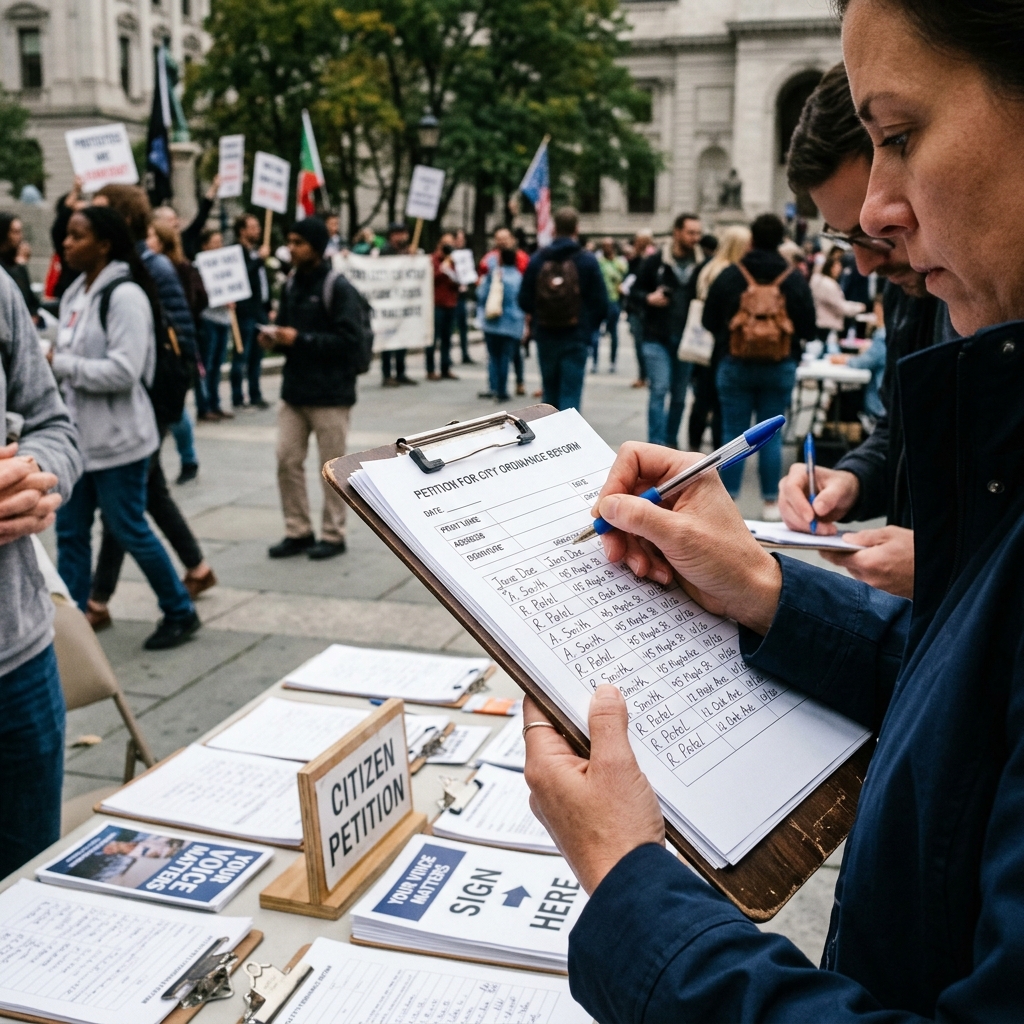
Signing a political petition looks simple: you write your name, address, and maybe your voter ID on a sheet that supports or opposes a ballot measure or candidate. But in constitutional terms, that act raises complex questions about free speech, public records, and privacy. Are petition signatures protected political speech? Can governments publish the names of signers? And what happens when transparency laws collide with fears of retaliation?
Petitions in American Democracy: More Than Just Lists of Names
Petitions are a core tool of direct democracy, allowing citizens to place initiatives and referenda on the ballot or request official action from public bodies. In many states, a measure cannot go before voters unless supporters gather a required number of valid voter signatures within a set time frame.
Although petition forms may look administrative, courts and legislatures have repeatedly recognized that circulating and signing petitions are activities deeply intertwined with political advocacy. Asking someone to sign a petition often involves explaining the measure, debating its merits, and persuading fellow citizens—activities the U.S. Supreme Court has described as core political speech entitled to special First Amendment protection.
- Circulating petitions involves verbal advocacy and engagement in public debate.
- Signing petitions expresses support for placing an issue on the public agenda.
- Petition thresholds determine whether ideas reach the ballot or stall at the signature-gathering stage.
Because of this dual role—administrative mechanism and expressive act—legal disputes frequently arise over how much protection petition-related activities deserve under the First Amendment.
Core Political Speech and the First Amendment
The First Amendment protects “speech” broadly, including words, symbolic acts, and expressive conduct related to politics and public affairs. The Supreme Court has long treated political expression as deserving of heightened protection compared to many other categories of speech.
When courts analyze laws that regulate political speech, they typically apply rigorous scrutiny, asking whether the government has a compelling interest and whether the regulation is narrowly tailored. Petition activities have repeatedly been viewed through this lens:
- States may regulate petition procedures to prevent fraud and ensure accurate elections.
- However, restrictions that burden advocacy or chill participation can raise serious constitutional concerns.
- Courts distinguish between regulating the mechanics (such as signature validity rules) and restricting expression (such as banning peaceful solicitation).
Several state-level legal documents explicitly acknowledge that asking people to sign petitions is at the heart of protected political speech. For example, a Washington initiative draft notes that courts have repeatedly held signature gathering to be “core political speech” that deserves the highest level of protection. This framing has influenced debates about whether signatures themselves—names and addresses on the petition—are part of that protected expression.
Signing vs. Circulating: Two Related but Distinct Activities
It is useful to separate circulating a petition from signing one, because the constitutional questions differ.
| Activity | Primary Purpose | Key Legal Concerns |
|---|---|---|
| Circulating petitions | Advocacy, persuasion, gathering signatures | Speech rights in public spaces, interference, harassment, time/place/manner limits |
| Signing petitions | Registering support to qualify a measure or candidate | Validity rules, public disclosure, privacy, risk of retaliation |
Courts and state laws consistently treat circulation—the process of soliciting signatures—as overt political expression. Signature gatherers generally enjoy strong First Amendment protections when operating on public sidewalks, walkways, and accessible public venues, subject to reasonable time, place, and manner regulations.
Signing, by contrast, is often analyzed both as an expressive act and as participation in a regulated electoral process. States impose detailed requirements on how a person must sign, what information must be provided, and who is eligible to sign, reflecting the importance of signature validity to ballot access.
Are Petition Signatures Themselves Protected Speech?
The key constitutional question is whether the act of signing—placing a name on a petition form—should be treated as political speech, government-regulated electoral conduct, or both. In practice, courts have adopted a hybrid approach.
Signature Gathering as Protected Expression
Courts routinely recognize that signature gathering involves protected expression. A draft initiative from Washington, summarizing prior judicial decisions, emphasizes that soliciting signatures for filed initiatives or referenda is “core political speech.” This view is echoed across multiple jurisdictions and underpins guidance from civil liberties organizations that counsel citizens on how to interact with petition circulators.
When governments attempt to prohibit signature gathering in traditional public forums like sidewalks, courts often strike down such bans or require narrow justifications. Law enforcement agencies are expected to protect both circulators and signers from intimidation or harassment while they engage in lawful petition activities.
Signatures as Part of Election Administration
At the same time, state election officials treat petition signatures as components of an electoral procedure that must be carefully regulated. For instance, Maryland’s election law requires that petition signers provide their name in a manner that matches the statewide voter registration list, including surname and at least one full given name. Colorado’s rules similarly restrict who may sign, how many times, and under what conditions.
- Signers must generally be registered electors at the time of signing.
- Signing more than once for the same measure or same office is prohibited.
- Forging signatures or altering petition entries is a criminal offense.
These rules underscore that signatures are not only expressive; they are legal instruments used to determine whether a proposed measure qualifies for the ballot. Election officials must verify them, count them, and sometimes reject them if they fail statutory requirements.
Public Disclosure: The Supreme Court and Petition Records
A major modern debate concerns whether petition signatures should remain confidential or be treated as public documents. In one prominent case involving Washington’s Referendum 71, the U.S. Supreme Court held that petition signatures could be made public as part of the state’s public records regime, with the Court ruling 8–1 to uphold disclosure.
In that case, opponents of disclosure argued that publishing names and addresses would expose signers to harassment and chill participation. The state contended that transparency served important interests in preventing fraud and ensuring public trust in the initiative process. The Court concluded that the state’s public records law could constitutionally apply to petition signatures in general, though it did not foreclose as-applied challenges in specific circumstances.
This decision has practical consequences:
- In many jurisdictions, petition signatures are treated as public records subject to disclosure.
- Individuals who sign may have their names made available to journalists, advocacy groups, or other members of the public.
- Courts may consider exemptions where signers can demonstrate a reasonable probability of threats, harassment, or reprisals.
Balancing Transparency and Privacy
Public access to petition signatures serves several democratic objectives. It allows citizens to scrutinize the process, monitor potential fraud, and verify that measures have legitimately met required thresholds. Yet transparency increases the risk that signers could be targeted because of their political participation.
Government Interests in Disclosure
States justify disclosure of petition records on multiple grounds:
- Deterring fraud: Public scrutiny can reveal irregularities, duplicate signatures, or non-eligible signers.
- Promoting confidence: Voters may trust the initiative process more when they can examine supporting signatures.
- Enforcing limits: Public records help ensure circulators are following legal rules, such as not forging or altering signatures.
These interests have repeatedly convinced courts that some level of disclosure is permissible, especially when records are maintained and released under established public records laws.
Privacy and Safety Concerns
On the other side, many citizens worry that disclosure of their petition signatures could lead to employment consequences, social ostracism, or even threats. Civil liberties advocates often field questions from people who encounter petition circulators and fear that signing could expose them to personal risk.
Some legal frameworks attempt to mitigate these risks:
- Anti-harassment and anti-retaliation provisions that penalize those who stalk or retaliate against signers and circulators.
- Allowing signers to request redaction of certain sensitive information where permitted by law.
- Possible as-applied constitutional challenges where a group can show a “reasonable probability” of threats or harassment targeted at signers.
The Supreme Court has indicated that such as-applied challenges remain viable even when general disclosure regimes are upheld, leaving room for privacy protections in exceptional situations.
Legal Limits: What Petition Rules Can and Cannot Do
Because petition processes blend expressive activity with regulated election mechanics, states impose numerous rules while trying not to unduly burden free speech. Two areas are particularly important: prohibited activities and signature validity rules.
Prohibited Conduct in Petition Campaigns
Official training materials from state election offices show the range of activities that are banned to preserve the integrity of the petition process. For example, Colorado prohibits:
- Circulating or signing any petition that falsely implies endorsement by a person or organization without written consent.
- Signing any name other than one’s own or signing multiple times for the same measure or candidate.
- Forging a signature or witness name on a petition.
- Defacing, destroying, or deliberately suppressing a petition.
- Paying someone to sign or withdraw a signature where such inducements are banned by law.
These prohibitions aim at fraud and coercion, not at the content of political expression. By focusing on misconduct rather than message, states seek to maintain the constitutionality of their regulations.
Signature Validity Requirements
Election officials also enforce detailed signature standards. Maryland’s guidance on petition signatures, for instance, explains that a signer must provide a name consistent with the voter registration list and include required components like surname and at least one full given name. The signer’s “ordinary signature” may be accepted so long as the full required information appears elsewhere in the petition entry.
Across states, common validity rules include:
- Signers must be registered voters or otherwise eligible electors.
- Signers must not sign the same petition more than once.
- Entries must contain sufficient identifying information for verification.
- Signatures may be rejected if information is incomplete, illegible, or inconsistent with registration records.
These rules sometimes lead to large numbers of signatures being discarded. Analyses of petition drives show that every election cycle, a significant portion of signatures for constitutional amendments or initiatives are invalidated for technical reasons such as missing information or non-registration of the signer.
Practical Guidance for Citizens and Advocates
Understanding how law treats petition signatures can help both signers and circulators make informed choices. While specific rules vary by state, some broad principles are widely applicable.
If You Are Asked to Sign a Petition
- Ask questions: You have the right to know the purpose of the petition, who is sponsoring it, and what the measure would do.
- Check eligibility: Ensure you are a registered voter if your state requires registration to sign.
- Provide complete information: Follow instructions on how to print and sign your name so your support is more likely to be counted.
- Be aware of disclosure: In many jurisdictions, your signature, name, and address may become part of a public record.
- Report misconduct: If you see forged signatures, pressure tactics, or misleading claims of endorsement, you can report them to election officials.
If You Circulate Petitions
- Know your rights: Signature gathering in public spaces is generally protected political speech, but local time, place, and manner rules may apply.
- Follow legal requirements: Only the registered circulator should handle a petition section and complete any required affidavits.
- Avoid coercion: Do not misrepresent endorsements or offer prohibited incentives for signing.
- Protect signers: Be prepared to call law enforcement if signers are harassed or threatened while exercising their rights.
Frequently Asked Questions (FAQs)
1. Is signing a petition considered free speech?
Courts generally treat petition-related activity as political expression. Circulating petitions is explicitly recognized as core political speech, and signing is usually analyzed as both expressive support and participation in a regulated election process.
2. Can my petition signature be made public?
In many states, petition signatures are part of public records and can be disclosed under public records laws. The U.S. Supreme Court has upheld such disclosure regimes, while leaving open the possibility of case-specific privacy challenges when signers face a credible risk of harassment.
3. What information do I need to include when signing?
Requirements vary by state, but signers typically must provide a name that matches voter registration records and sometimes include address or other identifying details. Maryland’s rules, for example, specify that the name must match the statewide voter registration list or include all parts required by statute.
4. Can I sign a petition more than once?
No. States usually prohibit signing the same petition more than once for a measure or candidate. Colorado’s rules explicitly bar electors from signing a petition for the same measure or office multiple times.
5. What happens if there is fraud or misconduct in signature gathering?
Fraudulent practices such as forging signatures, altering petition entries, or falsely implying endorsements without consent are typically criminal offenses. State election manuals enumerate these prohibited acts and may refer cases to law enforcement for investigation.
6. Can the government restrict petition activity in public places?
Governments may enforce reasonable time, place, and manner restrictions, but complete bans on peaceful petition activity in traditional public forums are likely to face constitutional challenges. Legal documents and civil liberties guidance emphasize that signature gathering in public walkways and similar venues is protected.
References
- SCOTUS rules R-71 petition signatures can be made public — Ballotpedia. 2010-06-24. https://ballotpedia.org/SCOTUS_rules_R-71_petition_signatures_can_be_made_public
- Petition Signature Gathering FAQ — Maryland State Board of Elections. 2020-01-01. https://elections.maryland.gov/petitions/Petition%20Signature%20Gathering%20FAQ.pdf
- Protect the Initiative Process (Initiative 500) — Washington Secretary of State. 2009-01-01. https://www.sos.wa.gov/elections/initiatives/text/i500.pdf
- Prohibited Activities – Petition Circulation Reference Manual — Colorado Secretary of State. 2021-01-01. https://www.sos.state.co.us/pubs/elections/petitionEntities/training/5-Prohibited.html
- Countering Initiative Petition Signature-Gatherers — ACLU of Washington. 2012-06-01. https://www.aclu-wa.org/know-your-rights/know-your-rights-guide-countering-initiative-petition-signature-gatherers
- Sign a Petition? Your Support May Not Count — State Court Report (Brennan Center). 2023-08-01. https://statecourtreport.org/our-work/analysis-opinion/sign-petition-your-support-may-not-count
Similar Articles








Read full bio of medha deb


