
When Alcohol, Bathrooms, and Ladders Collide: Workers’ Comp Lessons
A detailed look at how intoxication, personal comfort breaks, and risky choices can make or break a workers’ compensation claim.
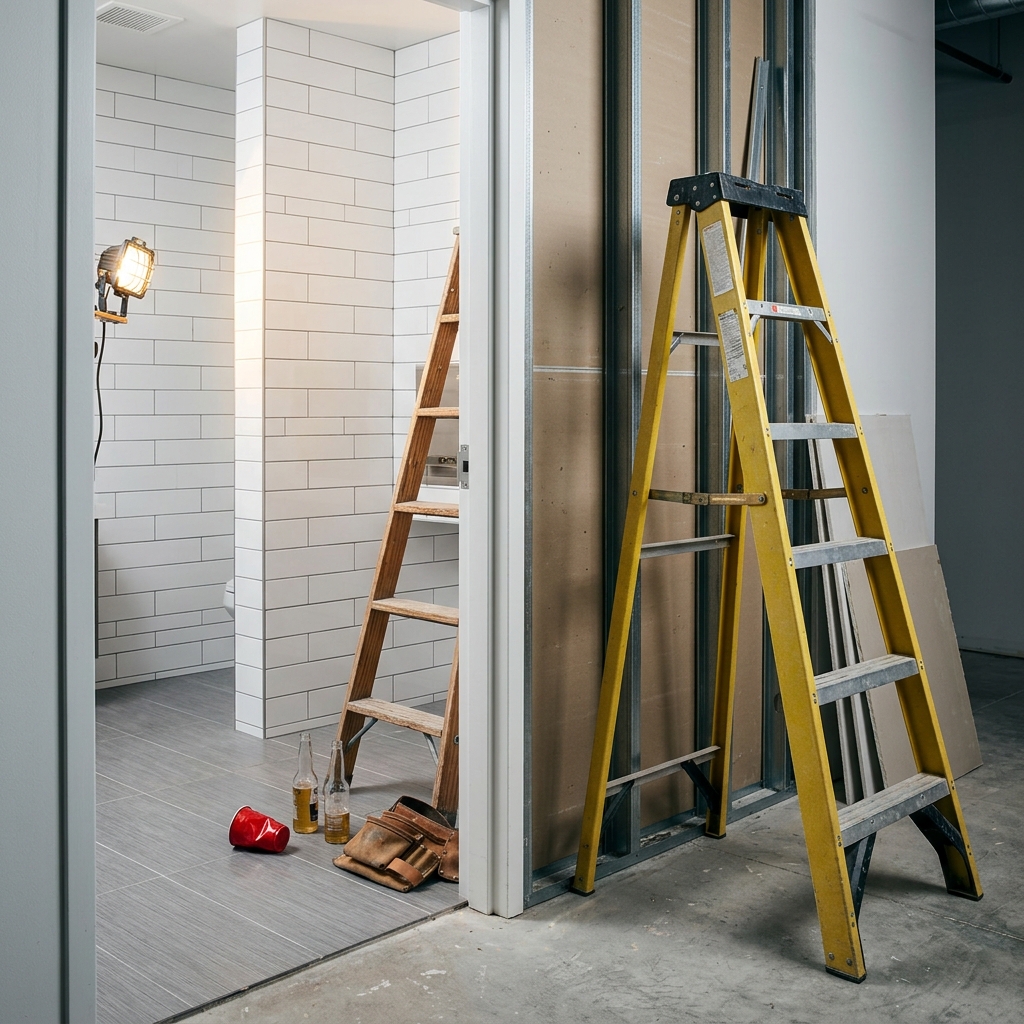
Work injuries do not always happen in tidy, textbook scenarios. Sometimes an employee has been drinking, needs to use the bathroom, takes a shortcut, ignores a safety rule, and ends up hurt. When that happens, one tough question quickly appears: is the worker still entitled to workers’ compensation benefits?
This article uses a typical fact pattern—an intoxicated worker, a risky bathroom trip, and a fall—to explain how U.S. workers’ compensation systems handle claims where alcohol, personal comfort, and unsafe conduct all play a role. It is inspired by a real case, but the discussion here is general information, not legal advice.
Workers’ Compensation in a Nutshell
Most employees in the United States are covered by a no-fault system called workers’ compensation. If an employee is injured in an accident that arises out of and in the course of employment, the system typically pays for medical care and a portion of lost wages, without the worker having to prove the employer did anything wrong.
Although each state has its own statute, many follow similar principles:
- The injury must have a sufficient connection to the job (“arising out of and in the course of employment”).
- Benefits usually cover medical treatment and partial wage replacement, not pain and suffering.
- Workers cannot sue their employers in civil court for most work injuries; workers’ comp is the exclusive remedy in many situations.
Because benefits are broadly available, legislatures also created defenses and exclusions—and intoxication is one of the most common.
Intoxication as a Defense: How States Treat Alcohol at Work
Many states allow employers or insurers to deny benefits when a worker is injured while intoxicated. But the details vary sharply. Some laws only bar benefits when intoxication is the sole cause of the injury; others impose partial reductions; still others are stricter and may deny benefits more broadly.
Common statutory patterns
| Approach | Typical Rule | Practical Effect |
|---|---|---|
| Sole cause standard | Benefits denied only if intoxication is the sole cause of injury. | Worker can still recover if job conditions or other factors contributed. |
| Proximate cause standard | Benefits denied if intoxication is a substantial cause of the accident. | More room for denial when impairment clearly contributed to the incident. |
| Partial reduction | Medical benefits paid; wage-loss benefits reduced if intoxication caused injury. | Worker still receives some benefits but not the full amount. |
Under many versions of these laws, the employer or insurer carries the burden of proof. They must demonstrate that the worker was intoxicated and that the intoxication met the legal standard for denying or reducing benefits.
What must the employer usually prove?
- The worker used alcohol or drugs close in time to the accident.
- The worker was legally impaired or intoxicated under the applicable standard (often supported by a test result or eyewitness testimony).
- The intoxication was the sole or primary cause of the injury, depending on the statute.
Courts have noted that this can be a heavy burden, particularly where there is a presumption that work injuries are compensable unless clearly excluded.
Personal Comfort Doctrine: Are Bathroom Trips Still “On the Job”?
In many work injury disputes, the key fight is not only whether the worker was intoxicated, but also whether the worker was still acting within the scope of employment at the time of the accident. That is where the personal comfort doctrine comes in.
The personal comfort doctrine is a judge‑made rule (developed through case law) that generally treats activities such as:
- Using the restroom
- Getting a drink of water or coffee
- Eating a snack or lunch on site
- Briefly stepping away to warm up or cool down
as incidental to employment. In other words, these activities are considered a normal part of working, so injuries that occur during them often remain compensable, as long as the employee has not substantially abandoned their job duties.
Limits of the personal comfort doctrine
The doctrine is not unlimited. Courts are more skeptical when the worker:
- Leaves the worksite entirely for a purely personal errand.
- Engages in dangerous horseplay or intentionally risky conduct.
- Goes to an area clearly off limits or unrelated to any job function or necessity.
When intoxication is added to the mix, judges must decide whether the worker was still just seeking ordinary comfort (like using a restroom), or whether they had embarked on a purely personal, unreasonable adventure that breaks the link to the job.
Risky Behavior: Shortcutting Safety and Ignoring Rules
Fact patterns involving drunk workers are rarely neat. Alcohol often leads to poor judgment: choosing unsafe routes, ignoring safety procedures, or misusing equipment. A classic scenario involves a worker who needs to use the bathroom but chooses a hazardous, makeshift path—such as climbing down from a high area using an unstable surface or ladder instead of a safe stairway.
From a legal perspective, courts ask several questions:
- Was the worker still in an area they were reasonably expected to be?
- Did the employer provide safe routes or equipment (stairs, guardrails, harnesses)?
- Did the worker deliberately ignore clear, enforced safety rules?
- How directly did intoxication contribute to the poor choices that caused the fall?
In many states, ordinary negligence by the employee (for example, failing to watch their step or being careless) does not bar workers’ comp benefits. The system is designed to compensate even careless workers. However, when conduct becomes a major departure from expected behavior—especially if combined with intoxication—insurers are more likely to raise defenses based on statutory intoxication bars or arguments that the worker stepped outside the course of employment.
Does Alcohol Automatically Kill a Workers’ Comp Claim?
Contrary to popular belief, a positive alcohol test does not automatically mean the claim is dead. Many state laws require more than proof of drinking—they require proof that intoxication was the sole or primary cause.
Consider how some jurisdictions handle this:
- In states using a sole cause rule, a claim may still succeed if workplace conditions (e.g., a defective ladder, cluttered floor, or inadequate lighting) also contributed to the fall.
- In states using a proximate cause standard, insurers may prevail if they show the level of impairment substantially caused the accident, even if other factors were present.
- In “partial reduction” states, such as Colorado, intoxication may reduce wage-loss benefits but not eliminate medical coverage if work remained a contributing factor.
Because of these differences, two workers in nearly identical incidents—both intoxicated, both falling while looking for a restroom—could get opposite outcomes depending on which state’s law applies.
When the Employer Provides the Alcohol
Another twist arises when alcohol is supplied or encouraged by the employer. This may happen at:
- Holiday parties
- Team‑building outings
- Client entertainment events
- Mandatory after‑hours functions
Some jurisdictions treat injuries at work‑related social events as potentially compensable, especially if attendance was strongly encouraged or required, or if the employer paid for the venue or alcohol. Where a statute allows intoxication as a defense, courts may consider whether the employer’s own conduct—such as providing open alcohol with little supervision—undercuts the fairness of denying benefits.
Even beyond workers’ compensation, employer‑sponsored drinking at company events can expose the business to additional liability if third parties are injured, for example in drunk driving crashes after a work function.
Key Factors Courts Weigh in Alcohol‑Related Work Injuries
When a case involves drinking, a bathroom break, and a fall from a height, courts and administrative judges typically examine a cluster of factors together rather than any single detail.
1. Legal standard in that state
- Is intoxication a complete bar to benefits or only a partial defense?
- Does the employer have to prove intoxication was the sole cause or just a contributing cause?
2. Evidence of impairment
- Objective test results (blood, breath, or urine), if obtained lawfully.
- Witness observations: slurred speech, unsteady gait, smell of alcohol.
- Time between alleged drinking and the accident.
3. Connection between intoxication and the accident
- Would the accident have likely happened even if the worker were sober?
- Were there independent hazards, such as defective equipment or unsafe work conditions?
- Did alcohol clearly influence the worker’s decision to take an unusual or reckless route (for example, climbing over railings instead of using stairs)?
4. Scope of employment and location
- Was the worker still on the clock or on the employer’s premises?
- Was the worker engaged in a personal comfort activity (e.g., restroom use) reasonably incidental to the job?
- Did the worker wander into an off‑limits area for reasons unrelated to work or comfort?
5. Employer policies and enforcement
- Did the employer have clear written rules against alcohol use on duty?
- Were those rules genuinely enforced, or was drinking quietly tolerated?
- Did the employer provide safety training and accessible safe routes to bathrooms or exits?
Practical Takeaways for Workers
While the law may still provide protection even when a worker has been drinking, alcohol always makes a claim more complicated. Consider the following practical points:
- Do not assume you are automatically barred from benefits if alcohol is involved; many states still allow recovery unless intoxication was the sole cause.
- Report the injury promptly and be honest about what happened; hiding alcohol use can damage credibility more than the drinking itself.
- Seek legal advice early if an insurer cites intoxication as a reason for denial. Statutory standards are technical and often misunderstood.
- Remember that personal comfort breaks, like using the restroom, are often treated as part of your work, but taking extreme risks or leaving the workplace entirely for personal reasons can change that.
Practical Takeaways for Employers
Employers also have a strong interest in understanding how intoxication interacts with workers’ comp law. The goal is not only to manage claims but to prevent dangerous situations from arising.
- Adopt clear substance‑use policies that address alcohol and drugs on duty and at work events, and ensure employees know them.
- Provide safe, accessible restroom facilities and safe paths of travel so workers are not tempted to improvise hazardous routes.
- Consider testing protocols that comply with state law when intoxication is suspected after a serious injury.
- Train supervisors to recognize signs of impairment and to act before an injured‑on‑the‑job scenario occurs.
- Plan work events with alcohol carefully—limit consumption, arrange safe transportation options, and set expectations for behavior.
Frequently Asked Questions (FAQs)
Does a failed alcohol test automatically mean my workers’ comp claim will be denied?
No. In many states, a positive test is only the starting point. The employer or insurer often must prove that intoxication was the legal cause of your injury—sometimes the sole cause, depending on the statute.
What if I was hurt while going to the bathroom at work after drinking?
Bathroom breaks are generally viewed as part of normal work under the personal comfort doctrine. If you were still on the job and on the premises, your injury may still be considered work‑related, though intoxication could complicate the analysis and may give the insurer an argument to deny or reduce benefits.
Can my employer reduce my benefits instead of denying them entirely?
Yes, in some states. For example, Colorado law allows full medical benefits but may reduce wage‑loss benefits when intoxication causes the injury. Other states follow an “all‑or‑nothing” approach. The result depends on the specific statute where you work.
Does it matter if my employer served the alcohol at a work event?
It can matter. When employers sponsor events, pay for alcohol, or encourage attendance, injuries connected to those events are more likely to be considered work‑related, and courts may scrutinize efforts to deny workers’ comp solely on intoxication grounds.
Should I talk to a lawyer if my claim is denied because of alleged intoxication?
In most cases, yes. Intoxication defenses are fact‑intensive, and the applicable legal standard is often complex. A lawyer familiar with workers’ compensation in your state can review your situation, assess the evidence, and help you understand your options.
References
- Drunk Worker Falls Off Ladder – Can He Get Comp? — HRMorning. 2024-05-06. https://www.hrmorning.com/news/drunk-worker-falls-off-ladder-workers-comp/
- Injured While Drunk at Work? Can You Receive Benefits? — Daniel M. Santarsiero, Esq. (Drazin and Warshaw, P.C.). 2021-06-15. https://dmlawyer.com/injured-drunk-work-can-receive-benefits/
- Injured When Drunk or High at Work: Are You Eligible for Workers’ Comp? — Pearson Koutcher Law. 2022-03-10. https://www.pearsonkoutcherlaw.com/blog/drugs-alcohol-and-workers-comp/
- Workers’ Comp 101: Intoxication and Injury at Work — Pinnacol Assurance. 2023-04-27. https://www.pinnacol.com/blog/intoxication-and-workers-comp-what-every-employer-should-know
- Legal Options After an Injury at a Workplace Event or Outing — Law Office of Michael D. Waks. 2022-09-02. https://www.michaelwaks.com/legal-options-after-an-injury-at-a-workplace-event-or-outing/
Similar Articles








Read full bio of medha deb




