
When Can Teachers Take Your Phone? Student Rights Explained
Understand when schools can confiscate or search your phone, what limits the law places on them, and how you can respond if your rights are crossed.
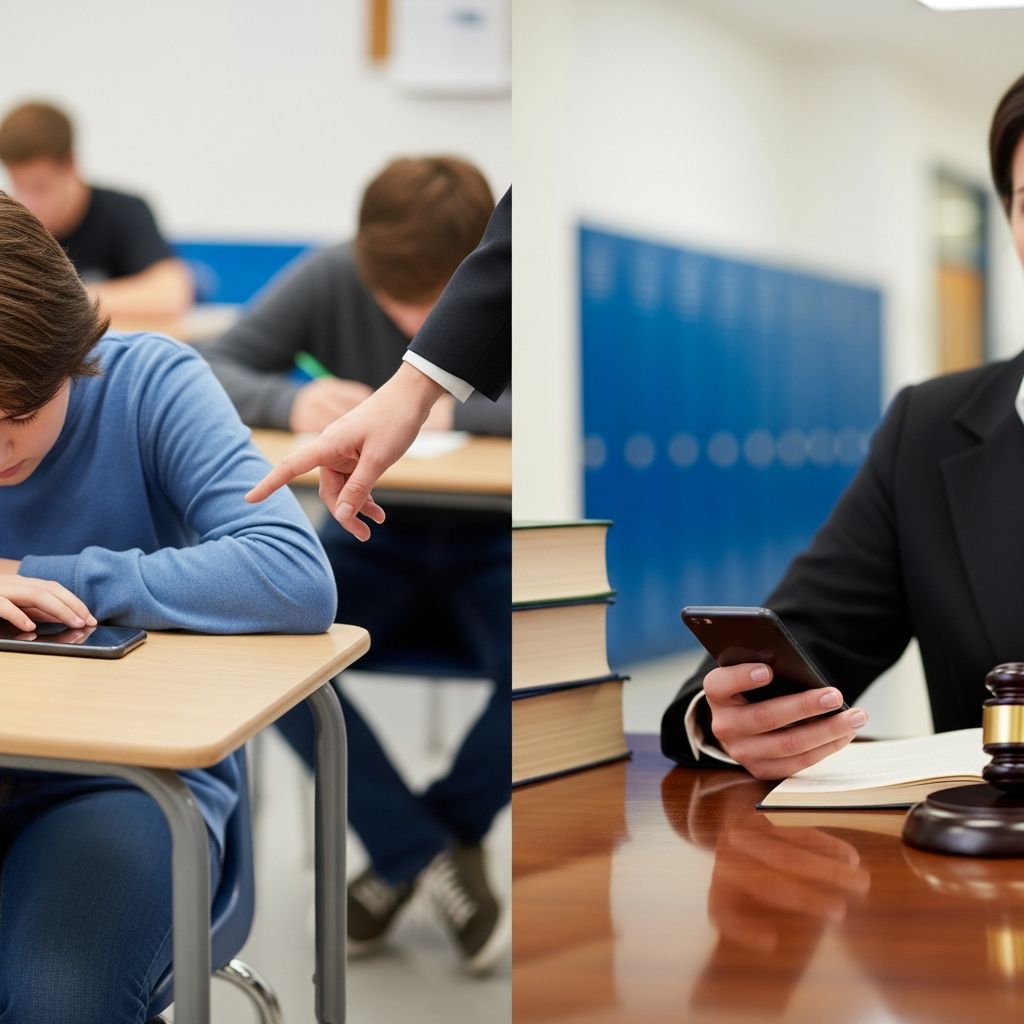
Smartphones are part of daily life for most students, so conflicts over phones in class are inevitable. This guide explains when teachers and schools can take your phone, what they cannot do, and how to handle a situation when you think a line has been crossed. Laws vary by country and state, but there are common principles about school authority, discipline, and privacy that appear in many legal systems.
1. Why Schools Care So Much About Phones
Schools often see phones as both a tool and a distraction. On one hand, they can support learning and communication with families. On the other, they can disrupt lessons, enable cheating, and raise serious issues like cyberbullying, harassment, or sharing inappropriate content.
Because of these concerns, most schools adopt clear rules about:
- When phones may be used (for example, only during lunch or breaks)
- Where phones may be used (e.g., not in class, not in exams, not in bathrooms/locker rooms)
- How they must be stored (e.g., silenced in backpack, turned off, placed in a locker or designated pouch)
- What happens if a student breaks those rules (e.g., verbal warning, phone confiscation until end of day, parent pickup)
These rules are typically written in a student or parent handbook or in a university code of conduct, and students are treated as having agreed to them by enrolling or attending.
2. School Rules vs. Legal Rights
Even inside school, students keep important legal rights. The school’s power to regulate behavior does not erase constitutional protections, human rights principles, or basic property rights.
2.1 Key legal ideas that often apply
- Property rights: Your phone belongs to you or your family. Taking it without lawful justification may raise issues of trespass to goods or conversion in some legal systems, especially if the device is kept for an unreasonable time or damaged.
- Search and privacy rights: Many countries limit when officials, including school staff, can search personal belongings. In the United States, for example, the Fourth Amendment protects students against unreasonable searches and seizures, even at school.
- Due process and fairness: Public institutions usually must follow written procedures before imposing serious penalties. Universities often require notice, an opportunity to be heard, and an appeal process for significant disciplinary sanctions.
- Proportionality: Discipline should be reasonably related to the misconduct. Confiscating a phone for a brief rule violation may be allowed; permanently taking it or imposing extreme penalties may be considered excessive.
2.2 How policies and laws interact
In many places, a school’s internal rules are valid only if they do not contradict higher-level laws, such as national constitutions, education statutes, or human rights obligations. That means:
- School rules can restrict phone use and allow temporary confiscation.
- School rules cannot erase fundamental legal safeguards around property and privacy.
3. Confiscation: When Can a Teacher Take Your Phone?
In practice, teachers usually can take a student’s phone when the student breaks a clear school rule about phone use and the confiscation is a reasonable response.
3.1 Typical situations where confiscation is allowed
Confiscation is more likely to be considered lawful when all of the following are true:
- The school has a written policy about phones, accessible to students and parents.
- The student violated that policy (for example, using the phone in class after being warned).
- The phone is taken for a limited time (e.g., until the end of class, school day, or until a parent collects it), not indefinitely.
- The device is stored safely and returned in the same condition.
Many ministries of education or national departments of education explicitly permit schools to confiscate items like phones where it is fair and necessary to maintain order.
3.2 When confiscation may cross a line
Concerns about legality or fairness increase when:
- A teacher demands phones from all students as a condition of being marked present, even if some students are not using them or causing any disruption.
- A student is following school policy (phone off and put away), but the teacher still insists on taking it without cause.
- The phone is held for weeks or months with no clear policy authorizing that length of confiscation.
- The device is lost, damaged, or accessed while in school custody.
In such cases, students or parents may have grounds to complain to the administration or, in more serious scenarios, consider legal advice about property rights or administrative law.
4. Searching Phones: A Different and Stricter Question
Taking a phone away is one thing. Going through its contents is something very different in the eyes of the law. Because phones can hold messages, photos, medical records, and financial information, many courts view them as highly sensitive devices that deserve strong privacy protection.
4.1 The basic rule in many systems
Most legal guidance distinguishes between:
- Seizing a phone (physically holding or securing it)
- Searching a phone (opening apps, reading messages, viewing photos, checking call logs)
Many credible education and civil rights organizations are clear that a rule violation alone (like using a phone in class) does not automatically justify a broad search of the device. In the U.S., groups explaining the Fourth Amendment note that school officials usually need at least reasonable suspicion that the phone holds evidence of a more serious rule or law violation—such as threats, harassment, or planned violence—before searching it.
| Action | What it involves | Legal threshold often required | Common examples |
|---|---|---|---|
| Confiscation | Teacher or administrator takes the phone and holds it for a limited period. | Violation of a written school rule; reasonable and proportionate response. | Phone rings in class after warnings; student uses phone to record others without consent. |
| Search | Opening messages, photos, apps, or logs on the device. | Some form of reasonable suspicion that the phone contains evidence of serious misconduct or danger, plus limits on how far the search can go. | Checking messages after a report of violent threats sent from the device. |
4.2 U.S. perspective: the role of the Fourth Amendment
In the United States, the Fourth Amendment protects against unreasonable searches and seizures, and this protection extends to students in public schools, though with some modifications for the school setting. Legal education resources emphasize that:
- School officials generally cannot search a phone just because a student protested the confiscation or was disrespectful.
- There must be a connection between the reason for the search and what is being searched. Looking for evidence of bullying, for example, does not justify browsing through all photos and unrelated apps.
- Searches should be limited in scope—only as intrusive as necessary to address the concern that triggered the search.
Student advocacy groups also stress that confiscation for a simple rule violation does not give the school a blank check to explore everything on the device.
5. International Approaches: Different Systems, Similar Tensions
Although the details differ between countries, several common themes emerge in comparative legal discussions about phone confiscation.
- United Kingdom: Government guidelines allow schools to confiscate or retain students’ property, including phones, when it is reasonable and proportionate, with attention to the student’s welfare and the specific circumstances.
- India: Commentators have linked confiscation to property rights under the Constitution of India, suggesting that university staff must act under valid authority (such as statutes or regulations) and that absence of such authority may make even temporary deprivation legally questionable.
- United States: Universities and schools must respect due process requirements, particularly for serious sanctions. Some institutions provide for written notice, a hearing, and a right to appeal for disciplinary measures, which can include confiscation in certain contexts.
In all these systems, the core tension is the same: how to balance institutional discipline and safety with individual rights to property, privacy, and fair treatment.
6. Practical Tips for Students and Parents
Even when you know your rights, situations with teachers can be stressful. These steps can help you respond calmly and constructively.
6.1 Before anything happens: know the rules
- Read the student handbook or code of conduct at the start of the school year. Look specifically for sections about electronic devices, confiscation, and searches.
- Ask for clarification from a counselor or administrator if the policy is vague.
- Talk at home about what your family is comfortable with—such as whether a parent should be called before any search of your phone.
6.2 When a teacher asks for your phone
- Stay calm and respectful, even if you think the request is unfair. Escalating the conflict can create additional disciplinary issues.
- If it feels safe, you may ask: “Can you tell me which rule I’m breaking and how long you will keep my phone?”
- Complying in the moment, then challenging the decision later through formal channels, is often safer than refusing outright—especially if your school has clear appeal processes.
6.3 If someone tries to search your phone
- You can calmly say that you do not consent to a search of your phone, and ask that your parent or guardian be contacted first.
- Do not physically interfere or grab the device back—focus on clearly stating your position and requesting an administrator or parent be involved.
- Write down what happened as soon as you can, including who was present and what was said.
6.4 Following up after an incident
- Review the school policy and compare it with what occurred. Note any differences.
- Schedule a meeting with an administrator, bringing a parent or guardian if possible, to discuss concerns.
- If you believe your privacy or property rights were violated in a serious way (for example, a broad search of your phone with no real justification, or damage to the device), consider seeking legal advice or contacting a student rights organization.
7. Frequently Asked Questions (FAQs)
Q1: Can a teacher take my phone if it was in my pocket and I wasn’t using it?
If you were following the school’s written phone policy (for example, the phone was off and out of sight), a blanket requirement that all students surrender phones may be harder to justify, especially if it is not supported by school policy. Whether it is allowed depends on local law and the exact wording of your school’s rules, but many legal commentators question confiscation without any disruption or rule violation.
Q2: How long can the school keep my phone?
Most systems expect confiscation to be temporary and proportionate—often just until the end of the class or school day, or until a parent picks it up. Keeping a phone for an extended period without clear policy backing may raise issues of fairness or property rights. Check your handbook for specific time limits and retrieval procedures.
Q3: Can school staff read my text messages or look through my photos?
Generally, staff cannot browse your messages or photos just because you broke a phone rule. In many jurisdictions, including the U.S., officials need a specific and reasonable suspicion that your phone contains evidence of serious misconduct and must limit the search to what is necessary for that purpose.
Q4: What if my phone is lost or damaged while the school has it?
Schools usually have a duty to take reasonable care of items they confiscate. If your phone is damaged or disappears while under school control, your family may have grounds to request compensation or file a formal complaint, depending on local law and the school’s policies on liability.
Q5: Does any of this apply in private schools or universities?
Yes, but details differ. Private institutions may have more contractual freedom, yet they are still bound by general laws on property, privacy, and sometimes human rights or consumer protection. Universities often have additional due process requirements for discipline and may spell out confiscation and search rules in detailed codes of conduct.
References
- Cell Phone Privacy — ACLU of Southern California / My School My Rights. 2020-08-01. https://www.myschoolmyrights.com/rights/cell-phone-privacy/
- Can Teachers Confiscate Phones Legally? — Jus Corpus Law Journal. 2022-05-15. https://www.juscorpus.com/can-teachers-confiscate-phones-legally/
- Can Teachers Take Your Phone? — LawyersCorner. 2023-03-10. https://lawyerscorner.com/can-teachers-take-your-phone/
- Can School Administrators Take My Phone and Go Through It? — McLellan Online, Michigan State University College of Law. 2018-09-12. https://mclellan.law.msu.edu/questions/searching-student-cellphones
- Do Teachers Have the Right to Confiscate Personal Items for No Reason? — Justia Ask a Lawyer. 2025-01-28. https://answers.justia.com/question/2025/01/28/do-teachers-have-the-right-to-confiscate-1046380
Similar Articles








Read full bio of medha deb


