
Section 230 and Online Free Speech Explained
A clear, practical guide to how Section 230 shapes online speech, platform liability, and the future of the social web.
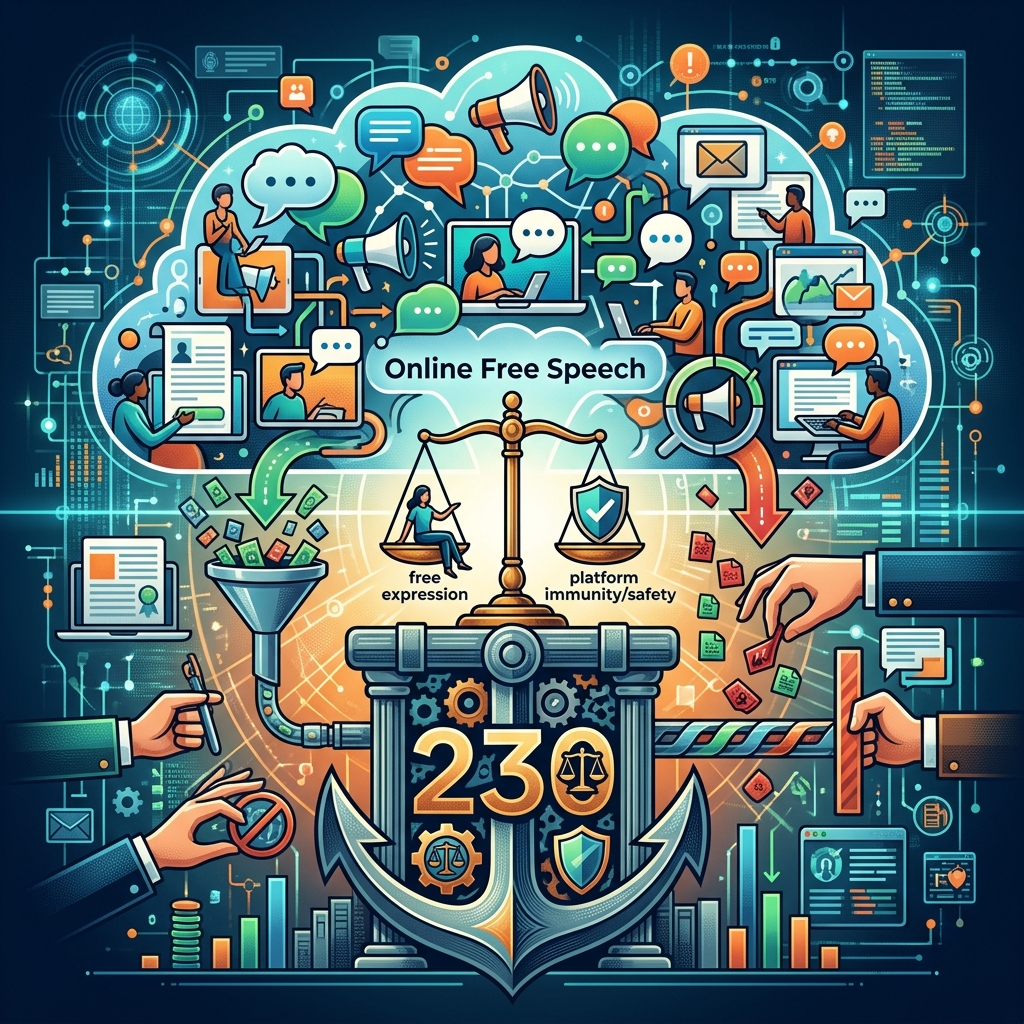
Section 230 of the Communications Decency Act is often described as one of the most important laws shaping the modern internet. It defines when online platforms are legally responsible for content posted by users and, in doing so, strongly influences what speech can thrive online.
This article offers a practical, plain-language guide to Section 230, how it works, why it matters for free expression, and what might happen if its protections are significantly changed.
What Section 230 Actually Says
At its core, Section 230 answers a simple but crucial question: when someone posts content on a digital service, who is legally responsible—the person who posted it, or the service that hosts it?
The key provision, often called the “shield” for platforms, states that no provider or user of an interactive computer service shall be treated as the publisher or speaker of information provided by another information content provider. In practice, this means that websites, apps, and other online services generally are not liable for what their users say, so long as the content is created by users rather than the service itself.
Two Main Pillars of Protection
Courts and scholars usually describe Section 230 as having two major pillars of immunity:
- Pillar 1: Host but not publisher – Platforms are treated as hosts for user-generated content, not as the legal “publisher” or “speaker” of that content.
- Pillar 2: Freedom to moderate – Platforms are protected when they choose to remove, restrict, or filter content they consider objectionable, so long as they act in good faith.
Together, these provisions allow platforms to both carry large volumes of user speech and make editorial decisions about what to remove, without incurring broad civil liability for either choice.
What Counts as an “Interactive Computer Service”?
Section 230 applies to a wide range of services, not just major social media platforms. The statute uses the term “interactive computer service”, which courts have interpreted broadly.
Examples of services typically covered include:
- Social networks and video-sharing platforms
- Online forums, message boards, and community sites
- Product review and rating sites
- Comment sections on news outlets and blogs
- Collaborative knowledge bases and wikis
The breadth of this definition is one reason Section 230 is sometimes described as the foundation of user-generated content online. Without these protections, many services would face strong incentives to drastically limit or remove user participation.
How Courts Decide if Section 230 Applies
When a case involves allegedly harmful online content, courts use a straightforward test to decide whether Section 230 shields the defendant from liability.
| Prong | Question | Effect if Answer is “Yes” |
|---|---|---|
| 1 | Is the defendant a provider or user of an interactive computer service? | If yes, the defendant is potentially eligible for Section 230 protection. |
| 2 | Does the claim treat the defendant as the publisher or speaker of the information? | If yes, the claim targets publishing decisions—precisely what Section 230 regulates. |
| 3 | Was the information provided by another information content provider (i.e., a third party)? | If yes, the platform did not create the content at issue and is generally protected. |
Only when all three prongs are satisfied does Section 230 immunity fully apply. If a platform materially contributes to or creates the content, it may be treated as a “content provider” and lose protection for that specific material.
Limits: What Section 230 Does Not Protect
Despite its broad reach, Section 230 is not a blanket immunity for everything that happens online. Several important limits remain in place.
- Federal criminal law – Platforms can still be prosecuted under federal criminal statutes; Section 230 does not provide immunity from criminal liability.
- Intellectual property claims – Claims involving copyright or trademark infringement are generally outside the scope of Section 230 protection.
- Certain regulatory obligations – Conduct such as discriminatory ad targeting can be challenged under civil rights and anti-discrimination laws.
- Platform-created content – If a service helps create or significantly shape the content, it may lose immunity for that content.
These boundaries are important for understanding why Section 230 is often framed as protecting user speech and routine hosting decisions, rather than shielding platforms from all legal consequences of their operations.
Why Section 230 Matters for Free Speech Online
Many civil liberties advocates and legal scholars argue that Section 230 plays a central role in protecting free expression in the digital age.
Reducing Incentives to Over-Censor
Before Section 230, platforms faced a dilemma: if they moderated content at all, courts might treat them as publishers and impose liability for any harmful material they failed to catch. That created a powerful incentive either to avoid moderation entirely or to heavily censor users.
By clarifying that engaging in good-faith moderation does not convert platforms into legal publishers, Section 230:
- Encourages platforms to remove genuinely harmful content
- Reduces the need to ban large categories of lawful but controversial speech
- Allows more nuanced rules tailored to community standards and safety
Enabling Diverse Online Communities
Because platforms are not broadly liable for what users say, many different kinds of communities can exist online, from niche forums to global social networks. Scholars and policy analysts argue that this has been critical to the growth of user-generated content and innovation.
According to policy research from organizations such as the Cato Institute, weakening Section 230 would likely push platforms to:
- Remove more lawful but risky content to avoid lawsuits
- Offer fewer interactive features that allow user posting
- Exit markets or shut down smaller services unable to manage increased legal risk
In this view, Section 230 helps support a wide range of expression by making large-scale user participation legally manageable.
Critiques and Calls for Reform
Despite its benefits, Section 230 has become a major political and policy flashpoint. Critics from different perspectives argue that the law either gives platforms too much freedom or encourages them to moderate in ways that unfairly impact certain speech.
Concerns About Harmful Content and Algorithmic Amplification
One line of criticism focuses on how platforms recommend and amplify content. Researchers from Harvard and other institutions note that modern platforms often use algorithms to boost posts likely to generate engagement, which can include misinformation or inflammatory content.
Some scholars argue that Section 230, as applied today, can shield platforms not just for hosting speech but also for enabling rapid, large-scale amplification of harmful content via algorithmic design.
Debates Over Platform Responsibility
Other critics point to issues such as harassment, extremist content, and disinformation, arguing that platforms should bear more legal responsibility when they facilitate or fail to address serious harm. State attorneys general and consumer advocates have explored how changing Section 230 might influence platform accountability.
Proposals in this area vary, but commonly include ideas such as:
- Requiring platforms to explain or justify certain moderation decisions
- Limiting immunity when services profit from paid content that causes harm
- Narrowing protections for specific categories of unlawful or dangerous material
However, these proposals often face concerns that they could unintentionally chill lawful speech or disadvantage smaller platforms that lack resources for extensive legal compliance.
How Proposed Changes Could Affect Innovation
Legal and policy analyses emphasize that Section 230 has been closely tied to the rise of innovative online services.
Research from academic and policy institutions identifies several likely consequences if Section 230 protections are significantly narrowed:
- Higher barriers to entry – New platforms would need extensive legal review and compliance systems before launching, making it harder for start-ups to compete with large incumbents.
- More conservative moderation – Services might respond to legal uncertainty by removing controversial or borderline content, even if it is lawful.
- Reduced user participation – Interactive features such as comments, reviews, and forums could be restricted or removed to minimize liability.
Legal scholarship in venues like the Harvard Law Review has even argued that the principles embodied in Section 230 align closely with First Amendment concerns about protecting speech from indirect suppression through publisher liability.
Section 230 and the Courts
Over time, the federal courts have played a crucial role in defining the scope of Section 230. Landmark decisions have confirmed that platforms are generally protected when they host user-generated content such as reviews, comments, photos, or videos, even if others find that material objectionable.
Cases before the Supreme Court, including disputes involving major platforms, continue to test the boundaries of how much protection Section 230 offers and in what circumstances. Civil liberties organizations emphasize that outcomes in these cases could significantly reshape how social media and other services operate.
Key Takeaways for Everyday Users
While Section 230 is a complex law, several practical points are helpful for everyday internet users:
- You are generally responsible for what you post online; platforms are normally not liable for your speech unless they helped create it.
- Platforms can set and enforce their own community standards, removing or limiting content that violates those rules, regardless of whether that content is legally protected speech.
- Section 230 does not shield platforms from federal criminal law, intellectual property disputes, or other core legal obligations.
- Changes to Section 230 could affect which services are available, what speech is allowed, and how moderation decisions are made.
Frequently Asked Questions (FAQs)
Does Section 230 mean platforms can never be sued?
No. Section 230 limits civil liability for user-generated content but does not block all lawsuits. Platforms can still face claims related to federal criminal law, intellectual property infringement, and their own conduct, such as discriminatory practices.
Is Section 230 the same as the First Amendment?
Section 230 is a federal statute, not a constitutional right. However, some legal scholars argue that its core rule—protecting platforms from liability for user defamation—aligns with First Amendment principles and helps safeguard online speech indirectly.
Can platforms choose what content to remove?
Yes. Section 230 explicitly protects platforms that remove or restrict content they consider obscene, violent, harassing, or otherwise objectionable, so long as they act in good faith. This allows services to enforce community standards and safety rules.
What would happen if Section 230 were repealed?
Analysts predict that repealing or heavily weakening Section 230 would lead platforms to more aggressively remove controversial content, reduce interactive features, or exit certain markets to manage legal risk. Smaller and new platforms would likely be most affected.
Does Section 230 protect content that violates criminal law?
No. Platforms can still be subject to federal criminal enforcement. Section 230 primarily addresses civil liability related to being treated as the publisher of user-generated content.
References
- Section 230 — Electronic Frontier Foundation. 2023-06-01. https://www.eff.org/issues/cda230
- Sunset and Renew: Section 230 Should Protect Human Speech, Not Algorithmic Virality — Harvard Kennedy School Ash Center. 2021-03-15. https://ash.harvard.edu/articles/sunset-and-renew-section-230-should-protect-human-speech-not-algorithmic-virality/
- The Future of Online Expression and Innovation Depends on Robust Section 230 Protections — Cato Institute Policy Analysis. 2020-07-02. https://www.cato.org/policy-analysis/future-online-expression-innovation-depends-robust-section-230-protections
- The Potential Impact of Proposed Changes to Section 230 on Speech and Innovation — George Mason Law Review. 2021-01-01. https://lawreview.gmu.edu/print__issues/the-potential-impact-of-proposed-changes-to-section-230-on-speech-and-innovation/
- Section 230 — U.S. Communications Decency Act Overview (summary). 2023-01-10. https://en.wikipedia.org/wiki/Section_230
- Is This the End of the Internet As We Know It? — American Civil Liberties Union. 2023-02-08. https://www.aclu.org/news/free-speech/section-230-is-this-the-end-of-the-internet-as-we-know-it
- Section 230 as First Amendment Rule — Harvard Law Review. 2018-05-01. https://harvardlawreview.org/wp-content/uploads/2018/05/2027-2048_Online.pdf
- The Future of Section 230: What Does It Mean for Consumers? — National Association of Attorneys General. 2023-05-01. https://www.naag.org/attorney-general-journal/the-future-of-section-230-what-does-it-mean-for-consumers/
Similar Articles








Read full bio of medha deb


