
Understanding Who Controls Minimum Wage Rules
A practical guide for employers and employees on how federal, state, county, and city governments share authority over minimum wage and enforcement.
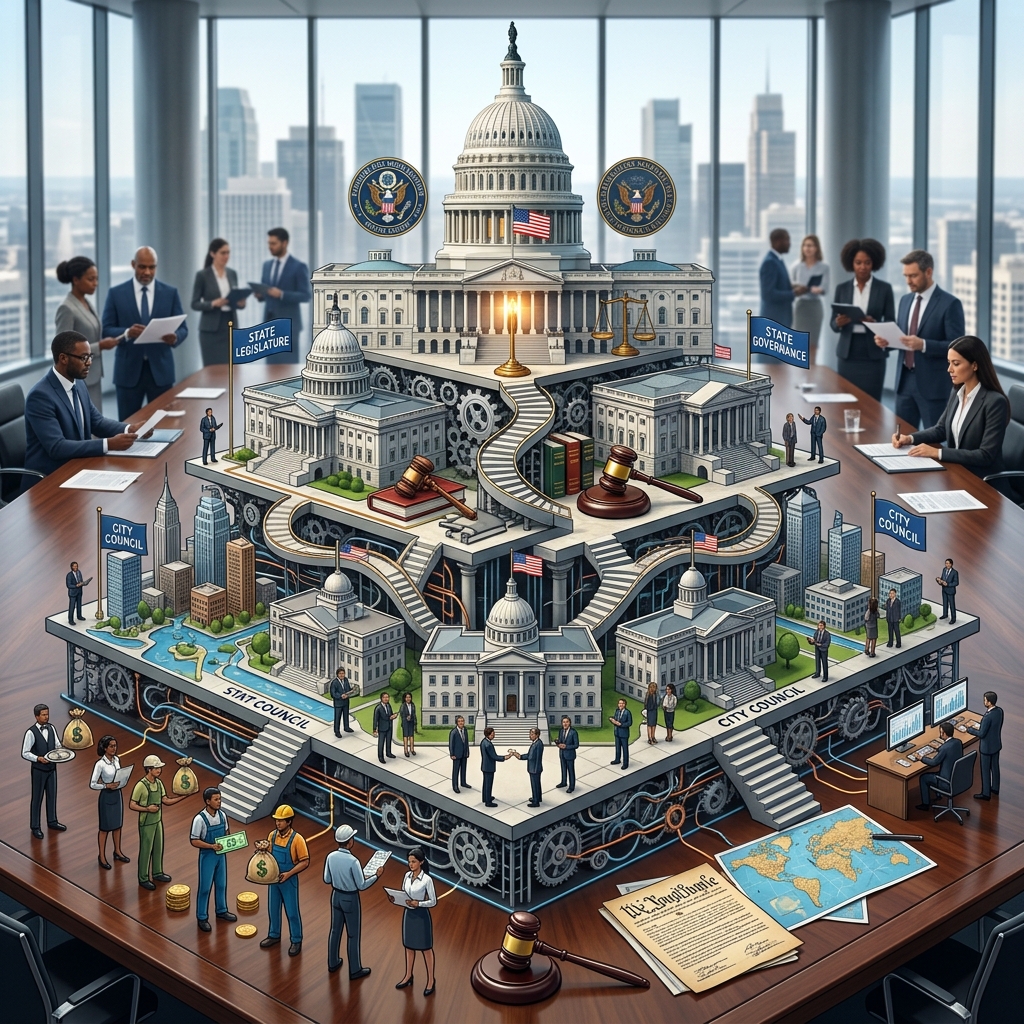
Minimum wage is one of the most visible labor rules in the United States, but the question of who actually controls it is more complicated than it appears. Several layers of government share responsibility for setting and enforcing minimum wage, and businesses often operate under overlapping rules. Understanding these layers is essential for both employers and workers who want to avoid costly mistakes and protect their rights.
This article explains how federal, state, county, and city governments interact in the minimum wage system, which wage rate applies when rules conflict, and how enforcement works in practice. It is designed for small business owners, HR professionals, and employees who need a clear roadmap through the patchwork of minimum wage regulations in the U.S.
The Basics: What Minimum Wage Is and Why Jurisdiction Matters
At its core, the minimum wage is the lowest hourly rate that covered employers are legally allowed to pay covered employees. It functions as a floor, not a ceiling: governments can set higher standards, but employers generally cannot go below the highest applicable rate.
Jurisdiction matters because different governments can impose different minimum wage rates. When a business operates in a place where federal, state, and local laws all address minimum wage, it must determine which law controls, which agency can enforce it, and how those rules apply to particular employees. Failure to correctly identify the controlling law can lead to unpaid wage claims, penalties, and reputational risk.
Key reasons jurisdiction is important
- Compliance costs: Employers may face multiple wage rules that vary by city, county, and state.
- Employee protections: Workers rely on knowing which wage rate they are legally entitled to receive and where to file complaints.
- Enforcement authority: Different agencies investigate violations, issue penalties, and collect back wages.
- Business planning: Companies must forecast labor costs accurately when expanding into new jurisdictions.
Federal Authority: The National Floor for Minimum Wage
At the federal level, minimum wage is governed by the Fair Labor Standards Act (FLSA), administered by the U.S. Department of Labor’s Wage and Hour Division. The FLSA sets a nationwide base wage for covered, non-exempt employees and establishes rules for overtime, child labor, and recordkeeping.
Federal minimum wage and scope
As of 2024, the federal minimum wage is $7.25 per hour, a rate that has remained unchanged since 2009. That wage applies to most workers of employers engaged in interstate commerce or with revenues above specified thresholds, though some workers are exempt or subject to special rules (for example, certain tipped employees, students, and agricultural workers).
| Feature | Description |
|---|---|
| Statute | Fair Labor Standards Act (FLSA) |
| Current rate | $7.25 per hour (since 2009) |
| Administering agency | U.S. Department of Labor, Wage and Hour Division |
| Coverage | Most employees of businesses engaged in interstate commerce or meeting revenue thresholds |
| Overtime | Time-and-a-half for hours over 40 in a workweek for covered, non-exempt employees |
Federal law provides the baseline for wage protection across the country. However, it explicitly allows states and local governments to adopt higher minimum wages. When they do, employers must follow the rule that grants the highest applicable wage to the employee.
State Authority: Raising the Floor Above Federal Levels
Almost every state has its own minimum wage law. Some states set the same rate as the federal minimum, some exceed it, and a few have no separate minimum wage statute and instead rely on federal law. The U.S. Department of Labor tracks these state-level rates.
Examples of higher state minimum wages
Many states now mandate rates substantially above the federal minimum. For example, Maryland’s minimum wage is $15.00 per hour for all employers, with additional local variations in Montgomery County. Other states such as California, Washington, New York, and Connecticut also have higher statewide rates.
- States without a minimum wage law rely fully on the federal rate.
- States with higher minimum wages require employers to pay at least the state rate to covered employees.
- Some states allow specific lower rates for certain categories of workers (e.g., youth wages or tipped employees), subject to federal limitations.
State labor departments, labor commissioners, or comparable agencies are responsible for enforcing state minimum wage rules, investigating violations, and collecting back pay for employees. For example, California’s Labor Commissioner accepts wage claims and can hold conferences or hearings to resolve disputes.
Local Authority: Counties and Cities Setting Their Own Wage Floors
In addition to states, many cities and counties adopt their own minimum wage ordinances. These local rules typically raise the minimum wage above the state level to address regional living costs and policy priorities. Whether local governments can do this depends on state law: some states permit local minimum wage ordinances, while others restrict or preempt them.
Why local minimum wage laws exist
- Higher cost of living: Urban areas often adopt higher wages to reflect local housing, transportation, and food costs.
- Policy innovation: Cities may want to experiment with wage policies more protective than state law.
- Targeted coverage: Local rules can vary by employer size or industry to address specific economic conditions.
Illustrative local examples
Several large counties and cities have created detailed minimum wage frameworks:
- Montgomery County, Maryland: As of July 1, 2024, local law sets tiered minimum wages based on employer size, up to $17.15 per hour for large employers.
- Los Angeles County and nearby cities: The county’s minimum wage applies to unincorporated areas, while incorporated cities such as Los Angeles, West Hollywood, and Santa Monica have their own separate minimum wage ordinances and enforcement systems.
- Numerous cities nationwide: Research shows many jurisdictions, including Chicago and others, maintain local wage ordinances as part of broader labor standards.
Local agencies, often housed within a city’s labor or wage standards office, are responsible for enforcing these ordinances. For instance, the Office of Wage Standards in Los Angeles administers and enforces that city’s minimum wage laws and supports workers with consultations and complaint procedures.
How Overlapping Jurisdictions Work: Which Wage Must Employers Pay?
When federal, state, and local minimum wage laws all apply, the controlling rule is simple in principle but complex in practice: the employer must pay the highest applicable minimum wage among the overlapping jurisdictions. The challenge is determining which jurisdictions apply to a particular employee and keeping track of changing rates.
General rule of precedence
- Federal law: Sets a nation-wide minimum floor at $7.25 per hour for covered employees.
- State law: If higher than federal, the state rate supersedes the federal minimum for covered workers within that state.
- Local law (city/county): If higher than both federal and state, the local rate controls for work performed within that jurisdiction.
For workers who regularly perform services in a city or county with a local ordinance, employers must ensure pay meets that local minimum wage for the hours worked there. Where an employee works across different jurisdictions, determining the applicable wage may require careful analysis of time records and governing statutes.
Illustrative scenario
Consider a worker employed in a state with a $15.00 per hour minimum wage and a city within that state that sets its own minimum at $17.00 per hour:
- Federal minimum wage: $7.25 per hour.
- State minimum wage: $15.00 per hour.
- City minimum wage: $17.00 per hour.
For work performed in the city, the employer must pay at least $17.00 per hour. For work outside the city but within the state, the employer must pay at least $15.00 per hour. If the worker is covered by federal law, the federal rate becomes irrelevant since higher protections exist under state and local rules.
Enforcement: Which Agencies Handle Minimum Wage Violations?
Jurisdiction over minimum wage enforcement mirrors the layers of law-making authority. Federal, state, and local agencies may have concurrent power to investigate wage violations, though they operate under different statutes and procedures.
Federal enforcement
- Agency: U.S. Department of Labor, Wage and Hour Division.
- Tools: Investigations, back wage recovery, civil money penalties for willful or repeated violations, and litigation in federal court.
- Scope: Violations of the FLSA, including failure to pay the federal minimum wage and overtime.
State enforcement
- Typical agencies: Labor departments, labor commissioners, or similar offices.
- Processes: Administrative wage claims, field investigations, hearings, and orders requiring payment of back wages and penalties.
- State-specific remedies: Some states offer additional penalty schemes and special enforcement mechanisms (for example, California’s Private Attorney General Act).
Local enforcement
- City programs: Offices of wage standards, municipal labor agencies, or dedicated enforcement units.
- Authorities: Ability to investigate complaints, issue citations, levy administrative penalties, and require restitution.
- Worker support: Many local agencies provide multilingual assistance, outreach, and education about rights.
Employees often have a choice of forum for pursuing unpaid wage claims: they can file with federal authorities, state labor agencies, local offices if available, or bring a civil lawsuit in court. The most appropriate forum depends on the facts, the laws allegedly violated, and available remedies.
Special Complications: Multi-State Work, Choice-of-Law, and Extraterritorial Issues
Jurisdiction over minimum wage can become especially complex when employees work across state lines, employers are headquartered in one state but operate elsewhere, or contracts invoke particular state laws. Courts generally presume that a state’s wage laws were intended to protect work performed within that state’s borders, unless the legislature clearly says otherwise.
Key considerations for multi-jurisdiction employment
- Location of work: Minimum wage rules typically apply to hours worked inside the jurisdiction that enacted the law.
- Choice-of-law clauses: Contract terms selecting one state’s law do not usually create a right to wages if that state’s law would not otherwise apply.
- Traveling employees: Employers must consider where work is physically performed and track time by location when laws differ substantially.
- Remote work: As remote arrangements expand, questions arise about which jurisdiction’s wage laws govern workers performing tasks from home in other states.
For these more complex scenarios, businesses may need specialized legal advice and more sophisticated timekeeping systems to ensure they are paying the correct minimum wage for each hour worked.
Practical Compliance Strategies for Employers
Because multiple levels of government share jurisdiction over minimum wage, employers should adopt deliberate compliance strategies that account for overlapping rules and changing rates. Proactive planning reduces the risk of enforcement actions and protects employee relations.
Core compliance steps
- Map your operations: Identify every state, county, and city where employees perform work.
- Determine governing wage laws: Review federal, state, and local minimum wage statutes and ordinances applicable to each location.
- Apply the highest rate: Set payroll systems so the highest applicable minimum wage operates as the effective floor for each employee.
- Monitor changes: Minimum wage rates often adjust annually or on set dates. Track upcoming increases and include them in budgeting.
- Train managers and HR: Supervisors should understand local wage rules and know where to direct employee questions.
- Maintain accurate records: Document hours worked, locations, and pay rates to demonstrate compliance in case of an audit.
Risk mitigation
- Review payroll periodically to confirm that no employee’s regular rate falls below the highest applicable minimum wage.
- Respond promptly to worker inquiries about pay and consider consultation with legal counsel for disputed issues.
- Enroll in updates from federal, state, and local agencies to be notified of rate changes.
Frequently Asked Questions About Minimum Wage Jurisdiction
1. If federal and state minimum wages differ, which one applies?
When federal and state minimum wages conflict, employers must pay the higher of the two to covered employees. For example, if a state sets its minimum wage at $15.00 per hour and the federal wage remains $7.25, covered workers in that state must receive at least $15.00 per hour.
2. Can cities or counties set their own higher minimum wage?
Many cities and counties are allowed to adopt their own minimum wage ordinances that exceed state and federal rates, provided state law does not prohibit or preempt local wage rules. In those areas, employers must follow the local wage ordinances for work performed within the jurisdiction.
3. Who enforces local minimum wage laws?
Local minimum wage laws are typically enforced by municipal agencies or dedicated wage standards offices. These agencies investigate complaints, issue citations, and can require employers to pay back wages and penalties. They often coordinate with state and federal authorities when violations implicate multiple laws.
4. Can an employment contract waive the minimum wage?
No. Minimum wage requirements are statutory rights designed to protect employees and cannot be waived by private agreement. Courts and enforcement agencies treat such rights as mandatory, meaning employers must comply regardless of what a contract says.
5. Where should a worker file a complaint about unpaid wages?
Workers may have several options. They can file a complaint with the U.S. Department of Labor for violations of the FLSA, submit a wage claim with a state labor agency, or use local wage enforcement offices where they exist. In many cases, workers can also bring a civil lawsuit in court, sometimes with the assistance of private counsel.
6. What happens if an employer repeatedly violates minimum wage laws?
Employers who repeatedly or willfully violate minimum wage laws can face significant consequences, including liability for unpaid wages, liquidated damages, civil money penalties, and court orders requiring changes to pay practices. These sanctions can arise under federal, state, or local law, depending on the violations involved.
Why Understanding Jurisdiction Helps Both Employers and Employees
Minimum wage jurisdiction may appear to be a technical legal topic, but it directly affects how much workers are paid and how businesses manage their labor costs. For employees, knowing which level of government sets the binding wage helps them verify their pay and recognize when something is wrong. For employers, understanding the hierarchy of federal, state, and local rules is essential to staying compliant, avoiding penalties, and maintaining trust with their workforce.
As more states and cities adjust their minimum wages to reflect economic and policy goals, questions about jurisdiction will continue to arise. Staying informed about which government has authority over minimum wage in each location of operation is one of the most effective steps any organization can take to protect both its employees and its long-term stability.
References
- State Minimum Wage Laws — U.S. Department of Labor, Wage and Hour Division. 2024-01-01. https://www.dol.gov/agencies/whd/minimum-wage/state
- Minimum Wage — Schneider Wallace Cottrell Konecky LLP. 2024-05-01. https://www.schneiderwallace.com/practice-areas/failure-to-pay-wages-overtime-commissions/minimum-wage/
- Minimum Wage Frequently Asked Questions — California Department of Industrial Relations. 2024-01-01. https://www.dir.ca.gov/dlse/faq_minimumwage.htm
- Wage Laws — Maryland People’s Law Library. 2024-07-01. https://www.peoples-law.org/wage-laws
- LA County: Incorporated vs Unincorporated Minimum Wage Laws — GovDocs. 2024-07-01. https://www.govdocs.com/la-county-incorporated-vs-unincorporated-minimum-wage-laws/
- Wages LA: Office of Wage Standards — City of Los Angeles. 2024-06-01. https://wagesla.lacity.gov/
- The Extraterritorial Application of State Wage and Hour Laws — Transnational Litigation Blog. 2023-04-03. https://tlblog.org/the-extraterritorial-application-of-wage-and-hour-laws/
Similar Articles








Read full bio of medha deb




