
Understanding the U Visa for Undocumented Crime Victims
How the U visa offers protection, encourages reporting, and supports undocumented victims of serious crimes in the United States.
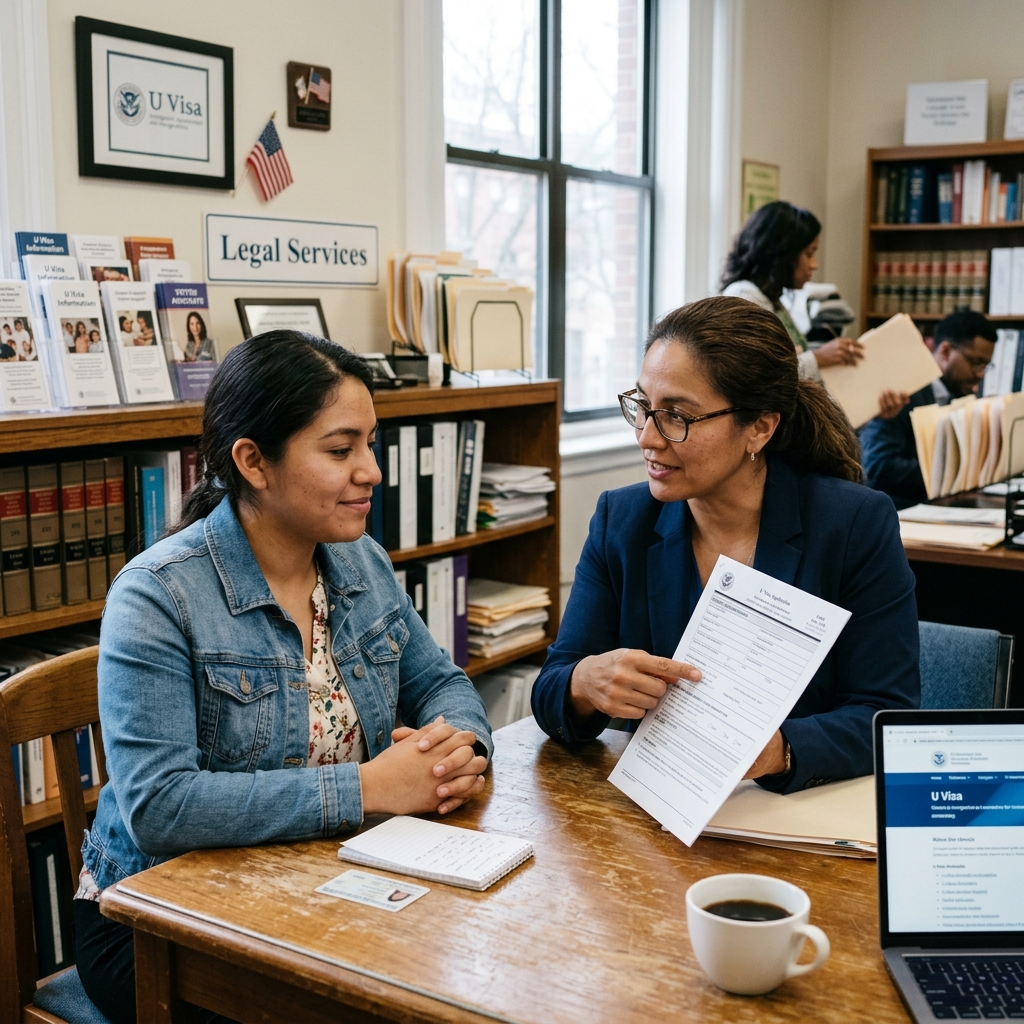
The U visa is a specialized immigration status created to protect undocumented victims of serious crimes who assist law enforcement in investigating or prosecuting those crimes. It recognizes that many immigrants are afraid to report criminal activity because they fear deportation or retaliation, and it offers a path to lawful status in exchange for cooperation with authorities. This guide explains what the U visa is, who it benefits, how to apply, and how it fits within the broader framework of immigration relief for crime and abuse victims.
What Is the U Visa?
The U visa is a form of nonimmigrant status available to victims of certain qualifying crimes who have suffered substantial physical or mental harm and are helpful, or willing to be helpful, to law enforcement or prosecutors. Unlike many other immigration benefits, applicants for the U visa do not need to be in lawful immigration status at the time of the crime or application. The central idea is to strengthen public safety and trust between immigrant communities and authorities by reducing the immigration risks that victims face when they come forward.
Key aspects of the U visa include:
- Protection from removal (deportation) once the petition is approved.
- Authorization to live and work legally in the United States for up to four years, with extensions in some circumstances.
- A pathway to apply for lawful permanent residence (a green card) after three years in U status.
- Potential derivative status for certain qualifying family members.
Policy Goals: Why the U Visa Exists
The U visa was established by Congress in 2000 as part of the Victims of Trafficking and Violence Protection Act, with a specific objective: encourage victims of crimes to report offenses and cooperate with authorities without fearing that coming forward will result in deportation. According to human rights organizations and legal experts, the program has become an important tool for building trust between immigrant communities and law enforcement.
Research and practice show several public safety benefits:
- Improved reporting of serious crimes: Victims of domestic violence, sexual assault, trafficking, and other offenses are more likely to contact police when they know protection is available.
- Stronger prosecutions: Law enforcement agencies use U visa certifications to document cooperation and secure victim testimony that might otherwise be unavailable.
- Community trust: The U visa helps counter the perception that interacting with authorities always risks immigration enforcement, which encourages broader engagement with police and courts.
Who Can Qualify for a U Visa?
Eligibility requirements are set out in U.S. immigration law and interpreted by U.S. Citizenship and Immigration Services (USCIS). To qualify, an applicant must meet all of the following core criteria:
- Victim of a qualifying crime in the United States or one that violated U.S. law.
- Substantial physical or mental abuse as a result of the crime.
- Possession of credible and reliable information about the criminal activity.
- Helpfulness to law enforcement: has been, is being, or is likely to be helpful in the investigation or prosecution.
- Admissibility to the United States or eligibility for a waiver of inadmissibility.
Importantly, both direct and indirect victims may qualify. Direct victims are those against whom the crime was committed. Indirect victims can include immediate family members of a murder victim or relatives of a victim who is a minor or unable to provide information themselves, if they meet the other legal requirements.
Examples of Qualifying Crimes
U.S. law specifies a list of offenses that may qualify for U visa protection. These crimes typically involve significant violence, coercion, or exploitation and often target vulnerable individuals.
- Domestic violence
- Rape and sexual assault
- Felonious assault and manslaughter
- Kidnapping, abduction, and unlawful restraint
- Trafficking and involuntary servitude
- Blackmail, extortion, and witness tampering
- Prostitution and sexual exploitation
- Torture and slave trade
Related crimes, attempts, conspiracies, or similar offenses may also be considered qualifying if they share essential characteristics with the listed crimes.
How the U Visa Differs from Other Forms of Relief
The U visa is often mentioned alongside other immigration protections for victims, including the Violence Against Women Act (VAWA) self-petitions and T visas for trafficking victims. While these programs share the goal of protecting vulnerable people, they have different requirements and serve distinct situations.
| Form of Relief | Primary Purpose | Key Requirements | Law Enforcement Cooperation |
|---|---|---|---|
| U Visa | Protect victims of certain serious crimes and strengthen criminal investigations. | Qualifying crime, substantial harm, helpfulness to law enforcement, crime violates U.S. law. | Required; certification from a law enforcement or similar agency. |
| VAWA Self-Petition | Protect abused spouses, children, and certain parents of U.S. citizens or permanent residents. | Qualifying relationship, evidence of abuse, good moral character. | Not required; no criminal report is necessary. |
| T Visa | Protect victims of severe trafficking who assist in prosecutions. | Severe trafficking, physical presence in U.S. due to trafficking, risk of extreme hardship if removed. | Generally expected; victims must report trafficking to appropriate authorities. |
This comparison highlights that the U visa is specifically oriented around crime victimization plus cooperation with law enforcement, in contrast to VAWA’s family-based focus and the T visa’s emphasis on trafficking.
Role of Law Enforcement Certification
One of the most critical features of the U visa process is the requirement for a certification from an authorized agency. This is typically completed on USCIS Form I-918, Supplement B, and must be signed by a law enforcement officer, prosecutor, judge, or other official with criminal investigative authority.
The certification confirms three core points:
- That a qualifying criminal activity occurred.
- That the applicant possesses information about the crime.
- That the applicant has been, is being, or is likely to be helpful in the detection, investigation, prosecution, conviction, or sentencing of the offender.
Important details about certification include:
- Certification alone does not grant immigration status; only USCIS can approve or deny the U visa.
- Local, state, tribal, and federal agencies may serve as certifying entities if they have jurisdiction over the investigated crime.
- Cooperation can take many forms, including providing statements, testifying, or sharing evidence.
Steps in the U Visa Application Process
Applying for a U visa is a multi-stage process that often requires detailed documentation and patient waiting due to limited annual visa numbers. While individuals should consult qualified immigration counsel for personalized advice, the general process can be summarized as follows:
1. Obtaining Law Enforcement Certification
The first practical step is typically securing the signed law enforcement certification (Form I-918 Supplement B). Applicants or their advocates contact the relevant agency, explain the case, and request the certification. Each agency may have its own policies or procedures on whether and how it issues certifications.
2. Preparing the Main Petition
The applicant completes Form I-918, which is the primary U visa petition, and gathers supporting evidence. Common documentation includes:
- Personal statement describing the crime, harm suffered, and cooperation.
- Police reports and court records, where available.
- Medical records, psychological evaluations, or therapy notes showing physical or mental impact.
- Witness statements or letters from advocates, counselors, or community organizations.
3. Addressing Inadmissibility Issues
Some applicants may have prior immigration violations or certain criminal issues that make them technically inadmissible under U.S. law. In many cases, they can request a waiver of inadmissibility using Form I-192, which USCIS considers as part of the overall U visa application.
4. Waiting for Review and Interim Benefits
USCIS reviews the petition and, if it appears credible and complete, may issue a bona fide determination that can allow the applicant to receive a temporary work authorization while the case remains pending. This interim relief is especially important given that federal law caps U visas at 10,000 principal beneficiaries per year, which has caused long wait times.
In recent years, observers have reported waits ranging from several years to more than a decade for final decisions in some cases. These delays are due to high demand, processing constraints, and the statutory cap on annual issuances.
5. Path to Permanent Residence
Once an individual is granted U nonimmigrant status, they may later apply for lawful permanent residence (a green card). Generally, U visa recipients can pursue permanent status after three years of continuous presence in the United States in U status, provided they continue to meet legal requirements.
Benefits and Limitations of the U Visa
For many undocumented crime victims, the U visa can be life-changing. Yet it also has limitations that applicants and advocates should understand.
Key Benefits
- Protection from deportation once the U visa is granted, which allows victims to remain in the United States lawfully.
- Legal work authorization, providing the ability to secure employment and support themselves and their families.
- Access to certain public benefits and social services in some jurisdictions, which can help stabilize victims who have suffered serious harm.
- Opportunity to obtain a green card after three years in U status, which offers long-term security.
- Derivative benefits for family members such as spouses, children, or, in some cases, parents, helping keep families together.
Major Limitations
- Long processing times: Limited annual visa numbers and high demand mean many applicants wait years, sometimes more than a decade, for a final decision.
- Dependence on certification: If a law enforcement agency refuses to issue a certification, an otherwise eligible victim may be unable to apply.
- Complex documentation: Gathering evidence of harm, cooperation, and crime details can be challenging, especially for those with limited resources.
- Not all crimes qualify: Some serious offenses may fall outside the statutory list, leaving victims to pursue other remedies such as asylum or VAWA if applicable.
Common Misunderstandings About the U Visa
Because the U visa sits at the intersection of criminal law and immigration law, myths and misunderstandings are common. Clarifying these points helps victims and advocates navigate the system more confidently.
- Myth: Reporting a crime automatically grants a U visa.
Reality: Reporting is one step, but applicants must meet all eligibility criteria, obtain a certification, and be approved by USCIS. - Myth: Only victims with lawful status can qualify.
Reality: Undocumented victims are explicitly included; legal status is not required to apply. - Myth: Cooperation means victims must testify in court every time.
Reality: Helpfulness is assessed case by case and can include various forms of assistance, not just testimony at trial. - Myth: A U visa is the same as asylum.
Reality: Asylum is based on fear of persecution in the home country, while the U visa is based on crime victimization in the United States and cooperation with law enforcement.
Practical Tips for Potential U Visa Applicants
Victims considering a U visa application should approach the process carefully and, whenever possible, seek professional assistance. While this article is informational and not legal advice, the following practical steps are frequently recommended by legal service providers:
- Document the crime and its impact as soon as possible, including police reports, medical records, photographs, and journal notes.
- Connect with victim advocacy organizations or legal aid groups that have experience with U visas and can help request law enforcement certifications.
- Maintain communication with law enforcement if safe to do so, since ongoing cooperation can support certification and later review.
- Track all deadlines and correspondence from USCIS, keeping copies of filings and notices in a secure place.
- Consider other relief options (such as VAWA, T visas, or asylum) with an attorney, especially if the incident involves abuse by a family member or severe trafficking.
Frequently Asked Questions (FAQs) About the U Visa
1. Do I need legal immigration status to apply for a U visa?
No. Victims are not required to have lawful immigration status to apply for a U visa. The program is specifically designed to provide protection to undocumented victims of qualifying crimes.
2. Does a U visa guarantee a green card?
Not automatically. U visa holders may apply for permanent residence after three years in U status, but USCIS must review and approve that application based on ongoing eligibility, including continuous presence and admissibility.
3. Can my family benefit from my U visa application?
In many cases, yes. Certain family members (such as spouses and children, and sometimes parents when the principal applicant is a minor) may receive derivative U status if the principal petition is approved.
4. What if law enforcement refuses to sign a certification?
Without certification, USCIS cannot approve a U visa petition. In such situations, victims may explore other forms of relief, and advocates may work with agencies to improve understanding of the program and encourage appropriate use of certifications.
5. How long will I have to wait for a decision?
Processing times vary and can be lengthy because only 10,000 principal U visas may be issued each year. Reports from legal practitioners and research organizations describe wait times of many years for some cases.
6. Does the U visa apply to crimes outside the United States?
Generally, the crime must have occurred in the United States or otherwise violated U.S. law to qualify for a U visa. Crimes solely occurring abroad without a U.S. legal nexus typically do not qualify.
References
- “We Need U”: How the U Visa Builds Trust, Counters Fear, and Promotes Community Safety — Human Rights Watch. 2025-12-02. https://www.hrw.org/report/2025/12/02/we-need-u/how-the-u-visa-builds-trust-counters-fear-and-promotes-community-safety
- U-Visas Victims of Crimes — Law Office of Karla De La Rosa. 2024-04-01 (last updated, approximate). https://delarosaimmigration.com/u-visas/
- U Visas: Protections for Victims of Crimes — Monrreal Law Firm. 2024-03-01 (approximate). https://monrreallaw.com/immigration-attorney/u-visas-protections-for-victims-of-crimes/
- Immigration Relief for Victims of Abuse and Crimes — Oklahoma Bar Association Bar Journal. 2025-10-01. https://www.okbar.org/barjournal/oct-2025/immigration-relief-for-victims-of-abuse-and-crimes/
- Immigration Relief for Crime Victims — National Immigrant Women’s Advocacy Project (NIWAP) Library. 2023-06-15 (approximate). https://niwaplibrary.wcl.american.edu/immigration-relief-for-crime-victims-2/
- U Visa/T Visa/VAWA — Immigrant Legal Resource Center. 2024-02-01 (approximate). https://www.ilrc.org/u-visa-t-visa-vawa
Similar Articles








Read full bio of Sneha Tete




