
Understanding the Money Mule Threat and How to Avoid It
How criminals recruit everyday people to move stolen funds—and practical steps you can take to stay safe, spot scams, and report suspicious activity.
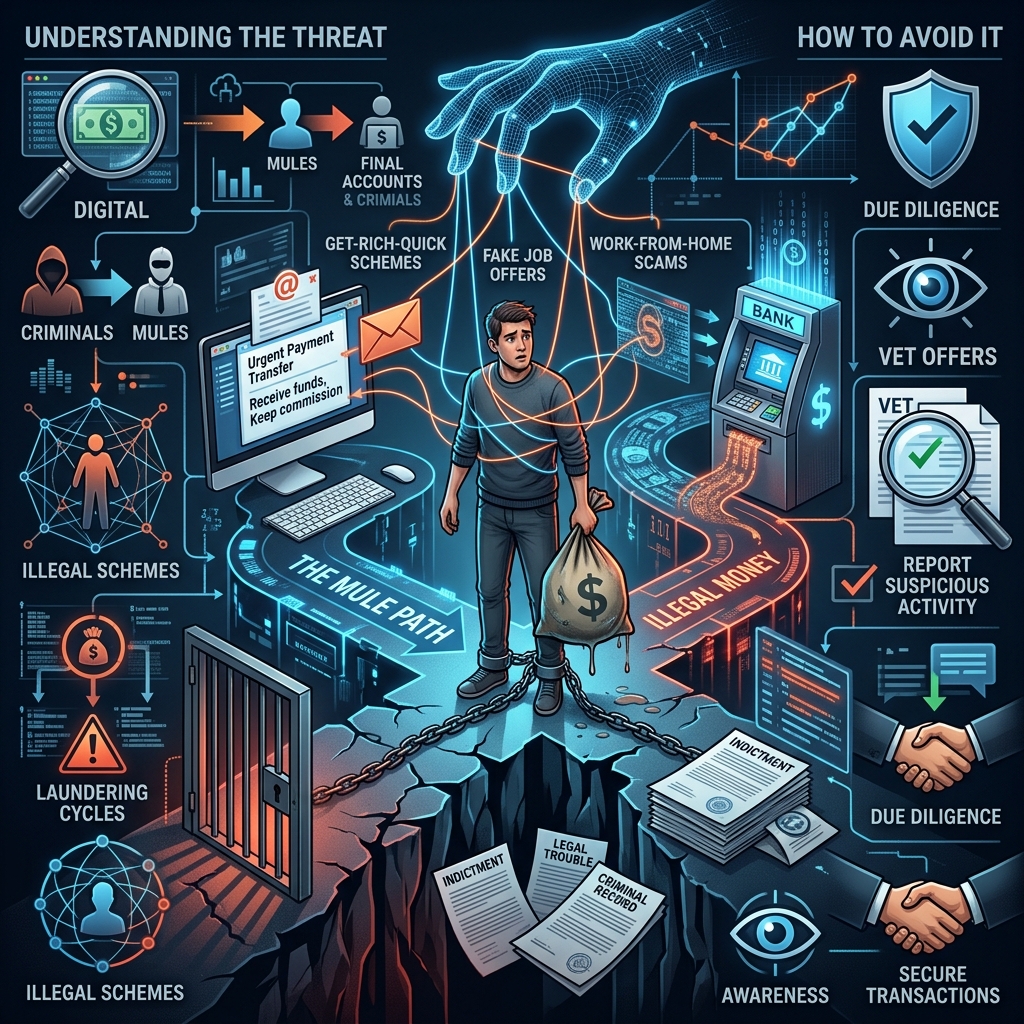
Across the world, criminal networks depend on a quiet but critical link in their operations: money mules. These are individuals who move illegally obtained money at someone else's direction, helping fraudsters hide their tracks and move stolen funds quickly. Some know they are assisting crime; many others do not realize it until it is too late.
This article explains what money mules are, how criminals recruit them, why the U.S. Department of Justice (DOJ) and partner agencies created a dedicated Money Mule Initiative, and what you can do to protect yourself and your community from these schemes.
1. What Is a Money Mule?
A money mule is a person who receives, moves, or transfers money that came from fraud or other crimes, often following instructions from someone else. The money may come from victims of:
- Online scams (romance scams, tech support scams, business email compromise, etc.)
- Lottery or sweepstakes fraud
- Government impersonation schemes
- Other crimes such as drug trafficking or human trafficking
Money mules help criminals by acting as a buffer between fraudsters and law enforcement, creating layers of transfers that make it harder to trace stolen funds. Even if the mule never meets the criminals in person and only communicates online, their actions can still be illegal.
1.1 Types of Money Mules
Not all money mules play the same role. Law enforcement and consumer protection agencies generally see three broad categories:
- Unwitting mules – People who genuinely do not realize they are helping criminals. They may believe they are doing legitimate work, helping a friend, or assisting a romantic partner.
- Willing but unaware mules – People who suspect something is wrong but do not ask questions because the scheme promises easy money or they feel emotionally involved.
- Knowing participants – Individuals who understand they are moving criminal proceeds and choose to continue, sometimes as part of organized networks.
Regardless of intent, moving criminal proceeds can lead to serious consequences, including account closures, damaged credit, and even civil or criminal enforcement.
2. How Criminals Recruit Money Mules
Fraudsters rarely call their schemes "money mule work." Instead, they disguise recruitment as legitimate opportunities or personal relationships. The DOJ and partner agencies report repeated patterns in how people are drawn into these roles.
2.1 Common Recruitment Channels
- Work-from-home offers – Unsolicited emails, social media messages, or job postings promising high pay for simple tasks like "payment processing" or "financial manager" roles.
- Online dating and social media relationships – A supposed romantic partner or close online friend asks for help receiving and forwarding money or packages.
- Lottery and prize scams – Victims are told they won a sweepstakes and must help move funds or pay fees using their bank account or gift cards.
- International business opportunities – Messages claiming the sender needs a "local representative" to handle payments for a foreign company.
- Cryptocurrency schemes – Instructions to deposit cash into cryptocurrency kiosks or transfer digital assets on someone else's behalf.
2.2 Red Flags That You Are Being Targeted
Law enforcement agencies highlight several warning signs that should immediately raise suspicion:
- You are asked to use your personal bank account or open a new account to receive and send money.
- The "employer" uses only free web-based email and avoids phone or video calls.
- You are told you can keep a portion of the funds you transfer as payment.
- You are directed to send money via wire transfer, money service business, mail, gift cards, or cryptocurrency—often to people you do not know.
- Your tasks have no clear job description or require no qualifications beyond access to a bank account.
- Someone you have never met in person wants to use your financial accounts or asks you to receive packages or funds for them.
If any of these signs appear, you may be at risk of becoming a money mule, even if the opportunity looks legitimate at first.
3. Inside the Money Mule Initiative
To combat the growing use of money mules, the DOJ, FBI, U.S. Postal Inspection Service, and other federal agencies launched the Money Mule Initiative, an annual coordinated effort to identify and disrupt mule networks. This initiative combines public education with enforcement actions against individuals and groups that move fraud proceeds.
3.1 Goals of the Initiative
According to official announcements, the initiative aims to:
- Identify people who are moving fraud proceeds domestically and internationally
- Disrupt networks that rely on money mules to transfer stolen funds
- Educate the public, including potential victims and potential mules, about the risks and warning signs
- Provide feedback to financial institutions to help them detect and prevent mule activity
The initiative uses a mix of strategies: warning letters, interviews, civil actions, and criminal prosecutions, depending on the facts and the person's level of knowledge and involvement.
3.2 Scale of Law Enforcement Actions
Over successive campaigns, law enforcement has taken action against thousands of suspected money mules across the United States and in coordination with international partners.
| Campaign Year / Period | Approximate Actions Against Money Mules | Key Details |
|---|---|---|
| Early campaigns | Over 2,300 individuals | Actions across 92 federal districts, targeting lottery, romance, and business email compromise scams. |
| Later three-month campaign | Approximately 5,000 actions | Coordinated effort to disrupt networks used by foreign fraudsters; combined enforcement with public education. |
| Recent annual initiative | Over 3,000 money mules | Focused on identifying, disrupting, and, where appropriate, prosecuting mule networks. |
These numbers underscore how widespread money mule activity has become—and how central it is to modern fraud schemes.
4. Why Being a Money Mule Is Dangerous
People sometimes underestimate the risks of moving money for someone else, especially when they believe they are helping a friend or earning easy income. However, the consequences can be significant.
4.1 Legal and Financial Risks
- Criminal charges – Knowingly transferring criminal proceeds can lead to charges such as money laundering, wire fraud, or conspiracy.
- Civil enforcement – Even where criminal charges are not filed, agencies may seek civil injunctions or other remedies to stop mule activity.
- Bank account closures – Financial institutions may close accounts involved in suspicious transactions, limit access to services, and file reports with regulators.
- Damage to credit and reputation – Losing bank relationships or being associated with fraud can affect your ability to obtain loans, housing, or employment.
- Liability for losses – You may be required to return money you received, even if you already sent it on or spent part of it.
4.2 Emotional and Personal Impact
Money mule schemes also cause personal harm:
- Feelings of betrayal when a supposed friend or romantic partner turns out to be a fraudster
- Stress from dealing with law enforcement, banks, and potential legal proceedings
- Strain on relationships with family or caregivers who may have warned against the scheme
In addition, money mules help criminals steal from vulnerable victims—often older adults and small businesses—contributing to further harm.[10]
5. How to Protect Yourself from Money Mule Schemes
Prevention starts with awareness. The DOJ, FBI, and other agencies emphasize that learning to recognize recruitment tactics is one of the most effective defenses.[10]
5.1 Practical Safety Tips
To reduce your risk of becoming a money mule:
- Never agree to move money for someone you have never met in person, whether the request comes by phone, email, or online message.
- Do not let anyone use your bank account or open a new account at their direction.
- Be wary of unsolicited job offers that involve receiving and forwarding money, packages, gift cards, or cryptocurrency.
- Research any company that offers you a position; perform independent online searches and check for complaints or warnings from government agencies.
- Reject requests to pay fees or "taxes" on supposed lottery or prize winnings, especially when asked to use wire transfers, gift cards, or cryptocurrency.
- Guard your personal and financial information; do not share bank account details, login credentials, or ID documents with people you only know online.
5.2 Extra Care for Older Adults and Caregivers
Older adults are frequently targeted both as victims of fraud and as money mules.[10] Families and caregivers can help by:
- Talking regularly about online scams and "too good to be true" offers
- Reviewing unusual financial activity with the account holder's permission
- Encouraging open discussion about new "friends," romantic interests, or job opportunities that appear suddenly
- Sharing information about official hotlines and complaint centers where concerns can be reported safely
6. What to Do If You Think You Are a Money Mule
If you realize you may be involved in moving fraud proceeds, acting quickly can limit harm to yourself and others. Official guidance from federal agencies highlights several immediate steps.
6.1 Steps to Take Immediately
- Stop sending money or moving funds at someone else's direction.
- Cut off contact with the person who recruited you—do not respond to messages, calls, or new requests.
- If you still have funds from the scheme, do not forward them or spend them; discuss next steps with law enforcement or your bank.
- Contact your financial institution to explain what happened, ask them to flag suspicious activity, and consider changing accounts or credentials.
6.2 Reporting to Authorities
Reporting is critical both to protect yourself and to help authorities track and shut down fraud networks. Federal agencies urge individuals to report suspected money mule activity and fraud losses as soon as possible because rapid reporting can improve the chances of recovering funds.
Options typically include:
- Filing a complaint with the FBI's Internet Crime Complaint Center (IC3) for online scams and related money mule activity.
- Contacting local law enforcement to document the situation.
- Reaching out to relevant federal hotlines, especially in cases involving older victims, such as the National Elder Fraud Hotline.
When you report, provide as much detail as possible: names or aliases used, email addresses, phone numbers, bank accounts involved, cryptocurrency wallet addresses, and copies of messages or instructions you received.
7. Frequently Asked Questions (FAQs)
7.1 Can I get in trouble if I did not know the money was stolen?
Even if you were unaware, you may still face consequences such as frozen or closed accounts, loss of funds, and interactions with law enforcement. Authorities often consider intent and cooperation when deciding how to proceed, which is why it is important to stop participating and report the situation as soon as you realize something is wrong.
7.2 How do I tell if a work-from-home job is legitimate?
Be cautious of any job that:
- Appears suddenly through unsolicited messages
- Requires you to use your bank account to receive or transfer money
- Promises high income for very little effort
- Has no clear job description or verifiable physical address
Legitimate employers will not ask you to move money using your personal financial accounts as a primary job duty.
7.3 What should I do if a romantic partner online asks me to send or receive money?
Requests to move money for an online romantic partner you have never met in person are a major red flag. Fraudsters frequently build emotional relationships to gain trust and then ask for help transferring funds. Decline the request, do not share your financial information, and consider reporting the account or profile as suspicious.
7.4 Are only large transfers considered money mule activity?
No. Criminals often break up large amounts into smaller transfers to avoid detection, and even relatively small amounts can be part of a larger scheme. Any pattern of receiving and forwarding funds for someone else—especially strangers or new online contacts—can be problematic.
7.5 How does the Money Mule Initiative help ordinary consumers?
The initiative not only pursues enforcement actions but also invests heavily in public education campaigns and resources designed to help consumers recognize and avoid scams.[10] By targeting the networks that move fraud proceeds, the initiative makes it harder for criminals to profit from scams, reducing the overall harm to victims.
8. Key Takeaways
- A money mule is anyone who moves money from victims to criminals, often under someone else's direction.
- Recruitment often happens through fake jobs, online relationships, lottery scams, and cryptocurrency schemes.
- Participating—even unknowingly—can lead to serious legal, financial, and personal consequences.
- The DOJ's Money Mule Initiative and partner agencies work to identify, disrupt, and, where appropriate, prosecute mule networks while educating the public.
- You can protect yourself by refusing to move money for others, scrutinizing work-from-home offers, safeguarding your financial information, and reporting suspicious activity quickly.
References
- Money Mule Initiative — U.S. Department of Justice, Civil Division. 2023. https://www.justice.gov/civil/consumer-protection-branch/money-mule-initiative
- U.S. Law Enforcement Takes Action Against More Than 3,000 Money Mules in Initiative to Disrupt International Fraud Schemes — U.S. Department of Justice, Office of Public Affairs. 2022-12-15. https://www.justice.gov/archives/opa/pr/us-law-enforcement-takes-action-against-more-3000-money-mules-initiative-disrupt
- U.S. Law Enforcement Takes Action Against Money Mules in Global Crackdown on Money Laundering — Oversight.gov summary of DOJ release. 2020-12-04. https://www.oversight.gov/us-law-enforcement-takes-action-against-money-mules-global-crackdown-money-laundering
- U.S. Law Enforcement Disrupts Networks Used to Transfer Fraud Proceeds, Taking Over 5,000 Actions in Fifth Campaign — U.S. Department of Justice / Office of Inspector General, Department of Labor (PDF). 2023. https://oig.dol.gov/public/Press%20Releases/US_Law_Enforcement_Disrupts_Networks_Used%20to_Transfer_Fraud_Proceeds_Taking_5000_Actions_5th%20Cam.pdf
- Money Mules — Federal Bureau of Investigation. 2023. https://www.fbi.gov/how-we-can-help-you/scams-and-safety/common-frauds-and-scams/money-mules
- Tackling Money Mules — National Association of Attorneys General. 2020. https://www.naag.org/attorney-general-journal/tackling-money-mules/
- Money Mule Initiative Educational Flyer — U.S. Department of Justice / Elder Justice Initiative. 2020. https://pfs2.acl.gov/strapib/assets/EJCC_DOJ_Money_Mule_Initiative_Educational_Flyer_7524960ec0.pdf
Similar Articles








Read full bio of Sneha Tete




