
Pennsylvania Wills: 6 Key Requirements, Probate Steps, And Tips
Learn the essential Pennsylvania rules for valid wills, signing, probate, and what happens if you die without an estate plan.
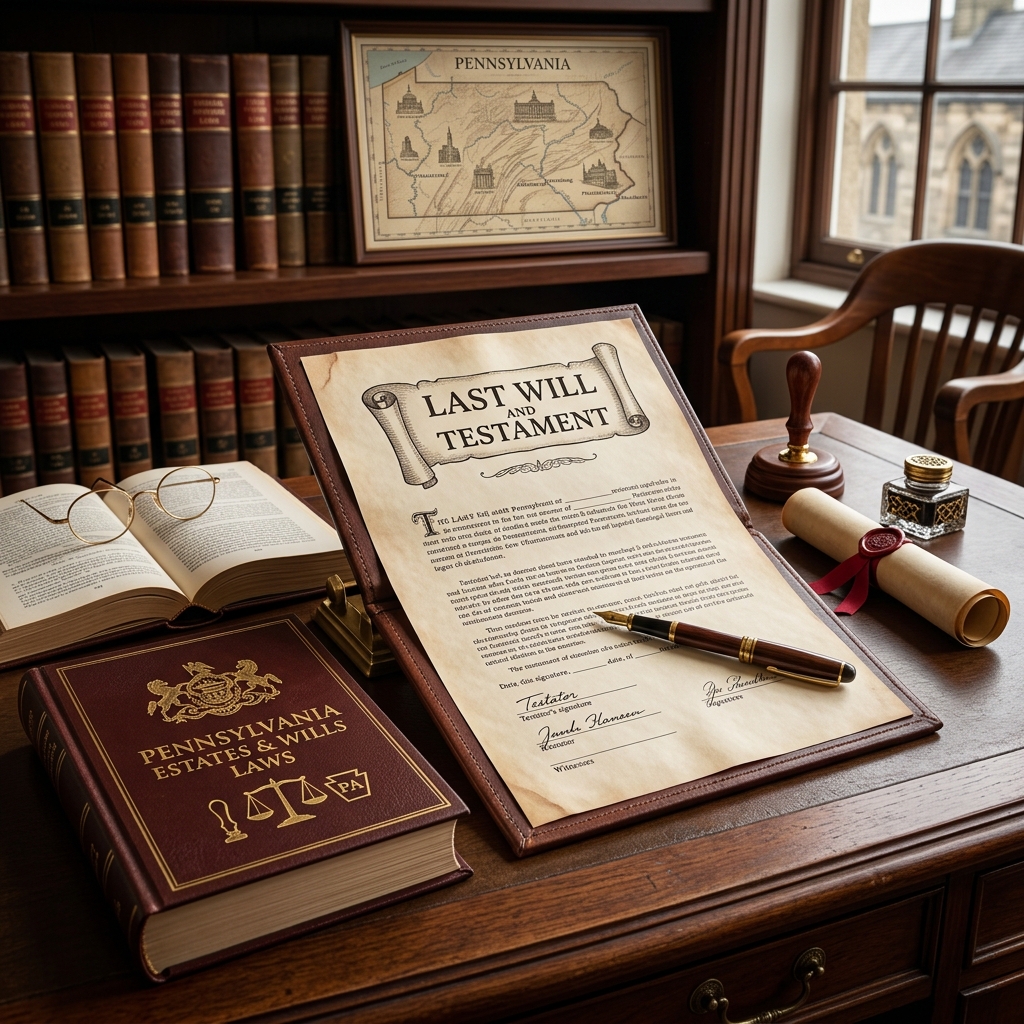
Pennsylvania has its own set of rules governing how wills are created, executed, and enforced. A will that fails to meet these legal standards can be partially or completely invalid, leaving your property to be distributed under the state’s intestacy rules instead of your wishes. This guide explains the major requirements for a valid will in Pennsylvania, how wills are signed and proved, what the probate process looks like, and what happens if you die without a will.
Core Legal Framework for Wills in Pennsylvania
Pennsylvania’s rules for wills are primarily found in Title 20 of the Pennsylvania Consolidated Statutes, especially Chapter 25, which sets out who may make a will and how it must be executed. Understanding this framework helps you see why certain formalities—like writing and signing—are strictly enforced.
| Statute Section | Subject | Practical Effect |
|---|---|---|
| 20 Pa.C.S. § 2501 | Who may make a will | Sets age and mental capacity requirements for testators. |
| 20 Pa.C.S. § 2502 | Form and execution of a will | Defines writing and signature requirements and allows signing by mark or another person. |
| 20 Pa.C.S. § 2503 (repealed) | Nuncupative wills | Oral wills are not recognized in Pennsylvania today. |
| 20 Pa.C.S. § 3132 | Self-proving wills | Authorizes self-proving affidavits to streamline probate. |
These statutes work together with local probate practice administered by the county Register of Wills, the office responsible for accepting wills and appointing personal representatives for estates.
Who Can Make a Valid Will in Pennsylvania?
Not everyone can legally make a will in Pennsylvania. The law is designed to ensure that only people with sufficient maturity and mental capacity are allowed to direct the distribution of their property after death.
Age Requirement
Under Pennsylvania law, a person must be at least 18 years old to make a valid will. Minors generally cannot execute binding wills, regardless of how much property they own or how sophisticated they may be.
Sound Mind and Testamentary Capacity
In addition to age, the testator must be of sound mind, meaning they have what lawyers call “testamentary capacity.” While the statutes do not give a detailed definition, case law and practice generally require that the person:
- Understands that they are making a will.
- Knows the nature and extent of their property.
- Recognizes the natural objects of their bounty (close family or other likely beneficiaries).
- Can form and communicate a rational plan for distributing their estate.
Someone previously declared legally incompetent may be presumed not to have sound mind, but capacity is ultimately a fact-specific question if challenged. If a will is attacked on grounds of lack of capacity or undue influence, the court will look closely at the testator’s mental state when the will was executed.
Form and Execution: How a Will Must Be Made
Even if the testator is eligible, a will must meet certain formal requirements to be valid in Pennsylvania. The focus is mainly on written form and proper signature at the end of the document.
Writing Requirement
Pennsylvania requires that a will be in writing. This includes documents that are typed or printed, as well as those handwritten by the testator. The state does not have a separate statute for holographic wills, but a handwritten will may be valid if it satisfies all other requirements.
By contrast, oral wills (also called nuncupative wills) are not recognized under current Pennsylvania law, because the statutory section that once allowed them has been repealed. As a result, simply stating your wishes verbally—even in front of witnesses—is not enough.
Signature at the End of the Will
Pennsylvania insists that the testator must sign at the end of the will. The purpose of this rule is to clearly identify the entire text above the signature as the testator’s final expression of intent. Any material added after the signature may be considered invalid or may raise questions.
The law provides flexibility for people who cannot sign their full name:
- Signing by mark: A testator may sign using a mark (such as an “X”) at the end of the document, but this must be witnessed by two competent witnesses.
- Signing by another person: If the testator is physically unable to sign, they may direct another individual to sign on their behalf. In that situation, the testator must declare in the presence of two witnesses that the document is their will, and those witnesses must sign in the testator’s presence.
These alternatives help accommodate disability or illness while still providing safeguards against fraud and misrepresentation.
Witnesses and Self-Proving Affidavits
Unlike many states, Pennsylvania does not generally require witnesses for a will that the testator personally signs. Nevertheless, witnesses are crucial in certain situations and can make probate more efficient.
Important points include:
- Witnesses required for marks or substitute signatures: If the will is signed by a mark or by another person at the testator’s direction, two witnesses must observe and later prove the execution.
- Self-proving wills: Pennsylvania permits wills to be made “self-proving” by attaching a notarized affidavit signed by the testator and the witnesses. This affidavit, completed before a notary public, states that the will was properly executed. When a self-proving will is presented to the Register of Wills, the court can accept it without requiring live testimony from witnesses, simplifying probate.
Because of this, many estate planning attorneys recommend using witnesses and a self-proving affidavit even though witnesses are not strictly required in all cases.
Probate in Pennsylvania: What Happens After Death?
Probate is the legal process by which a will is accepted as valid and an estate is administered. In Pennsylvania, this process is overseen by the county Register of Wills. The register’s office probates wills and appoints personal representatives for decedents who die with or without a will.
Role of the Register of Wills
The Register of Wills serves as the initial gatekeeper for estate administration:
- Receives and reviews the will for formal validity.
- Determines whether the document qualifies as the decedent’s last will.
- Issues letters testamentary (for executors named in a will) or letters of administration (for administrators when there is no will or no executor) so that the representative can manage the estate.
Disputes over a will’s validity or questions of interpretation may be transferred to the Orphans’ Court division of the Court of Common Pleas, which handles more complex estate litigation.
Overview of the Probate Process
While details vary by county and by estate size, a typical Pennsylvania probate involves:
- Filing the will: The original will is filed with the Register of Wills in the county where the decedent resided at death.
- Appointment of a personal representative: An executor named in the will or, if there is no will, an administrator is formally appointed.
- Inventory and valuation: The representative gathers assets and prepares an inventory and accounting as required by Pennsylvania estate practice.
- Payment of debts, expenses, and taxes: Creditors are paid, final income tax returns are filed, and any applicable estate or inheritance taxes are addressed under Pennsylvania and federal law.
- Distribution of remaining assets: Once obligations are satisfied, remaining property is distributed either according to the will or, absent a valid will, under intestacy rules.
- Closing the estate: After final distributions and court approvals (when required), the estate is formally closed.
If There Is No Will: Intestacy in Pennsylvania
When a person dies without a valid will—either because they never made one or because the document fails to meet legal requirements—Pennsylvania’s intestacy statutes determine who inherits the estate. These default rules may not match what the person would have wanted, which is one major reason lawyers encourage written wills.
How Intestate Property Is Distributed
Pennsylvania’s intestacy laws follow a hierarchy of relatives. Although exact distribution percentages depend on whether the decedent left a surviving spouse, children, parents, or more distant relatives, the basic pattern is:
- Spouse and children often share the estate in specified proportions.
- If there are no children, a surviving spouse may share with or take ahead of parents or siblings.
- If there is no spouse, children typically inherit first, followed by parents, then siblings, and more distant relatives.
- If no eligible relatives exist, property may eventually escheat to the Commonwealth.
Because intestacy is rigid and cannot account for individual preferences, blended families, or charitable goals, relying on it is generally considered a poor substitute for a carefully drafted will.
Practical Considerations When Drafting a Pennsylvania Will
Pennsylvania does not require you to use an attorney to create a will, and the state does not provide an official standard form. However, careful planning and professional advice can reduce the risk of disputes, delays, and unintended consequences.
Key Elements Commonly Included in a Will
While every estate plan is unique, most Pennsylvania wills include the following components:
- Identification of the testator: Full legal name, address, and statement of intent to make a will.
- Appointment of a personal representative: Naming an executor and at least one alternate in case the first choice cannot serve.
- Beneficiary designations: Clear identification of those who will receive property (individuals, charities, trusts).
- Specific bequests and residue clause: Instructions for particular assets and a “catch‑all” clause covering the remainder of the estate.
- Guardian nominations: If minor children are involved, a nomination of a guardian (subject to court approval).
- Tax and debt provisions: Guidelines for how debts, expenses, and taxes should be paid.
Reducing the Risk of Challenges
Disputes over wills often involve claims of lack of capacity, undue influence, or improper execution. To reduce these risks, consider:
- Signing your will in calm, ordinary circumstances rather than during a medical crisis.
- Using a self-proving affidavit and independent witnesses who do not stand to inherit under the will.
- Keeping the original document in a secure location, such as a fireproof safe or with your attorney or the Register of Wills, depending on local practice.
- Updating your will after major life events, such as marriage, divorce, birth or adoption of children, or significant changes in assets.
Frequently Asked Questions About Pennsylvania Wills
Do I need witnesses for my Pennsylvania will?
If you personally sign your will at the end, Pennsylvania law does not require witnesses as a general rule. However, two witnesses are required if you sign by a mark or if another person signs for you at your direction, and witnesses are used for self-proving affidavits.
Are handwritten wills valid in Pennsylvania?
Yes, a handwritten will can be valid if it meets all other legal requirements for form and execution. Pennsylvania does not have a separate holographic will statute, but it does not automatically reject handwritten instruments. These wills may be more vulnerable to challenges about authenticity or capacity.
Can I make an oral will in Pennsylvania?
No. Pennsylvania does not recognize nuncupative (oral) wills because the statutory provision that once allowed them has been repealed. Your wishes must be expressed in a written document that meets the execution requirements.
Do I need a lawyer to write my will?
Pennsylvania law does not require you to hire a lawyer, and the state does not supply an official form will. However, professional legal advice is strongly recommended, especially for larger estates, blended families, business interests, or potential tax issues.
What is a self-proving will and why should I consider one?
A self-proving will includes a notarized affidavit signed by the testator and witnesses stating that the will was properly executed. This allows the Register of Wills to accept the will without requiring witness testimony, which can reduce delays and costs during probate.
What happens if my will is found invalid?
If your will is invalid in whole or in part, the affected property may be distributed under Pennsylvania’s intestacy rules rather than according to your written wishes. This can change who receives your property and may cause disputes among surviving relatives.
References
- Pennsylvania Will Requirements — FindLaw. 2023-07-12. https://www.findlaw.com/state/pennsylvania-law/pennsylvania-wills-laws.html
- Basic Requirements for a Last Will and Testament in Pennsylvania — LawInfo. 2021-05-10. https://www.lawinfo.com/resources/wills/pennsylvania/
- Title 20, Pennsylvania Consolidated Statutes, Chapter 25: Wills — Pennsylvania General Assembly. 2024-01-01. https://www.palegis.us/statutes/consolidated/view-statute?txtType=htm&ttl=20&div=0&chapter=25
- Frequently Asked Questions: Register of Wills — Montgomery County, Pennsylvania. 2020-09-15. https://www.montgomerycountypa.gov/FAQ.aspx?QID=88
- Pennsylvania Wills, Trusts, and Estates: Overview — Jenkins Law Library. 2023-03-01. https://guides.jenkinslaw.org/pennsylvania-wills-trusts-and-estates
Similar Articles








Read full bio of Sneha Tete


