
Understanding Pennsylvania Family Custody and Visitation
A practical guide to Pennsylvania custody and visitation laws, court procedures, and parental rights for families navigating separation or divorce.
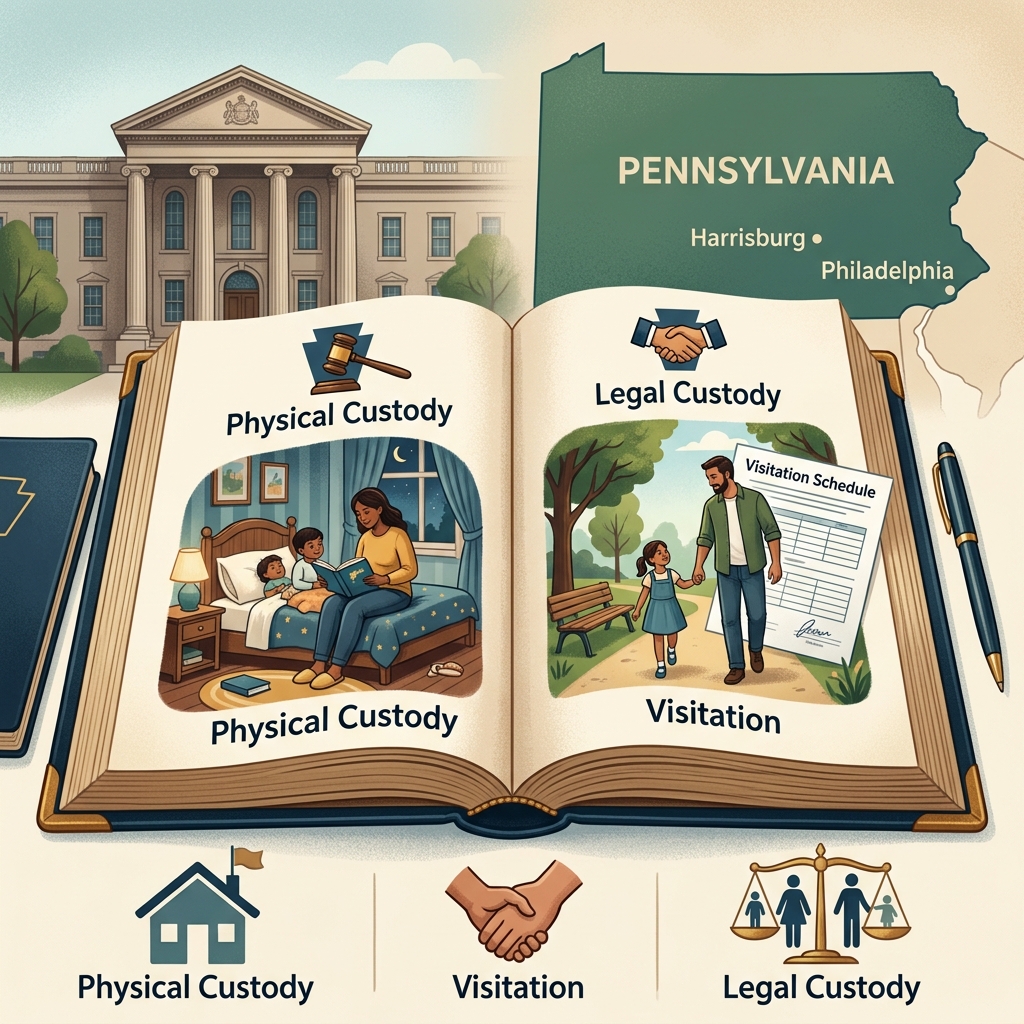
Child custody and visitation are often the most emotionally difficult parts of a separation or divorce. In Pennsylvania, these issues are governed by detailed state laws designed to protect the best interests of the child while balancing the rights and responsibilities of parents and, in some cases, extended family members.
This guide explains how custody and visitation work in Pennsylvania, the different forms of custody recognized under state law, how courts make decisions, and what parents can expect during the legal process. It also addresses common concerns such as supervised visitation, relocation, and grandparents’ rights.
Core Concepts in Pennsylvania Child Custody
Pennsylvania law treats custody as a broad concept that includes both decision-making authority and time spent with the child. To understand your rights and options, it is helpful to distinguish between legal custody and physical custody.
Legal Custody: Decision-Making Authority
Legal custody is the right and responsibility to make major decisions for a child, including choices about education, medical care, and religious upbringing. Pennsylvania generally recognizes two main forms:
- Sole legal custody – One adult has exclusive authority to make major decisions. The other parent may still have contact with the child, but does not share in these key decisions.
- Shared legal custody – Both parents (or parties) must consult and agree on major decisions affecting the child’s life.
In the absence of a court order, Pennsylvania law often presumes shared legal custody, which means both parents retain decision-making rights even if the child primarily lives with one parent.
Physical Custody: Where the Child Lives and Spends Time
Physical custody concerns the child’s day-to-day care and where the child resides. Pennsylvania law defines several forms of physical custody:
- Sole physical custody – One individual has exclusive physical custody of the child; the child lives primarily with that person.
- Primary physical custody – One party cares for the child most of the time; the other may have partial or supervised time.
- Shared physical custody – Both parties have frequent or nearly equal time with the child.
- Partial physical custody – Unsuspervised time with the child that does not amount to the majority of overnights, such as weekends or specific evenings.
- Supervised physical custody – Time with the child that must occur in the presence of a third party or agency designated by the court.
Visitation as Part of Custody
Historically, people referred to “visitation” as a separate concept from custody. Under Pennsylvania’s domestic relations statutes, however, the term visitation is formally included within child custody and is usually understood to mean partial, shared, or supervised physical custody.
In practice, when parents or relatives talk about “visitation,” they are typically referring to:
- Time schedules for a non-primary caregiver.
- Overnight or weekend contact with the child.
- Supervised visits ordered due to safety concerns.
Who May Seek Custody or Visitation in Pennsylvania?
While parents are the most common parties in custody cases, Pennsylvania law allows others to seek custody or specific forms of visitation when they have a close and ongoing relationship with the child.
Parents and Adoptive Parents
- Biological parents whose rights have not been legally terminated may seek any form of legal or physical custody.
- Adoptive parents have the same custody rights and responsibilities as biological parents.
Grandparents and Great-Grandparents
Pennsylvania provides limited avenues for grandparents and, in some situations, great-grandparents to seek custody or visitation. These rights typically arise where:
- A parent has died or the parents are divorced or separated, and court involvement is deemed in the child’s best interests.
- The child has lived with the grandparent for a substantial period (often at least 12 consecutive months), and then was removed by a parent.
- There is an existing relationship formed with parental consent or a previous court order, and a new custody case could disrupt that relationship.
Courts consider the impact on the child, the strength of the grandparent–child relationship, and any potential conflict with parental decision-making before granting visitation.
Individuals Standing In Loco Parentis
A person who is not a biological or adoptive parent may qualify for custody or visitation if they stand in loco parentis, meaning they have taken on genuine parental responsibilities with the consent or acquiescence of a parent.
Court considerations include:
- Whether the individual has assumed day-to-day parental duties for a substantial time.
- Whether the child’s parent has effectively delegated parental responsibilities to that individual.
How Pennsylvania Courts Decide Custody and Visitation
Custody decisions are guided by the best interests of the child standard. Pennsylvania courts evaluate numerous factors, with safety-related considerations given greater weight.
The Best-Interests Framework
When determining custody or visitation arrangements, judges look at all relevant factors, including:
- The child’s physical safety and emotional well-being.
- Each parent’s ability to provide a stable home and consistent care.
- The child’s relationship with each parent and other family members.
- Any history of domestic violence, abuse, neglect, or substance misuse.
- Which arrangement will most likely foster ongoing contact with both parents, where safe.
Importantly, Pennsylvania courts are gender-neutral; neither parent has an automatic advantage based on sex.
When Courts Order Supervised Visitation
Supervised visitation is generally reserved for situations where unsupervised contact could pose a risk to the child.
- Courts may order supervision if there is evidence of domestic violence, child abuse, serious substance abuse, or other safety concerns.
- Supervision can be conducted by a relative, a trusted third party, or a professional agency approved or designated by the court.
- Supervised visitation is often intended as a temporary measure, allowing a parent to demonstrate safe behavior, comply with treatment, or complete assessments before expanding parenting time.
Limitations on Denying Visitation
Courts generally aim to preserve some level of contact between a child and a non-custodial parent unless there is a serious safety issue.
- Restrictions may include conditions such as sobriety or completion of parenting classes, rather than outright denial of all contact.
- Total prohibition of visitation is more likely when there is ongoing abuse, extreme violence, or other significant risk that cannot be mitigated by supervision or safety conditions.
The Custody Case Process in Pennsylvania
Parents can often reduce stress and cost by reaching agreements outside court. However, if they cannot agree, formal custody proceedings provide a structured way to resolve disputes.
Filing a Custody Action
In most cases, a custody case must be filed in the county where the child has lived for the last six months (or since birth if younger than six months). Typically:
- A parent or other eligible party files a custody complaint with the Domestic Relations Division of the Court of Common Pleas in the appropriate county.
- The filing party (plaintiff) must properly serve the other party (defendant) with the complaint, usually by mail or personal service in accordance with court rules.
Conferences, Mediation, and Settlement
After filing, many Pennsylvania courts schedule a pre-trial custody conference or mediation session.
- The goal is to help parties reach a parenting plan without a contested hearing.
- Parenting plans often address legal custody, physical custody schedules, holiday arrangements, and communication guidelines.
- When parties agree, they may ask the court to turn their agreement into a formal custody order.
Mediation and negotiation can be beneficial because they allow more flexible solutions tailored to the family’s schedule, reduce conflict, and may be less disruptive for children.
Contested Hearings Before a Judge
If parents or other parties cannot agree, the case proceeds to a contested custody hearing.
- Each side presents evidence and testimony regarding the child’s needs, the proposed custody schedule, and any safety or welfare concerns.
- The judge weighs all evidence under the best-interests standard and then issues a custody order.
- The resulting order is binding; failure to comply can lead to enforcement actions or modifications.
Common Types of Custody and Visitation Orders
Because every family is different, Pennsylvania courts can customize orders. However, several patterns appear frequently:
| Type of Arrangement | Key Features | Typical Use Case |
|---|---|---|
| Primary physical custody & partial custody | Child lives primarily with one parent; the other has scheduled parenting time (e.g., weekends or evenings). | When parents live apart and a 50/50 schedule is impractical or not in the child’s best interests. |
| Shared physical custody | Child spends frequent or nearly equal time with each parent. | When both parents can provide stable homes and co-parent effectively. |
| Supervised physical custody | Parenting time occurs in the presence of an approved supervisor or agency. | When safety concerns exist but the court wants to preserve the parent–child relationship. |
| Sole legal and sole physical custody | One parent makes major decisions and provides all day-to-day care. | In rare cases involving extreme risk, abandonment, or terminated parental rights. |
Modifying Custody and Visitation Orders
Custody orders are not necessarily permanent. When circumstances change, parents or other parties can ask the court to modify the existing order, as long as changes are consistent with the child’s best interests.
Reasons for Modification
Courts may revisit custody or visitation orders when there is a substantial change in circumstances, such as:
- Significant changes in either parent’s work schedule or living situation.
- Evidence of new safety concerns, such as substance abuse or domestic violence.
- Improvement in a parent’s ability to provide a stable, safe environment.
- Relocation proposals that would affect the existing parenting plan.
Relocation and Its Impact on Parenting Time
Parental relocation can have major implications for custody and visitation. When a move would substantially change the child’s relationship with the other parent or affect the schedule, the relocating parent often must obtain consent or court approval.
- Court review typically examines the reason for relocation, the distance, and the effect on the child’s relationships.
- Judges may adjust visitation schedules, including longer but less frequent visits, extended holiday time, or virtual contact.
Balancing Safety and Contact: Restrictions on Visitation
Pennsylvania courts strive to protect children while, where possible, maintaining meaningful relationships with both parents. In some cases, visitation must be restricted or structured to manage risk.
Examples of Visitation Restrictions
- Conditioned visitation – Parent must comply with conditions such as drug testing, counseling, or completing anger management before or during parenting time.
- Supervised-only visitation – Parent may see the child only in a supervised setting, often due to abuse, neglect, or serious safety concerns.
- Limited duration or activities – Visits may be shorter or restricted in location and activities to mitigate risk.
When Visitation May Be Denied
Complete denial of visitation is uncommon, because courts typically look for ways to maintain contact safely. However, visitation may be refused where there is substantial, ongoing danger to the child and no suitable protective conditions exist.
Practical Tips for Parents in Pennsylvania Custody Cases
While every case is unique, certain practical approaches tend to help parents navigate custody disputes more effectively.
- Focus on the child’s needs – Judges respond favorably to parenting plans centered on the child’s schedule, schooling, health, and emotional stability.
- Document important events – Maintain records of schedules, missed visits, communications, and any incidents that affect the child’s well-being.
- Utilize mediation or parenting coordination – Alternative dispute resolution can reduce conflict and produce more flexible arrangements.
- Respect existing court orders – Compliance builds credibility with the court and can support requests for future modifications.
- Seek legal advice when needed – The rules and procedures can be complex; consulting a knowledgeable family law attorney or legal aid organization can provide critical guidance, especially in contested cases.
Frequently Asked Questions (FAQs)
1. Does one parent automatically get custody in Pennsylvania?
No. Pennsylvania law does not favor mothers or fathers automatically; courts apply gender-neutral standards and base decisions on the child’s best interests.
2. What is the difference between legal and physical custody?
Legal custody refers to the authority to make major decisions about the child’s life (education, medical care, religion), while physical custody concerns where the child lives and who provides day-to-day care.
3. When will the court require supervised visitation?
Supervised visitation is generally ordered when unsupervised time could endanger the child, such as cases involving abuse, serious substance misuse, or other significant safety issues.
4. Can grandparents request visitation with a grandchild?
In certain circumstances, yes. Grandparents may petition for custody or visitation where a parent has died, the parents are separated or divorced, or the child lived with the grandparent for a substantial period and was later removed.
5. How do I start a custody case if we can’t agree?
Typically, you file a custody complaint in the county where the child has lived for the last six months and properly serve the other parent. The court may schedule conferences or mediation before any contested hearing.
6. Can a custody order be changed later?
Yes. If circumstances change, such as a new work schedule, safety concerns, or relocation, you can request a modification. The court will again evaluate what is in the child’s best interests.
References
- Child Custody — PALawHELP.org. 2023-05-01. https://www.palawhelp.org/resource/child-custody-5
- Chapter 53, Title 23 – Domestic Relations — Pennsylvania General Assembly. 2019-11-20. https://www.legis.state.pa.us/WU01/LI/LI/CT/HTM/23/00.053..HTM
- Custody Law in Pennsylvania — Neighborhood Legal Services. 2022-09-15. https://nlsa.us/legal-resources/children-family/custody-law-in-pennsylvania/
- Pennsylvania Child Custody Laws — FindLaw. 2023-04-10. https://www.findlaw.com/state/pennsylvania-law/pennsylvania-child-custody-laws.html
- Pennsylvania Custody — WomensLaw.org. 2023-07-01. https://www.womenslaw.org/laws/pa/custody/all
- Child Custody in Pennsylvania — PA Safe Law. 2022-06-30. https://pasafelaw.org/resources/custody/
- Custody Proceedings — Unified Judicial System of Pennsylvania. 2021-03-25. https://www.pacourts.us/learn/representing-yourself/custody-proceedings
Similar Articles








Read full bio of medha deb


