
Understanding Federal Domestic Violence Laws in the U.S.
A clear, practical guide to how federal domestic violence, firearms, and protection order laws work and what victims need to know.
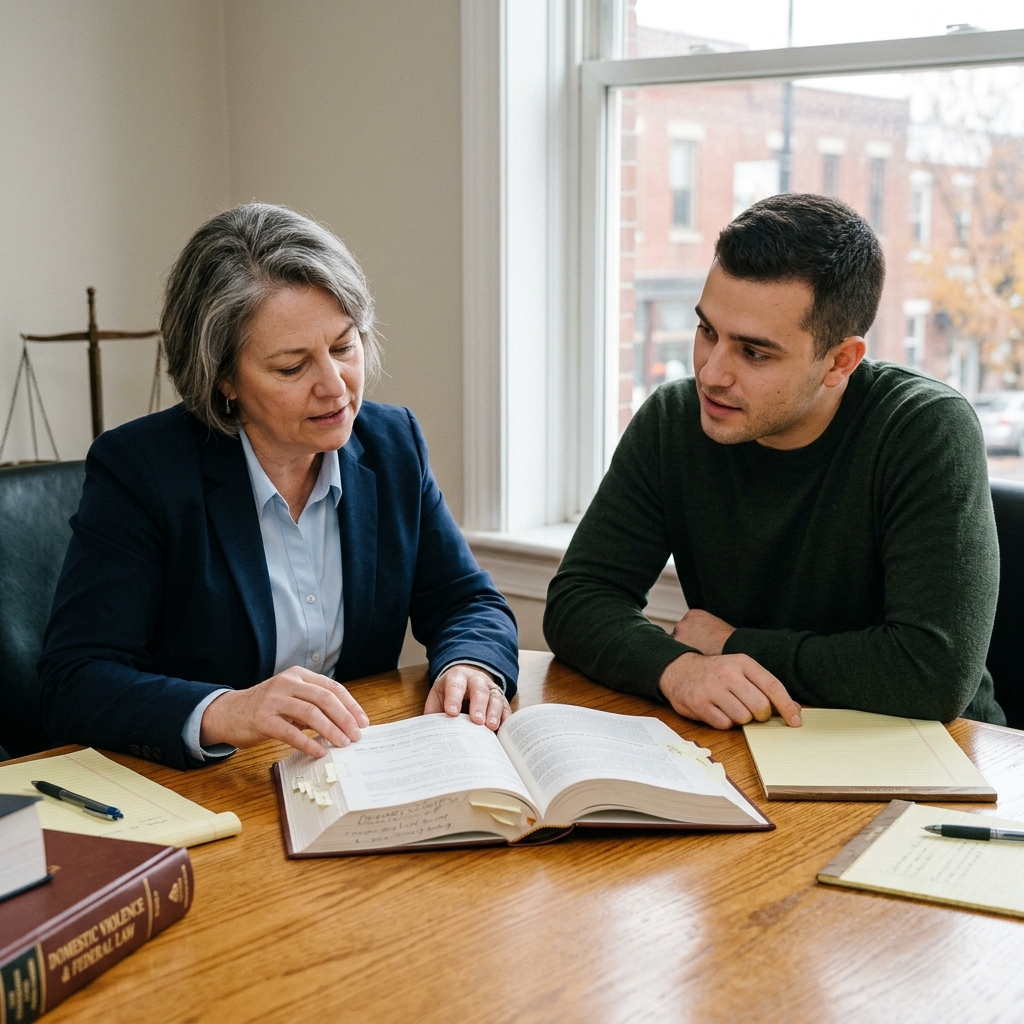
Domestic violence is primarily prosecuted under state law, but in certain serious situations, the United States federal government can also bring criminal charges and provide additional protections to survivors. Federal domestic violence laws are designed to address conduct that crosses state or tribal boundaries, involves firearms, or interferes with federally protected rights.
This article explains when domestic violence becomes a federal crime, how firearms restrictions work, what protections exist under the Violence Against Women Act (VAWA), and what rights and resources are available for victims and survivors.
1. What Domestic Violence Means Under Federal Law
The term domestic violence can cover a wide range of abusive behavior, including physical, sexual, emotional, and economic abuse. Under federal law, definitions often appear in the context of specific statutes, such as VAWA or the federal gun laws. These laws focus on particular relationships and types of conduct.
1.1 Relationships Covered
Federal statutes commonly use the term intimate partner, which can include:
- A current or former spouse
- A person who shares a child with the victim
- A person who lives or has lived with the victim as a spouse or partner
- In some contexts, a person in a serious romantic or dating relationship
Additional protections under VAWA extend beyond intimate partners and can apply to survivors of dating violence, sexual assault, and stalking, even when they are not married to or living with the perpetrator.
1.2 Federal vs. State Role
Most domestic violence crimes—such as assault, battery, and violations of local protection orders—are handled by state, tribal, or local courts. Federal laws are triggered when:
- Abuse or threats involve crossing state lines or entering/leaving Indian country
- A valid protection order is violated through interstate conduct
- Firearms are possessed or transferred despite domestic violence convictions or orders
- Certain federal benefits or programs, such as housing, are affected by domestic violence
Understanding this distinction helps victims and advocates know when federal law enforcement agencies and U.S. Attorneys may become involved.
2. Key Federal Crimes Related to Domestic Violence
Several federal statutes create crimes specifically aimed at domestic violence and related conduct. Many of these statutes were created or strengthened by the Violence Against Women Act of 1994 and later amendments.
2.1 Interstate Domestic Violence
Under federal law, it is a crime to travel across state lines or into or out of Indian country with the intent to injure, harass, or intimidate an intimate partner, and then commit a violent act that causes bodily injury. This is often referred to as interstate domestic violence.
Key elements typically include:
- Travel across a state boundary or into/out of Indian country
- Intent to harm, threaten, or intimidate an intimate partner
- Commission of a violent crime during or as a result of the travel
- Resulting bodily injury to the victim
It is also a federal crime to force or coerce an intimate partner to cross state lines or enter or leave Indian country, if bodily harm occurs during or as a result of that travel.
2.2 Interstate Stalking
Stalking behavior can become a federal offense when it involves interstate activity. It is a crime to travel across state lines, or enter or leave Indian country, with the intent to harass or intimidate another person, if the conduct places that person or a close family member in reasonable fear of death or serious bodily injury.
Examples of conduct that may support an interstate stalking charge include:
- Repeatedly following a victim across state lines
- Traveling to another state to threaten, surveil, or harass
- Engaging in a pattern of interstate contact that creates fear of serious harm
Federal law can also apply to stalking conduct that occurs on federal lands and facilities, such as military bases or other federal property.
2.3 Interstate Violation of Protection Orders
A protection order (often called a restraining order or order of protection) is a court order designed to keep an abuser away from the victim. Under certain federal statutes, it is a crime to travel across state lines or enter or leave Indian country with the intent to violate a valid protection order that prohibits threats, harassment, or physical harm, and then actually violate that order.
To support a federal charge for interstate violation of a protection order, usually the following must be present:
- A valid protection order that meets federal criteria (for example, the respondent had notice and an opportunity to be heard)
- Interstate travel by the abuser, or causing the victim to travel, with the intent to violate the order
- An actual violation, such as contact, threats, or violence prohibited by the order
This federal offense helps ensure that protection orders follow victims when they move or travel, and that abusers cannot evade legal consequences by crossing state lines.
2.4 Penalties for Federal Domestic Violence Crimes
Penalties for federal domestic violence crimes depend on factors such as the degree of injury, use of weapons, and whether death results. For example, penalties for interstate domestic violence and stalking can range from several years in prison to life imprisonment in cases where the victim is killed.
| Type of Federal Conduct | Typical Trigger | Possible Penalties (Illustrative) |
|---|---|---|
| Interstate domestic violence | Travel across state lines with intent to injure intimate partner and cause bodily injury | Multi-year imprisonment; may reach life if death results |
| Interstate stalking | Interstate conduct causing fear of death or serious bodily injury | Up to decades of imprisonment depending on harm |
| Interstate violation of protection order | Travel intending to violate a valid order and actual violation | Years of imprisonment; higher if serious injury occurs |
| Illegal firearm possession after DV offense | Possession after qualifying DV conviction or while under certain orders | Up to 10 years in prison under federal gun statutes |
3. Firearms Restrictions in Domestic Violence Cases
Firearms play a major role in lethal domestic violence incidents, and federal law directly addresses this risk. In 1996, Congress enacted the Domestic Violence Offender Gun Ban (often called the Lautenberg Amendment) as part of the Gun Control Act, expanding existing firearm prohibitions.
3.1 Firearm Bans Based on Protection Orders
Federal law prohibits certain individuals who are subject to qualifying domestic violence protection orders from possessing firearms or ammunition, and from receiving new firearms. In general, the order must:
- Have been issued after notice and an opportunity for the person to be heard
- Restrict harassment, stalking, or threats against an intimate partner or the partner’s child
- Include a finding that the person represents a credible threat, or explicitly prohibit the use of force that could cause bodily injury
These firearms prohibitions typically last for as long as the qualifying protection order remains in effect.
3.2 Firearm Bans After Domestic Violence Convictions
Federal law also bars individuals convicted of certain misdemeanor crimes of domestic violence from possessing firearms or ammunition. This prohibition can apply even if:
- The conviction is for a misdemeanor rather than a felony
- The state where the conviction occurred does not impose its own firearm ban
The underlying offense must generally have:
- Involved the use or attempted use of physical force, or the threatened use of a deadly weapon, and
- Been committed by a person in a qualifying domestic relationship with the victim
It is a separate federal crime to knowingly sell or provide a firearm to someone who is subject to a qualifying protection order or who has been convicted of a qualifying domestic violence misdemeanor.
3.3 Recent Developments: Closing the “Boyfriend Loophole”
Historically, some firearm restrictions applied mainly to spouses or co-parents, leaving a gap for certain dating partners. In 2022, the Bipartisan Safer Communities Act narrowed this so-called “boyfriend loophole” by imposing time-limited firearm prohibitions on some individuals convicted of violence in dating relationships, even if they were not married to or living with the victim. This change reflects a growing recognition that serious abuse also occurs outside marriage and cohabitation.
4. Protections and Benefits Under the Violence Against Women Act
The Violence Against Women Act (VAWA), first enacted in 1994, is a wide-ranging federal law that both establishes federal crimes and funds programs to assist victims and improve the justice system response.
4.1 General Goals of VAWA
VAWA aims to:
- Improve investigation and prosecution of domestic violence, sexual assault, and stalking
- Support specialized law enforcement units and prosecutors
- Fund victim services such as shelters, hotlines, and advocacy programs
- Promote coordinated community responses to gender-based violence
VAWA has been reauthorized several times, each time adding or refining protections, including those related to housing, immigration, and tribal jurisdiction.
4.2 VAWA Housing Protections
VAWA includes specific protections for survivors in federally subsidized or assisted housing. According to the U.S. Department of Housing and Urban Development (HUD), people applying for or living in covered housing programs who have experienced domestic violence, dating violence, sexual assault, or stalking have several important rights.
Under VAWA housing provisions, a survivor:
- Cannot be denied admission to covered housing solely because they have experienced abuse
- Cannot be evicted or lose housing assistance because of criminal or violent acts committed against them
- Cannot be penalized for lease violations or negative rental history that directly result from the violence
- Has a right to confidentiality regarding their status as a victim or survivor
- Can request lease bifurcation to remove the abuser from the lease while allowing the survivor to remain
- Has the right to seek law enforcement or emergency help without being punished by the housing provider
These protections apply regardless of how long ago the violence occurred and do not require the survivor to be married to or living with the perpetrator.
5. Rights and Resources for Victims and Survivors
In addition to criminal statutes, federal law and policy recognize important rights for crime victims, including those harmed by domestic violence. Survivors also have access to national and local resources for safety planning, legal information, and emotional support.
5.1 General Victim Rights in the Federal System
Federal law recognizes that victims of federal crimes have rights such as:
- Being treated with fairness and respect for their dignity and privacy
- Receiving reasonable, accurate, and timely notice of public court proceedings
- Being reasonably heard at certain proceedings, including sentencing
- Reasonable protection from the accused
- Information about plea agreements, convictions, and sentencing
Victim-witness coordinators in U.S. Attorney’s Offices help survivors understand and exercise these rights in federal cases.
5.2 National Hotlines and Support Services
Anyone experiencing domestic violence, or concerned about a friend or family member, can reach out to national hotlines for confidential help, safety planning, and referrals.
- National Domestic Violence Hotline: 1-800-799-7233 (SAFE) or text START to 88788
- StrongHearts Native Helpline (for American Indian and Alaska Native survivors): 1-844-762-8483
- Local shelters and advocacy programs: These can assist with emergency shelter, protection orders, and court accompaniment.
Hotlines and advocacy organizations can help victims determine whether their situation might involve federal law and whether to contact federal law enforcement agencies.
5.3 Safety Planning When Federal Issues Are Involved
When abuse involves travel across state lines, firearms, or threats on federal property, safety planning may require additional steps. Survivors can consider:
- Discussing interstate or firearms issues with an advocate or attorney
- Keeping copies of protection orders in different locations and ensuring they are entered into relevant databases
- Documenting incidents, threats, travel, and firearm possession
- Contacting law enforcement when immediate danger exists
Legal aid organizations and victim advocates can help survivors understand both state and federal protections and how they interact.
6. Common Questions About Federal Domestic Violence Laws
6.1 Does every domestic violence case become a federal case?
No. The vast majority of domestic violence cases are handled by state, local, or tribal authorities. Federal involvement is usually limited to situations that meet specific statutory conditions, such as interstate travel with intent to harm, violations of protection orders involving travel, or firearm-related offenses.
6.2 Do I need a federal protection order for federal law to apply?
Not necessarily. Federal statutes often rely on state or tribal protection orders that meet certain criteria. If a valid order exists and the abuser crosses state lines intending to violate it, a federal crime may be committed, even though the order itself was issued by a state or tribal court.
6.3 What if the abuser crosses state lines but I do not?
Federal law can still apply. For example, interstate domestic violence and interstate stalking statutes can be triggered when the abuser travels across state lines with intent to harm or intimidate and then engages in violent or threatening conduct. The victim does not need to travel for federal jurisdiction to arise.
6.4 Can a misdemeanor domestic violence conviction really affect gun rights?
Yes. The federal Domestic Violence Offender Gun Ban prohibits many individuals with qualifying misdemeanor domestic violence convictions from possessing or receiving firearms or ammunition. This applies even if state law does not impose similar restrictions, and violations can lead to separate federal criminal charges.
6.5 Are protections only for women?
No. Although VAWA and related statutes are often described in terms of violence against women, their protections and services are available regardless of gender identity. Men, non-binary people, and individuals of all gender identities can be victims of domestic violence and may be covered by these federal laws and programs.
6.6 How can I find out whether my situation involves federal law?
Whether a case will be treated as a federal matter depends on specific facts, including where conduct occurred, what orders exist, and whether firearms are involved. Survivors can:
- Speak with a local domestic violence advocate or legal aid attorney
- Ask local law enforcement whether federal agencies should be notified
- Contact national hotlines for information and referrals
Even if federal charges are not brought, state or tribal systems can still offer significant legal protections and remedies.[10]
7. Practical Takeaways for Survivors and Advocates
- Domestic violence is not solely a private matter. Under both state and federal law, it is treated as a serious crime.
- Federal involvement is targeted. It is most common where abuse crosses state lines, violates protection orders through interstate conduct, or involves firearms restricted by federal law.
- Protection orders can have national impact. A valid order can trigger federal criminal liability if an abuser travels to violate it, and it is generally enforceable across state lines.
- Firearms restrictions can save lives. Federal bans related to certain protection orders and domestic violence convictions are designed to reduce the risk of serious or lethal violence.
- VAWA extends beyond criminal law. It supports housing protections, victim services, and systemic improvements to the justice response.
- Help is available 24/7. National hotlines, local shelters, and legal aid programs can help survivors understand their options and stay safer.
Because domestic violence law is complex and varies by jurisdiction, survivors are encouraged to seek personalized legal advice and advocacy support. Federal domestic violence laws do not replace state protections; instead, they add powerful tools when certain serious circumstances are present.
References
- domestic violence | Wex | US Law — Legal Information Institute, Cornell Law School. 2023-05-01. https://www.law.cornell.edu/wex/domestic_violence
- FEDERAL DOMESTIC VIOLENCE STATUTES — Crime Victim Services, Ohio. 2018-06-01. https://www.crimevictimservices.org/federaldomesticviolencestatutes
- Violence Against Women Act (VAWA) — U.S. Department of Housing and Urban Development (HUD). 2022-11-15. https://www.hud.gov/vawa
- History of Domestic Violence Laws in the U.S. — FindLaw. 2021-10-12. https://www.findlaw.com/family/domestic-violence/domestic-violence-background.html
- Domestic violence in the United States — Summary of U.S. federal law developments. 2023-06-20. https://en.wikipedia.org/wiki/Domestic_violence_in_the_United_States
- Domestic Violence Federal Crimes — People’s Law Library of Maryland. 2020-09-01. https://www.peoples-law.org/node/190/printable/print
- Know the Laws – By State — WomensLaw.org, National Network to End Domestic Violence. 2022-04-05. https://www.womenslaw.org/laws/general
Similar Articles








Read full bio of medha deb


