
Understanding Bankruptcy Discharge in Ohio
A practical guide to how bankruptcy discharge works in Ohio, what debts it erases, and what to expect before, during, and after your case.
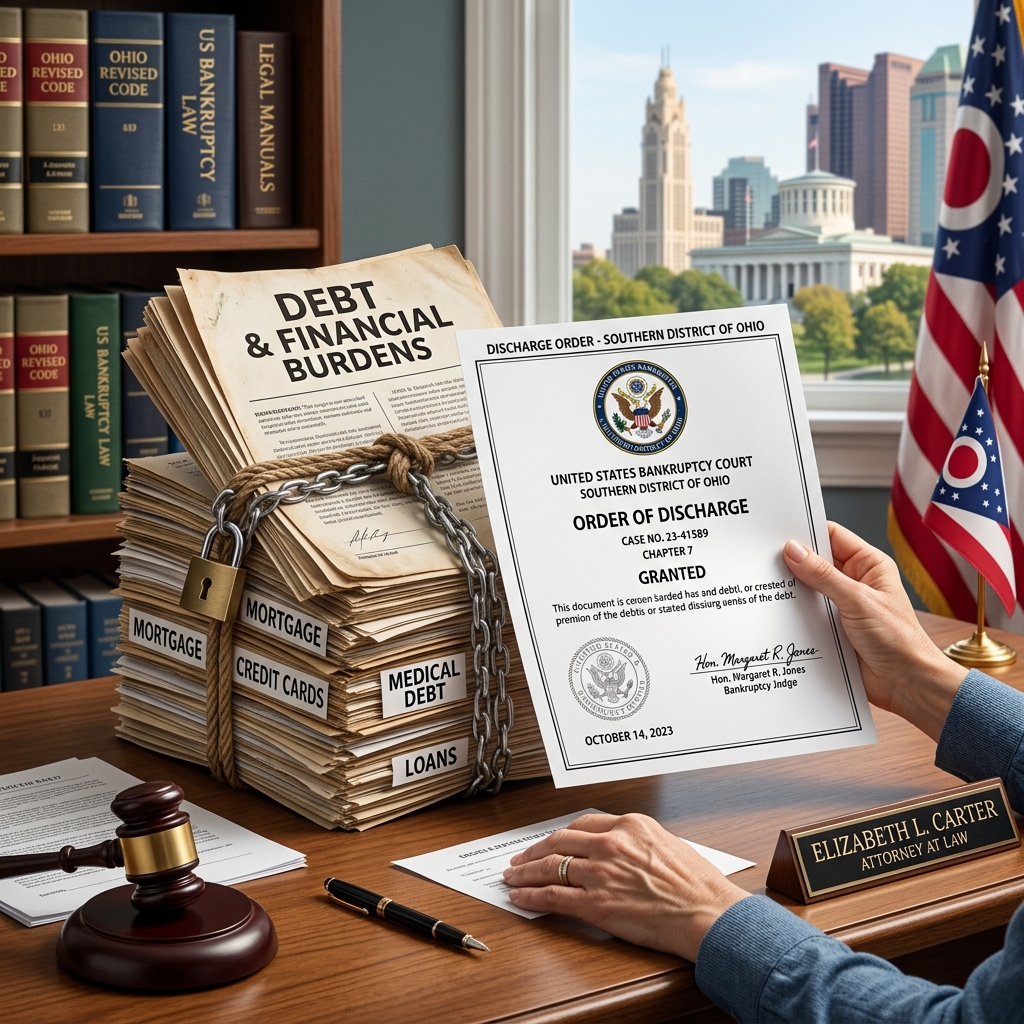
Bankruptcy discharge is the legal end point of a successful bankruptcy case: it is the court order that wipes out qualifying debts and permanently stops creditors from trying to collect them. In Ohio, the rules that govern discharge come from federal bankruptcy law, applied through the United States Bankruptcy Court for the Northern and Southern Districts of Ohio. This guide explains how discharge works in Ohio, which debts can be erased, how long the process usually takes, and what happens after your case is over.
What a Bankruptcy Discharge Does — And Does Not Do
A discharge is a federal court order stating that you are no longer legally obligated to pay certain debts. Once the order is entered, creditors covered by the discharge:
- Cannot sue you to collect discharged debts
- Cannot garnish your wages or bank accounts for discharged debts
- Cannot send collection letters or make harassing phone calls about discharged debts
Importantly, discharge only affects personal liability on covered debts. It does not automatically remove liens, such as a mortgage lien on your home or a lien on your car, which may still allow the creditor to repossess or foreclose if you stop paying.
Discharge also does not apply to every type of obligation. Some debts are non-dischargeable under federal law and remain your responsibility even after the case is over.
Ohio Bankruptcy Courts and Case Information
Ohio has two federal bankruptcy court districts: the Northern District and the Southern District. Each district handles Chapter 7 and Chapter 13 cases and issues discharge orders when cases are successfully completed.
The Southern District of Ohio, for example, maintains case records electronically via the PACER system and phone-based access (McVCIS). Debtors can confirm whether a discharge was entered, and on what date, by checking their case information through these official channels.
- PACER access: Online case records for filings, discharge orders, and closing dates
- McVCIS telephone system: Basic case information, including case status and disposition
- Clerk’s Office: Copies of discharge orders and other case documents upon request
Chapter 7 vs. Chapter 13: How Discharge Works in Ohio
Most individuals in Ohio file either Chapter 7 or Chapter 13 bankruptcy. Both can lead to a discharge, but the timeline and conditions differ.
| Feature | Chapter 7 (Liquidation) | Chapter 13 (Repayment Plan) |
|---|---|---|
| Primary purpose | Erase unsecured debt quickly, possibly liquidate non-exempt assets | Repay part or all of debt over time, protect key assets |
| Typical discharge timing in Ohio | About 3–5 months after filing, if no complications | After completing a 3–5 year repayment plan |
| Requirement before discharge | Complete a financial management course and meet all filing requirements | Make plan payments as confirmed, complete financial management course |
| Effect on non-exempt property | Trustee may sell non-exempt assets to pay creditors | Debtors typically keep property and pay creditors through the plan |
Chapter 7 Discharge Timeline in Ohio
In a typical Chapter 7 case filed in Ohio, the process from filing to discharge is relatively fast:
- Case filing: Debtor files petition and schedules with the bankruptcy court, listing assets, debts, income, and expenses.
- Meeting of creditors (341 meeting): Held about a month after filing; the trustee and creditors can ask questions.
- Financial management course: Debtor completes an approved debtor education course before discharge.
- Discharge order: In many Ohio cases, the court issues the discharge within about three to five months of the filing date, assuming requirements are met and no objections are filed.
Chapter 13 Discharge in Ohio
Chapter 13 is a longer process because it involves a court-approved repayment plan. The plan usually runs three to five years, during which the debtor makes regular payments to a trustee who distributes funds to creditors. A discharge is entered only after the debtor:
- Completes all required plan payments
- Stays current on any direct payments required (such as mortgages, if paid directly)
- Completes the debtor education course
- Complies with any additional court orders or local requirements
Ohio rules on when you can obtain a new discharge after prior cases, and how courts apply federal discharge rules, are summarized in materials from the Ohio State Bar Association.
Debts Commonly Discharged in Ohio Bankruptcy
In both Chapter 7 and Chapter 13 cases, the types of debts that are typically eligible for discharge include:
- Credit card balances
- Medical and hospital bills
- Personal loans not secured by collateral
- Certain judgments and collection accounts
- Old utility balances and similar consumer debts
These are generally unsecured obligations, meaning they are not backed by specific collateral. After discharge, you have no legal duty to pay them, and creditors must stop collection efforts.
Debts That Are Harder or Impossible to Discharge
Federal law limits the discharge of certain types of debt. In Ohio, as elsewhere, key non-dischargeable or partially dischargeable obligations include:
- Recent tax debts: Many recent income tax debts cannot be discharged, and other state or local taxes may remain due even after bankruptcy.
- Domestic support obligations: Child support, spousal support (alimony), and related arrears are not discharged.
- Certain fines and penalties: Criminal fines, restitution, and some governmental penalties survive discharge.
- Most student loans: Discharge typically requires a separate lawsuit and proof of undue hardship, which is a high standard.
- Debts incurred through fraud or intentional wrongdoing: These may be excluded from discharge if a creditor successfully challenges them.
The Ohio Department of Taxation emphasizes that state tax debts are treated differently depending on their type and age, and not all tax liabilities qualify for discharge.
Ohio Exemptions: What You Keep Even When Debts Are Discharged
While discharge eliminates qualifying debts, Ohio law also protects certain property so that you are not left with nothing. These protections are called exemptions. Exemptions define what the trustee cannot take and sell for the benefit of creditors in a Chapter 7, and they help structure Chapter 13 repayment plans.
Examples of Ohio exemptions include:
- Home equity: A significant amount of equity in your primary residence is protected by the homestead exemption.
- Car equity: A portion of the equity in your vehicle is exempt, allowing many debtors to keep their car.
- Household goods: Essential household items are protected up to specific values per item and in total.
- Tools of the trade: Profession-related tools, equipment, or books are protected up to a statutory limit.
- Cash and miscellaneous property: An aggregate exemption sometimes referred to as a “wildcard” can protect additional items.
- Support payments and certain tax credits: Child support, spousal support, and specific tax credits like the Earned Income Tax Credit and Child Tax Credit are exempt.
These protections are especially important for understanding how discharge will affect your practical life. Even if some non-exempt property is sold in Chapter 7, exemptions ensure you keep essential assets.
Dismissal vs. Discharge: A Critical Difference
Many people confuse the terms dismissal and discharge, but they have opposite consequences.
- Discharge: The court erases eligible debts at the end of a successful case, and creditors lose the right to collect them.
- Dismissal: The court closes the case without granting a discharge. You remain liable for your debts, and collection actions may resume or continue.
Common reasons for dismissal include failing to file required documents, missing plan payments in Chapter 13, or not completing required courses. In some situations, a dismissal can limit how soon you may file again, and collection efforts—including lawsuits, garnishments, or asset seizures—may restart.
Steps Ohio Debtors Must Complete Before Discharge
Whether you file Chapter 7 or Chapter 13 in Ohio, federal law and local court procedures impose several mandatory steps before discharge is granted:
- Gather financial documents: Income records, tax returns, bank statements, and a full list of debts and assets for your petition.
- Credit counseling: Complete an approved credit counseling session before filing. This is required nationwide for individual debtors.
- File a complete petition and schedules: Your filing must fully disclose your financial situation and recent financial transactions.
- Attend the 341 meeting: The meeting of creditors is mandatory unless the court specifically excuses you.
- Debtor education course: After filing and before discharge, complete a financial management course through an approved provider.
Ohio bankruptcy practitioners emphasize that failure to complete the debtor education course is a common, easily avoidable reason for delay or denial of discharge.
After Discharge: Practical Next Steps for Ohio Debtors
When the court issues your discharge order, your case may close soon thereafter, but your financial rebuilding process is just beginning. After discharge, consider the following steps:
- Keep copies of your discharge order: You may need them if a creditor later claims the debt is still owed.
- Obtain your credit reports: Check that discharged debts are reported as “discharged in bankruptcy” rather than still active.
- Create a realistic budget: Use what you learned in your debtor education course to avoid new unmanageable debt.
- Prioritize necessary credit: When you rebuild credit, focus on affordable, transparent products, such as secured cards.
- Protect exempt assets: Maintain insurance and good records for property you kept through exemptions.
Chapter 7 cases remain on your credit report for up to ten years, while Chapter 13 generally appears for up to seven years, but the impact on your credit score can improve well before those timelines if you manage finances responsibly.
Bankruptcy Discharge and Ohio Tax Debts
Tax obligations require special attention. The Ohio Department of Taxation notes that not all tax debts are dischargeable. Whether a tax can be discharged depends on factors such as:
- The type of tax (income tax vs. sales tax, withholding tax, etc.)
- How old the tax debt is
- Whether required returns were filed on time
- Whether there was any fraud or willful evasion
Even if some tax debts are discharged, others may remain collectible after your case concludes. Debtors with significant state or local tax liability should consult official guidance or professional advice focused specifically on tax discharge rules.
Frequently Asked Questions about Ohio Bankruptcy Discharge
How long does it take to receive a discharge in an Ohio Chapter 7 case?
In many Ohio Chapter 7 cases, debtors receive a discharge order about three to five months after filing, provided they complete all required steps and there are no objections.
Can I discharge debts incurred after I file for bankruptcy?
No. Bankruptcy discharge applies only to debts that existed before you filed your petition. New debts you incur after filing are not covered and remain your responsibility.
Will my Ohio home be taken if I file for Chapter 7?
Ohio’s homestead exemption protects a substantial amount of equity in your primary residence. If your equity is within the exemption limit, the Chapter 7 trustee typically will not sell your home to pay creditors.
What happens if my case is dismissed instead of discharged?
If your case is dismissed, the court closes it without erasing your debts. Creditors can resume collection, and you remain liable for outstanding balances. In some cases, there may be a waiting period before you can file again.
Are Ohio state tax debts automatically wiped out in bankruptcy?
No. Whether a state tax debt is dischargeable depends on the type of tax, its age, and other factors. Many tax debts survive bankruptcy wholly or in part.
How can I confirm that my discharge was entered in Ohio?
You can verify your discharge through the PACER electronic records system, the McVCIS phone system, or by requesting copies from the Clerk’s Office of the relevant Ohio bankruptcy court district.
References
- Case Information — United States Bankruptcy Court, Southern District of Ohio. 2024-01-10. https://www.ohsb.uscourts.gov/case-information
- Southern District of Ohio Bankruptcy Court Home Page — United States Bankruptcy Court, Southern District of Ohio. 2024-01-10. https://www.ohsb.uscourts.gov/
- Law Facts: Bankruptcy — Ohio State Bar Association. 2023-05-01. https://www.ohiobar.org/public-resources/commonly-asked-law-questions-results/law-facts/law-facts-bankruptcy/
- Bankruptcy — Ohio Legal Help. 2023-11-15. https://www.ohiolegalhelp.org/topic/bankruptcy
- Resources for Taxpayers in Bankruptcy — Ohio Department of Taxation. 2022-09-30. https://tax.ohio.gov/help-center/bankruptcy
- Bankruptcy Timeline — LHA Cleveland Bankruptcy Attorney. 2023-06-01. https://www.clevelandbankruptcyattorney.com/bankruptcy/about-bankruptcy/bankruptcy-timeline/
- What Happens After a Bankruptcy Dismissal in Ohio? — CWBK Law. 2023-03-15. https://cwbklaw.com/what-is-a-bankruptcy-dismissal-in-ohio/
Similar Articles








Read full bio of Sneha Tete




