
Understanding the Timeline of a Workers’ Compensation Claim
Learn what happens at every stage of a workers’ compensation case, from the day of injury through benefits, disputes, and final resolution.
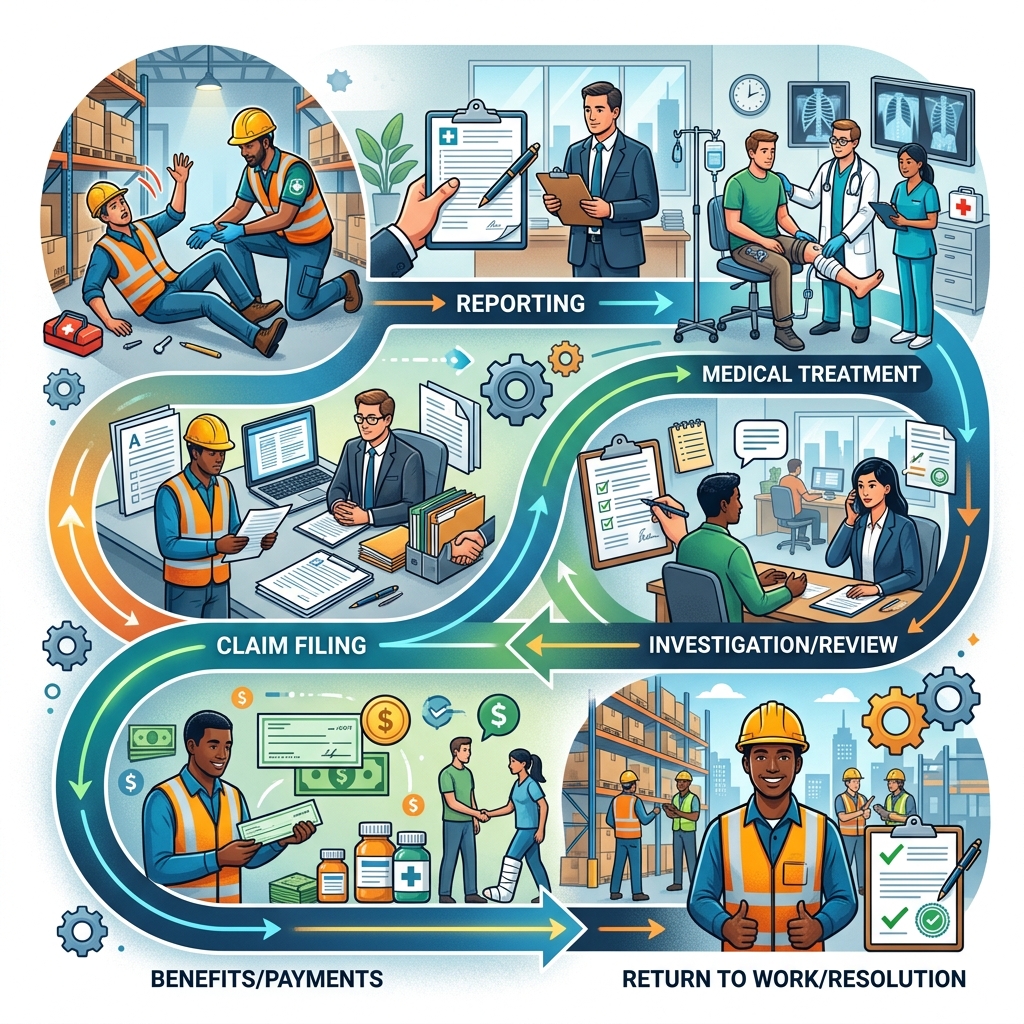
When you are hurt on the job, it is natural to wonder how long a workers’ compensation claim will take and what happens at each step. The answer depends on your state, your employer, and the seriousness of your injury, but most claims follow a fairly predictable sequence from the moment of injury through final resolution.[10]
This guide walks through that sequence in plain language. It explains the major milestones, typical deadlines, and common decision points so you can better understand where your claim is in the process and what you can do to protect your rights.
Big-Picture Overview: From Injury to Case Closure
Although every state has its own workers’ compensation laws, there is a general pattern that most claims follow. At a high level, your case will move through these broad phases:
- Workplace injury or diagnosis of an occupational illness
- Immediate medical care and documenting what happened
- Reporting the injury to your employer within the legally required timeframe
- Employer and insurer notification to the state workers’ compensation agency
- Investigation and initial decision to approve or deny your claim
- Payment of benefits and ongoing medical treatment if accepted
- Disputes and appeals if your claim is denied or benefits are too low
- Settlement or case closure when treatment stabilizes and benefits end
Some claims resolve quickly—often in a matter of weeks—while others with serious injuries or disagreements may stretch into months or even years.
Phase 1: The Day of Injury and Immediate Steps
The timeline starts the moment you are injured or learn that you have a work-related illness. What you do in the first hours and days is critical for both your health and your legal rights.
Seek Prompt Medical Care
Workers’ compensation systems assume that you will get medical attention as soon as reasonably possible after an injury. In many states, you may be required to see a specific doctor or network approved by the employer or insurer for non-emergency care.[10]
Early treatment serves several important functions:
- Protects your health and prevents complications
- Creates an official medical record linking your condition to the workplace
- Documents the severity of the injury and your work limitations
Document What Happened
As soon as you are able, write down the details of the incident and keep copies of any documents you receive. Helpful information includes:
- Date, time, and location of the event
- Names of witnesses or co-workers present
- How the injury occurred (for example, fall from ladder, machine malfunction)
- Symptoms you experienced immediately and in the following days
- Records of all medical visits and instructions provided
These notes can make it easier to complete claim forms later and may become important evidence if your case is disputed.
Phase 2: Reporting Requirements and Legal Deadlines
Workers’ compensation is governed by state law. Every jurisdiction sets its own time limits for reporting injuries and filing formal claims with the state agency or board. Missing these deadlines can result in losing your right to benefits, so it is vital to act promptly.
Notifying Your Employer
In most states, you must tell your employer about the injury within a specific number of days. Some examples drawn from state rules include:
| State (example) | Typical time to notify employer | Notes |
|---|---|---|
| North Carolina | Within 30 days of injury | Notice should be in writing; employer then files forms with the Industrial Commission. |
| Pennsylvania | Ideally within 21 days | If not reported within 120 days, benefits can be lost. |
| New York | Within 30 days | Failure to notify within 30 days may result in loss of rights to benefits. |
| California | Within 30 days | Employers must provide a claim form (DWC-1) promptly after notice. |
Even if your state allows more time, many attorneys and safety professionals recommend reporting injuries as soon as possible—often within 24 hours—to avoid disputes later.
Filing a Formal Claim With the State
After you notify your employer, there is usually a second deadline for filing a formal claim with your state’s workers’ compensation authority. This step is often completed by submitting a specific form, such as an employee claim form, to the state board or commission.
Examples of filing deadlines include:
- North Carolina: Generally, two years from the date of injury to file with the Industrial Commission.
- New York: You must notify the Workers’ Compensation Board of your injury or illness within two years.
Some states have different timelines for occupational diseases and death claims, often measured from the date of diagnosis or the date you knew the condition was related to work.
Phase 3: Employer, Insurer, and State Agency Actions
Once your employer is aware of the injury, they have legal responsibilities to report it to their insurance carrier and, in many cases, to the state workers’ compensation agency. This stage can unfold over several days or weeks, depending on the jurisdiction.[10]
Employer’s Reporting Duties
Most states require employers to complete an initial accident or injury report promptly. In North Carolina, for example, the employer should file the necessary forms with its workers’ compensation insurer or the Industrial Commission within five days of receiving your report. Other states impose similar short timeframes for an employer’s first report.
Insurance Company Notification and Rights Statement
Once the insurer receives the employer’s report and any claim forms, the company begins its internal review. Under New York rules, the insurance carrier must provide a written statement of your rights and any network requirements within 14 days after notification of the injury or with your first check, whichever comes first.
At this stage, insurers gather information such as:
- The employer’s description of what happened
- Your own report or claim form
- Medical records and doctors’ opinions
- Any prior injury to the same body part or related conditions
The insurer may also schedule an independent medical examination or request supplemental documentation before issuing a decision.[10]
Phase 4: Investigation, Decision, and Initial Benefit Payments
The length of this phase varies significantly. Some insurers issue decisions in a matter of weeks; others take longer when the facts are complex or liability is unclear.
Typical Investigation Timeline
In California, insurance companies have up to 90 days to investigate a workers’ compensation claim and decide whether to approve or deny benefits. Other states may use shorter timeframes or require insurers to issue a notice of their decision within a set number of days after receiving the claim.
During investigation, the insurer may:
- Review workplace safety records and incident reports
- Interview witnesses and supervisors
- Analyze medical records and diagnostic test results
- Arrange second opinions or specialist evaluations
Receiving the Initial Decision
Once the investigation is complete, the insurer issues a formal decision. You may receive a written notice stating that your claim is:
- Accepted – Benefits will be paid according to state law and your medical restrictions.
- Denied – The insurer believes the injury is not covered or not work-related.
- Accepted in part – Some aspects of your claim are covered, while others are disputed.
Many straightforward claims result in benefits starting within two to three weeks after filing, although more complicated claims can take longer.
Waiting Periods for Wage Replacement
Workers’ compensation benefits typically include medical coverage and partial wage replacement when you cannot work or must work reduced hours. Most states impose a short waiting period before wage benefits begin. In North Carolina, for example, there is a seven-day waiting period; if disability lasts more than 21 days, those initial days are reimbursed retroactively.
Phase 5: Ongoing Treatment and Benefit Management
Once your claim is accepted, your case enters a longer, more variable stage. The timeline here depends largely on how quickly you heal and whether you can return to your previous job.[10]
Medical Care Over Time
Workers’ compensation generally pays for reasonable and necessary medical treatment related to your work injury. This can include:
- Doctor visits and specialist consultations
- Diagnostic tests (X-rays, MRIs, lab work)
- Surgery and hospital stays
- Physical or occupational therapy
- Prescriptions and medical devices
The medical evaluation period often takes around 60 days in a typical case, but more serious injuries may require many months of care, rehabilitation, and follow-up.
Types of Monetary Benefits
Although the details differ by state, common benefit categories include:[10]
- Temporary total disability (TTD): Paid when you cannot work at all for a limited period.
- Temporary partial disability (TPD): Paid when you can work, but only with reduced hours or duties.
- Permanent disability benefits: Paid if a doctor determines you have lasting impairment after maximum medical improvement.
- Death benefits: Paid to eligible dependents if a worker dies from a job-related injury or illness.
Benefit duration may be capped by statute or continue until you reach a defined medical endpoint.
Phase 6: Disputes, Hearings, and Appeals
Not all workers’ compensation claims proceed smoothly. If the insurer denies your claim, stops benefits, or offers a settlement you believe is too low, you may enter the dispute and appeal stages. This can significantly extend the timeline.[10]
Common Reasons for Disputes
- Insurer claims the injury is not work-related
- Disagreement about how serious the injury is or what restrictions apply
- Arguments about whether proposed medical treatments are necessary
- Conflicts over permanent disability ratings and future earning capacity
Administrative Hearings
If you disagree with an insurer’s decision, most states allow you to request a hearing before a workers’ compensation judge or commissioner. For example, in North Carolina, if no agreement is reached, it may take 30 to 60 days to get a hearing scheduled before a Deputy Commissioner.
At a hearing, both sides can present evidence, call witnesses, and argue their position. The judge then issues a written decision. Some states provide short windows—such as 15 days—to appeal a Deputy Commissioner’s ruling to a higher-level commission.
Court Appeals
In many jurisdictions, if either party still disagrees after the commission’s decision, they may appeal to the state courts. That process can take several additional months and may involve complex legal arguments.[10]
Phase 7: Settlement, Resolution, and Case Closure
The final phase occurs when your medical condition stabilizes and the parties agree—or a court orders—how your future benefits will be handled. Some cases simply end when benefits run their course; others conclude with a negotiated settlement.[10]
Settlement Discussions
Once your injury has reached maximum medical improvement, your lawyer and the insurer may discuss settlement options such as:
- Lump-sum payment: A one-time payment intended to resolve future wage and medical claims, often with conditions.
- Structured benefits: Ongoing periodic payments over a set timeframe.
Settlement negotiations can take about 90 days in many cases and may follow an earlier investigation and medical evaluation period. Some claims in California with moderate injuries settle between six and nine months, while more serious or disputed cases can last 12 to 18 months, and cases that go to trial may extend to around two years from injury to resolution.
Case Closure
After settlement or the natural end of benefits, your workers’ compensation file is closed. The insurer stops payments, and you return to work or pursue other work options based on your residual abilities. The employer and insurer then treat the matter as resolved, although some states permit reopening in limited circumstances when conditions worsen.[10]
Practical Tips to Keep Your Claim on Track
While you cannot control every part of the process, there are steps you can take to avoid delay and protect your rights.
- Report quickly: Notify your employer as soon as possible, even if you think the injury is minor.
- Seek timely medical care: Do not wait to see a doctor or ignore follow-up appointments.
- Follow restrictions: Comply with work and activity limitations prescribed by your physician.
- Keep records: Save copies of correspondence, forms, and medical documents.
- Ask questions: If you do not understand a notice or deadline, contact your state agency or consult an attorney.
Frequently Asked Questions About Workers’ Compensation Timelines
How soon should I report my work injury?
It is best to report your injury immediately or within 24 hours, even though many states allow a longer period such as 21 or 30 days. Waiting increases the risk that your employer or insurer will question whether the injury is truly work-related and may jeopardize your benefits if you miss a legal deadline.
How long does it usually take to start receiving benefits?
In uncomplicated cases, many injured workers begin receiving wage replacement and medical benefits within two to three weeks after filing a claim. However, investigation, medical evaluations, and administrative processes can extend that timeframe, especially if questions arise about how the injury occurred.
Why does my state have a waiting period before paying lost wages?
Waiting periods—often around seven days—are designed to avoid administrative burdens for very short-term injuries. If your disability continues long enough, many states reimburse the waiting period retroactively, as seen in North Carolina when disability lasts more than 21 days.
What happens if my claim is denied?
If your claim is denied, you generally have the right to challenge the decision through an administrative hearing and, if necessary, further appeals. You must file your request for a hearing within the time limits set by your state, and it is often helpful to consult a workers’ compensation attorney to navigate this process.[10]
Can a workers’ compensation case take more than a year?
Yes. While many cases resolve within several months, claims involving serious injuries, contested issues, or court appeals can last one to two years or more. For example, some California cases with trials may extend to roughly a two-year timeline from injury to final resolution.
Do I need a lawyer to file a workers’ compensation claim?
Many workers file initial claims on their own, particularly for straightforward injuries. However, legal counsel is commonly recommended when benefits are denied, the injury is severe, or there are disputes over permanent disability ratings, long-term medical care, or settlement value.[10]
References
- Workers’ Compensation Claim Timeline in North Carolina — North Carolina Industrial Commission / Stewart Law Offices summary. 2023-06-01. https://www.stewartlawoffices.net/north-carolina-personal-injury-lawyer/workers-compensation/claim-timeline/
- The Flow of a Pennsylvania Workers’ Compensation Claim — Pennsylvania Department of Labor & Industry. 2022-01-01. https://www.pa.gov/content/dam/copapwp-pagov/en/dli/documents/businesses/compensation/documents/flow-of-wc-claim.pdf
- Understanding the Claims Process — New York State Workers’ Compensation Board. 2023-05-10. https://www.wcb.ny.gov/content/main/Workers/HowSystemWorks.jsp
- What’s the Timeline of a California Worker’s Compensation Case — Inland Empire Workers Compensation Lawyer. 2023-04-01. https://www.inlandempireworkerscomplawyer.com/notification-settlement-whats-timeline-california-workers-compensation-case/
- The Workers’ Compensation Claims Process: A Step-by-Step Guide — DJD Law. 2022-08-15. https://www.djdlawyers.com/blog/the-workers-compensation-claims-process-a-step-by-step-guide
- The Lifecycle of a Workers’ Comp Claim, Explained — Alloy Employer Services. 2023-02-20. https://www.alloyemployer.com/blog/the-lifecycle-of-a-workers-comp-claim-explained
- How Long Does It Usually Take to Get Workers’ Compensation? — Ben Crump Law. 2021-11-01. https://bencrump.com/workers-compensation-lawyer/how-long-does-it-usually-take-to-get-workers-compensation/
Similar Articles








Read full bio of medha deb




