
The Fourth Amendment and Evidence Suppression
A practical guide to when illegal searches can keep evidence out of court.
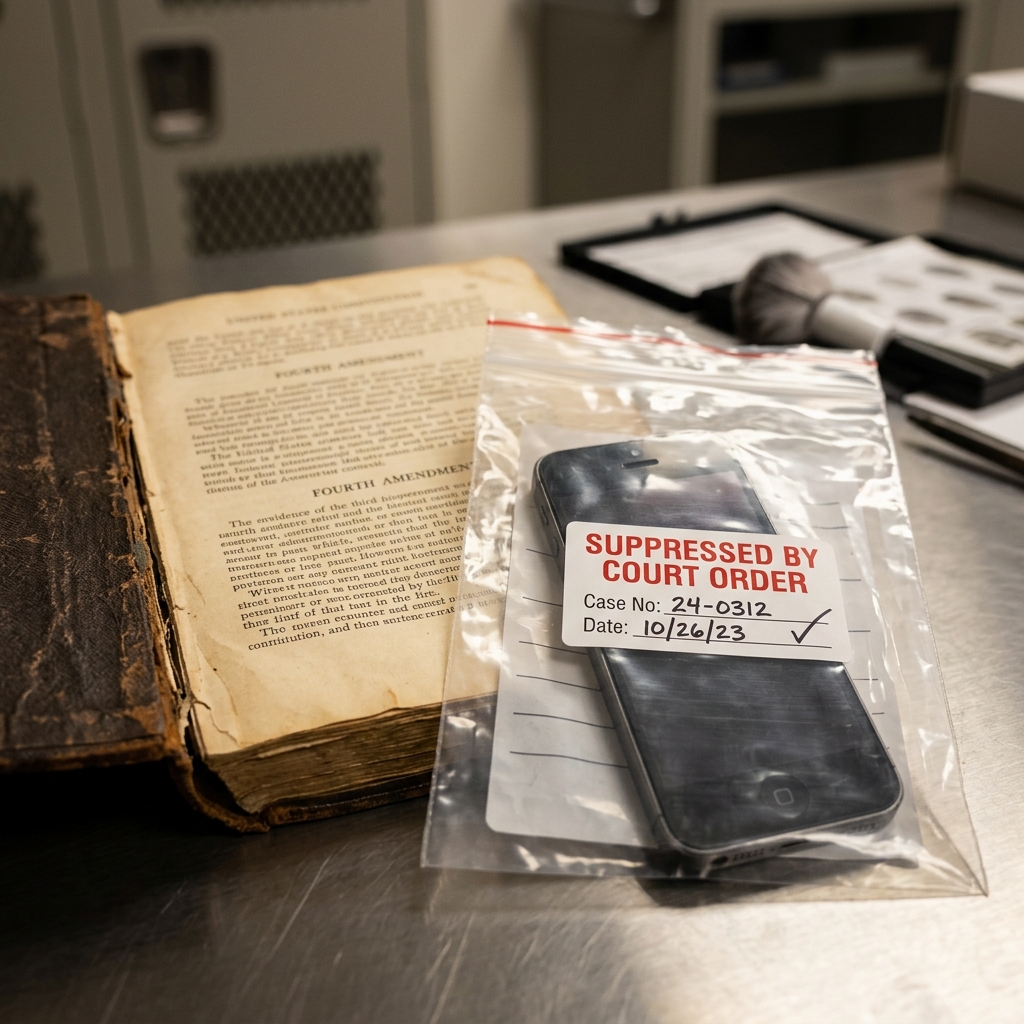
The Fourth Amendment protects people from unreasonable searches and seizures by the government, and the exclusionary rule is the main court-made remedy for violations of that protection. In criminal cases, the rule can keep illegally obtained evidence out of trial, but it does not apply in every setting and it contains important exceptions.
Why the Fourth Amendment matters
The Fourth Amendment does more than state a privacy principle. It creates a constitutional limit on police conduct, requiring government searches and seizures to be reasonable and, in many situations, supported by a warrant based on probable cause. When officers cross that line, courts may respond by excluding the evidence they obtained.
This remedy exists because constitutional rights need a practical enforcement mechanism. Without one, the promise of protection against unreasonable searches could become largely symbolic.
What the exclusionary rule does
The exclusionary rule prevents the government from using evidence gathered in violation of the Constitution in a criminal prosecution. The point is not to reward a defendant, but to deter unlawful conduct by law enforcement and to preserve the integrity of the justice system.
Courts have described the rule as a judicially created remedy rather than an independent constitutional right. That distinction matters because it explains why courts apply the rule selectively and why they sometimes admit evidence even after police misconduct.
How a suppression issue usually arises
In practice, the issue often begins when the defense files a motion to suppress. The defendant asks the court to prevent the prosecution from using a piece of evidence, arguing that the police obtained it through an unconstitutional search, seizure, or interrogation.
If the judge agrees that the evidence was unlawfully obtained and no exception applies, the evidence may be excluded from the trial record. That can significantly weaken the prosecution’s case, especially if the challenged evidence is central to proving guilt.
Common forms of Fourth Amendment problems
Fourth Amendment disputes can involve many different police actions. Common examples include searches of homes, cars, phones, bags, and other effects; seizures of property; and detentions that lead to searches or statements.
- Searching a home without a valid warrant or recognized exception
- Stopping a person or vehicle without lawful justification
- Taking property without adequate legal authority
- Using information from an unlawful search to discover more evidence
In each situation, the key question is whether the government’s conduct violated the defendant’s own constitutional rights.
The idea behind “fruit of the poisonous tree”
The exclusionary rule does not stop with the first item police find. If the original illegality leads to additional evidence, that later evidence may also be excluded under the “fruit of the poisonous tree” doctrine.
For example, if officers unlawfully search a house and then use what they find to locate a hidden storage unit, the later discovery may also be challenged if it depends too closely on the original illegal search. The basic inquiry is whether the challenged evidence was derived from the unconstitutional act or obtained by a separate, lawful path.
When evidence may still be admitted
The exclusionary rule is powerful, but it is not absolute. Courts sometimes admit evidence even after police misconduct if the connection between the illegal act and the evidence is weak, indirect, or broken by a later lawful event.
One important concept is attenuation. If the link between the unlawful conduct and the evidence becomes too remote, courts may decide that suppression is not justified. Another path to admission is an independent lawful search or source that would have led to the same evidence without the constitutional violation.
Situations that may limit suppression
| Situation | Possible effect on evidence |
|---|---|
| Independent lawful source | The evidence may be admitted if police obtained it through a separate legal route. |
| Attenuation | The evidence may be admitted if the connection to the illegality is too remote. |
| Later valid search or seizure | Evidence may become admissible if later recovered through a constitutionally valid process. |
Who can ask for exclusion
A person usually may suppress evidence only when the challenged search or seizure violated that person’s own Fourth Amendment rights. In other words, a defendant generally cannot object to a search simply because it infringed someone else’s privacy interests.
This standing requirement narrows the rule’s reach. It means the court focuses on whose rights were actually invaded, not just on whether police acted improperly in the abstract.
What the rule is meant to achieve
The main goal of the exclusionary rule is deterrence. Courts use it to discourage officers from cutting constitutional corners because unlawfully obtained evidence may be unusable in court.
Supporters also view the rule as a way to protect the legitimacy of the criminal justice system. If courts routinely relied on illegally obtained evidence, public confidence in constitutional limits could erode.
Important limits on the rule
The exclusionary rule does not operate like a universal punishment for police misconduct. It is generally a remedy inside criminal litigation, not a free-standing damages remedy for every constitutional violation.
It also does not usually apply in the same way in civil cases or in certain administrative settings. That limited scope reflects the Supreme Court’s view that exclusion is a remedy to be used when it will create meaningful deterrence, not automatically whenever an error occurs.
Consent and other lawful exceptions
One major reason evidence may be admissible is consent. If a person voluntarily allows police to search a car, home, or other property, the search may be lawful even without a warrant. In that situation, the exclusionary rule typically will not help because there is no Fourth Amendment violation to suppress.
Other lawful exceptions exist as well, including circumstances where police have a valid warrant, act under recognized emergency conditions, or rely on another established exception to the warrant requirement. The details depend on the facts, the type of search, and the governing law.
Why courts balance deterrence and cost
Modern courts do not treat exclusion as automatic. The Supreme Court has repeatedly emphasized that suppression is a serious remedy because it can prevent reliable evidence from being heard by the factfinder.
For that reason, courts weigh whether excluding the evidence will create appreciable deterrence and whether that benefit outweighs the harm to the justice system. This balancing approach helps explain why some unlawful police conduct leads to exclusion while other conduct does not.
How this affects a criminal case
When key evidence is suppressed, the practical consequences can be substantial. A case built on a gun, drugs, a confession, or digital evidence may become difficult to prove once the prosecution loses that material.
At the same time, suppression does not necessarily end every case. Prosecutors may still proceed if enough independent evidence remains or if the state can show that the challenged evidence fits an exception to the exclusionary rule.
Questions people often ask
Below are a few recurring questions that come up in suppression litigation and Fourth Amendment analysis.
Does every illegal search lead to dismissal?
No. A Fourth Amendment violation may justify excluding evidence, but it does not automatically dismiss the entire case. The result depends on what evidence is challenged and whether the prosecution can continue without it.
Can later evidence be challenged too?
Yes, if it was discovered because of the original illegal search or seizure. But if the government can show an independent source, attenuation, or another lawful basis, the later evidence may still be used.
Is the exclusionary rule a constitutional right?
No. Courts treat it as a judge-made remedy designed to enforce constitutional protections, especially those in the Fourth Amendment.
Practical takeaways
- The Fourth Amendment limits unreasonable government searches and seizures.
- The exclusionary rule is the main remedy used to enforce those limits in criminal court.
- Evidence can be suppressed if it was obtained through a violation of the defendant’s own rights.
- Related evidence may also be excluded under the “fruit of the poisonous tree” doctrine.
- Exceptions such as consent, attenuation, and independent lawful discovery can keep evidence admissible.
FAQs
What is the exclusionary rule in simple terms?
It is a rule that can stop the government from using evidence obtained through an unconstitutional search, seizure, or other rights violation in a criminal case.
Does the rule apply outside criminal cases?
Not usually in the same way. The rule is primarily a criminal procedure remedy, and courts do not apply it broadly to all civil or administrative matters.
Why does the law allow exceptions?
Because courts try to balance two goals: deterring unlawful police conduct and avoiding unnecessary loss of reliable evidence in the justice system.
What should a defendant do if evidence was illegally obtained?
In a criminal case, the typical step is to raise the issue through a motion to suppress so the judge can decide whether the evidence should be excluded.
References
- Exclusionary rule — Cornell Law School, Legal Information Institute. n.d. https://www.law.cornell.edu/wex/exclusionary_rule
- Exclusionary rule – Wikipedia — Wikipedia contributors. n.d. https://en.wikipedia.org/wiki/Exclusionary_rule
- Amdt4.7.1 Exclusionary Rule and Evidence — Congress.gov, Constitution Annotated. n.d. https://constitution.congress.gov/browse/essay/amdt4-7-1/ALDE_00000805/
- No. 2: Revising the Exclusionary Rule — The Army Lawyer, U.S. Army Judge Advocate General’s Legal Center and School. 2020-09-30. https://tjaglcs.army.mil/Periodicals/The-Army-Lawyer/tal-2020-issue-5/Post/4626/No-2-Revising-the-Exclusionary-Rule
- How We Got the Fourth Amendment Exclusionary Rule and Why We Need It — Office of Justice Programs. n.d. https://www.ojp.gov/ncjrs/virtual-library/abstracts/how-we-got-fourth-amendment-exclusionary-rule-and-why-we-need-it
Similar Articles








Read full bio of Sneha Tete




