
Understanding Tennessee Child Custody and Parenting Plans
A clear, practical guide to Tennessee’s child custody rules, parenting plans, and parental rights for married and unmarried parents.
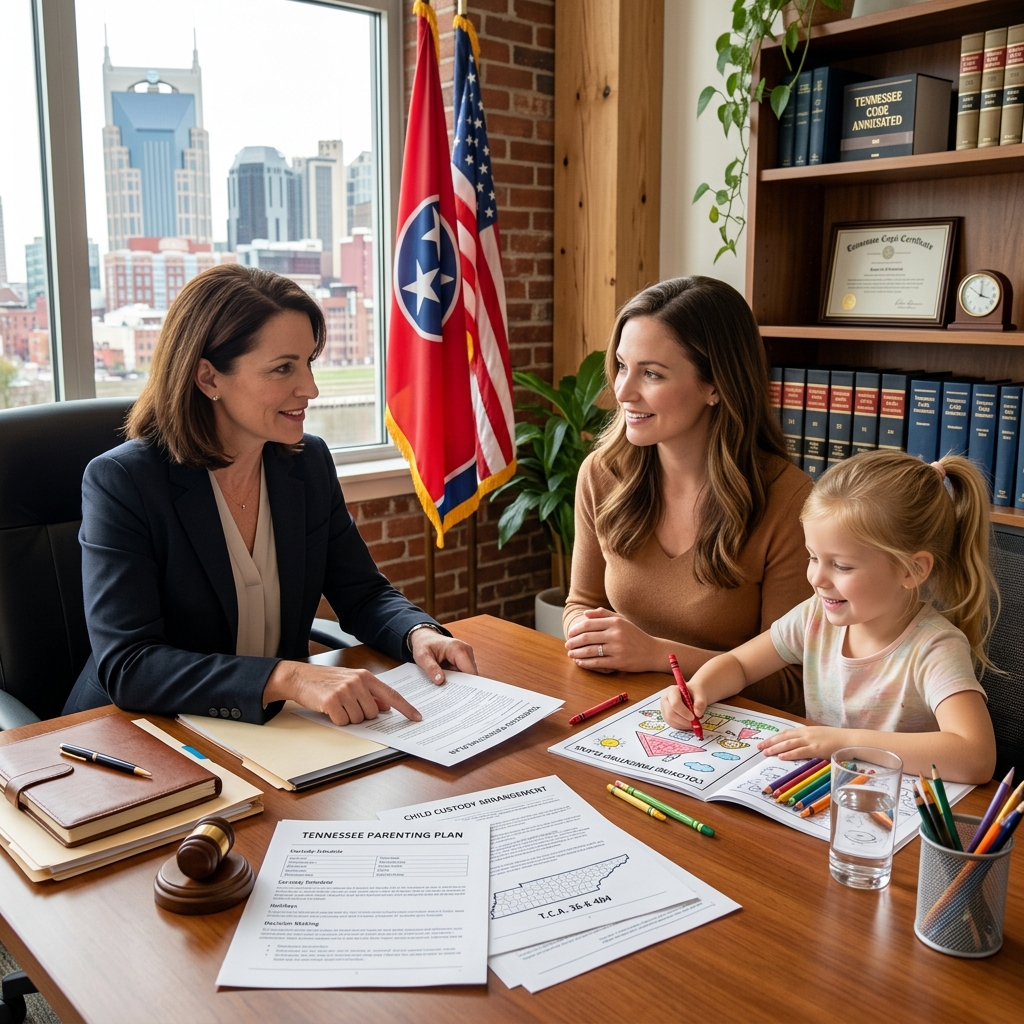
Tennessee has moved away from traditional “custody” labels and now focuses on detailed parenting plans that outline how parents will share time and decision-making for their children. The core idea behind every decision is the best interests of the child, not the preferences or convenience of either parent.
From Custody Labels to Parenting Plans
In Tennessee, courts no longer simply declare one parent the custodial parent and the other the non-custodial parent. Instead, judges require a parenting plan that addresses where the child lives, how often each parent sees the child, and who makes major decisions.
Every plan must be approved by the court and should be detailed enough to reduce conflict and uncertainty in the future.
Key Components of a Parenting Plan
- Residential schedule – which days and nights the child spends with each parent.
- Decision-making authority – who makes major choices about education, medical care, religion, and extracurricular activities.
- Holiday and vacation arrangements – how parents share special occasions and school breaks.
- Communication rules – how parents exchange information about the child and handle disputes.
- Transportation and exchanges – where and how the child is transferred between households.
Primary Residential Parent and Parenting Time
Tennessee law uses specific terminology to describe where a child lives and how time is shared.
Primary Residential Parent (PRP)
The Primary Residential Parent (PRP) is the parent with whom the child lives most of the time. This parent typically:
- Provides the child’s day-to-day care and routine.
- Is the address used for school enrollment and many official records.
- Often receives child support, depending on the overall parenting schedule and incomes.
Alternative or Non-Primary Parent
The other parent is often called the alternate residential parent or non-primary parent. This parent usually has scheduled parenting time, which may range from limited visitation to substantial, nearly equal time, depending on the case.
Equal Parenting Time and Joint Legal Custody
Recent changes in Tennessee law create a presumption that joint legal custody and equal parenting time are generally in a child’s best interests, unless safety or other serious concerns are present. This means that courts often start from the idea that children benefit from strong, ongoing relationships with both parents.
| Arrangement Type | Time Sharing | Decision-Making |
|---|---|---|
| Joint legal custody with equal time | Approximately 50/50 schedule | Both parents share major decisions |
| Joint legal custody with unequal time | One parent has more overnights | Decisions shared; one parent may have tie-breaking authority |
| Sole decision-making authority | Time may still be shared | One parent makes major decisions if joint authority would harm the child |
How Tennessee Courts Decide What Is Best for the Child
When parents disagree, the judge must step in and design or approve a parenting plan. Tennessee law requires the court to base its decision on the best interests of the child, not on either parent’s gender or personal wishes.
Core Best-Interest Factors
Under Tennessee Code § 36-6-106, courts consider multiple factors when deciding parenting time and decision-making authority. Key considerations include:
- Strength of each parent-child relationship – the emotional bond, history of care, and involvement in the child’s life.
- Stability of each home environment – including housing, routines, and ability to provide for the child’s needs.
- Each parent’s past and potential future caregiving – who has been responsible for school, medical care, and daily activities.
- Physical and mental health of the parents and child – to ensure the parenting plan supports safety and well-being.
- Willingness to encourage a relationship with the other parent – whether each parent supports the child’s ongoing contact with the other.
- Any history of abuse, neglect, or criminal behavior – especially violence or sexual offenses involving minors.
The Child’s Wishes
Judges may also consider the child’s own preferences about where to live and how time should be divided, especially as the child gets older and can express thoughtful, independent views. The child’s wishes are just one factor and never control the outcome on their own.
No Automatic Preference for Mothers or Fathers
Tennessee law explicitly states that gender cannot be a factor in deciding custody or parenting time. Both parents start on equal footing, and the court looks at behavior, caregiving history, and the child’s needs rather than stereotypes about mothers or fathers.
Special Situations: Abuse, Abandonment, and Safety Concerns
While Tennessee encourages children to have meaningful contact with both parents, that priority does not override safety. When there is credible evidence of abuse or serious risk, the court must protect the child.
Abuse and Restricted Visitation
If a parent has physically or emotionally abused the child, the judge may order:
- Supervised visitation – visits occur in a safe setting with a neutral supervisor present.
- Temporary suspension of visitation – until the court is satisfied that the risk has been addressed.
- Very limited contact – such as telephone or video calls only, if any in-person contact is unsafe.
For confirmed child abuse or child sexual abuse, Tennessee courts can award visitation only under conditions that guarantee the child’s safety.
Willful Abandonment
When a parent has willfully abandoned the child for 18 months or more—such as refusing to perform parenting responsibilities or having little to no contact without good reason—the court generally reduces that parent’s residential time and may limit visitation.
Unmarried Parents and Paternity in Tennessee
Child custody issues are often more complicated when parents are not married. Tennessee law draws a clear line between married and unmarried parents when a child is born.
Default Custody at Birth
When a child is born to unmarried parents, the mother automatically has legal custody at birth. She has full decision-making authority unless a court later orders otherwise. The father’s rights exist in principle, but they are not legally enforceable until certain steps are taken.
Establishing Paternity
Before an unmarried father can obtain court-ordered parenting time or decision-making rights, he must legally establish paternity. Common methods include:
- Signing a Voluntary Acknowledgment of Paternity form, often at the hospital soon after birth.
- Participating in a court process that may involve DNA testing.
Once paternity is established, the father can ask the court to approve a parenting plan, modify default custody, and define his rights and responsibilities.
Parenting Plans for Unmarried Parents
Unmarried parents may jointly propose a parenting plan and submit it to the court for approval, or the judge may create a plan if the parents cannot agree. The same best-interest factors apply regardless of marital status, and both parents can seek substantial parenting time when it is safe and appropriate.
Child Support and Financial Responsibility
Child custody and parenting time do not stand alone. Tennessee also requires both parents to contribute financially to their children’s upbringing based on an income shares model.
Income Shares Model
The income shares approach estimates the cost of raising a child and allocates that cost between parents according to their respective incomes and parenting schedule. Typically:
- Both parents’ gross incomes are combined.
- A guideline amount is determined based on the number of children and total income.
- The parent with less parenting time usually pays support to the PRP.
Importantly, a parent cannot legally withhold parenting time simply because the other parent has not paid child support. Visitation and support are legally separate issues.
Modifying Existing Parenting Plans
Parenting plans are designed to last, but they are not frozen in place forever. If circumstances significantly change, a parent may ask the court to modify the plan.
Material Change in Circumstances
To modify an existing order, Tennessee requires proof of a material change in circumstances. Examples may include:
- Major changes in a child’s needs, such as medical issues or schooling.
- Significant changes in a parent’s living conditions or work schedule.
- Relocation that affects the practical parenting schedule.
- Repeated violation of the current parenting plan by one parent.
If the court finds that a material change has occurred and that a new arrangement would better serve the child’s interests, it may modify time-sharing, decision-making, or both.
FAQs About Tennessee Child Custody and Parenting Plans
Does Tennessee always favor joint custody?
There is a legal presumption that joint legal custody and equal parenting time are generally best for children, but that presumption can be overcome by evidence showing that a different arrangement is safer or more suitable.
Can a younger child’s opinion affect the parenting plan?
Yes. Judges may consider the preferences of a younger child if requested, though the child’s wishes are only one of many factors and are weighed alongside maturity and the reasons for the preference.
What happens if a parent has a history of abuse?
If there is credible evidence of child abuse or child sexual abuse, the court can strictly limit or supervise visitation and will only allow contact under conditions that protect the child’s safety.
Does an unmarried father automatically have custody rights?
No. When parents are unmarried, the mother has automatic legal custody at birth. The father must establish paternity and then seek a court-ordered parenting plan to obtain enforceable rights.
Can my parenting plan be changed if I move or my work schedule shifts?
Possibly. If the change is significant enough to affect the child’s welfare or the practicality of the schedule, it may qualify as a material change in circumstances. The court will then decide whether a new plan better serves the child’s best interests.
References
- Tennessee Code § 36-6-106 – Child Custody — Tennessee General Assembly / Justia. 2024-01-01. https://law.justia.com/codes/tennessee/title-36/chapter-6/part-1/section-36-6-106/
- Tennessee Child Custody Laws — FindLaw. 2023-08-01. https://www.findlaw.com/state/tennessee-law/tennessee-child-custody-laws.html
- Tennessee Custody — WomensLaw.org. 2023-05-15. https://www.womenslaw.org/laws/tn/custody/all
- Tennessee Child Custody Requirements: Laws, Rights, & Tips — Cordell & Cordell. 2024-07-10. https://cordellcordell.com/blog/requirements-to-get-custody-of-a-child-in-tennessee/
- Unmarried Fathers’ Rights in Custody and Parenting in Tennessee — Nashville Family Law. 2022-06-01. https://www.nashvillefamilylaw.com/family-law/fathers-rights/
- Tennessee Child Custody Laws for Unmarried Parents Explained — Freeman & Fuson. 2023-02-20. https://www.helpingclients.com/tennessee-child-custody-laws-for-unmarried-parents-explained/
- Parenting Plan — Tennessee Administrative Office of the Courts. 2021-09-01. https://www.tncourts.gov/programs/parenting-plan
Similar Articles








Read full bio of Sneha Tete


