
Supreme Court Rulings Reshape Gerrymandering Landscape
Unpacking recent Supreme Court cases on partisan and racial gerrymandering that redefine electoral fairness in America.
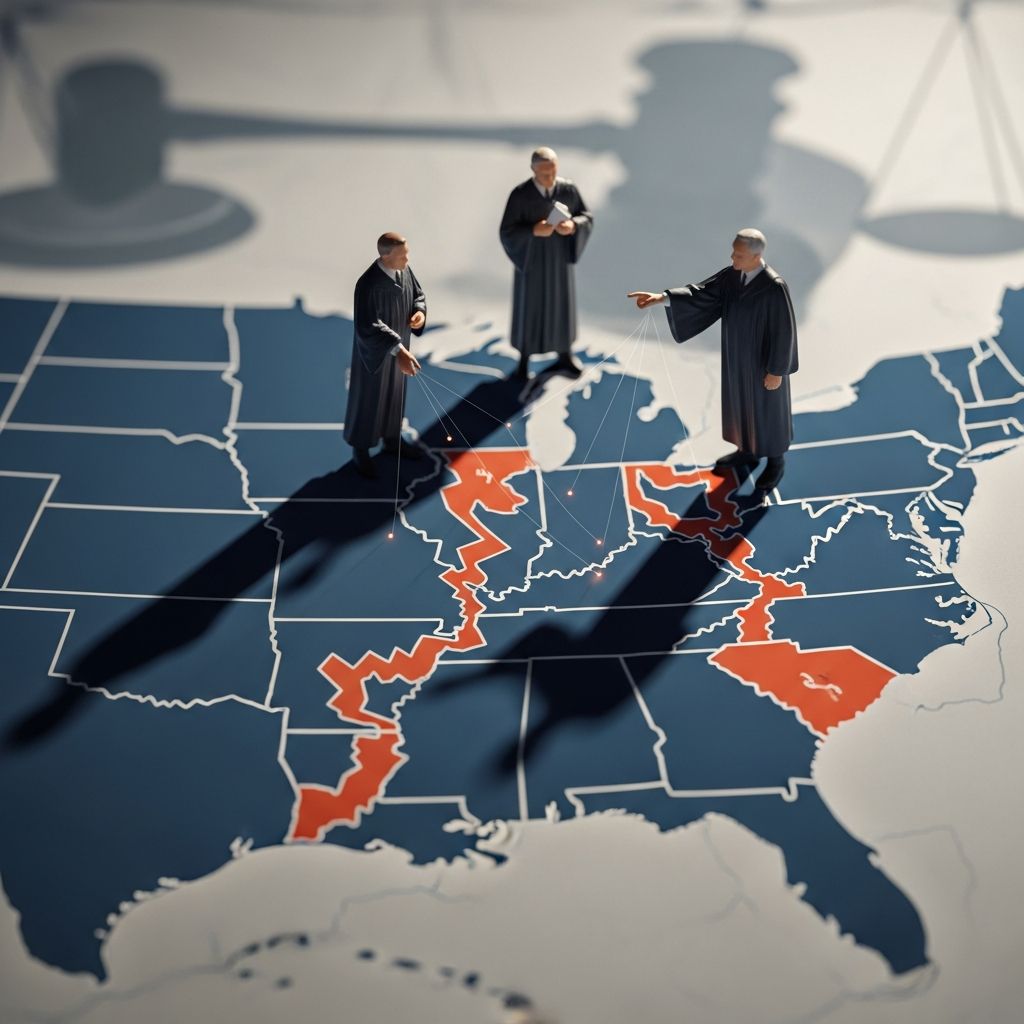
Gerrymandering, the practice of manipulating electoral district boundaries to favor one political party, has long been a contentious issue in American politics. Recent Supreme Court decisions have significantly influenced how states draw these maps, often prioritizing partisan goals over equitable representation. This article delves into pivotal cases, their rationales, and broader consequences for democracy.
Historical Foundations of Gerrymandering Challenges
The term ‘gerrymander’ originated in the early 19th century, named after Massachusetts Governor Elbridge Gerry, whose administration crafted a salamander-shaped district to benefit his party. Over time, courts have grappled with defining limits on this practice. The Supreme Court established key principles like ‘one person, one vote’ in Baker v. Carr (1962) and Reynolds v. Sims (1964), mandating equal population sizes across districts to prevent dilution of voting power.
However, partisan gerrymandering—drawing lines to maximize one party’s seats—proved harder to regulate. Early cases like Davis v. Bandemer (1986) acknowledged justiciability but failed to provide clear standards, leaving lower courts without workable tests.
Rucho v. Common Cause: Closing Federal Doors on Partisan Claims
In 2019’s Rucho v. Common Cause, the Supreme Court ruled 5-4 that excessive partisan gerrymandering claims are nonjusticiable political questions unfit for federal courts. Chief Justice John Roberts’ majority opinion argued no ‘judicially discernible and manageable standards’ exist to determine ‘how much’ gerrymandering is unconstitutional. The decision dismissed challenges to North Carolina’s Republican-favoring maps and Maryland’s Democrat-favoring ones, emphasizing that such issues belong to legislatures and Congress under the Elections Clause.
Justice Elena Kagan’s dissent warned this greenlit extreme map manipulations, predicting maps that ‘entrench’ one party for decades. Post-Rucho, states like North Carolina and Maryland continued aggressive redistricting, exacerbating partisan imbalances.
Mid-Decade Redistricting Sparks Controversy
Traditionally, redistricting follows the decennial census, but recent years saw mid-decade efforts. In Texas, Republican legislators, urged by former President Trump, redrew congressional districts in 2025 to gain five more GOP seats. A three-judge panel, after a nine-day trial with thousands of exhibits, ruled the maps impermissibly race-based, violating Equal Protection precedents like Shaw v. Reno (1993).
The Supreme Court reversed in Abbott v. League of United Latin American Citizens (December 2025), upholding the maps. Reasons included: (1) lower courts’ failure to presume legislative good faith; (2) lack of an alternative map achieving Texas’s partisan aims without race; and (3) application of the Purcell principle against pre-election disruptions. Justice Kagan dissented, noting direct evidence of race-based decisions persisted.
Similarly, California Democrats faced challenges for pro-Democrat mid-decade maps, but the Court dismissed on February 4, 2026, maintaining consistency. These rulings, via the ‘shadow docket’ with minimal briefing, fueled accusations of partisan favoritism.
Racial Gerrymandering: Evolving Standards
Unlike partisan cases, racial gerrymandering remains justiciable when race predominates without compelling justification. Alexander v. South Carolina NAACP (2024) eased burdens on states, ruling 6-3 that plaintiffs must prove race was the ‘predominant factor’ via direct evidence, not circumstantial inferences. Critics argue this shields subtle racial sorting masked as partisan strategy.
In Louisiana v. Callais (ongoing as of 2026), the Court reheard arguments on a second majority-Black district complying with the Voting Rights Act (VRA). Challengers claim it violates the 14th/15th Amendments post-Allen v. Milligan (2023), which upheld VRA Section 2 against racial gerrymander attacks.
| Case | Year | Issue | Ruling Summary | Impact |
|---|---|---|---|---|
| Rucho v. Common Cause | 2019 | Partisan | Nonjusticiable | Federal courts sidelined |
| Abbott v. LULAC (Texas) | 2025 | Racial/Partisan mid-decade | Upholds maps | Allows GOP gains |
| Alexander v. SC NAACP | 2024 | Racial | Higher proof burden | Easier for states |
| Louisiana v. Callais | 2026 | VRA compliance | Ongoing | Tests Black representation |
State-Level Reforms and Independent Commissions
With federal courts limited, states pursue reforms. Arizona’s independent commission, upheld in Arizona State Legislature v. Arizona Independent Redistricting Commission (2015), uses data-driven processes to curb partisanship. Michigan, Colorado, and others adopted similar models via voter initiatives, employing criteria like compactness and community preservation.
- Pros of Commissions: Reduce insider manipulation, promote competitive districts.
- Cons: Still face legal challenges; may reflect voter biases indirectly.
- Examples: New York’s 2014 commission produced fairer maps; Ohio’s 2021 maps balanced urban-rural divides.
Mathematical Tools and Efficiency Gaps
Scholars propose metrics like the efficiency gap, measuring ‘wasted votes’ (votes not contributing to a win). A gap exceeding 7% signals gerrymandering. Simulations compare enacted maps to thousands of neutral alternatives, flagging outliers. Though rejected in Rucho, states like Virginia incorporate them.
Partisan bias metrics assess seat-vote proportionality: e.g., if Party A wins 50% votes but 60% seats, bias = 10%.
Implications for Democracy and 2026 Elections
These rulings enable ‘perpetual redistricting’ in states like Missouri, North Carolina, and Utah, distorting representation. Brennan Center analysis shows post-2020 census maps added 20+ safe seats for one party, deepening gridlock.
Public trust erodes: 70% of Americans view gerrymandering as a major problem (Pew Research, 2024). Mid-decade shifts risk constant litigation, confusing voters.
Potential Paths Forward
Congress could enact the For the People Act, standardizing criteria nationwide. State courts, unbound by Rucho, struck maps in six states post-2020 using constitutions. The Court might revisit Rucho amid escalating mid-decade abuses.
Frequently Asked Questions
What is gerrymandering?
Gerrymandering involves drawing electoral districts to favor a specific party or group, often by packing opponents into few districts or cracking them across many.
Can federal courts stop partisan gerrymandering?
No, per Rucho v. Common Cause (2019), such claims are political questions beyond federal judiciary reach.
How does racial gerrymandering differ?
Racial cases remain reviewable if race predominates without VRA justification, unlike partisan ones.
What is the Purcell principle?
Federal courts avoid altering election rules near elections to prevent chaos.
Are there fixes for gerrymandering?
Independent commissions, shortest-splitline algorithms, and state laws offer remedies.
References
- The gerrymandering mess — SCOTUSblog. 2026-02-04. https://www.scotusblog.com/2026/02/the-gerrymandering-mess/
- Rucho v. Common Cause — Supreme Court of the United States. 2019-06-27. https://www.supremecourt.gov/opinions/18pdf/18-422_9ol1.pdf
- Supreme Court Hammers Away at Democracy — Brennan Center for Justice. 2025-12-15. https://www.brennancenter.org/our-work/analysis-opinion/supreme-court-hammers-away-democracy
- How the Supreme Court Made Racial Gerrymandering Easier — League of Women Voters. 2024-05-25. https://www.lwv.org/blog/how-supreme-court-made-racial-gerrymandering-easier-alexander-v-south-carolina-naacp
- Supreme Court Arguments Conclude in Landmark Voting Rights Case — ACLU. 2026-01-20. https://www.aclu.org/press-releases/supreme-court-arguments-conclude-in-landmark-voting-rights-case
- Redistricting and the Supreme Court: The Most Significant Cases — National Conference of State Legislatures. 2025-10-01. https://www.ncsl.org/redistricting-and-census/redistricting-and-the-supreme-court-the-most-significant-cases
Similar Articles








Read full bio of medha deb




