
Understanding Maryland Rental Housing Law
A practical guide to Maryland rental housing law, covering leases, deposits, repairs, eviction rules, and fair housing protections.
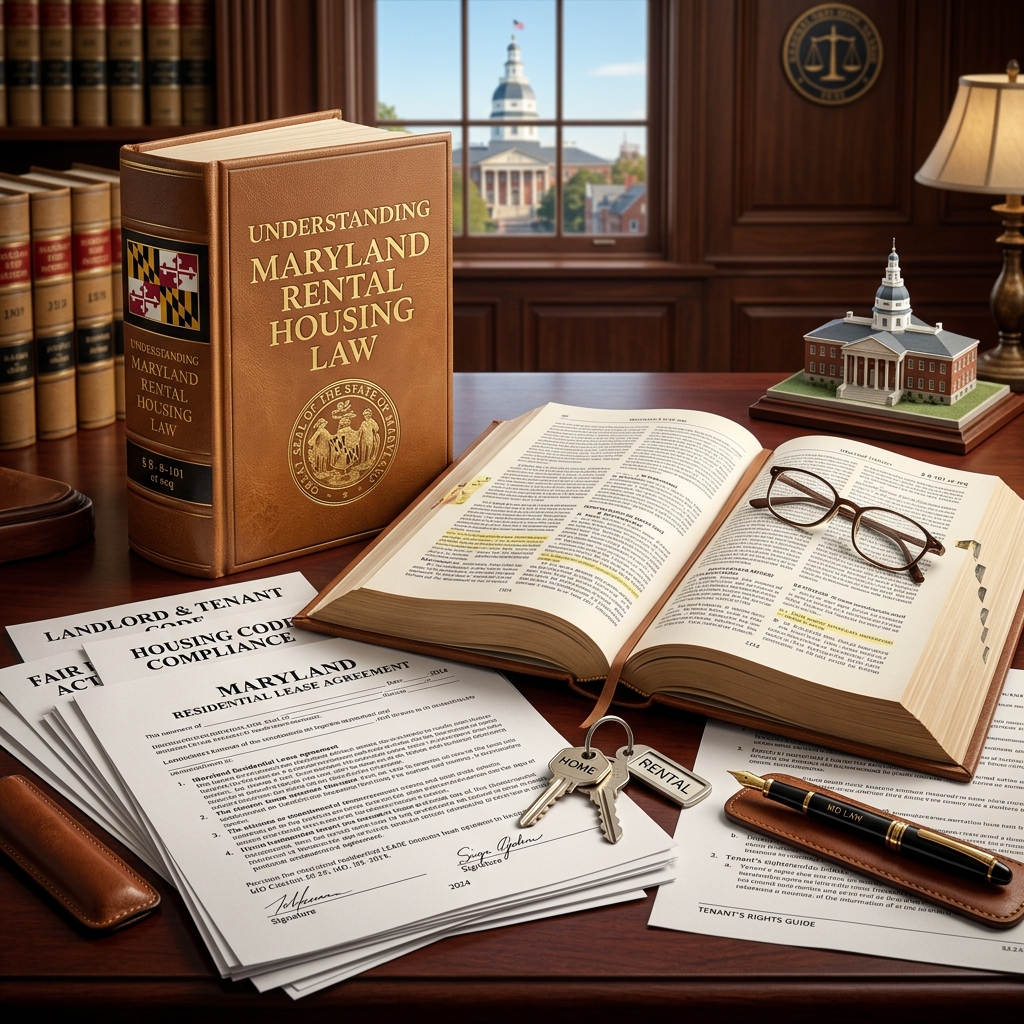
Maryland has a detailed set of laws that govern rental housing, designed to balance the interests of landlords and tenants. This guide explains the key rules on leases, security deposits, repairs and living conditions, eviction procedures, and fair housing protections so that both renters and property owners can understand their rights and obligations.
Because many disputes arise from misunderstandings, knowing the basic legal framework can help you prevent problems, negotiate effectively, and recognize when to seek legal help.
1. Rental Agreements in Maryland
A rental agreement, often called a lease, is the foundation of the landlord–tenant relationship in Maryland. It sets out the rules for how long the tenant can stay, what rent must be paid, and what each party is responsible for.
1.1 Written vs. Oral Leases
Maryland law allows both written and oral residential leases, but written agreements are strongly preferred because they provide clear proof of the terms.
- Landlords who rent five or more units in Maryland are required to use a written lease.
- Landlords with four or fewer units are not legally required to use a written lease, but tenants may request one.
- Even without a written lease, paying rent and occupying the unit creates a legal tenancy with rights and duties under state law.
Before signing, tenants should read all terms carefully, ask questions, and request changes if provisions seem unfair or unclear.
1.2 Common Lease Terms to Review
Whether you are a landlord drafting a lease or a tenant reviewing one, pay close attention to:
- Rent amount, due date, and acceptable payment methods
- Length of the lease (month-to-month, six months, one year, etc.)
- Late fees and grace periods, if any
- Utility responsibilities (who pays for water, gas, electricity, trash, internet)
- Repair and maintenance duties for both landlord and tenant
- Rules on guests, pets, parking, and use of common areas
- Grounds for ending the lease early, including notice requirements
Maryland law limits some terms. For example, landlords cannot waive certain legal rights of tenants, and any lease clause that conflicts with state law may be unenforceable.
2. Security Deposits and Fees
Security deposits are a frequent source of conflict. Maryland regulates how much can be charged, how deposits must be handled, and when they must be returned.
2.1 Maximum Security Deposit
For most residential rentals, the maximum security deposit a landlord may charge is no more than one month’s rent under recent changes to Maryland law. This limit is intended to make moving into rental housing more affordable and to prevent excessive upfront charges.
Other key points include:
- Deposits are separate from regular rent and other fees.
- Charging more than the legal maximum can expose the landlord to penalties and the obligation to refund the excess.
2.2 Handling and Returning the Deposit
Maryland law sets rules for holding and returning security deposits.
- The deposit must be held in a financial institution in an account that complies with state requirements.
- When the tenancy ends, the landlord generally must return the deposit within a legally defined period, minus any lawful deductions for unpaid rent or damage beyond normal wear and tear.
- If deductions are taken, the landlord must provide an itemized statement describing each charge and the cost.
Tenants who disagree with the deductions or who do not receive their deposit on time may file a claim in the Maryland District Court to recover disputed amounts.
2.3 Lawful Uses of the Security Deposit
Landlords may use the security deposit only for specific purposes allowed by law, such as:
- Unpaid rent or late fees allowed by the lease
- Costs to repair damage that is more than ordinary wear and tear
- Court-awarded costs or fees related to the tenancy, when permitted by law
A landlord cannot lawfully keep the deposit simply because the tenant ended the lease early without showing actual losses or damage. The landlord must be able to demonstrate the basis for deductions with documentation.
3. Rent, Late Fees, and Increases
Maryland law gives landlords the right to charge rent and tenants the duty to pay it, but places limits on late fees and prohibits certain unfair practices.
3.1 Rent Payments and Receipts
Rent must be paid according to the schedule set in the lease. Tenants are generally entitled to request receipts confirming payment, especially when paying in cash.
3.2 Limits on Late Fees
State law restricts the amount that can be charged when rent is paid late. A landlord may not charge more than a set percentage of the monthly rent as a late fee, and fees must be clearly described in the lease.
| Monthly Rent | Maximum Late Fee (percentage-based cap) | Key Rules |
|---|---|---|
| $1,000 | Up to the lawful percentage limit | Fee must be in the lease and cannot exceed statutory cap |
| $1,500 | Up to the lawful percentage limit | Fee may not be compounded or disguised as other charges |
Tenants can challenge late fees that exceed the legal maximum or that were never agreed to in the lease.
3.3 Rent Increases
In most Maryland jurisdictions, landlords may increase rent when a lease term ends as long as they provide proper notice and do not raise rent for discriminatory or retaliatory reasons.
- Rent increases must usually wait until the end of the lease term (for fixed-term leases) unless the lease expressly allows an increase mid-term.
- Some local governments may have additional rules on how much notice is required or other protections.
- Rent hikes in response to a tenant’s lawful complaints or participation in a tenants’ association may be considered retaliation and are prohibited.
4. Repairs, Habitability, and Rent Escrow
Landlords in Maryland must keep rental properties in a condition that is safe and fit to live in. When serious problems are not fixed, tenants may have access to a special court procedure called rent escrow.
4.1 Landlord’s Duty to Maintain the Property
Under Maryland law, landlords must comply with applicable housing codes and maintain the rental so it is safe, sanitary, and habitable.
Examples of conditions that may violate this duty include:
- No heat during cold weather or inadequate hot water
- Serious plumbing issues or sewage backups
- Dangerous electrical problems
- Significant rodent or insect infestations
- Structural defects that pose safety risks
Tenants should report problems to the landlord in writing and give a reasonable time to make repairs. Keeping copies of letters, emails, and photographs can be important if the matter later goes to court.
4.2 Using Rent Escrow
If a landlord fails to repair serious or dangerous defects after notice, the tenant may ask the District Court to create a rent escrow account.
- The tenant pays rent into a court-controlled account rather than directly to the landlord.
- The court will hold a hearing to determine whether the conditions justify escrow and what relief is appropriate.
- Possible outcomes include ordering repairs, reducing the rent, or releasing some funds to the landlord or tenant based on the circumstances.
Tenants should not unilaterally stop paying rent without using the legal escrow process, as this can expose them to eviction for nonpayment.
5. Eviction Rules and Court Process
Maryland does not allow landlords to evict tenants on their own. To remove a tenant, a landlord must follow a formal court process and obtain a judgment.
5.1 Unlawful Self-Help Evictions
Landlords may not:
- Change the locks without a court order
- Shut off utilities to force the tenant to leave
- Remove the tenant’s belongings from the home on their own
These actions are considered unlawful “self-help” evictions. Tenants subjected to such tactics may seek legal remedies and, in some cases, damages.
5.2 Legal Grounds for Eviction
Common grounds for eviction in Maryland include:
- Nonpayment of rent – landlord claims the tenant has failed to pay rent due.
- Breach of lease – tenant has violated a serious term of the lease, such as causing significant property damage or engaging in prohibited conduct.
- Holding over – tenant remains in the property after the lease term ends without the landlord’s consent.
The landlord must file the appropriate case in the District Court, and the tenant has the right to attend the hearing, present evidence, and raise defenses.
5.3 Steps in the Eviction Process
Although timelines can vary, the eviction process generally follows these steps:
- Notice – In many situations, the landlord must give written notice before filing an eviction case, such as a notice of intent to file for nonpayment.
- Filing in District Court – The landlord files a complaint alleging the reason for eviction.
- Court hearing – Both parties can appear, testify, and present documents.
- Judgment – If the court finds in favor of the landlord, it may enter a judgment for possession.
- Warrant of restitution – The landlord must then request a warrant authorizing the sheriff or constable to carry out the actual eviction.
- Sheriff-supervised eviction – Only law enforcement, not the landlord, may physically remove the tenant from the property.
Tenants may have the right to appeal an eviction judgment within a short timeframe, which varies depending on the type of case.
6. Protection from Retaliation and Discrimination
Maryland law and federal law protect tenants from both retaliatory actions and housing discrimination.
6.1 Retaliation is Prohibited
Landlords may not punish tenants for exercising their legal rights. Retaliatory acts may include:
- Raising rent in response to a complaint about conditions
- Reducing services, such as shutting off utilities or restricting access to amenities
- Attempting to evict a tenant soon after the tenant reports code violations or joins a tenant organization
If timing and circumstances suggest that the landlord’s actions are meant to retaliate for a tenant’s good faith complaint or lawful activity, courts may treat those actions as unlawful.
6.2 Fair Housing and Protected Classes
Under federal and Maryland law, landlords and housing providers cannot discriminate against applicants or tenants based on protected characteristics, such as:
- Race or color
- Religion
- Sex
- Disability
- Familial status (having children under 18)
- National origin
- Marital status and certain other characteristics under Maryland law
Examples of discriminatory conduct include refusing to rent a unit, setting different terms or conditions, or harassing tenants because of a protected trait. Tenants who experience discrimination can file complaints with state or federal fair housing agencies.
7. Additional Tenant Protections and recent changes
Maryland has adopted additional protections for renters in recent years, including a Tenants’ Bill of Rights and reforms affecting eviction and security deposit rules.
7.1 Maryland Tenants’ Bill of Rights
The state requires the Office of Tenant and Landlord Affairs to publish a Tenants’ Bill of Rights, which summarizes key legal protections.
- Landlords renting a certain number of units must provide tenants with a copy of this document when the lease is signed.
- The Bill of Rights highlights topics such as the right to a written lease, limits on deposits and late fees, and protections against discrimination.
7.2 Right of First Refusal for Some Tenants
Recent legislation expanded opportunities for some Maryland tenants to purchase the rental properties where they live.
- For smaller residential buildings with a limited number of units, tenants who have rented for a minimum period may have a right of first refusal if the owner decides to sell.
- The owner must give tenants notice and the chance to make an offer before selling to an outside buyer in certain situations.
These rules are designed to expand homeownership opportunities and provide tenants with more stability.
8. Practical Tips and Frequently Asked Questions
Understanding the law is only part of the picture; how you act day-to-day also matters. The following tips and FAQs provide practical guidance.
8.1 Practical Tips for Tenants
- Document everything – keep copies of your lease, letters, emails, texts, repair requests, and payment records.
- Communicate in writing whenever possible, especially for serious issues like repairs or lease disputes.
- Know your deadlines – appeal periods and response times in court cases are short.
- Seek help early if you receive court papers or believe your rights are being violated; many legal services organizations assist low-income tenants.
8.2 FAQs about Maryland Rental Housing Law
Q1. Can my landlord evict me without going to court?
No. In Maryland, a landlord cannot legally evict a tenant without filing a case in District Court, obtaining a judgment for possession, and having the sheriff or other authorized official supervise the eviction. Changing locks, shutting off utilities, or removing belongings without a court order is unlawful self-help.
Q2. What can I do if my landlord refuses to fix serious problems?
If the problem is serious and affects health or safety, you should notify the landlord in writing and give a reasonable time to make repairs. If the landlord still does not act, you may be able to ask the District Court to set up a rent escrow account, paying rent into the court instead of directly to the landlord. The court will then decide whether conditions justify repairs, rent reductions, or other relief.
Q3. How much can my landlord charge as a security deposit?
For most residential leases, Maryland law limits the security deposit to no more than one month’s rent under recent statutory changes, with only narrow exceptions. Charging more than the lawful maximum can result in penalties and an obligation to refund the excess.
Q4. What if I think I am being discriminated against?
If you believe a landlord has refused to rent to you, treated you differently, or harassed you because of your race, color, religion, sex, disability, familial status, national origin, or other protected characteristic, you may file a fair housing complaint with state or federal agencies. Keep detailed notes and any documents related to the discriminatory conduct.
Q5. Where can I learn more about my rights and get legal help?
The Maryland Office of the Attorney General offers information on landlord–tenant disputes, and the state’s Tenants’ Bill of Rights summarizes key protections. Legal aid organizations and bar association referral services may also provide advice or representation, especially for tenants facing eviction or living in unsafe conditions.
References
- Landlord-Tenant Disputes — Office of the Attorney General of Maryland. 2023-06-01. https://oag.maryland.gov/i-need-to/Pages/landlord-tenant-disputes.aspx
- Maryland Tenants’ Bill of Rights — Maryland Department of Housing and Community Development. 2024-01-15. https://dhcd.maryland.gov/Tenant-Landlord-Affairs/Documents/Tenant-Bill-of-Rights-V2.pdf
- Renter Rights and Laws — Maryland Homeownership. 2024-05-01. https://www.marylandhomeownership.com/rental/rental-rights-and-laws/
- Maryland’s New Rental Laws — Maryland Volunteer Lawyers Service. 2024-10-01. https://mvlslaw.org/new-maryland-rental-laws/
- Baltimore County Rental and Housing Laws — Maryland People’s Law Library. 2022-09-12. https://www.peoples-law.org/baltimore-county-rental-and-housing-laws
- TOP 10 Tenant’s Rights in Maryland — Public Justice Center. 2019-04-26. https://www.publicjustice.org/wp-content/uploads/2019/09/Top_10_Tenants_Rights_in_MD_4-26-19.pdf
Similar Articles








Read full bio of Sneha Tete


