
Sarcasm, Social Media and the Law: The Justin Carter Facebook Case
How a sarcastic Facebook post turned into a criminal case and what it reveals about online speech, intent, and legal risk.
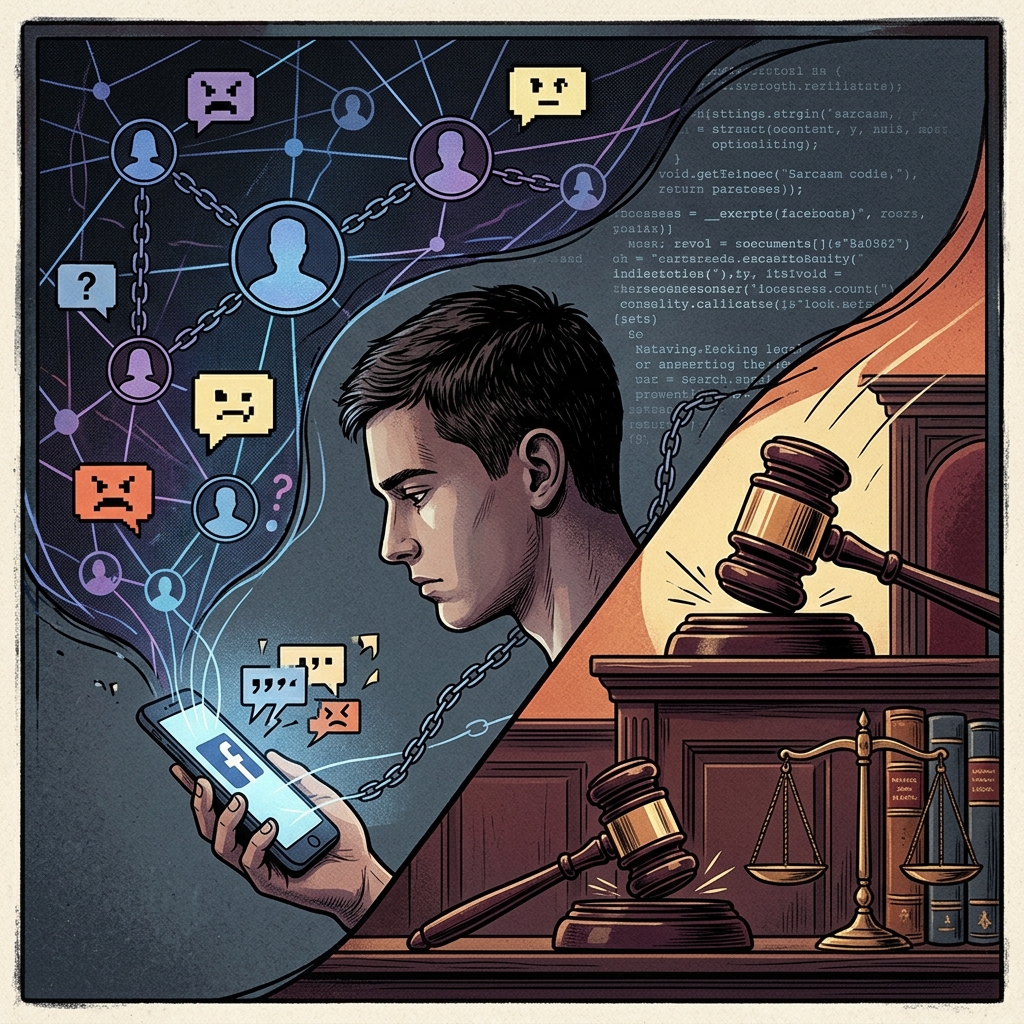
When a teenager from Texas posted a sarcastic, violent-sounding comment on Facebook during an argument about a video game, he probably expected eye-rolls or a ban from the forum—not an arrest, months in jail, and a felony charge. The case of Justin Carter, accused of making a terroristic threat based on a Facebook post, has become a touchpoint in debates about online speech, criminal law, and how seriously authorities should treat statements made on social media.
This article explores what happened in the Carter case, why a comment framed as a joke triggered such a harsh legal response, and what the episode tells us about the evolving boundary between free expression and criminal threat in the digital age.
From Video Game Argument to Criminal Charges
The events began with a heated exchange on Facebook about the online game League of Legends. In February 2013, Carter, then 18, was arguing with other players when the conversation escalated. In the middle of that argument, he posted a message that described extremely violent acts against a kindergarten, followed by the abbreviations “LOL” (laughing out loud) and “J/K” (just kidding).
One Facebook user, reportedly in another state, saw the comment and took it seriously. Concerned that it might represent a genuine threat, they reported the post to local law enforcement. The report eventually reached police in Texas, who opened an investigation.
Authorities sought and obtained an arrest warrant. Carter was charged under Texas law with making a terroristic threat, a serious offense that can carry substantial prison time. A judge set bail at a very high level—reported as hundreds of thousands of dollars—far beyond what his family could afford. As a result, he remained in jail for months awaiting trial, including spending his nineteenth birthday behind bars.
Key facts about the case
- Carter was 18 years old at the time of the Facebook post.
- The comment referred to shooting up a kindergarten and other graphic violence, followed by “LOL” and “J/K”.
- The post came only weeks after the Sandy Hook Elementary School shooting, in which 20 children and 6 adults were killed.
- A Facebook user reported the comment to police, who initiated a criminal investigation.
- He was charged with making a terroristic threat under Texas law and held on high bail.
The timing of the comment—so soon after a high-profile school shooting—almost certainly influenced how police and prosecutors perceived the risk of harm and the need to act.
Why Authorities Took the Facebook Post Seriously
To understand why a post that Carter and his family characterized as sarcasm led to criminal charges, it is important to look at the broader context. The late 2000s and early 2010s saw growing concern in the United States about threats of school violence and mass shootings. High-profile incidents such as the Sandy Hook Elementary School shooting in December 2012 led schools and police to treat any mention of attacks on children with heightened seriousness.
Several factors likely influenced the decision to treat Carter’s post as a potential threat rather than mere dark humor:
- Content of the message: The post did not merely contain generic profanity or insults; it depicted shooting a kindergarten and graphic violence in vivid terms.
- Post-Sandy Hook sensitivity: After real attacks on schools, authorities may have felt they could not risk dismissing violent language as harmless joking.
- Uncertainty about intent: Law enforcement had limited information about Carter’s mental state or circumstances, and social media messages often lack clear cues about sarcasm or irony.
- Public safety concerns: From a police perspective, failing to act on a reported threat could have devastating consequences if the threat turned out to be genuine.
In this environment, officials chose to treat the comment as a possible real threat requiring aggressive intervention.
Free Speech, Sarcasm, and the Legal Concept of Threat
The Carter case raises difficult questions about where to draw the line between protected speech and criminal threat. In the United States, the First Amendment protects most speech, including offensive and unpopular expression. The U.S. Supreme Court has held that laws punishing speech must generally target true threats—statements where a reasonable person would interpret them as a serious expression of intent to commit violence.
Texas and other states have statutes that criminalize threatening conduct or terroristic threats. These laws are often designed to:
- Prevent intimidation or fear of injury.
- Stop conduct that disrupts public services or school operations.
- Allow police to intervene before violence occurs.
Whether a particular statement qualifies as a true threat can depend on multiple factors, including:
- The words used: How explicit and specific is the threat?
- Context: Was it said during a heated argument, a comedy performance, or a private conversation?
- Audience reaction: Did recipients actually feel threatened or change their behavior?
- Intent: Did the speaker intend to cause fear or carry out the threatened acts?
Social media posts complicate these questions because they can be seen by unknown audiences, stripped of tone and facial cues, and shared rapidly beyond their original context. The addition of “LOL” and “J/K” might signal sarcasm to some readers, but not to others, especially when dealing with very sensitive topics.
Facebook, Law Enforcement, and Public Safety
The Carter case also illustrates the role social media platforms can play in modern policing. Facebook and other platforms regularly receive government requests for user information and assist law enforcement in investigations involving threats, terrorism, and other serious crimes.
| Stage | What happens |
|---|---|
| Posting | A user publishes content that may include violent or threatening language. |
| Reporting | Another user, a platform moderator, or an automated system flags the content as potentially dangerous. |
| Platform review | The platform assesses whether the post violates policies and may contact law enforcement for serious threats. |
| Law enforcement response | Police evaluate the report, gather information, and may seek warrants, arrest suspects, or conduct searches. |
In Carter’s situation, a member of the public took the initiative to report the post, which led to police involvement and the eventual criminal charges.
Public Reaction: Overreach or Necessary Caution?
As news organizations began to report on Carter’s case, public opinion was sharply divided. Some commentators were outraged that a teenager could be jailed for months for what they saw as an ill-judged joke. Others argued that law enforcement must treat all violent threats seriously, particularly when children are mentioned.
Arguments criticizing the prosecution
- Context as sarcasm: Supporters of Carter pointed to the “LOL” and “J/K” in his post as evidence he did not intend to carry out any violence.
- Chilling effect on speech: Critics worried that prosecuting sarcastic comments would discourage young people from speaking freely online or using dark humor.
- Disproportionate punishment: The high bail and extended pretrial detention seemed harsh for a case involving words rather than acts.
Arguments supporting strong enforcement
- Serious reference to school violence: Supporters of a tough response stressed that threats involving schools cannot be ignored, even if the speaker claims to be joking.
- Uncertain intent: Law enforcement must often act before intent is clear; waiting for more information could mean missing a chance to prevent harm.
- Deterrence: Prosecuting extreme threats may discourage others from making similar statements that could terrorize communities.
This clash of perspectives highlights the tension between civil liberties and public safety in the era of social media.
Lessons for Social Media Users
Regardless of one’s view of the Carter case, it offers several practical lessons for anyone who uses social media, especially young users who may underestimate how seriously their words can be taken.
Think before you post
- Assume that anything you publish can be seen by people who do not know you and cannot read your tone.
- Recognize that certain topics—school shootings, terrorism, threats toward children—are highly sensitive and likely to attract attention from authorities.
- Understand that even if you intend a statement as a joke, others may interpret it as a real threat.
Know that online speech can have offline consequences
- Social media companies may cooperate with law enforcement when posts are reported as threats.
- Police can obtain warrants for arrests or searches based on online statements.
- Criminal charges related to threats can result in jail time, high bail, and long-term legal consequences.
Use clear signals of humor cautiously
- Markers such as “LOL” or “J/K” may not be enough to prevent a statement from being taken seriously, especially when the content involves violence.
- Consider avoiding jokes about harming others, especially children or schools, altogether.
Implications for Law, Policy, and Platforms
The Carter case is part of a broader conversation about how legal systems and technology companies should respond to online speech that references violence. Legislators, courts, and platform designers face several difficult questions:
- How to define a true threat online: Courts must adapt traditional legal standards to digital contexts where tone and audience are ambiguous.
- How platforms should respond: Companies like Facebook must balance user privacy, free expression, and obligations to cooperate with law enforcement.
- How to educate users: Schools and families may need to teach young people about the legal implications of online speech.
Legal analysis of threats on social media increasingly considers factors such as whether the speaker’s words were directed at specific individuals, whether they contained details suggesting planning, and how recipients reacted. Courts also scrutinize whether the defendant intended to cause fear or whether they were engaging in artistic expression, political rhetoric, or obvious humor.
Frequently Asked Questions (FAQs)
Was Justin Carter convicted for his Facebook post?
The central controversy in Carter’s case focused on the fact that he was jailed for months while awaiting trial, facing serious charges and a high bail. The news coverage at the time emphasized pretrial detention and the possibility of a lengthy sentence if convicted, illustrating the serious legal risk of his online comment.
Why did the post trigger such a strong reaction?
The content of the post referred to attacking a kindergarten and included graphic descriptions of violence, published shortly after a widely publicized school shooting. In that climate, authorities felt they could not dismiss it as mere joking.
Is sarcasm a legal defense to a threat charge?
Courts do consider the speaker’s intent and the context, including whether a reasonable person would see the statement as a serious expression of harm. However, simply labeling a statement as a joke or adding “LOL” does not automatically make it legally harmless. The surrounding circumstances and how others interpret the message play a major role.
Can my social media posts be used against me in court?
Yes. Social media posts can be collected, preserved, and presented as evidence in criminal and civil cases. Law enforcement routinely relies on online content to support charges, including allegations of threats, harassment, or other crimes.
What can I do to reduce legal risk when posting online?
Practical steps include avoiding jokes or comments about harming others, especially vulnerable groups or schools; using privacy settings carefully; and remembering that speech that might seem trivial among friends can look very different to outsiders or authorities.
Key Takeaways
- A single social media post can trigger serious legal consequences, especially if it appears to threaten violence.
- Context, timing, and content all matter: references to school attacks are more likely to be treated as threats, particularly after real incidents.
- Markers of sarcasm like “LOL” and “J/K” are not guaranteed protection from legal scrutiny.
- Social media platforms and law enforcement increasingly collaborate to respond to reported threats.
- Users should be aware that their online speech is visible, searchable, and potentially usable in court.
The Justin Carter case stands as a warning about the power of words in the digital age and a reminder that the boundary between joke and threat is not only social but legal. As societies continue to grapple with violence, extremism, and the role of technology in everyday life, how we talk online—and how authorities respond—will remain a crucial issue.
References
- Teen in jail for months over ‘sarcastic’ Facebook threat — CNN. 2013-07-02. https://www.cnn.com/2013/07/02/tech/social-media/facebook-threat-carter
- Teen in jail for months over ‘sarcastic’ Facebook threat — Fox 13 News. 2013-07-03. https://www.fox13now.com/2013/07/03/teen-in-jail-for-months-over-sarcastic-facebook-threat
- Texas teen could get 10 years in prison for Facebook post — CBC News. 2013-07-04. https://www.cbc.ca/news/world/texas-teen-could-get-10-years-in-prison-for-facebook-post-1.1322449
- Texas teen arrested for Facebook ‘terroristic threat’ — NBC / Today Show. 2013-07-05. https://www.today.com/video/texas-teen-arrested-for-facebook-terroristic-threat-36025411973
- Texas teen jailed for four months over sarcastic Facebook comment — Manchester Digital. 2013-07-09. https://www.manchesterdigital.com/post/manchester-digital/texas-teen-jailed-for-four-months-over-sarcastic-facebook-comment
Similar Articles








Read full bio of Sneha Tete


