
Protect Yourself From Counterfeit Check Scams
Learn how modern counterfeit check scams work, why banks can reverse deposits, and the practical steps you can take today to avoid losing your money.
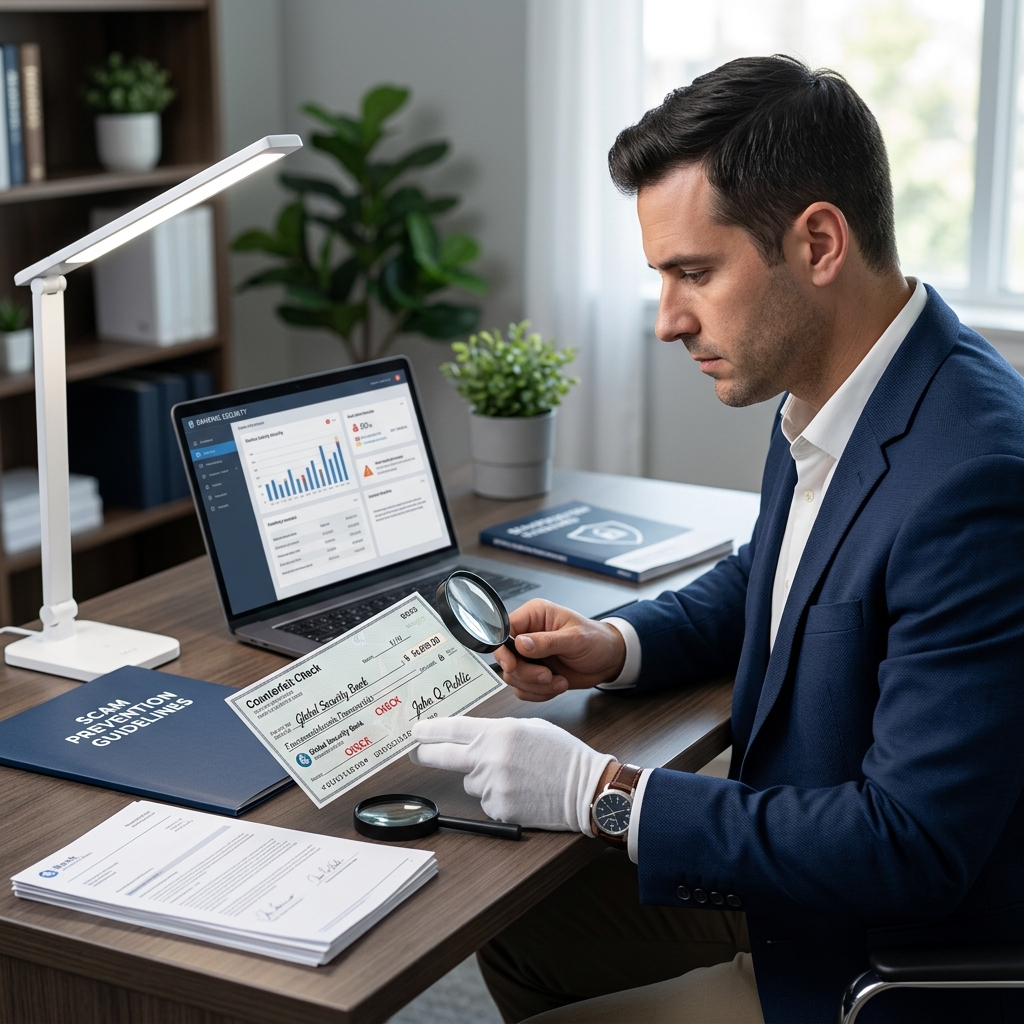
Counterfeit check scams remain one of the most damaging kinds of financial fraud targeting everyday consumers, small businesses, and even non‑profits. In many cases, victims only discover the scam after they have sent money away, believing a check had safely “cleared,” only to learn later that the check was fake and the bank is reversing the deposit.
This article explains how counterfeit check scams work, why victims are often left responsible for the loss, and what practical steps you can take to recognize, avoid, and report these scams.
What Is a Counterfeit Check Scam?
A counterfeit check scam is a scheme in which a scammer gives you a check that looks legitimate, convinces you to deposit it, and then pressures you to send part of the funds back before your bank discovers the check is fake. When the check is eventually rejected, the bank removes the money from your account, leaving you to cover any funds you already sent to the scammer.
Common Types of Fake Checks
Scammers use several types of fraudulent checks that can appear highly convincing:
- Imitation cashier’s checks that appear to come from real banks and use real bank logos.
- Counterfeit business checks that mimic well‑known companies or payroll checks.
- Altered checks where the payee or amount is changed after a legitimate check is stolen or “washed” to remove the ink.
- Money orders that are fabricated or altered to show higher amounts.
Modern printing technology allows criminals to produce checks that look authentic to the untrained eye, and sometimes even to bank employees at first glance.
Why These Scams Work
These scams exploit several misunderstandings about how checks are processed and how bank deposits work:
- Availability of funds vs. final payment: Banks are legally required in many cases to make some portion of deposited check funds available quickly, often within 1–2 business days, even though the check may take significantly longer to fully clear through the banking system.
- False sense of security: Many consumers wrongly assume that if the money is visible in their account balance, the check is valid and can no longer be reversed.
- Trust in official-looking documents: Checks that appear to be from a reputable bank or company can lower a victim’s guard, especially when paired with a plausible story.
- Pressure and urgency: Scammers often create a tight deadline, insisting that money be sent back immediately.
Typical Scenarios Used in Counterfeit Check Scams
Fraudsters reuse a handful of basic storylines, tailoring them to different targets. Regardless of the details, they all revolve around the same core pattern: you receive a check, you send money back, and then the check bounces.
Representative Scam Storylines
- “Overpayment” scams – You sell something online, and the buyer sends you a check for more than the purchase price. They ask you to deposit the check and send back the difference, sometimes claiming the excess covers shipping or a “mistake.” When the check is found to be fake, you lose both the item and the money sent back.
- Fake job or mystery shopper offers – You are “hired” for a remote job, often as a secret shopper, or asked to test a money transfer service. The scammer sends a check and instructs you to deposit it and then send money elsewhere. The job disappears after the check is rejected.
- Lottery, prize, or grant scams – You are told you won a sweepstakes or grant, but must pay taxes or fees upfront. The scammer sends you a check and tells you to deposit it and send them the fee. Real lotteries and grants do not operate this way.
- Small business “client” scams – A supposed new customer pays you in advance for services with a check and then cancels, asking you to refund part of the payment. Once again, the check is fake and you are left with the loss.
How Check Processing Really Works
Understanding how banks process checks is essential to recognizing why counterfeit check scams are so dangerous.
Funds Availability vs. Final Settlement
When you deposit a check, your bank may show the money as “available” before it has truly collected the funds from the issuing bank. This is due to regulations that set maximum hold times and require banks to release funds on a schedule, even though they have not yet confirmed that the check is genuine.
Later, when the check is routed back through the banking system, the bank that supposedly issued the check can reject it as counterfeit or altered. When that happens, your bank reverses the deposit and removes the funds from your account, including any amount you already spent or transferred.
| Stage | What You See | What Is Really Happening |
|---|---|---|
| Deposit | Receipt shows the check amount; account balance increases. | Your bank accepts the check for collection but has not yet received money from the other bank. |
| Funds “available” | Online or mobile banking shows funds as available to spend. | Bank releases funds under regulatory availability rules; the check may still be in transit and unverified. |
| Collection/return | Days or weeks later, your balance drops unexpectedly. | The issuing bank refuses the check as counterfeit or altered; your bank reverses the deposit and debits your account. |
Who Bears the Loss?
Under U.S. law, you generally bear the risk if you deposit a fraudulent or altered check because you are considered to be in the best position to know and verify the source of the payment. Regulators emphasize that if you send money to someone based on a fake check, it is “almost impossible to get it back.” Banks may offer limited assistance, but they are not usually required to cover losses caused by counterfeit checks that you deposited.
Red Flags That a Check May Be Fake
While some counterfeit checks are extremely sophisticated, many share warning signs that can help you avoid trouble.
Visual and Physical Clues
- Poor print quality – Blurry logos, misaligned text, or inconsistent fonts.
- Odd paper feel – Very thin, glossy, or flimsy paper compared with typical checks.
- Missing or crude security features – Many genuine checks include microprinting, watermarks, or security threads that are hard to reproduce. If security indicators look fake or are missing, be cautious.
- MICR line issues – The numbers printed along the bottom should be in special magnetic ink and feel slightly raised. If the line looks like it was printed by a standard office printer or feels flat, the check may be counterfeit.
Information and Context Clues
- Sender you do not know – Legitimate companies rarely send large checks to people they have never met without a clear documented reason.
- Overpayments or “extra” funds – Any scenario where someone sends more than they owe and asks you to send money back is suspicious.
- Requests to send funds in hard‑to‑reverse ways – Scammers often ask for repayment via wire transfer, prepaid cards, gift cards, money orders, or cryptocurrency because these are difficult to reverse once sent.
- Urgency and secrecy – Pressure to act immediately or keep the transaction confidential is a common indicator of fraud.
How to Protect Yourself Before Depositing a Check
Once you understand the risk, you can take concrete steps to reduce the chances of becoming the next victim.
Verification Steps You Can Take
- Contact the purported issuer directly – Use an official phone number from the organization’s website, not any number printed on the check, to confirm that they issued the check and for what amount.
- Wait for full clearance, not just availability – Even if your bank shows funds as available, ask your bank when the check will be fully collected and no longer subject to reversal.
- Refuse overpayments – Insist that buyers, clients, or others send the exact amount owed and through secure electronic payment methods whenever possible.
- Be skeptical of unsolicited checks – If you did not expect a payment, treat the check as suspicious until you have fully verified it.
Secure Alternatives to Checks
Checks carry inherent risks because they can be lost, stolen, altered, or forged. Banks and regulators often recommend safer payment methods when possible.
- Electronic transfers (ACH) for recurring payments.
- Online bill pay through your bank, which may not reveal your account number to the recipient.
- Instant payment services offered by your bank or regulated providers.
While no method is completely risk‑free, these options reduce the opportunities for criminals to manipulate paper checks.
If You Think You Are Involved in a Counterfeit Check Scam
Quick action can sometimes limit the damage and helps law enforcement track patterns of fraud.
Immediate Steps to Take
- Stop sending money – Do not send any additional funds or gift cards and do not share more personal information.
- Contact your bank right away – Explain that you suspect the check is fraudulent and ask what can be done to protect your account, including possible holds, account monitoring, or closing and reopening the account.
- Try to reverse any recent payments – If you sent money via wire transfer, money order, or cryptocurrency, contact the company involved immediately to report fraud and ask whether the transaction can be reversed, recognizing that reversal may be unlikely.
Reporting the Scam
Reporting helps authorities identify repeat offenders and issue warnings to other potential victims.
- Federal Trade Commission (FTC) – File a report at the FTC’s official reporting portal for fraud and scams.
- U.S. Postal Inspection Service (USPIS) – If the fake check or related materials arrived by mail, report it to the federal law enforcement arm of the postal service.
- State Attorney General or local consumer protection office – Many states have consumer protection units that track and prosecute fraud.
- Local law enforcement – Filing a police report creates a record that may help with bank disputes and other investigations.
Protecting Your Own Checks From Being Counterfeited
Fraudsters do not just send fake checks; they also steal legitimate checks and alter or copy them. Taking basic security steps can reduce the chance that your checks are turned into tools for fraud.
Good Check‑Handling Practices
- Store blank checks securely – Keep checkbooks in a locked location, not in open drawers, vehicles, or bags that can be easily stolen.
- Use secure mail options – When mailing checks, drop them inside a staffed post office or use secure mailboxes instead of open, curbside boxes that thieves often target.
- Use permanent or pigment‑based ink – Some inks resist “check washing,” a technique in which criminals remove ink to change payee names and amounts.
- Fill out all fields completely – Do not leave blank spaces that someone could later fill in or alter; draw lines through any unused areas.
- Monitor your accounts frequently – Review online banking activity and monthly statements so that you can spot and report unauthorized checks quickly.
Business‑Level Protections
Businesses that issue many checks face higher risk and should consider more advanced security measures.
- Positive Pay services – Many banks offer systems that compare checks presented for payment against a list of checks your business has issued, flagging mismatches for review.
- Employee training – Staff who handle mail, accounts payable, or deposits should be trained to spot suspicious checks and understand your internal verification procedures.
- Segregation of duties – Separate check issuance, reconciliation, and approval functions to reduce the risk of internal fraud.
Frequently Asked Questions About Counterfeit Check Scams
How long can it take for a bank to discover a counterfeit check?
There is no fixed timeframe, but it can take days or even weeks for a check to be fully processed and rejected as counterfeit. Banks may initially make funds available under regulatory guidelines, but that does not mean the check has cleared for good.
If my bank made the funds available, why am I still responsible?
Funds availability rules are designed to give consumers quicker access to deposits, not to guarantee that checks are genuine. You are usually responsible for deposits you make, and if a check is returned as fake or altered, your bank can reverse the credit and seek repayment from you.
Can I be prosecuted for depositing a counterfeit check?
If you were unaware of the fraud and cooperate with investigators, you are typically treated as a victim. However, intentionally depositing checks you know are forged or altered can lead to criminal charges, including check fraud or related offenses under state or federal law.
Are cashier’s checks always safe?
No. Cashier’s checks and other official‑looking instruments can be counterfeited. You should still verify unexpected cashier’s checks directly with the issuing bank using contact information you find independently.
What is the safest way to receive payment from someone I do not know?
No method is perfectly safe, but secure electronic payments through reputable financial institutions are generally harder for scammers to fake than paper checks. If you must use checks, insist on exact amounts, avoid overpayments, and wait until your bank confirms that the payment has fully cleared before sending goods or money.
References
- Check Fraud Is Back — And More Sophisticated Than Ever — Bank of Colorado. 2026-01-18. https://www.bankofcolorado.com/articles/2026/check-fraud-is-back
- How to Combat Check Fraud in Businesses — Pinnacle Bank. 2024-06-03. https://www.pinnbank.com/articles/2024/check-fraud
- How to Avoid Check Fraud and Scams — Veridas. 2023-05-24. https://veridas.com/fraude-con-cheques/
- Cómo detectar, evitar y reportar las estafas de cheques falsos — U.S. Federal Trade Commission. 2021-10-01. https://consumidor.ftc.gov/articulos/como-detectar-evitar-y-reportar-las-estafas-de-cheques-falsos
- Check Fraud Is Constantly Evolving: How to Protect Yourself — Pinnacle Bank Texas. 2021-03-15. https://www.pinnbanktx.com/articles/2021/check-fraud
- How to Spot Scams — JPMorgan Chase & Co. 2023-11-02. https://www.chase.com/digital/resources/privacy-security/security/how-to-spot-scams
- Fake Check Scams and Your Small Business — U.S. Federal Trade Commission. 2018-05-01. https://www.ftc.gov/media/79951
- Check Fraud — Jeffrey S. Weiner, P.A. (Criminal Defense Law Firm). 2020-06-10. https://www.jeffweiner.com/defensa-criminal/delitos-de-fraude/comprobar-el-fraude/
Similar Articles








Read full bio of Sneha Tete




