
Practical Risk Management Checklist for Small Businesses
A clear, actionable checklist to help small business owners identify, reduce, and transfer key risks before they become costly losses.
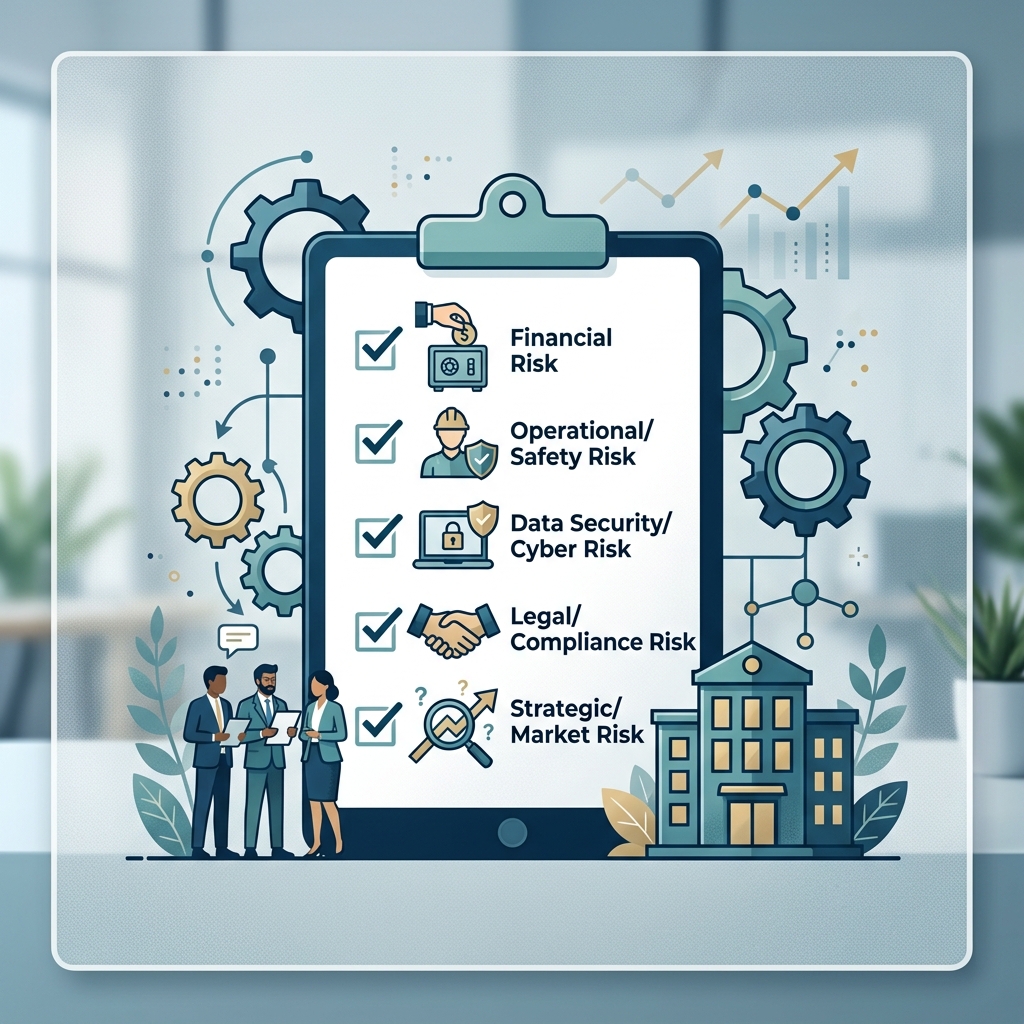
Running a small business involves taking risks every day, from hiring employees to signing contracts and buying equipment. Without a deliberate strategy to manage those risks, a single incident can lead to significant financial loss or even force the business to close. Risk management is the structured process of identifying, assessing, and mitigating threats that could disrupt your operations, damage your assets, or harm your reputation.[10]
This guide provides an original, comprehensive checklist designed for small business owners. It walks through practical steps to recognize key risks, choose the right safeguards, and build resilience using proven risk management concepts and reputable guidance from government and industry sources.[10]
1. Build a Foundation: Understand Your Risk Landscape
Effective risk management starts with understanding what could realistically go wrong in your business and how much risk you are willing to accept to reach your goals. Many frameworks emphasize a cycle of identify, assess, mitigate, and monitor to keep threats under control.[10]
1.1 Clarify Your Risk Appetite
Your risk appetite is the level of risk you are prepared to tolerate in pursuit of growth. A high-growth startup may accept greater financial and operational uncertainty, while a family-owned retail shop may prioritize stability over aggressive expansion.
- Decide which types of risk you are most concerned about (e.g., liability, cyber, supply chain, regulatory).
- Set basic boundaries: what events would be unacceptable, even if they promise high returns?
- Communicate this appetite to key managers so decisions align with your tolerance.
1.2 Map Out Core Business Activities
List the major activities that keep your business running and earning revenue. Typical categories include:
- Customer-facing work (sales, service, support)
- Internal operations (inventory, production, scheduling)
- Financial processes (billing, payroll, credit management)
- Technology and data (systems, software, records)
- People management (hiring, training, supervision)
Each activity can be a source of risk. For instance, a dependency on a single supplier may create a supply chain vulnerability, while manual bookkeeping may increase the risk of errors or fraud.
2. Identify and Categorize Key Business Risks
Once the basics of your operations are clear, the next step is to identify specific risks. Many small business resources recommend structured brainstorming with your leadership team to capture potential threats before they occur.
2.1 Major Risk Categories to Consider
| Risk Category | Typical Examples |
|---|---|
| Strategic | Entering a new market without research, relying on one large client, pricing decisions that undercut profitability. |
| Operational | Equipment breakdowns, staff shortages, supply chain disruptions, errors in processes. |
| Financial | Cash flow problems, credit risk, unexpected expenses, inadequate reserves. |
| Legal & Compliance | Violations of regulations, contract disputes, employment law issues. |
| Safety & Liability | Customer or employee injuries, property damage, product defects. |
| Technology & Cyber | Data breaches, ransomware, system outages, loss of critical information. |
| Environmental & Disaster | Severe weather, fire, flooding, regional emergencies disrupting operations. |
2.2 Practical Identification Techniques
To uncover risks across these categories, use structured methods rather than relying on intuition alone.
- Team workshops: Gather staff from different departments to list potential problems they see in day-to-day work.
- Customer feedback: Complaints or repeated issues can reveal service, product, or safety risks.
- SWOT analysis: Conduct a strengths, weaknesses, opportunities, and threats review to highlight internal vulnerabilities and external hazards.
- Community scan: Monitor changes in local conditions (construction, zoning, new competitors) that could affect your business.
3. Assess Likelihood and Impact with a Simple Risk Matrix
Identifying risks is useful only if you can distinguish which ones matter most. Many small business guides recommend ranking each risk by its likelihood (how probable it is) and impact (how severe the consequences would be).[10]
3.1 Creating a Basic Risk Matrix
You can use a simple three-level scale for both likelihood and impact:
- Likelihood: Low / Medium / High
- Impact: Minor / Serious / Critical
| Impact Likelihood | Low | Medium | High |
|---|---|---|---|
| Minor | Monitor occasionally | Plan if easy | Manage but low priority |
| Serious | Mitigate when resources allow | Plan and assign owner | High-priority mitigation |
| Critical | Consider transfer or avoidance | Urgent mitigation or transfer | Immediate action required |
Discuss each risk as a team and assign a rating. Prioritize those that are both likely and capable of causing serious or critical harm.
3.2 Documenting Your Top Risks
For the small set of highest-priority risks, maintain a simple record that is easy to review and update.
- Describe the risk and why it matters.
- Note current controls already in place (policies, insurance, procedures).
- Choose a response strategy (avoid, reduce, transfer, accept).
- Assign an owner responsible for managing it and set a review date.
4. Choose Your Risk Responses: Avoid, Reduce, Transfer, Accept
After assessing your most important risks, decide how you will respond. Small business frameworks typically group responses into four main approaches: avoid, reduce, transfer, or accept.
4.1 Avoiding Unacceptable Risks
Risk avoidance means changing plans to eliminate exposure. This is appropriate when a risk is too severe or incompatible with your values.
- Declining projects that require unsafe practices or violate regulations.
- Choosing not to store sensitive customer data if you lack adequate protection.
- Avoiding reliance on a single, unstable supplier by diversifying sources.
4.2 Reducing Risk Through Controls and Best Practices
Risk reduction focuses on minimizing the likelihood or impact of an event. Government and industry guidance for small businesses highlight several practical controls.
- Staff training: Teach employees safe work practices, data security habits, and procedures for handling unusual situations.
- Written policies: Establish clear expectations for behavior, reporting, and escalation when problems occur.
- Facility safety: Improve lighting, signage, housekeeping, and equipment maintenance to reduce accidents.
- Technology protections: Use strong passwords, multi-factor authentication, security updates, and backups to guard critical systems.
4.3 Transferring Risk with Insurance and Contracts
Risk transfer involves shifting part of the financial consequences of an event to another party, typically through insurance or contractual arrangements. Federal small business guidance emphasizes insurance policies and well-drafted agreements as core risk management tools.
- Business insurance: Work with a licensed professional to evaluate coverage such as general liability, property, workers’ compensation, professional liability, and cyber insurance. These policies can help absorb losses from lawsuits, injuries, or damage.
- Contracts with vendors and clients: Use written agreements that define responsibilities, warranties, indemnity clauses, and limitations of liability. Clear contracts reduce disputes and help allocate risk fairly.
- Employee agreements: Consider confidentiality or non-disclosure agreements to protect trade secrets and customer data.
4.4 Accepting and Monitoring Lower-Level Risks
Not every risk can or should be eliminated. When the cost of avoidance or mitigation outweighs the potential loss, you may choose to accept a risk while monitoring it over time.
- Document why the risk is acceptable and under what conditions.
- Track indicators that might signal the risk is becoming more serious.
- Review accepted risks periodically to confirm they still fit your risk appetite.
5. Strengthen Everyday Practices to Prevent Losses
Risk management is most effective when embedded into daily operations rather than treated as a one-time exercise. Federal small business guidance offers several practical routines that help businesses minimize losses.
5.1 Improve Hiring and Supervision
Employees can significantly reduce or increase risk depending on how they are selected and managed.
- Use clear job descriptions and vet candidates appropriately, including checking driving records for driving roles.
- Provide orientation and ongoing training focused on safety, ethics, and compliance.
- Set expectations early and address performance issues before they escalate into legal or operational problems.
5.2 Enhance Safety and Compliance
Maintaining a safe and compliant workplace protects employees, customers, and the business itself.
- Regularly inspect your premises for hazards such as spills, obstructions, or poor lighting.
- Stay current with local, state, and federal regulations relevant to your industry (labor, health, environmental, tax).
- Create simple checklists for daily or weekly safety tasks (e.g., equipment checks, cleanliness, signage review).
5.3 Protect Data and Technology Assets
Cyber incidents can be devastating for small businesses. Official guidance stresses basic security measures to manage technology-related risks.
- Know which systems and data are most critical to your operations.
- Use multi-factor authentication, regular software updates, and reputable security tools.
- Monitor for unusual activity and have a plan to respond to incidents, including contacting technical support and relevant advisors.
- Maintain secure backups and test your ability to restore essential systems.
6. Prepare for Disruptions with a Business Continuity Plan
A business continuity plan describes how you will keep operating—or return to operation quickly—if a disaster or major disruption occurs. Many risk management frameworks consider continuity planning a core component of overall business planning.
6.1 Key Elements of a Continuity Plan
- Critical processes: Identify the minimum activities you must maintain to serve customers and generate revenue.
- Alternative arrangements: Plan backup suppliers, temporary locations, remote work options, and manual processes to use if systems fail.
- Communication procedures: Determine how you will communicate with employees, customers, and partners during a disruption.
- Recovery priorities: Decide which systems and functions must be restored first, and in what sequence.
6.2 Integrating Continuity into Your Risk Strategy
Rather than treating continuity planning as separate, link it to the risks identified and assessed earlier:
- Use your risk register to identify high-impact events that would trigger continuity procedures.
- Align insurance coverage, contracts, and disaster plans so they support recovery goals.
- Review and test aspects of your plan periodically, adjusting for new threats or changes in the business environment.
7. Implement, Monitor, and Continually Improve
A written plan is only valuable if it is implemented and updated. Official resources emphasize monitoring and evaluation as essential parts of risk management for small businesses.
7.1 Putting Your Checklist into Action
To move from planning to execution:
- Assign clear responsibilities for each major risk, control, and continuity step.
- Integrate risk-related tasks into regular management meetings.
- Include risk and exit strategies in your business plan and revisit them at least annually.
7.2 Monitor and Review on a Schedule
Monitoring ensures that controls remain effective and that new risks are captured as the business evolves.
- Schedule periodic reviews of your risk register and mitigation plans.
- Track key indicators, such as incident reports, near misses, compliance findings, and customer complaints.
- Update your risk assessments when you expand products, enter new markets, or adopt new technology.
8. Frequently Asked Questions (FAQs)
How often should a small business update its risk management plan?
Many experts recommend reviewing your risk management plan at least once a year, and more frequently when there are significant changes, such as new locations, major technology upgrades, or regulatory shifts. Regular reviews help ensure that previously accepted risks still match your risk appetite and that new threats are properly assessed.
Is risk management different for small businesses compared to large companies?
The principles of risk management—identifying, assessing, mitigating, and monitoring—are similar across organizations.[10] However, small businesses typically have fewer resources and may rely on simpler tools like basic risk matrices, streamlined policies, and targeted insurance coverage. The focus is on practicality and embedding risk awareness into everyday decisions.
Which insurance policies are most important for reducing small business risk?
While needs vary, guidance from small business authorities often highlights general liability, property, workers’ compensation (where required), and specialized coverage such as professional liability or cyber insurance, depending on your industry. A licensed insurance professional can help match policies to your specific risk profile.
Why is a business continuity plan necessary if I already have insurance?
Insurance can help cover financial losses, but it does not specify how you will keep serving customers or restore operations quickly after a disruption. A continuity plan complements insurance by outlining practical steps to maintain critical services, protect relationships, and reduce downtime.
What is the simplest way for a very small business to start managing risk?
Microbusinesses can begin with a short checklist: list main activities, identify a handful of worst-case scenarios, rate their likelihood and impact, and decide on one or two concrete actions for each—such as basic safety improvements, clear contracts, and essential insurance coverage. Even a modest, written plan can significantly improve resilience.
References
- Risk Management for a Small Business — Federal Deposit Insurance Corporation (FDIC). 2016-09-01. https://catalog.fdic.gov/catalog/sfc/servlet.shepherd/document/download/069t000000Bch4uAAB
- 5 Best Risk Management Strategies — U.S. Small Business Administration (SBA). 2020-04-23. https://www.sba.gov/blog/5-best-risk-management-strategies
- Common Small Business Risks and How to Manage Them — Nationwide Insurance. 2023-03-15. https://www.nationwide.com/business/solutions-center/risk-management/risk-management-for-small-business
- Risk Management for Small Businesses: Protect Your Future — Helpside. 2022-06-10. https://www.helpside.com/risk-management-for-small-businesses/
- Enterprise Risk Management for Small Businesses: What It Is and How to Start — University of Wisconsin Center for Professional & Executive Development. 2021-11-05. https://blog.uwcped.org/enterprise-risk-management-for-small-businesses-what-it-is-and-how-to-start/
- What Is Risk Management & Why Is It Important? — Harvard Business School Online. 2023-01-25. https://online.hbs.edu/blog/post/risk-management
- What Is Risk Management for Small Business? — Insureon. 2022-08-19. https://www.insureon.com/insurance-glossary/risk-management
Similar Articles








Read full bio of medha deb




