
Parody vs Satire: Copyright Fair Use Explained
Unravel the legal differences between parody and satire in copyright law, and how fair use protects creative commentary.
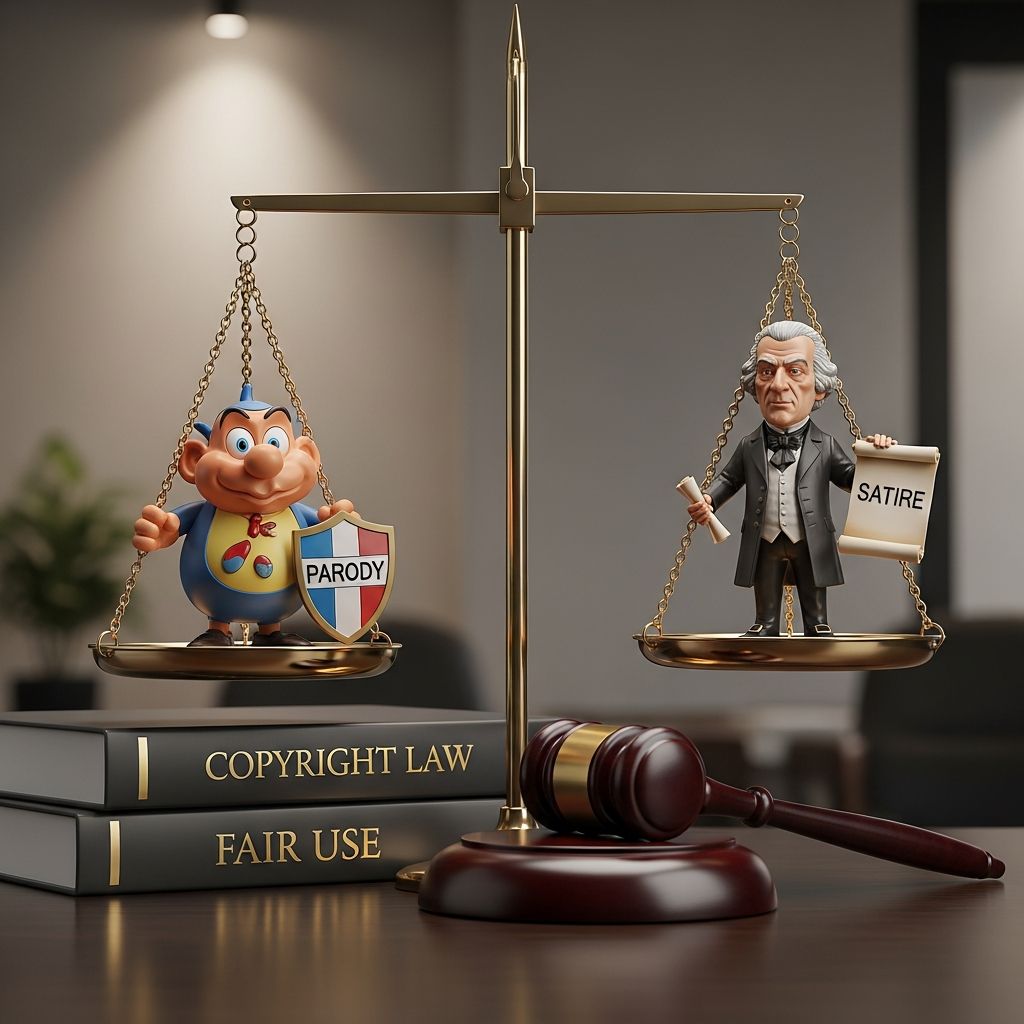
Understanding the boundary between protected expression and copyright infringement is crucial for creators, comedians, and commentators. In U.S. law,
parody
andsatire
both employ humor to critique, but they receive different treatments under the fair use doctrine. Parody, which directly mocks the original work, is more likely to be shielded, while satire, targeting broader societal issues, often requires stronger justification.Foundations of Copyright Protection and Fair Use
Copyright law grants creators exclusive rights to reproduce, distribute, and display their works, preventing unauthorized copying. However, the fair use exception, codified in 17 U.S.C. § 107, permits limited use for purposes like criticism, comment, news reporting, teaching, and research. Courts evaluate fair use through four key factors: the purpose and character of the use, the nature of the copyrighted work, the amount and substantiality of the portion used, and the effect on the market value of the original.
These factors balance incentivizing creativity with fostering free expression. Transformative uses—those adding new meaning or expression—receive favorable consideration, particularly in the first factor.
Defining Parody in Legal Terms
**Parody** involves imitating an original work’s style, structure, or elements to ridicule or comment on that specific work itself. It is inherently transformative because it critiques the source material directly, often exaggerating its flaws for comedic effect. For instance, a parody song might mimic melody and lyrics to lampoon the artist’s style or message.
The U.S. Supreme Court has emphasized that parody ‘needs to mimic an original to make its point,’ justifying its use of protected elements. This necessity distinguishes it from mere copying.
How Satire Differs from Parody
In contrast,
satire
employs humor, irony, or exaggeration to expose vices, follies, or societal issues, using a copyrighted work merely as a vehicle. The target is not the original creation but something external, like politics or culture. Satire can often achieve its goal without the specific work, making it less transformative and harder to defend as fair use.Weird Al Yankovic exemplifies this duality: his ‘Eat It’ parodies Michael Jackson’s ‘Beat It’ by mocking the song’s content, qualifying as parody, while other tracks using originals to jab at unrelated topics lean satirical.
Applying the Four Fair Use Factors
| Factor | Parody Application | Satire Application |
|---|---|---|
| 1. Purpose and Character | Highly transformative; comments on original | Less transformative; comments on external issues |
| 2. Nature of Work | Fictional/creative works weigh against, but transformation mitigates | Similar, but weaker justification |
| 3. Amount Used | Only what’s necessary to evoke original | Often more, without necessity |
| 4. Market Effect | Rarely substitutes original; may boost it | Potential to harm if it diverts audience |
This table illustrates why parodies succeed more often: they align better across factors, especially transformation and market impact.
Landmark Supreme Court Ruling: Campbell v. Acuff-Rose
The definitive case is Campbell v. Acuff-Rose Music, Inc. (1994), where the Supreme Court ruled 2 Live Crew’s rap parody of Roy Orbison’s ‘Oh, Pretty Woman’ as fair use. The Court held that commercial parodies can qualify if sufficiently transformative, rejecting the notion that profit-seeking automatically negates fair use. Justice Souter wrote: ‘Parody has an obvious claim to transformative value… whereas satire can stand on its own two feet.’
This decision set precedent, affirming parody’s role in free speech while cautioning against broad satire defenses.
Real-World Examples Across Media
- Music: ‘Smells Like Nirvana’ by Weird Al mocks Nirvana’s grunge style directly—parody.
- Film: Scary Movie exaggerates Scream‘s tropes—parody.
- Satire Example: Using a pop song’s beat to critique politics without targeting the song—riskier.
- Visual Arts: Caricatures mimicking a book’s cover to mock its plot qualify as parody.
These cases show parody’s strength when the butt of the joke is the original.
Challenges and Gray Areas for Creators
Not all parodies win; they must clearly target the original and use minimal elements. Courts scrutinize if the new work could supplant the market or if it’s just derivative humor. Satire struggles unless highly transformative or de minimis use.
Trademark adds complexity: parody trademarks (e.g., ‘Chewy Vuiton’ dog toys) may parody brands under nominative fair use, but dilution claims loom. Freedom of speech bolsters defenses, especially for political satire.
Practical Strategies to Minimize Risk
- Ensure your work comments directly on the original for parody status.
- Use only essential portions to ‘conjure up’ the source.
- Document transformative intent and market non-impact.
- Consider public domain alternatives or seek licenses.
- Consult an IP attorney for borderline cases.
Proactive steps and legal advice safeguard against lawsuits.
Frequently Asked Questions
Does commercial use disqualify parody as fair use?
No, as Campbell confirmed; transformation trumps profit motive.
Can satire ever qualify as fair use?
Possibly, if highly transformative and minimally infringing, but it’s rarer than parody.
Is Weird Al’s work always parody?
Often yes when mocking the song, but some tracks satirize unrelated topics.
How does First Amendment interplay with copyright?
It underpins fair use, protecting parody as essential speech, per Supreme Court.
What if my satire uses public figures?
Stronger First Amendment protection, but copyright claims persist if infringing.
Navigating Modern Digital Challenges
In the streaming era, platforms like YouTube auto-flag potential infringements via Content ID. Creators must appeal with fair use arguments, often citing parody. Recent cases reinforce Campbell‘s principles, but AI-generated parodies introduce new questions on authorship.
Satirists on TikTok or memes face takedowns unless clearly transformative. Best practice: watermark as parody and limit clips.
Global Perspectives on Parody and Satire
While U.S. fair use is flexible, EU moral rights emphasize author dignity, limiting parodies. Countries like Canada and Australia have parody exceptions, but narrower than U.S.. Creators targeting international audiences must adapt.
Future Implications for Creative Industries
As generative AI blurs lines, courts may refine tests. Parody’s protection encourages innovation, preventing monopolies on cultural critique. Satirists might pivot to original elements, preserving speech.
Ultimately, these doctrines foster vibrant discourse, balancing rights.
References
- Parody vs. Satire in Copyright Law — LegalZoom. 2023. https://www.legalzoom.com/articles/parody-vs-satire-in-copyright-law
- Why Is Parody Considered Fair Use but Satire Isn’t? — Copyright Alliance. 2023-10-12. https://copyrightalliance.org/faqs/parody-considered-fair-use-satire-isnt/
- Copyright Fair Use: Distinction between Parody and Satire — Marks Gray. 2023. https://marksgray.com/intellectual-property-law/copyright-fair-use-distinction-between-parody-and-satire/
- Parody, Satire, and “Fair Use” — Daniel Ross Law Firm. 2021-06-09. https://danielrosslawfirm.com/2021/06/09/parody-satire-and-fair-use/
- Satire and Parody — First Amendment Encyclopedia, Middle Tennessee State University. 2023. https://firstamendment.mtsu.edu/article/satire/
Similar Articles








Read full bio of medha deb


