
Understanding North Dakota Overtime Rules
A clear, practical guide to overtime pay, exemptions, and recordkeeping requirements for North Dakota workers and employers.
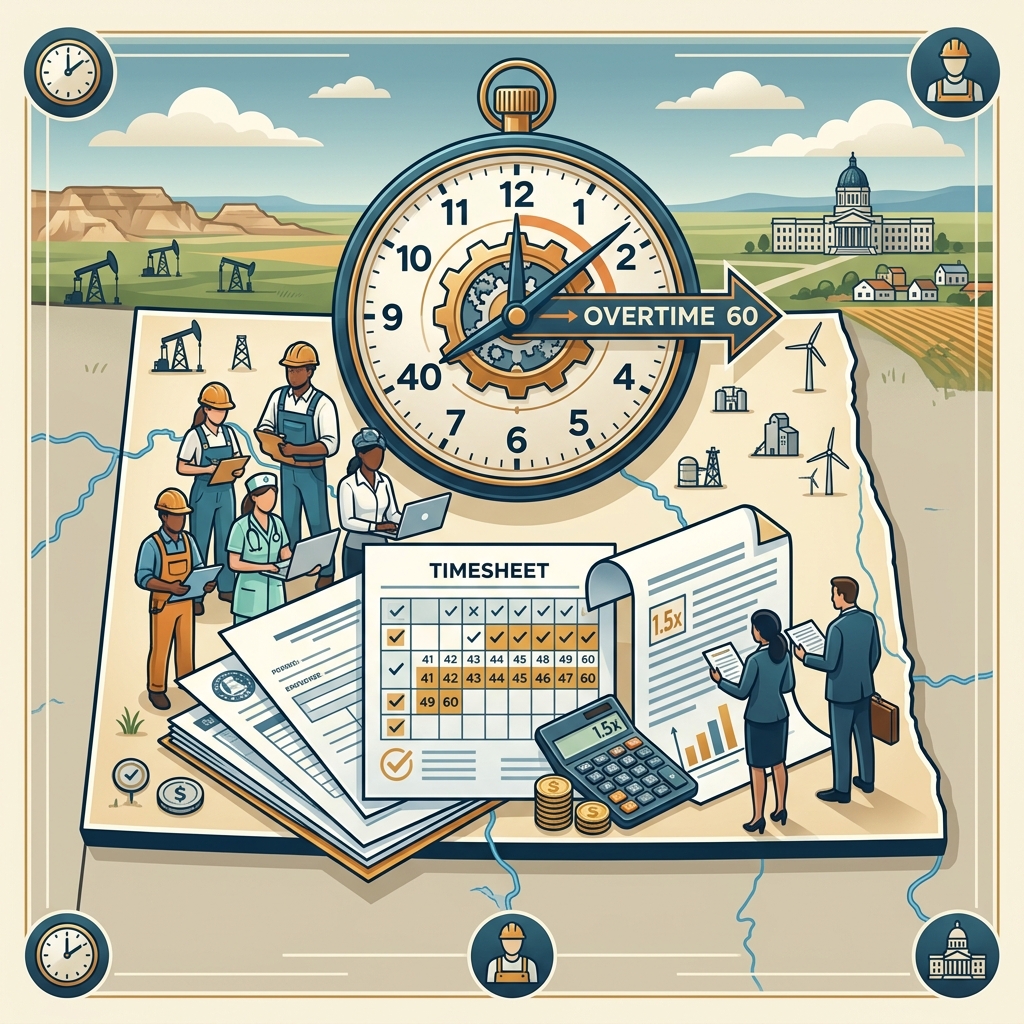
North Dakota overtime law combines state rules with the federal Fair Labor Standards Act (FLSA), creating a framework that defines when extra hours must be paid at a higher rate, who is exempt, and how employers must calculate overtime. Understanding this framework is critical for both employees and employers to avoid costly mistakes and disputes.
This guide explains North Dakota’s overtime requirements, how they interact with federal law, which workers are covered, and the most common calculation methods, using practical terms and examples.
1. Core Overtime Rule in North Dakota
North Dakota law generally requires overtime pay at one and one-half times (1.5x) the regular rate of pay for all hours worked over 40 hours in a workweek for covered employees. This mirrors the FLSA standard but is explicitly set out in the state’s administrative code.
1.1 What counts as a workweek?
A workweek is any fixed and recurring period of seven consecutive 24-hour days chosen by the employer. It does not have to match the calendar week, but once selected, it should be applied consistently.
- The workweek is the only basis for standard overtime; there is no general daily overtime requirement under state law.
- Overtime must be computed week by week and cannot be averaged across multiple weeks.
1.2 Weekly, not daily, overtime
Unlike some states, North Dakota does not require overtime just because an employee works more than a set number of hours in a single day (such as eight hours), nor is overtime automatically required for weekend or holiday work. What matters is the total hours in the defined workweek, unless a special rule applies (for example, certain hospitals).
2. Interaction Between State Law and the FLSA
North Dakota employers must follow both state overtime rules and the FLSA, applying whichever is more protective of the employee in a given situation.
- The state code directly requires overtime at 1.5x the regular rate after 40 hours in a week.
- The FLSA imposes the same 40-hour threshold and 1.5x rate for non-exempt employees nationwide.
In practice, for most private-sector employees in North Dakota, the federal and state overtime obligations are aligned and must be met simultaneously.
3. Who Is Entitled to Overtime Pay?
Only non-exempt employees are guaranteed overtime pay. Both state and federal law recognize categories of exempt employees who are not entitled to overtime under certain conditions.
3.1 Non-exempt employees
Non-exempt employees generally include workers who:
- Are paid on an hourly basis (though salary alone does not decide exemption), and
- Do not meet the specific duties and salary criteria for one of the recognized exemptions (such as executive, administrative, or professional).
Most retail, service, clerical, and manual labor workers fall into the non-exempt category and must be paid overtime when they work more than 40 hours in a week.
3.2 Common exempt categories
North Dakota law incorporates exemptions that are similar to those used under the FLSA. Typical exempt categories include:
- Executive employees – managers who supervise other workers and have meaningful authority over hiring, firing, or similar decisions.
- Administrative employees – office or non-manual workers whose primary duties involve independent judgment on significant business matters.
- Professional employees – such as accountants, engineers, lawyers, or other learned professionals whose work is predominantly intellectual.
- Outside salespeople – employees who customarily work away from the employer’s place of business making sales or obtaining orders.
- Certain computer professionals – programmers, systems analysts, or software engineers who meet specific duties and pay thresholds.
Additionally, North Dakota recognizes other more specialized exemptions for artistic, educational, and seasonal roles, among others.
3.3 Importance of duties and salary levels
Exempt status is determined by both job duties and pay structure, not job titles alone. Under federal guidance, most white-collar exemptions require the employee to meet:
- A minimum salary threshold (updated periodically under federal rules), and
- Specific primary duties tests tied to the nature and level of responsibility in the role.
Misclassifying employees as exempt can expose employers to back pay, penalties, and legal claims.
4. How Overtime Pay Is Calculated
The key to calculating overtime in North Dakota is the employee’s regular rate of pay. The regular rate is not always the same as the hourly wage; it can include certain additional earnings.
4.1 Regular rate basics
The regular rate generally includes:
- Hourly wages
- Salary converted to an hourly equivalent
- Nondiscretionary bonuses (for example, performance-based bonuses promised in advance)
- Certain commissions attached to the work performed
Purely discretionary bonuses (such as unexpected gifts) and some benefits may be excluded, following FLSA standards.
4.2 Standard hourly employees
For an employee with a single hourly rate, overtime is straightforward:
- Regular rate = hourly wage
- Overtime rate = 1.5 × hourly wage
- Overtime pay owed = overtime rate × number of overtime hours (hours above 40)
4.3 Employees paid hourly plus bonus or commission
When employees earn hourly pay plus a nondiscretionary bonus or commission, the bonus/commission must be factored into the regular rate.
- Add all earnings for the week (hourly wages + applicable bonus/commission for that week).
- Divide by total hours worked in the week to get the regular rate.
- For each overtime hour, pay an extra 0.5 × regular rate on top of the regular hourly earnings already paid for that hour.
4.4 Salaried employees (non-exempt)
Some salaried employees are still non-exempt and must receive overtime. In such cases, employers must convert the salary to an hourly regular rate.
| Situation | Regular rate calculation | Overtime approach |
|---|---|---|
| Salary intended to cover less than 40 hours | Regular rate = salary ÷ number of hours the salary is meant to cover | Pay regular rate for every hour up to 40; pay 1.5 × regular rate for each hour over 40 |
| Salary intended to cover exactly 40 hours | Regular rate = salary ÷ 40 | Pay 1.5 × regular rate for each hour above 40 |
4.5 Hours that do not count toward overtime
North Dakota and federal law both emphasize that overtime is based on hours actually worked, not on benefits or paid time off.
- Paid holidays
- Paid vacation or paid time off (PTO)
- Paid sick leave
These hours do not count as “hours worked” when calculating overtime, even if the employee received pay for them.
5. Special Overtime Rules for Certain Employers
North Dakota provides targeted overtime rules for specific sectors or job types.
5.1 Multiple jobs for the same employer
If an employee works more than one job under the control of the same employer, all hours worked in all positions must be added together for overtime purposes. Employers cannot treat each position separately to avoid overtime obligations.
5.2 Taxicab drivers
Individuals employed as drivers by taxicab companies are subject to a different threshold: overtime is required only after 50 hours in a workweek, rather than 40. The overtime rate remains 1.5 times the regular rate.
5.3 Hospitals and residential care facilities
Hospitals and certain residential care institutions may adopt a 14-day work period instead of the standard 7-day workweek, if certain conditions are met.
- There must be an agreement with employees to use a 14-day period.
- Overtime must be paid at 1.5x the regular rate for hours over 8 in a day or over 80 in the 14-day period, whichever results in more overtime pay.
6. Recordkeeping and Payroll Practices
Accurate records are central to complying with overtime rules. North Dakota requires employers to keep wage and hour records, and federal law has parallel requirements.
6.1 Required records
Employers typically must maintain the following information for each employee:
- Full name and identifying information
- Regular rate of pay and basis (hourly, salary, piece rate, etc.)
- Hours worked each workday and each workweek
- Straight-time earnings and overtime earnings
- Deductions and additions to wages
- Total wages paid and date of payment
These records must be kept for a period that covers the employee’s employment and an additional period afterward, consistent with state and federal requirements.
6.2 Pay frequency and timing
North Dakota law requires employees to be paid all wages due at least once per month on a regular payday identified in advance. Upon termination, all wages owed are due by the next regular payday.
7. Worker Rights and Employer Risks
Overtime violations can lead to significant financial consequences. Both state and federal authorities can enforce wage and hour laws, and employees may also bring private lawsuits.
7.1 Rights of employees
In North Dakota, employees have the right to:
- Receive overtime pay for all hours over 40 in a workweek if they are non-exempt.
- Be free from retaliation for asking about overtime, filing a complaint, or cooperating in an investigation.
- Access certain wage information and, where available, file complaints with the North Dakota Department of Labor and Human Rights or the U.S. Department of Labor.
7.2 Common employer pitfalls
Frequent sources of overtime disputes include:
- Misclassification – treating a non-exempt employee as exempt based primarily on job title or salary, rather than duties.
- Off-the-clock work – failing to record or pay for preparatory work, cleanup, travel between job sites, or required meetings.
- Improper averaging – averaging hours over multiple weeks to avoid paying overtime, which is prohibited.
- Incorrect bonus handling – not including nondiscretionary bonuses or commissions in the regular rate calculation.
8. Practical Tips for Compliance
To reduce overtime-related risk, employers and employees can adopt straightforward best practices.
8.1 For employers
- Carefully define and document the workweek for each employee or group of employees.
- Use timekeeping systems that track all hours worked, including remote or mobile work.
- Review job descriptions and actual duties regularly to ensure exemption classifications fit federal and state criteria.
- Train managers not to encourage off-the-clock work or ignore reported hours.
- Consult legal or HR professionals when designing bonus and commission plans that may affect the regular rate.
8.2 For employees
- Record all hours actually worked, including before or after scheduled shifts, and during required travel or meetings.
- Ask your employer to clarify your workweek, overtime policy, and whether your role is classified as exempt or non-exempt.
- Review pay stubs for overtime hours and rates whenever you work more than 40 hours in a week.
- Raise questions promptly if your overtime seems incorrect or unpaid.
9. Frequently Asked Questions About North Dakota Overtime
9.1 Does North Dakota require overtime after eight hours in a day?
No. North Dakota’s general rule is overtime only after 40 hours in a workweek, not after a certain number of hours in a single day. However, certain hospitals and residential care facilities using a 14-day period may incur overtime after eight hours in a day as part of their alternative schedule.
9.2 Do weekend or holiday hours automatically earn overtime?
Not necessarily. North Dakota does not automatically require overtime just because work is performed on weekends or holidays. Overtime is required only when total hours exceed 40 in a workweek (or the special thresholds for certain industries), regardless of which days those hours are worked.
9.3 Can an employee agree to waive overtime?
No. The right to overtime pay under state and federal law cannot be waived by private agreement. An employee cannot legally sign away the right to overtime pay for hours that qualify.
9.4 How is overtime handled if I work two positions for the same employer?
All hours worked for the same employer must be combined for overtime purposes. Employers cannot treat separate positions as unrelated if they are under the same control; once the total exceeds 40 hours in a week, overtime is due for the extra hours.
9.5 Who enforces overtime law in North Dakota?
Overtime law is enforced by both the North Dakota Department of Labor and Human Rights and the U.S. Department of Labor, depending on the nature of the violation and whether state or federal law (or both) are involved. Employees may also have the ability to pursue private legal claims.
References
- North Dakota Administrative Code, Title 46-02-07 (Wage and Hour) — North Dakota Legislative Branch. 2023-01-01. https://ndlegis.gov/prod/acdata/pdf/46-02-07.pdf
- Wage and Hour FAQ — North Dakota Department of Labor and Human Rights. 2024-03-01. https://www.nd.gov/labor/wage-and-hour-faq
- Wage and Hour Questions (Brochure) — North Dakota Department of Labor and Human Rights. 2022-05-01. https://www.nd.gov/labor/sites/www/files/documents/Brochures/Wage&Hour%20and%20Equal%20Emp.pdf
- North Dakota Overtime Laws — FindLaw. 2023-08-15. https://www.findlaw.com/state/north-dakota-law/north-dakota-overtime-laws.html
- North Dakota Employment Law Overview — Brightmine. 2024-02-01. https://www.brightmine.com/us/resources/hr-compliance/north-dakota-employment-law/
- North Dakota Overtime Laws — WorkforceHub. 2024-01-10. https://www.workforcehub.com/hr-laws-and-regulations/north-dakota/north-dakota-overtime-laws/
- Quick and Easy Guide to Labor & Employment Law: North Dakota — Baker Donelson. 2024-01-05. https://www.bakerdonelson.com/easy-guide-north-dakota
Similar Articles








Read full bio of medha deb




